ISO 22000 Certification in Democratic Republic of Congo (DRC) | Food Safety Management System:
ISO 22000 Certification in Democratic Republic of Congo (DRC), Vertex Certifiers is a globally trusted ISO consulting and certification support organization dedicated to helping food industry businesses in the Democratic Republic of the Congo achieve internationally recognized food safety standards. With a deep understanding of the region’s rapidly evolving food production and distribution ecosystem, Vertex Certifiers provides customized ISO 22000 Food Safety Management System (FSMS) implementation that ensures regulatory compliance, consumer safety, and business growth. We proudly serve food industry organizations across major cities in the Democratic Republic of the Congo, including: Kinshasa, Lubumbashi, Mbuji-Mayi, Kisangani, Goma, Bukavu, Kolwezi, and Matadi.
Food safety remains a critical challenge in the Democratic Republic of the Congo (DRC) due to diverse factors such as supply chain complexity, varied climatic conditions, and growing urban consumption. Increasingly, companies involved in food production, processing, storage, distribution, and supply chain management recognize the need to adhere to internationally accepted safety standards to protect consumers and expand market access. ISO 22000 certification provides a robust framework for ensuring food safety and allows organizations in the DRC to boost credibility while minimizing risks related to foodborne illnesses.
What is ISO 22000 Certification in DRC?
ISO 22000 is a globally recognized standard specifying requirements for a Food Safety Management System (FSMS). It integrates principles of the Hazard Analysis Critical Control Point (HACCP), risk management strategies, prerequisite programs (PRPs), and a process-based approach to food safety applicable at every stage of the food supply chain. ISO 22000:2018 serves organizations of all sizes and sectors involved in the food chain, from farmers and manufacturers to retailers and catering services, helping them demonstrate their capability to control food safety hazards effectively.
Why ISO 22000 Certification is Important in DRC ?
The DRC’s expanding food manufacturing and export activities face growing scrutiny from consumers and regulatory bodies. International buyers and retailers increasingly demand compliance with food safety standards to ensure product quality and safety. Obtaining ISO 22000 certification helps address these demands by providing a systematic approach to managing food safety risks, ensuring consumer protection, and building trust within local and global markets.
The process to get ISO 22000 certification in Democratic Republic of Congo (DRC):
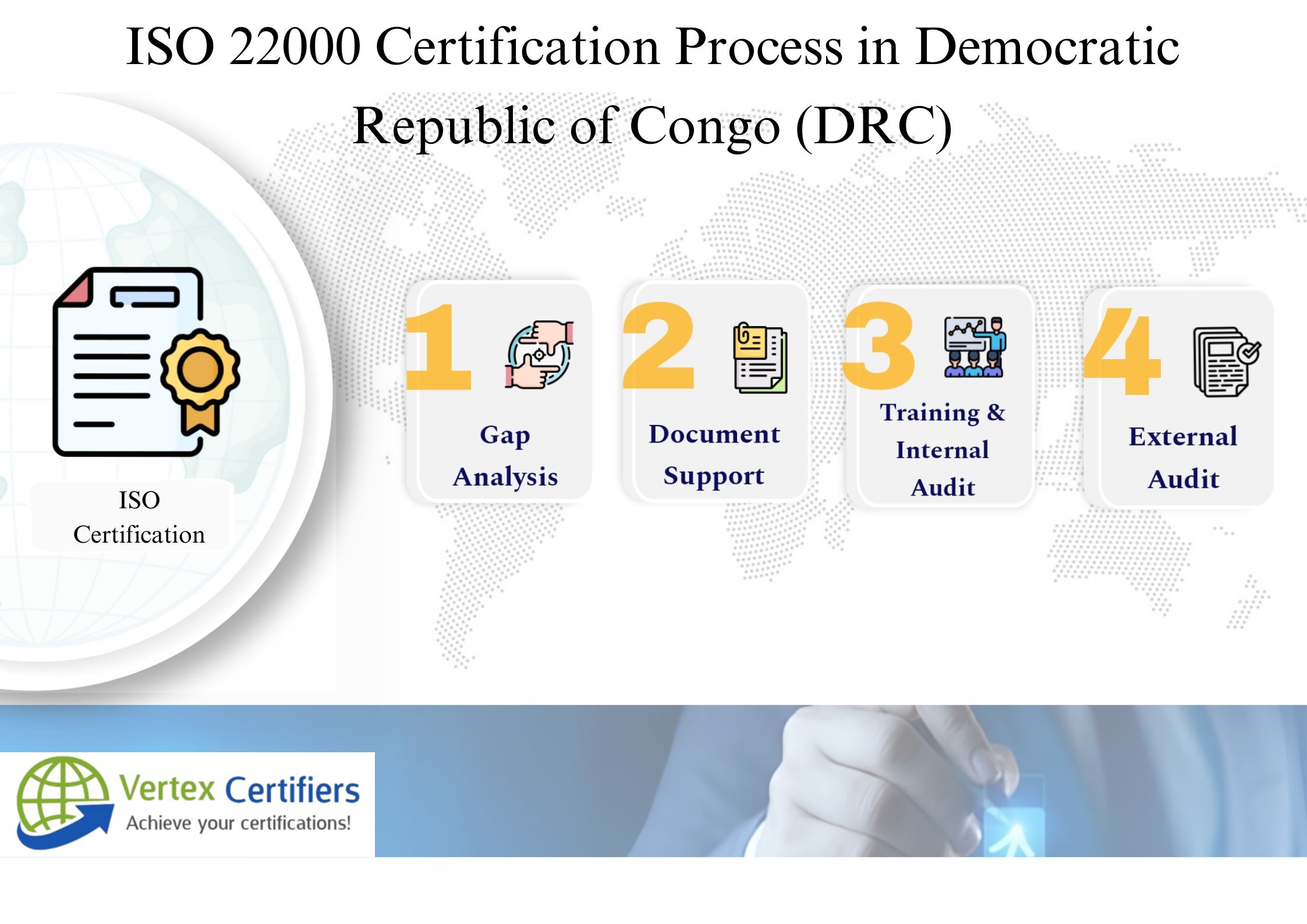
The process to get ISO 22000 certification in the Democratic Republic of the Congo (DRC) involves several structured steps designed to help organizations systematically establish and maintain an effective Food Safety Management System (FSMS) that complies with international standards. Here is a detailed step-by-step outline:
Initial Consultation and Commitment Begin by understanding your organization’s current food safety practices and defining the scope of the FSMS. Secure top management commitment to ensure resources and leadership support for the certification journey.
Gap Analysis Conduct a comprehensive assessment of your existing food safety policies, procedures, and controls against ISO 22000 requirements. Identify gaps and areas that need improvement to comply fully with the standard.
Documentation Development Create or update essential documents, including food safety policies, hazard analyses, critical control points (HACCP plans), prerequisite programs (PRPs), procedures for monitoring, verification, corrective actions, and record-keeping. This documentation forms the backbone of your FSMS.
Implementation of FSMS Roll out the documented food safety management system across operations. Ensure all employees understand their roles through training and awareness programs focused on food safety risks and controls.
Internal Audits Conduct internal audits to verify that FSMS procedures are effectively implemented and adhered to. Identify any non-conformities, implement corrective actions, and document results to demonstrate continual improvement.
Management Review Top management reviews the FSMS performance by assessing audit findings, customer feedback, and system effectiveness. This step ensures the system’s ongoing suitability, adequacy, and alignment with food safety objectives.
Pre-assessment (Optional) Engage with an external consultant or certification body to perform a pre-assessment audit. This helps identify any last-minute gaps before the official certification audit.
Stage 1 Certification Audit (Documentation Review) A certified external auditor reviews your FSMS documents to check compliance with ISO 22000 requirements and evaluates preparedness for the Stage 2 audit.
Stage 2 Certification Audit (On-site Evaluation) This comprehensive on-site audit verifies the effective implementation and continuous improvement of the FSMS in your operational environment. Auditors interview staff, observe operations, and review records.
Certification Decision and Issuance If the audit outcome is satisfactory, the certification body issues the ISO 22000 certificate valid for three years. The organization is now officially recognized as compliant with ISO 22000 global food safety standards.
Surveillance Audits Regular surveillance audits, typically annually, ensure your FSMS remains compliant and promotes ongoing improvement. Certifications must be renewed through recertification audits every three years.
Working with experienced ISO 22000 consultants in DRC, especially ISO 22000 consultants in Kinshasa, can significantly simplify your journey toward ISO 22000 certification in Kinshasa and across the country. These expert consultants understand the unique regulatory landscape and food safety challenges faced by organizations in the DRC and provide tailored guidance on documentation, training, internal audits, and effective liaison with accredited certification bodies. Engaging certified professionals ensures your Food Safety Management System complies with international standards and positions your business for smooth and successful certification, boosting food safety, customer confidence, and market access.
ISO 22000 Certification in DRC | Vertex Certifiers
ISO 22000 Certification in the Democratic Republic of the Congo (DRC)
Ensure food safety, compliance, and operational efficiency across your organization with expert ISO 22000 implementation and certification support in the DRC.
About Vertex Certifiers
Vertex Certifiers – ISO 22000 Experts in the DRC
Vertex Certifiers is a globally trusted ISO consulting firm specializing in Food Safety Management Systems (ISO 22000). We offer end-to-end FSMS services across the DRC, from hazard analysis and documentation to training, audits, and certification support.
We serve organizations in Kinshasa, Lubumbashi, Mbuji-Mayi, Kisangani, Goma, Bukavu, Kolwezi, and Matadi, providing both onsite and remote consultation tailored to your needs.
Key Benefits of ISO 22000 Certification in DRC
Improved food safety and hygiene throughout the supply chain, reducing contamination risks and costly recalls.
Streamlined compliance with national and international food safety regulations, lowering legal liabilities.
Stronger brand reputation and customer confidence, enhancing competitiveness.
Enhanced supply chain control and traceability, easing product recalls and audits.
Operational efficiency through minimized wastage and optimized resource use, benefiting bottom-line and sustainability goals.
Industries Benefiting from ISO 22000 Certification in DRC
Food and Beverage Manufacturers: Ensure safe processing and packaging practices.
Dairy and Meat Processing Units: Control contamination risks specific to perishables.
Hospitality and Catering Services: Maintain hygiene and food safety standards.
Food Storage and Logistics Companies: Preserve food quality during handling and transit.
Retail Chain Supermarkets: Manage supplier compliance and product safety.
Exporters and Importers of Food Products: Meet international compliance requirements.
Packaging and Food Ingredient Suppliers: Guarantee safety of materials and inputs.
Agriculture and Farming Sector: Adopt good agricultural practices supporting food safety.
ISO 22000 Certification Requirements
Identify food safety hazards and critical control points within operations.
Establish robust prerequisite programs (PRPs) such as hygiene practices and equipment maintenance.
Document food safety policies and objectives aligned with regulations and stakeholder expectations.
Implement operational controls, continuous monitoring, and systematic record-keeping.
Conduct internal audits and management reviews for FSMS effectiveness and continual improvement.
Cost of ISO 22000 Certification in DRC
Costs vary according to company size, number of facilities, complexity of processes, and risk levels in the food sector. Consulting, training, documentation, and certification fees influence total investment. Customized quotes ensure alignment with your operational profile.
Timeframe for ISO 22000 Certification
Typical implementation and certification duration ranges between 45 days and 4 months, depending on readiness, employee involvement, and resource allocation for system setup, audits, and corrective actions.
Why Choose Vertex Certifiers for ISO 22000 in DRC
Global expertise combined with deep understanding of DRC’s food sector.
Tailored FSMS documentation, practical training (onsite & online), and internal audits.
An international standard for food safety management systems suitable for all food chain organizations.
Who needs ISO 22000 certification in the DRC?
Organizations involved in food production, processing, distribution, or supply.
How long is ISO 22000 certification valid?
Valid for three years with periodic surveillance audits.
Can ISO 22000 integrate with HACCP or ISO 9001?
Yes, it complements existing food safety and quality management systems.
Is ISO 22000 suitable for SMEs?
Yes, the standard is scalable and beneficial for organizations of all sizes.
Conclusion
ISO 22000 certification provides a comprehensive framework that elevates food safety standards across the DRC’s complex food supply chain. It protects consumer health, strengthens brand trust, facilitates compliance, and unlocks export opportunities, providing a pathway for sustainable business growth. With Vertex Certifiers’ expert guidance, organizations can navigate the certification process confidently and effectively.