

ISO 45001 Certification in Saudi Arabia | ISO Consultant in Saudi Arabia:
ISO 45001 Certification in Saudi Arabia, Vertex Certifiers is a global ISO consulting company providing end-to-end ISO 45001 certification consulting in Saudi Arabia for organizations looking to strengthen workplace health, safety, compliance, and operational resilience. We support businesses across Riyadh, Jeddah, Dammam, Al Khobar, Dhahran, Jubail, Yanbu, Mecca, and Medina with complete ISO 45001 implementation services, including gap analysis, hazard identification, risk assessment, OH&S documentation, implementation support, employee awareness training, internal audits, and certification audit coordination. Our consultants work with organizations across construction, oil & gas, petrochemical, manufacturing, logistics, warehousing, healthcare, utilities, food processing, and facility management sectors, helping them build safer workplaces and structured Occupational Health & Safety Management Systems aligned with ISO 45001:2018. In Saudi Arabia’s rapidly expanding industrial and infrastructure environment, driven by Vision 2030, mega construction projects, industrial diversification, and rising contractor safety expectations, ISO 45001 certification helps organizations reduce workplace incidents, improve legal and client compliance, strengthen worker welfare, and demonstrate a proactive commitment to health and safety performance.
How to get ISO 45001 Certification in Saudi Arabia?

What is ISO 45001?
ISO 45001:2018 is the international standard for an Occupational Health and Safety Management System (OH&S / OHSMS). It is published by the International Organization for Standardization (ISO) and is designed to help organizations create safer and healthier workplaces by preventing work-related injury and ill health, controlling OH&S risks, and continually improving safety performance.
The purpose of ISO 45001 is to provide a structured management-system framework that helps organizations identify workplace hazards, assess and control risks, involve workers in safety processes, meet legal and other compliance obligations, and strengthen day-to-day safety management. ISO explains that the standard includes leadership commitment, worker participation, hazard identification, operational controls, emergency preparedness, training, monitoring, incident management, and continual improvement.
ISO 45001 is not just about reacting to accidents after they happen. It is built to prevent incidents before they occur by creating a proactive system for hazard identification, risk assessment, control measures, communication, competence, and performance review. This makes it useful for construction companies, industrial plants, logistics operations, hospitals, energy providers, food-processing businesses, and service organizations that need formal workplace-safety controls.
The standard also emphasizes worker participation, which means employees and workers should be involved in identifying hazards, reporting unsafe conditions, contributing to safety improvements, and supporting OH&S objectives. ISO highlights worker consultation and participation as an important part of an effective occupational health and safety management system.
ISO 45001 follows the PDCA cycle – Plan, Do, Check, Act. In practice, this means an organization plans its OH&S objectives and controls, implements them, monitors performance and incidents, and then takes action to improve the system. This structured cycle helps businesses build safety into normal operations instead of treating it as a separate compliance activity.
- Hazard identification: Identifying unsafe conditions, activities, tasks, and exposures that can cause harm.
- Risk assessment and control: Evaluating OH&S risks and implementing controls to eliminate or reduce them.
- Worker participation: Involving workers in consultation, communication, and safety improvement.
- Incident prevention: Preventing work-related injury, ill health, near misses, and repeated nonconformities.
- Legal compliance: Determining and reviewing applicable OH&S legal and other requirements.
- Operational controls: Establishing and maintaining safe work processes, contractor controls, and procurement controls.
- Emergency preparedness: Planning and testing emergency response arrangements. ]
- Continual improvement: Monitoring performance, investigating incidents, taking corrective action, and improving the system over time. ]
How ISO 45001 Differs from ISO 9001 and ISO 14001
ISO 45001 is specifically focused on occupational health and safety, while ISO 9001 and ISO 14001 cover different management priorities.
- ISO 45001 vs ISO 9001: ISO 45001 focuses on worker health and safety, hazard control, and incident prevention, while ISO 9001 focuses on quality management, customer satisfaction, and process consistency.
- ISO 45001 vs ISO 14001: ISO 45001 focuses on workplace OH&S risks, while ISO 14001 focuses on environmental aspects, impacts, and environmental performance.
Many Saudi businesses choose to integrate ISO 45001 with ISO 9001 and ISO 14001 so they can manage quality, environment, and safety through one aligned management system rather than separate frameworks.
Why ISO 45001 Certification is Important in Saudi Arabia
ISO 45001 certification is especially important in Saudi Arabia because the Kingdom is experiencing large-scale growth in construction, infrastructure, industrial development, logistics, and energy-related activities under Vision 2030. These developments increase the need for formal occupational health and safety systems that can manage complex work environments, multiple contractors, large workforces, and high-risk operations in a disciplined and auditable way.
In Saudi Arabia, workplace-safety expectations are particularly relevant in sectors such as construction and EPC, oil and gas, petrochemicals, manufacturing, warehousing and logistics, utilities and energy, healthcare, food processing, facility management, and industrial services. These sectors often involve hazardous equipment, heavy vehicles, working at height, confined spaces, chemicals, process risks, maintenance activities, outsourced labor, and subcontractor coordination, all of which require strong OH&S control.
ISO 45001 helps Saudi businesses build a safer and more structured operating model by improving hazard identification, risk assessment, worker participation, contractor control, legal-compliance review, emergency preparedness, and incident prevention. This is especially valuable for organizations working on large projects, in industrial zones, or inside complex client-driven supply chains where health and safety performance affects qualification and contract continuity.
The standard also supports worker welfare, accident prevention, and stronger reputation with customers and stakeholders. For many Saudi companies, good OH&S performance is no longer only a compliance issue; it is also linked to tender eligibility, client confidence, reduced downtime, fewer disruptions, lower compensation exposure, and stronger overall business resilience.
Companies that work with large industrial clients, government projects, semi-government organizations, or multinational customers often face safety expectations during vendor approval and subcontractor onboarding. ISO 45001 certification can therefore support both compliance and commercial credibility in the Saudi market.
ISO 45001 Certification Process in Saudi Arabia
A proper ISO 45001 certification process in Saudi Arabia should move from hazard-based planning to implementation and then to certification audit. The following process gives a more complete and practical structure for a Saudi pillar page.
- Initial Gap Analysis: Review the current safety system, documents, site practices, and existing OH&S controls against ISO 45001:2018 requirements.
- Scope Definition: Define the locations, activities, projects, departments, and services that will be covered by the OH&S management system.
- Hazard Identification: Identify workplace hazards, unsafe conditions, routine and non-routine activities, contractor exposures, and other OH&S threats. ]
- Risk Assessment and OH&S Opportunity Review: Evaluate OH&S risks and opportunities, prioritize controls, and determine where improvements are needed.
- Legal and Compliance Obligation Review: Identify applicable OH&S legal requirements, client safety obligations, and other relevant commitments.
- OH&S Policy and Objectives Development: Establish the organization’s safety policy, OH&S objectives, and measurable improvement direction.
- ISO 45001 Documentation Development: Prepare required policies, procedures, registers, forms, records, and supporting documented information.
- Operational Control and Emergency Preparedness Planning: Implement safe work controls, contractor controls, emergency response plans, and workplace operational requirements. [web:225]
- Employee Awareness and Safety Training: Train workers, supervisors, and relevant personnel on OH&S responsibilities, risks, controls, and emergency response.
- Implementation of OH&S Management System: Put the documented system into day-to-day operation across departments, projects, and sites.
- Internal Audit: Conduct an internal audit to check conformity, implementation effectiveness, and readiness for certification. [web:224]
- Management Review: Top management reviews safety performance, incidents, risks, compliance status, audit findings, and improvement actions.
- Stage 1 Audit: The certification body reviews documented information and organizational readiness for the main audit.
- Stage 2 Audit: The certification body evaluates actual implementation, site controls, worker awareness, and system effectiveness.
- Certification Issuance: Once audit findings are addressed and conformity is confirmed, the ISO 45001 certificate is issued.
- Annual Surveillance Audits: Periodic audits are conducted to maintain certification and verify continued OH&S performance.
Key Industries That Need ISO 45001 in Saudi Arabia
ISO 45001 is relevant across many sectors in Saudi Arabia, but some industries have stronger operational, contractual, and workplace-risk drivers for certification.
Construction and Infrastructure
Construction companies, civil contractors, EPC firms, and infrastructure developers need strong site-safety controls, subcontractor management, and incident prevention systems.
Oil & Gas / Petrochemical
These sectors involve process hazards, chemical exposure, maintenance risk, shutdown activities, permit-to-work environments, and strict client HSE expectations.
Manufacturing and Industrial Plants
Factories and industrial plants use ISO 45001 to control machinery risk, material handling, worker exposure, maintenance safety, and operational discipline.
Warehousing and Logistics
Warehouses, transport operators, cold-chain businesses, and logistics providers need better control over vehicle movement, lifting, loading, handling, and contractor safety.
Healthcare and Hospitals
Hospitals and healthcare facilities face occupational risks related to infection control, sharps, chemicals, ergonomics, emergency response, and support services.
Utilities and Energy
Utilities and energy operations require strong OH&S systems for electrical safety, field work, maintenance, contractor control, and emergency readiness.
Food Manufacturing
Food factories and processing units use ISO 45001 to improve machine safety, worker training, hygiene-linked safety controls, and production continuity.
Facility Management / MEP / Industrial Maintenance
These businesses often manage mobile teams, technical maintenance, subcontractors, and multiple client sites, making formal OH&S control highly important.
Benefits of ISO 45001 Certification in Saudi Arabia
ISO 45001 offers practical business and operational benefits for Saudi organizations working in risk-sensitive, contractor-heavy, and client-driven environments. The standard helps businesses improve workplace safety while also supporting stronger project performance, compliance credibility, and commercial trust.
Reduced Workplace Accidents and Incidents
Better hazard identification, risk controls, training, and emergency planning can reduce injuries, unsafe acts, and repeated incident patterns.
Better Compliance with OH&S Expectations
ISO 45001 helps organizations structure their legal, contractual, and internal safety obligations in a more disciplined way.
Stronger Tender and Client Credibility
Certification can improve confidence during vendor registration, project prequalification, and contractor approval in Saudi supply chains.
Improved Contractor Control
Businesses can manage subcontractors, outsourced workers, and site safety expectations more effectively through formal OH&S controls. [web:225]
Lower Downtime and Disruption
Fewer safety incidents and better operational planning can reduce work stoppages, investigations, delays, and project disruption.
Improved Worker Morale and Safety Culture
Worker participation and visible safety commitment can improve trust, reporting culture, and overall workforce confidence. [web:145]
Better Legal and Insurance Risk Management
A structured OH&S system helps organizations demonstrate stronger control over risks, incidents, records, and compliance-related issues.
Support for Integrated Systems
ISO 45001 can be integrated with ISO 9001 and ISO 14001 so Saudi businesses can manage quality, environment, and safety together more efficiently.
Apply for ISO 45001 Certification in Saudi Arabia
Build a Safer Workplace with Vertex Certifiers
Vertex Certifiers supports businesses across Saudi Arabia with ISO 45001 consulting, OH&S documentation, hazard-based implementation, employee training, internal audits, and certification coordination.
- Support for construction, oil and gas, petrochemical, manufacturing, logistics, healthcare, facility management, and industrial services
- Remote and onsite consulting across Saudi Arabia
- Practical implementation aligned with your workplace risks and operations
- Support for certification audits and annual surveillance maintenance
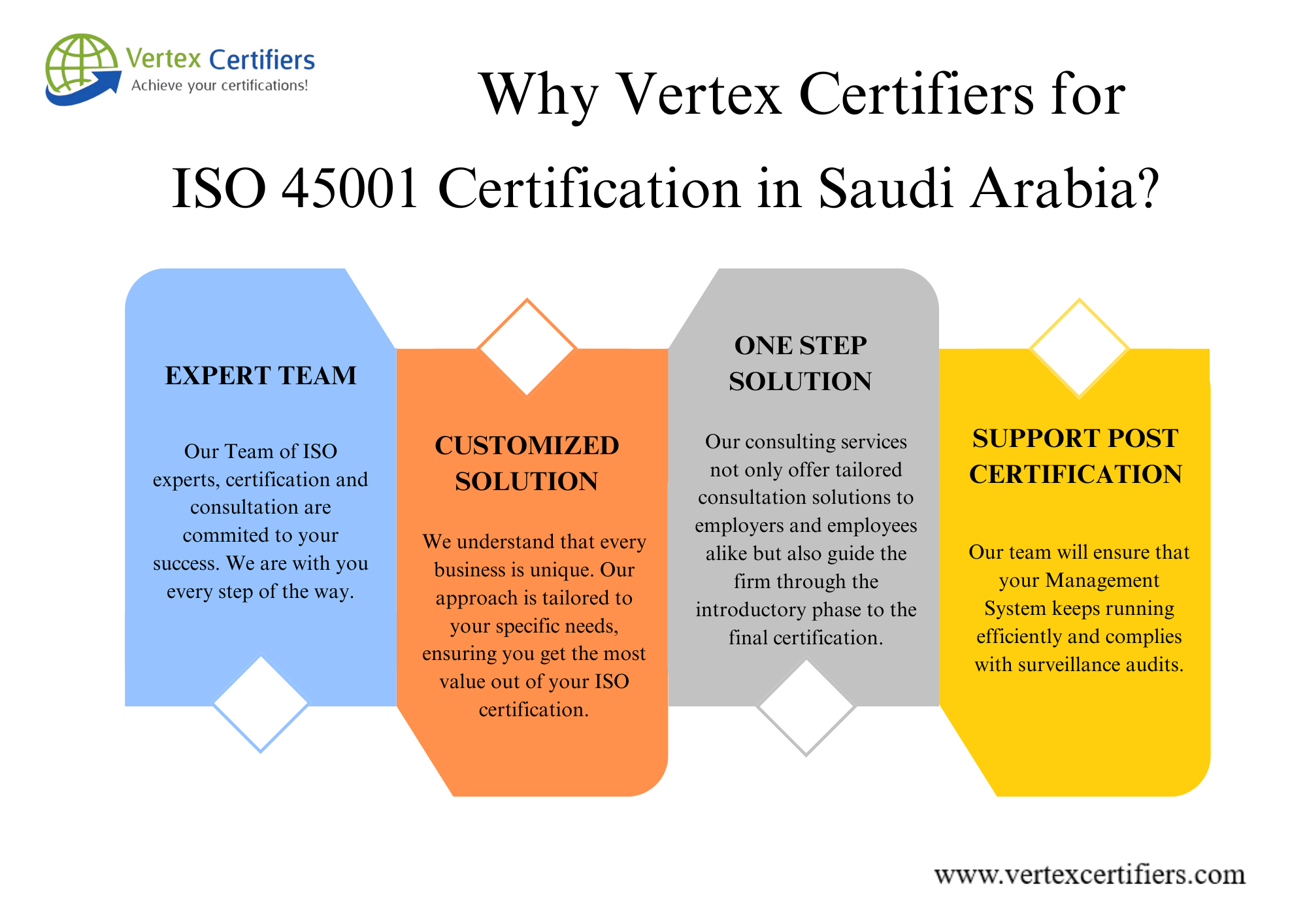
Why Vertex Certifiers for ISO 45001 certification in Saudi Arabia?
- Professional Consultation – Our highly experienced professionals support you at each step.
- ISO Implementation Strategy, suited to every industry.
- Affordable Pricing – Value-for-money certification without quality compromise.
- Efficient Process – Easy and quick certification.
- Continuous Support – Help for audits, renewals, and compliance management.
Get In Touch With Us
KSA ISO Certifications
Explore our most requested ISO certification services in Saudi Arabia, including quality, information security, environment, occupational health and safety, and food safety standards.
Our Services