ISO Certification in Philippines:
ISO Certification in Philippines, Vertex Certifiers is a global leader in ISO consulting, providing complete end-to-end certification support for businesses across the Philippines – Metro Manila, Quezon City, Manila, Makati, Taguig, Pasig, Cebu City, Mandaue, Lapu-Lapu City, Davao City, Iloilo City, Baguio City, Cagayan de Oro, General Santos City, Zamboanga City, Bacolod City, Angeles City, San Fernando, Dagupan, Legazpi City, and Batangas City. we help organizations of all sizes implement world-class management systems that enhance quality, compliance, and operational excellence. With a team of experienced lead auditors, industry specialists, and ISO implementers, Vertex Certifiers offers comprehensive services including gap analysis, documentation development, staff training, internal audits, implementation support, and seamless coordination with accredited certification bodies. Our approach ensures fast, effective, and fully compliant ISO certification tailored to the unique needs of Philippine industries.
We assist organizations in achieving a wide range of globally recognized ISO standards, including ISO 9001 (Quality), ISO 14001 (Environmental), ISO 45001 (Occupational Health & Safety), ISO 27001 (Information Security), ISO 22000 (Food Safety), ISO 22301 (Business Continuity), ISO 50001 (Energy Management), ISO 37001 (Anti-Bribery), ISO 13485 (Medical Devices), ISO 21001 (Educational Organizations), ISO 20000-1 (IT Service Management), ISO 41001 (Facility Management), ISO 28000 (Supply Chain Security), ISO 55001 (Asset Management), ISO 41001 (Facility Management), ISO 19650 (BIM) and ISO 17025 (Testing & Calibration Laboratories).
What Is ISO Certification?
The International Organization for Standardization (ISO) is an independent international body that develops globally recognized standards for quality, safety, efficiency, and sustainability. ISO standards are designed to help organizations implement structured management systems that improve their performance and customer satisfaction.
ISO certification refers to the process by which a company’s management system is verified by an accredited third-party certification body to ensure it meets specific ISO standard requirements.
It’s important to note the difference between certification and accreditation:
- Certification is the process through which a company proves it complies with ISO standards.
- Accreditation refers to the formal recognition of a certification body’s competence to certify organizations.
Implementing ISO standards provides businesses with a framework for consistency, process improvement, and enhanced competitiveness—key ingredients for long-term success in the Philippine market.
Why ISO Certification Is Important in the Philippines
ISO certification brings both immediate and lasting benefits to organizations across the Philippines:
- Compliance with Regulatory and Tender Requirements:Â Government projects, such as those under DPWH, DOH, and LGUs, often require ISO certification as a prequalification criterion.
- Access to International Markets:Â ISO-certified companies gain the trust of foreign partners and customers, opening doors to export and cross-border trade opportunities.
- Improved Efficiency and Operations:Â Standardized systems reduce waste, eliminate redundancies, and improve productivity.
- Enhanced Customer Confidence: Certification demonstrates a company’s dedication to consistently delivering quality.
- Risk Reduction and Continuous Improvement:Â ISO helps organizations identify risks before they occur, improving resilience and decision-making.
How to get ISO Certification in Philippines:
Our Services
- GMP Certification
- GLP Certification
- GDP Certification
- Halal Certificate
- Organic Certificate
- CE Marking Certification
- RoHS Certification
- FDA Certification
- CMMI Certification
- Cyber Security
- VAPT Testing
- Security Assessment
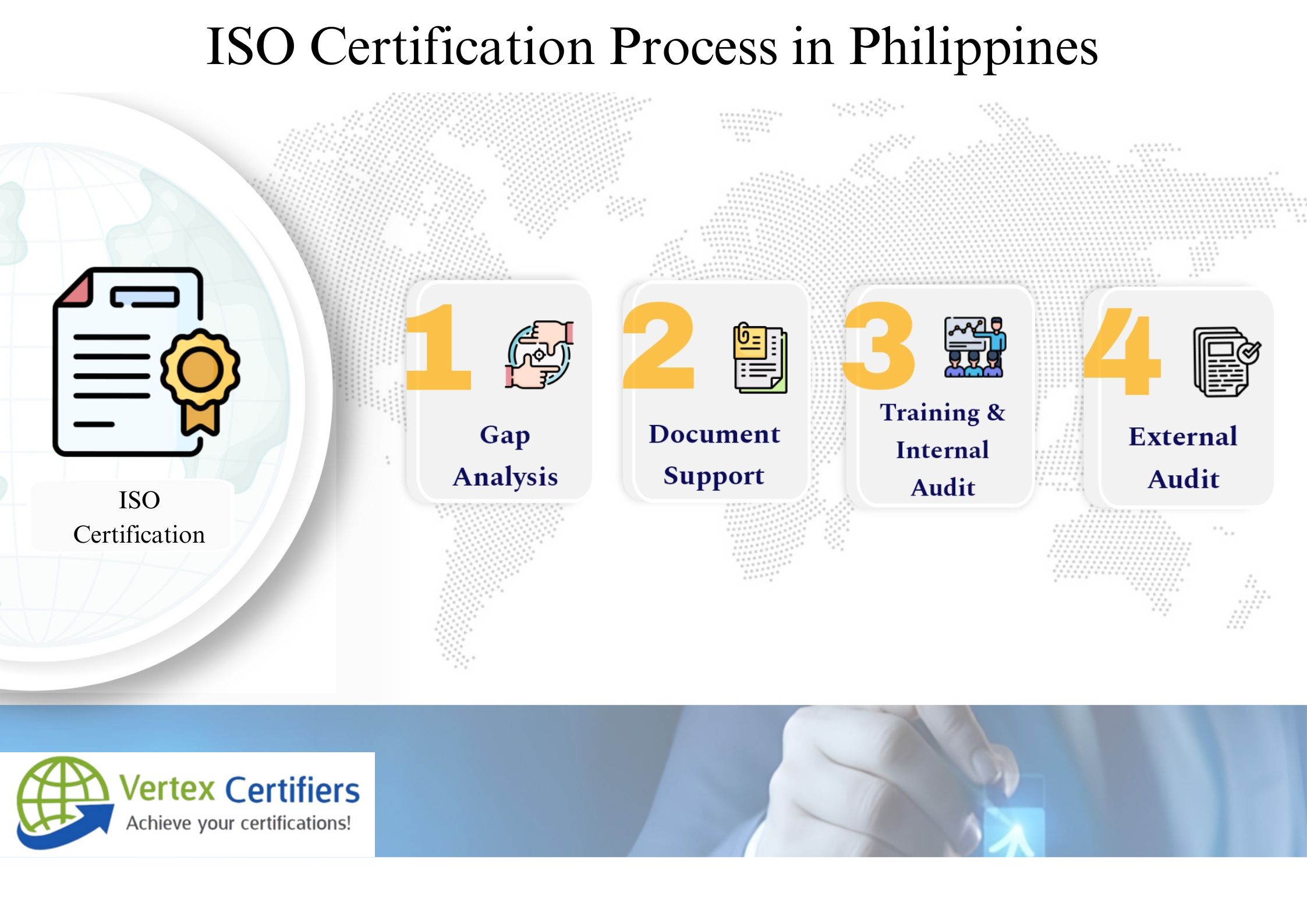
Step-by-Step Process of Getting ISO Certification in the Philippines
A practical, end-to-end guide to certification — from gap analysis to surveillance audits — with industry insights and consultant benefits.
Step-by-Step Process of Getting ISO Certification
Step 1: Initial Consultation & Gap Analysis
A consultant or internal team evaluates your current processes to determine compliance gaps with the desired ISO standard.
Step 2: Development of Documentation
Create necessary documents such as policies, manuals, and standard operating procedures (SOPs) tailored to your organization’s needs.
Step 3: System Implementation
Implement the documented processes within your day-to-day operations to ensure consistency and traceability.
Step 4: Staff Awareness & Training
Conduct training sessions to ensure employees understand ISO requirements, their responsibilities, and how they contribute to compliance.
Step 5: Internal Audit
Internal auditors evaluate whether the management system operates effectively and complies with ISO requirements.
Step 6: Management Review
Top management reviews internal audit results, performance data, and improvement needs before proceeding to certification.
Step 7: Stage 1 Audit – Documentation Check
An external certification body reviews your documentation for completeness and compliance.
Step 8: Stage 2 Audit – Implementation Audit
The certification auditor verifies that documented processes are implemented effectively across departments.
Step 9: Certification Issuance
If all requirements are met, your company receives an ISO certificate, typically valid for three years.
Step 10: Annual Surveillance Audits
Certification bodies conduct yearly audits to verify continued compliance and improvement.
ISO Certification Timeline in the Philippines
ISO certification generally takes between 2 to 6 months, depending on:
- The organization’s readiness level.
- The complexity of processes and size of the company.
- The chosen ISO standard (some require more documentation or training).
- Availability of internal resources and management commitment.
Working with experienced ISO consultants in the Philippines like Vertex Certifiers can significantly shorten the process by ensuring proper documentation, training, and pre-audit preparation.
Industries in the Philippines That Need ISO Certification
ISO certification benefits nearly every industry, but it is especially vital for sectors with regulatory, safety, and customer-satisfaction demands:
- Manufacturing: Ensures product consistency, quality, and compliance.
- BPO & IT Services: Improves service management, data protection, and client trust.
- Construction: Promotes safety, project efficiency, and environmental management.
- Healthcare & Medical Devices: Ensures patient safety and quality assurance.
- Food Processing & Hospitality: Guarantees hygiene, safety, and customer satisfaction.
- Logistics & Warehousing: Enhances inventory control and supply chain reliability.
- Education & Training: Improves curriculum delivery and learner satisfaction.
- Government Suppliers & NGOs: Meets prequalification standards for public tenders.
- Oil, Gas & Energy: Reduces workplace hazards and environmental risks.
- Transportation & Shipping: Strengthens operational safety and supply chain performance.
Key Benefits of ISO Certification
For Businesses
- Streamlined processes and reduced inefficiencies.
- Better resource utilization and cost control.
- Improved productivity and reduced downtime.
- Stronger brand reputation and competitive advantage.
For Customers
- Consistent product and service quality.
- Faster, more reliable response times.
- Increased confidence and loyalty.
For Employees
- Clear roles and accountability.
- Enhanced training and development.
- Higher morale and performance motivation.
Challenges Faced by Philippine Companies During ISO Implementation
- Lack of Internal Expertise: Many companies lack ISO-trained staff.
- Complex Documentation Requirements: Preparing manuals, policies, and records can be time-intensive.
- Resistance to Change: Employees may find new work procedures challenging.
- Budget Limitations: Smaller organizations may struggle with up-front costs.
- Choosing the Wrong Certification Body: Working with unaccredited or inexperienced auditors may cause delays or invalid certification.
Partnering with experienced consultants can help overcome these obstacles and ensure a smoother process.
How to Choose the Right ISO Certification Body in the Philippines
- Accreditation: Ensure the body is recognized by an IAF member.
- Industry Experience: Look for auditors familiar with your particular sector.
- Transparent Audit Process: Fees, scope and schedules should be clear and documented.
- Local Presence: Bodies with representatives in the Philippines provide better post-certification support.
- Value for Money: Focus on audit quality and reputation, not just price.
Why Work With ISO Consultants in the Philippines
Hiring ISO consultants saves time, resources, and stress during certification. Experienced consultants assist with each stage of the process, ensuring compliance and audit readiness. Typical consultant services include:
- Conducting the gap analysis and preparing all required documents.
- Training employees in ISO principles.
- Guiding management on implementing effective systems.
- Performing internal audits and pre-assessments.
- Coordinating with certification bodies for audit scheduling.
Consultants like Vertex Certifiers are vital partners in ensuring your company earns certification on the first attempt and establishes a culture of continual improvement.
Why Choose Vertex Certifiers
Vertex Certifiers is a global leader in ISO consulting with a strong presence in the Philippines. The company supports organizations across multiple industries and sizes, providing customized and reliable certification services.
- Global presence and network across 40+ countries.
- Expertise in over 30 ISO standards.
- Tailored documentation for each organization.
- Onsite and virtual consulting services for convenient access.
- Transparent and cost-effective approach.
- 100% implementation support from start to finish.
- High first-time audit pass rate for client organizations.
Whether your business is based in Manila, Makati, Cebu, or Davao, Vertex offers dependable consulting solutions to help you achieve ISO certification efficiently and credibly.
Frequently Asked Questions (FAQs)
- What is the validity of ISO certification?
ISO certificates are typically valid for three years, subject to annual surveillance audits. - Which ISO standard is best for small businesses?
ISO 9001 is ideal for SMEs as it improves processes, quality, and customer satisfaction without excessive complexity. - Do government projects require ISO certification?
Yes, many Philippine government tenders and contracts require bidders to be ISO-certified for eligibility. - Can ISO certification increase sales?
Yes. Certification enhances credibility, helping attract clients who prefer working with standardized organizations. - How long does the process take?
Depending on company readiness and system complexity, it takes about 2–6 months to get certified. - Is the ISO certification process difficult?
Not with the right consultant. Expert guidance simplifies documentation, preparation, and audit success.
Conclusion
As the Philippine business landscape becomes more competitive and connected, ISO certification has evolved into a crucial tool for sustainable growth and global recognition. It helps organizations enhance quality, efficiency, and trust—three pillars essential for long-term success.
From manufacturing plants in Cebu to BPOs in Manila and construction firms in Davao, ISO-certified organizations consistently outperform their peers in productivity and customer satisfaction. Embracing ISO certification ensures readiness for both local challenges and international opportunities while fostering a culture of continual improvement and operational excellence.
Ready to get ISO certified in the Philippines?
Request a Free ConsultationEmail: info@vertexcertifiers.com
Popular ISO Standards in the Philippines
ISO 9001 Certification in Philippines
ISO 9001 – Quality Management System (QMS): Focuses on improving customer satisfaction by standardizing processes and promoting continual improvement. Organizations adopt it to reduce defects, streamline delivery, and build measurable quality controls. It helps Philippine businesses demonstrate reliability to customers, partners and regulators.
ISO 9001 Certification in Philippines
ISO 14001 – Environmental Management System (EMS): Provides a structured approach to manage environmental impacts and improve sustainability performance. Companies use it to reduce waste, comply with environmental laws, and meet stakeholder expectations. It supports cost savings through efficient resource use and risk reduction.
ISO 9001 Certification in Philippines
ISO 45001 – Occupational Health & Safety Management System (OHSMS): Establishes processes to keep employees safe and reduce workplace incidents. It helps organizations identify hazards, implement controls, and foster a safety-first culture. Adoption demonstrates commitment to workforce wellbeing and legal compliance.
ISO 9001 Certification in Philippines
ISO 27001 – Information Security Management System (ISMS): Frames policies and controls to protect sensitive data from threats and breaches. Organizations adopt it to secure customer information, intellectual property, and business continuity. Certification builds trust with clients and partners handling confidential data.
ISO 9001 Certification in Philippines
ISO 22000 – Food Safety Management System (FSMS): Integrates hazard control and prerequisite programs to ensure safe food across the supply chain. It is used by food producers, processors, and service providers to prevent contamination and ensure regulatory compliance. Certification reassures consumers and opens export opportunities.
ISO 9001 Certification in Philippines
ISO 50001 – Energy Management System: Provides a framework to manage and reduce energy consumption and costs. Companies implement it to measure energy use, set improvement targets, and optimize operations for efficiency. The standard supports sustainability goals and long-term cost savings.
ISO 9001 Certification in Philippines
ISO 22301 – Business Continuity Management System (BCMS): Helps organizations prepare for, respond to, and recover from disruptive incidents. It ensures critical functions continue during crises and reduces downtime and financial loss. Certification demonstrates resilience to customers and stakeholders.
ISO 9001 Certification in Philippines
ISO 37001 – Anti-Bribery Management System: Sets up policies and controls to prevent, detect, and address bribery and corruption risks. Organizations use it to embed ethical practices, strengthen governance, and protect reputation. Certification signals integrity to clients, investors, and regulators.
ISO 9001 Certification in Philippines
ISO 13485 – Medical Devices Quality Management System: Specifies regulatory and quality requirements for medical device design, production, and distribution. Manufacturers and suppliers apply it to ensure product safety and regulatory compliance. Certification is critical for market access and patient safety assurance.
ISO 9001 Certification in Philippines
ISO 21001 – Educational Organizations Management System (EOMS): Focuses on improving learning outcomes, stakeholder satisfaction and administrative effectiveness in educational settings. Schools and training providers adopt it to standardize course delivery, assessment and feedback mechanisms. Certification enhances credibility and institutional performance.
ISO 9001 Certification in Philippines
ISO 20000-1 – IT Service Management System (ITSMS): Establishes best practices for delivering reliable IT services and improving customer experience. It helps IT organisations manage incidents, changes and service levels with measurable processes. Certification boosts confidence among clients relying on IT service continuity.
ISO 9001 Certification in Philippines
ISO 28000 – Supply Chain Security Management: Provides a framework for managing security risks across the supply chain and logistics operations. Businesses use it to protect cargo, facilities and transportation routes from disruption and threats. Certification strengthens supply chain resilience and partner confidence.
Each standard above offers Philippine organisations a proven framework to improve performance, manage risk, and meet regulatory or market expectations. For tailored support across these standards, consider partnering with an experienced ISO consultant.
