ISO 22000 Certification in Afghanistan:
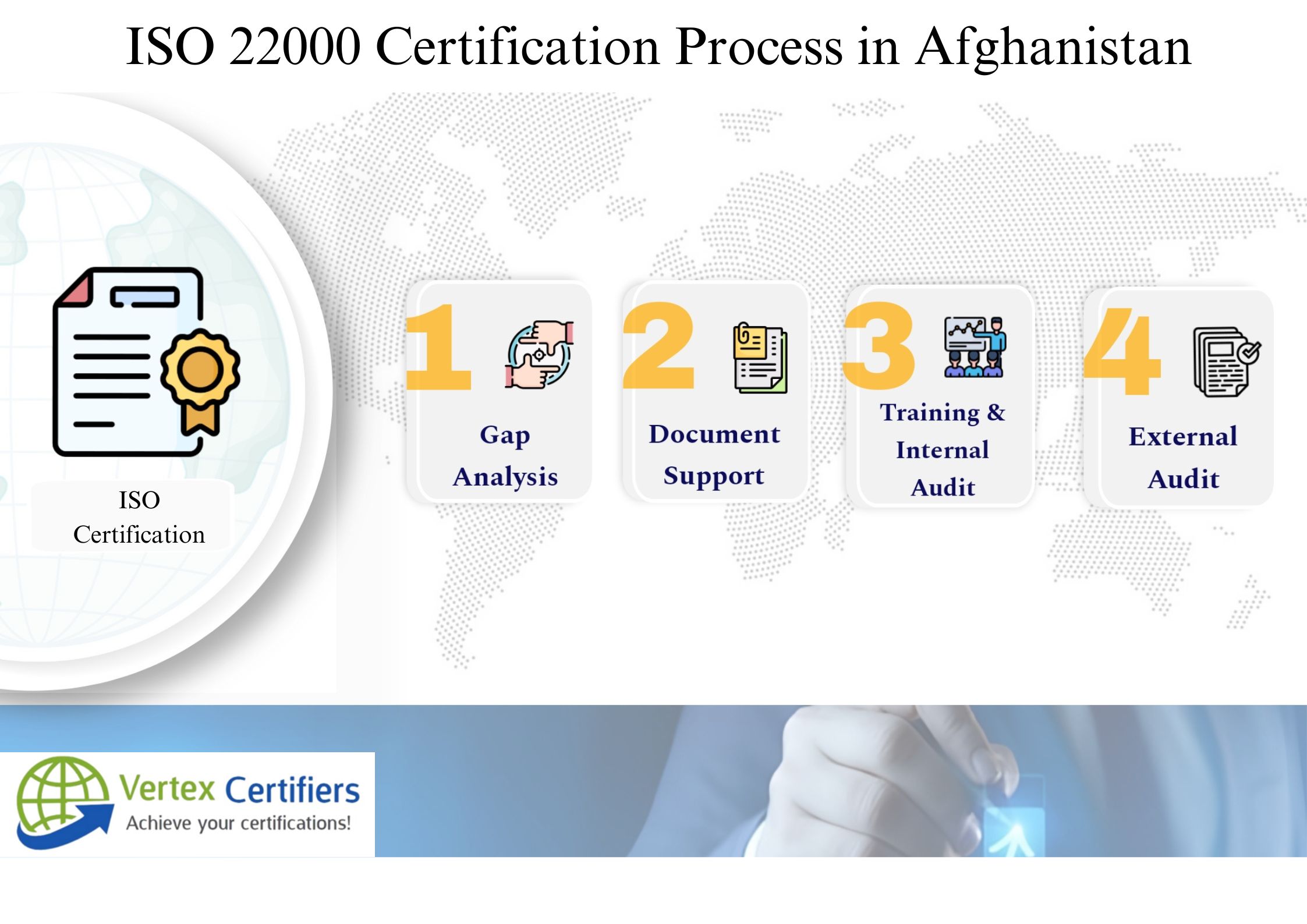
ISO 22000 Certification in Afghanistan, Vertex Certifiers provides end-to-end ISO consulting and certification services across Afghanistan, helping food businesses implement globally recognized standards efficiently. With extensive experience in ISO 22000, HACCP, and related food safety standards, our expert consultants support companies in Kabul, Herat, Mazar-e-Sharif, Kandahar, Jalalabad, Balkh, Helmand, Nimruz, and other regions.We guide organizations through every stage of the certification process—from gap analysis, documentation development, and system implementation to internal audits and liaison with accredited certification bodies. Beyond ISO 22000, Vertex also offers consulting for 15+ ISO standards, including ISO 9001, ISO 14001, ISO 45001, ISO 27001, ISO 22301, ISO 50001, ISO 41001, ISO 20000-1, ISO 13485, ISO 37001, ISO 31000, ISO 17025, FSSC 22000, ISO 27701, and ISO 10002.Our practical, results-driven approach ensures compliance, operational efficiency, and international credibility, enabling Afghan food businesses to safely expand in local and global markets.
Afghanistan’s agriculture and food processing industries form the backbone of its economy, with significant potential in fruits, nuts, dairy, meat, and grains for both local consumption and exports to EU, Gulf, and CIS markets. As cold chains develop and processing plants modernize, food safety has become critical to prevent contamination risks and meet stringent buyer requirements.
ISO 22000, the international Food Safety Management System (FSMS) standard, equips Afghan organizations with a systematic approach to control hazards throughout the supply chain. From farms in Herat to processors in Kabul, certification demonstrates commitment to safe food production, enhancing market access and consumer confidence
What is ISO 22000?
ISO 22000:2018 specifies requirements for a Food Safety Management System that consistently delivers safe products through risk-based controls and prerequisite programs. It integrates HACCP principles (Hazard Analysis and Critical Control Points), PRPs (cleaning, pest control, maintenance), CCPs/OPRPs for hazard mitigation, traceability systems, and recall procedures
The standard follows the PDCA cycle for continual improvement and applies across the food chain: primary producers (farms), processors, packagers, transporters, storage facilities, retailers, and HORECA (hotels, restaurants, catering). Afghan businesses benefit from its flexibility for small farms to large exporters
ISO 22000 certification involves implementing a Food Safety Management System (FSMS), internal verification, and a two-stage external audit process.​
Step-by-Step Process to get ISO 22000 Certification in Afghanistan:

Step-by-Step Process for ISO 22000 Certification
1. Gap Analysis
Assess current food safety practices against ISO 22000:2018 requirements to identify gaps in PRPs, HACCP, documentation, and processes.
2. FSMS Development
Define the scope, create a food safety policy, conduct hazard analysis, and develop the HACCP plan including CCPs/OPRPs, PRPs, traceability, and recall procedures. Operate the system for 3 months to ensure stability.
3. Implementation & Training
Deploy controls across all relevant areas, train staff on food safety responsibilities, monitor CCPs, maintain records, and conduct supplier evaluations to ensure compliance.
4. Internal Audit & Review
Perform a complete internal audit cycle, conduct management review meetings, and implement corrective actions to confirm readiness for certification.
5. Stage 1 Audit
Submit an application to an accredited certification body. Auditors review documentation, scope, and preparedness on-site, identifying any gaps to be addressed before the Stage 2 audit.
6. Stage 2 Audit
On-site verification of FSMS implementation through process observation, interviews, record review, and compliance testing. All nonconformities are addressed and closed.
7. Certification Issuance
Upon successful Stage 2 audit, the certification body approves and issues the ISO 22000 certificate, valid for 3 years.
8. Surveillance & Recertification
Annual surveillance audits are conducted in Years 1 and 2, followed by a recertification audit in Year 3 to maintain certification and ensure continual improvement.
Our Services
- GMP Certification
- GLP Certification
- GDP Certification
- Halal Certificate
- Organic Certificate
- CE Marking Certification
- RoHS Certification
- FDA Certification
- CMMI Certification
- Cyber Security
- VAPT Testing
- Security Assessment
ISO 22000 Certification in Afghanistan
Why ISO 22000 is Important in Afghanistan
Afghanistan's food exports—pistachios, raisins, almonds, dairy, and meat—face growing scrutiny from international buyers demanding verifiable safety systems. Domestic regulations and consumer expectations also emphasize hygiene amid urbanization and retail expansion.
ISO 22000 ensures:
- Consistent standards meeting Afghan food laws and global specifications.
- Hazard control from farm to fork, reducing contamination risks.
- Compliance facilitating export approvals and supermarket listings.
- Supply chain transparency through traceability and supplier controls.
Key Benefits of ISO 22000 Certification
- Safe, consistent products minimizing foodborne illness risks.
- Integrated HACCP system with validated CCPs and PRPs.
- Fewer recalls/complaints through proactive monitoring.
- Superior supplier control ensuring raw material quality.
- Boosted confidence from customers, regulators, and partners.
- Export market access via recognized international compliance.
- Legal/contractual assurance for tenders and partnerships.
Industries in Afghanistan That Need ISO 22000
- Food processing plants (canning, RTE, frozen products).
- Agriculture & farming (fruits, vegetables, grains).
- Dairy & milk manufacturers (cheese, yogurt, butter).
- Poultry & meat exporters (slaughter, processing).
- Fish & aquaculture operations.
- Beverage producers (juices, water, soft drinks).
- Flour mills & grain processors.
- Packaged foods & snacks.
- HORECA (hotels, restaurants, catering services).
- Supermarkets, cold storage, logistics.
- Food trading/export companies.
- Food-contact packaging manufacturers.
ISO 22000 Documentation Requirements
- Food safety policy/objectives from management.
- HACCP plan/hazard analysis per product/process.
- PRPs, SOPs, CCPs/OPRPs documentation.
- Traceability/recall procedures and records.
- Supplier evaluation/monitoring.
- Customer complaint handling.
- Internal audit/corrective action reports.
- Management review minutes.
Cost of ISO 22000 Certification in Afghanistan
Costs scale with operations but remain SME-accessible. Major factors include:
- Company size/product diversity.
- Risk levels (high-risk meat vs. low-risk dry goods).
- Site numbers and lab testing needs.
- Consultant/certification fees.
Remote/hybrid models make it affordable, with ROI from reduced waste and market gains.
Certification Timeline
- Small: 4–6 weeks.
- Medium: 2–3 months.
- Large/multi-site: 3–5 months.
Management commitment accelerates success.
ISO 22000 Certification Bodies in Afghanistan
- IAF-accredited bodies or local representatives in Kabul/Herat.
- Food/HACCP auditor expertise.
- Surveillance/recertification support.
- Export/donor recognition.
Importance of a Consultant
- HACCP design/validation.
- FSMS documentation/PRPs.
- Training/internal audits.
- Readiness checks and NC reduction.
Why Choose Vertex Certifiers
- End-to-end: gap analysis to certification.
- Food safety/HACCP specialists.
- Remote/onsite execution.
- Coverage: Kabul, Herat, Mazar-e-Sharif, Kandahar, Jalalabad, Balkh, Helmand, Nimruz.
- Multi-standard support: ISO 9001, 14001, 45001, 27001, 22000, 22301, 50001, 41001, 20000-1, 13485, 37001, 31000, 17025, 27701, FSSC 22000, 10002.
Contact Vertex Certifiers
Free consultation, cost estimate, and roadmap:
- Phone/WhatsApp: +91-98804 29121
- Email: info@vertexcertifiers.com
- Enquiry Form: Contact Us
FAQs
- Is ISO 22000 mandatory in Afghanistan? No, but buyer-required.
- Is it suitable for SMEs? Yes, scalable.
- Certificate validity? 3 years + annual surveillance.
- Export benefits? Strong compliance proof for international markets.
- Difference from HACCP? ISO 22000 builds on HACCP with a full management system approach.
