GLP Certification in Singapore:
GLP Certification in Singapore, Vertex Certifiers provides end-to-end GLP (Good Laboratory Practice) certification and compliance services in Singapore, supporting laboratories, CROs, biotech companies, and research institutes in achieving OECD GLP–aligned, HSA-ready compliance with full inspection confidence. From GLP gap assessment, documentation, QA framework setup, and staff training to mock inspections and audit support, Vertex delivers practical, inspection-ready GLP solutions focused on data integrity and international acceptance. We support clients across Singapore’s key life-sciences clusters including Biopolis, Jurong, Tuas, and one-north, offering flexible onsite and remote GLP consulting tailored to Singapore’s highly regulated research and innovation ecosystem.
Singapore hosts over 500 life sciences firms and A*STAR research centers, driving billions in R&D for drugs, devices, and biotech. Labs need strong GLP systems because regulators and sponsors check data closely—no room for errors in this competitive market. Perfect GLP setup helps win contracts and avoid costly retests.
How GLP Works in Singapore
GLP follows simple OECD rules for quality lab work, managed by HSA for health products and SAC for monitoring. No single paper certificate exists; labs prove compliance by passing regular inspections from HSA, A*STAR, or sponsors like FDA/EMA. This keeps data trustworthy for global use.
How to get GLP Certification in Singapore:
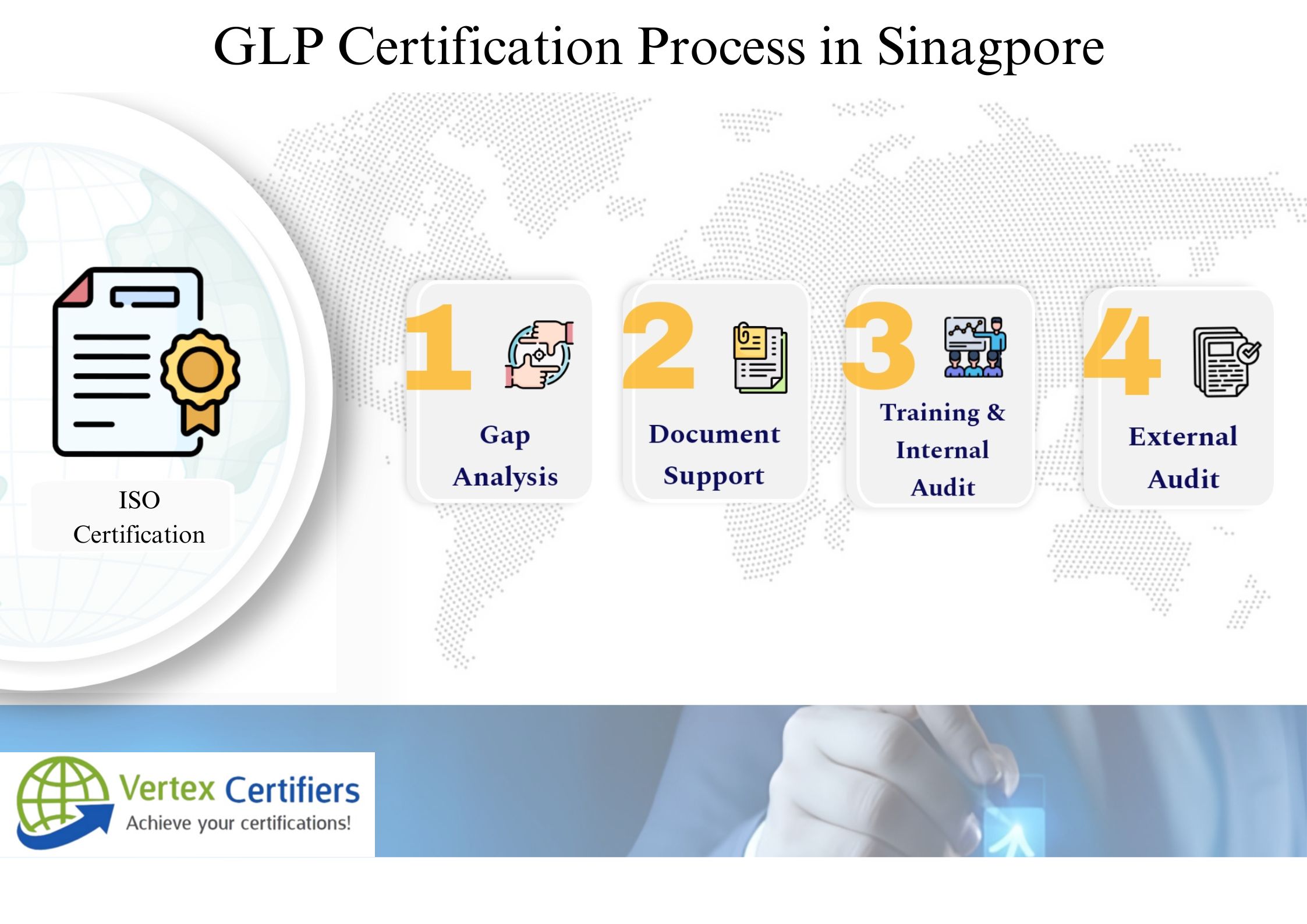
Singapore has established itself as one of Asia’s most advanced hubs for life sciences, biotechnology, pharmaceuticals, and contract research. With strong government backing, world-class infrastructure, and a highly regulated research ecosystem, laboratories operating in Singapore face stringent expectations for data quality, integrity, and traceability.
In this environment, Good Laboratory Practice (GLP) compliance is not optional—it is a strategic requirement for laboratories generating non-clinical safety data intended for regulatory submissions, global sponsors, or international markets.
This guide explains GLP Certification in Singapore, how it works in practice, who needs it, how laboratories should implement it, and how to achieve inspection-ready compliance aligned with OECD principles and Health Sciences Authority (HSA) expectations.
Singapore’s Position as a GLP-Critical Research Hub
Singapore’s life sciences sector is built on credibility and global acceptance. The country hosts multinational pharmaceutical companies, global CROs, medtech innovators, and publicly funded research institutions under A*STAR, all operating within tightly controlled regulatory frameworks.
Key characteristics of Singapore’s research ecosystem include:
High volume of non-clinical safety and toxicology studies
Strong emphasis on data integrity and reproducibility
Frequent sponsor-led and regulatory inspections
Global submission pathways (US FDA, EMA, PMDA, WHO)
Because Singapore-based studies are often submitted internationally, GLP compliance becomes the foundation for regulatory trust. Any weakness in GLP systems can lead to data rejection, re-testing, sponsor loss, or inspection findings.
What GLP Certification Really Means in Singapore
Unlike ISO certifications, GLP is not a paper-based certificate issued after a simple audit. In Singapore, GLP compliance is demonstrated through:
Conformance to OECD Principles of Good Laboratory Practice
Robust internal systems and documented evidence
Successful regulatory or sponsor inspections
GLP governs how non-clinical studies are planned, performed, monitored, recorded, archived, and reported. It ensures that study data is:
Accurate
Complete
Traceable
Reconstructable
Scientifically credible
In practical terms, GLP answers one critical question regulators ask:
“Can this study be fully reconstructed and trusted years after it was conducted?”
Our Services
- GMP Certification
- GLP Certification
- GDP Certification
- Halal Certificate
- Organic Certificate
- CE Marking Certification
- RoHS Certification
- FDA Certification
- CMMI Certification
- Cyber Security
- VAPT Testing
- Security Assessment
Timeline, Cost Expectations, and Common GLP Pitfalls
Typical GLP Implementation Timelines
GLP implementation timelines in Singapore vary based on laboratory scale, system maturity, and study complexity. Typical ranges are:
- Small laboratories: 1–3 months
- Medium CROs: 2–4 months
- Large or multi-site facilities: 3–6 months
Timelines depend heavily on:
- Number of ongoing and planned studies
- Existing quality system maturity
- Extent of computerized systems and validation scope
Cost Considerations for GLP in Singapore
GLP implementation costs in Singapore are not fixed and depend on the operational reality of each laboratory. Key cost drivers include:
- Laboratory size and technical complexity
- Documentation gaps and customization needs
- Quality Assurance staffing and independence requirements
- Computerized system and data integrity validation
A GLP gap assessment is the most accurate and cost-effective way to determine implementation scope, budget, and timelines.
Common Pitfalls in Singapore GLP Projects
Many laboratories appear compliant on paper but face challenges during inspections due to systemic weaknesses. Common GLP pitfalls include:
- Copy-paste GLP templates with no operational alignment
- Weak or non-independent QA structures
- Unvalidated spreadsheets, LIMS, or electronic data systems
- Poor deviation handling and ineffective CAPA management
- Inadequate archiving and long-term data retention controls
These issues often surface during inspections—not during documentation reviews, leading to critical findings and data rejection.
Why Vertex Certifiers for GLP Certification in Singapore
Vertex Certifiers provides end-to-end GLP certification and compliance services in Singapore, supporting laboratories, CROs, biotech companies, and research institutes in achieving OECD GLP–aligned, HSA-ready compliance with full inspection confidence.
Our GLP services include:
- GLP gap assessment and risk mapping
- Custom documentation aligned to real laboratory operations
- QA framework setup and role-based training
- Computerized system and data integrity validation guidance
- Internal audits and mock inspections
- Sponsor and regulatory inspection support
We support organizations across Singapore’s major research clusters including Biopolis, one-north, Jurong, and Tuas, offering flexible onsite and remote consulting models tailored to Singapore’s highly regulated research environment.
Vertex’s approach emphasizes practical compliance, data integrity, and long-term inspection readiness—not generic GLP templates.
Frequently Asked Questions – GLP in Singapore
Is GLP mandatory in Singapore?
Yes. GLP is mandatory for laboratories generating non-clinical safety data
intended for regulatory submissions or international sponsors.
Does HSA issue a GLP certificate?
No. GLP compliance is demonstrated through inspections and documented
conformity to OECD GLP principles.
Can overseas studies be accepted in Singapore?
Yes, provided the studies are GLP-compliant and recognized under
OECD Mutual Acceptance of Data (MAD).
How often are GLP inspections conducted?
Inspection frequency depends on study risk, scope, and sponsor or regulatory
requirements.
Can GLP and ISO 17025 share systems?
Yes. Many Singapore laboratories operate integrated quality systems with
shared processes where appropriate.
Get GLP Certified in Singapore – Inspection Ready, Globally Accepted
GLP compliance in Singapore requires more than documentation—it requires operational discipline, strong QA, and inspection confidence.
Vertex Certifiers helps laboratories achieve GLP compliance efficiently, sustainably, and with full regulatory credibility.
- ✔ Free GLP Gap Assessment
- ✔ Tailored implementation roadmap & cost clarity
- ✔ Mock inspections and inspection support
Who Needs GLP Compliance in Singapore?
GLP compliance is essential for laboratories generating non-clinical safety data intended for regulatory submissions, international sponsors, or global market acceptance. In Singapore’s highly regulated research environment, GLP-aligned systems are increasingly expected across the following sectors:
Pharmaceutical and Biopharmaceutical Laboratories
- Toxicology studies
- Pharmacokinetics and pharmacodynamics (PK/PD)
- Preclinical safety assessments
Contract Research Organizations (CROs)
- Multinational sponsor studies
- Regulatory submission packages
- Outsourced non-clinical research programs
Medical Device Testing Facilities
- Biocompatibility studies
- Safety and performance evaluations
Agrochemical and Environmental Laboratories
- Pesticide safety studies
- Environmental risk assessments
- Export-oriented compliance testing
Government and Grant-Funded Research Institutes
- A*STAR and publicly funded research programs
- Projects requiring international data acceptance under OECD MAD
Major research clusters such as Biopolis, one-north, Jurong, and Tuas increasingly expect GLP-aligned systems for both commercial and publicly funded work.
A Practical GLP Implementation Model for Singapore Laboratories
Effective GLP implementation in Singapore must be risk-based, scalable, and inspection-ready. Successful laboratories treat GLP as a living quality system, not a one-time documentation exercise.
Risk-Based GLP Gap Mapping
Existing laboratory systems are assessed against OECD GLP principles with focused attention on:
- Data flows and data integrity risks
- Quality Assurance authority and independence
- Electronic records and audit trails
- End-to-end study lifecycle controls
Modular Documentation Framework
Instead of bulky, generic manuals, documentation is designed to reflect real laboratory operations:
- Lean and practical GLP Quality Manual
- SOPs directly mapped to day-to-day activities
- Study-specific templates and controlled records
Embedded Quality Assurance (QA) Function
QA is integrated into daily operations rather than treated as an afterthought:
- Independent QA reporting lines
- Scheduled internal audits
- Real-time oversight of ongoing studies
Digital and Validation Readiness
Singapore GLP inspections place strong emphasis on electronic data integrity, including:
- Controlled spreadsheets and calculation tools
- LIMS and computerized system validation
- Electronic signatures and secure audit trails
Continuous Compliance Cycle
Long-term GLP compliance is sustained through:
- Routine internal audits and QA reviews
- Management review meetings
- Periodic GLP refresher training
This structured yet flexible approach minimizes inspection risk while keeping GLP systems efficient, scalable, and sustainable.
