
ISO 22000 Certification in Kuwait:
ISO 22000 Certification in Kuwait, Vertex Certifiers is a globally trusted ISO consulting and certification service provider offering end-to-end support for ISO 22000 Certification in Kuwait. We help food manufacturers, restaurants, catering companies, distributors, and logistics providers implement robust Food Safety Management Systems (FSMS) that meet international standards and Kuwait regulatory requirements. Our experienced ISO consultants and lead auditors provide complete assistance—from gap analysis, documentation, HACCP implementation, training, internal audits, and certification coordination—to ensure a smooth and timely process. In addition to ISO 22000, we also support organizations with ISO 9001, ISO 14001, ISO 45001, ISO 27001, and other ISO standards. Our services are available across major Kuwait cities, including Kuwait City, Hawalli, Farwaniya, Al Ahmadi, Jahra, and Mubarak Al-Kabeer.
In Kuwait’s booming food industry, where imports fuel over 80% of consumption and hospitality thrives amid rapid urbanization, food safety isn’t just a regulation—it’s a competitive edge. ISO 22000 certification in Kuwait stands out as the gold standard for Food Safety Management Systems (FSMS). This international standard, developed by the International Organization for Standardization (ISO), integrates HACCP principles with a robust management system to prevent contamination at every stage of the food chain.
Why does this matter in Kuwait? The country’s food market, valued at billions, faces unique challenges: high reliance on imports, diverse cuisines in hotels and restaurants, and strict oversight from the Kuwait Municipality and Public Authority for Food and Nutrition (PAFN). Non-compliance can lead to hefty fines, shutdowns, or reputational damage. For food manufacturers, restaurants, catering companies, distributors, and supermarkets, achieving ISO 22000 certification aligns operations with these local mandates while opening doors to global markets.
What is ISO 22000 and Who Needs It?
ISO 22000 is a globally recognized standard for FSMS, blending the Hazard Analysis and Critical Control Points (HACCP) methodology with ISO’s process-based management approach. Unlike basic HACCP, which focuses solely on hazards, ISO 22000:2018 (the latest version) emphasizes continual improvement, communication across the supply chain, and top management involvement. It ensures organizations systematically identify, evaluate, and control food safety risks—from farm to fork.
In Kuwait, this framework is essential for diverse sectors vulnerable to contamination outbreaks, supply disruptions, or regulatory scrutiny. Key applicable sectors include:
- Food manufacturing and processing units: Bakeries, dairy plants, and meat processors in industrial hubs like Al Ahmadi must implement hazard controls for pathogens and allergens.
- Restaurants, hotels, and catering services: High-volume operations in Kuwait City and Hawalli benefit from standardized hygiene protocols amid tourist influxes.
- Food importers and distributors: Handling perishables from Europe or Asia requires robust traceability to comply with PAFN import guidelines.
- Packaging and storage companies: Ensuring materials don’t leach contaminants is critical for shelf-life integrity.
- Cold chain and logistics providers: Refrigerated transport firms prevent spoilage in Kuwait’s hot climate.
Many Kuwaiti firms integrate ISO 22000 with other standards like ISO 9001 (quality management), ISO 14001 (environmental), or ISO 45001 (occupational health). This holistic approach streamlines audits and boosts eligibility for tenders from Kuwait Petroleum or major retailers like Lulu Hypermarket.
ISO 22000 Certification Process in Kuwait
The ISO 22000 certification process in Kuwait is straightforward, typically managed by accredited bodies approved auditors. Vertex Certifiers streamlines it for local businesses:
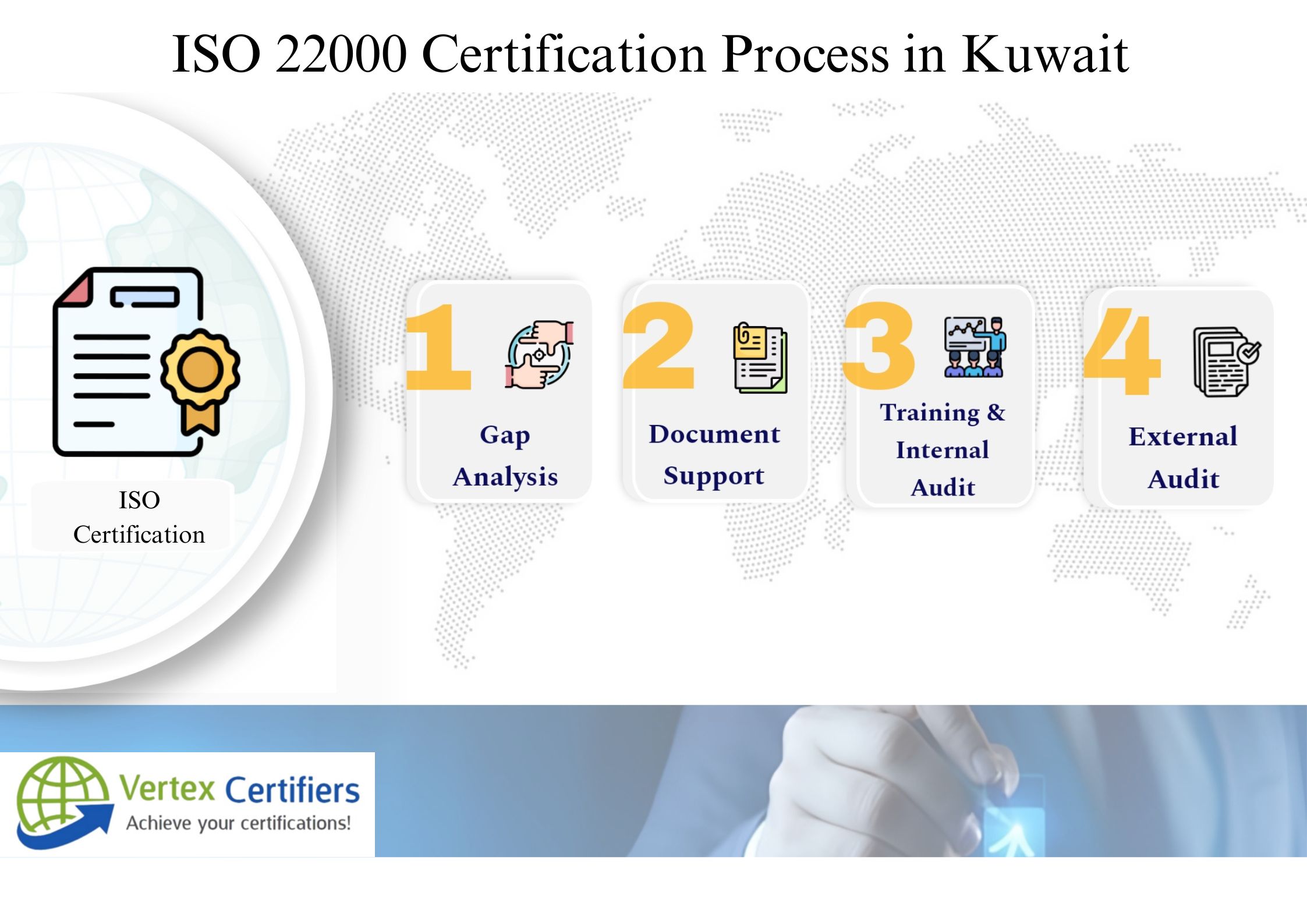
- Gap analysis: Assess current practices against ISO 22000:2018 to identify deficiencies.
- FSMS documentation and implementation: Develop manuals, procedures, and records for PRPs and HACCP.
- HACCP study and risk assessment: Conduct thorough hazard analysis workshops.
- Employee training and awareness: Roll out sessions on hygiene, CCP monitoring, and emergency response.
- Internal audit and corrective actions: Simulate audits to fix gaps.
- Certification audit:
- Stage 1: Documentation review and readiness check.
- Stage 2: On-site verification of implementation.
- Issuance of ISO 22000 certificate: Valid for 3 years, with annual surveillance.
Post-certification, maintain via internal reviews. In Kuwait, this aligns with PAFN approvals, often fast-tracked in 2-4 months.
Cost and Timeline for ISO 22000 Certification in Kuwait
Budgeting for ISO 22000 certification in Kuwait hinges on your operation’s scale. Timelines range from 2-4 months: smaller firms (under 50 employees) finish in 8-10 weeks; larger ones with complex processes take longer due to multi-location audits.
Key factors influencing investment:
- Organization size and number of employees
- Complexity of food processes (e.g., high-risk seafood processing requires detailed HACCP)
- Number of locations (multi-site operations in Farwaniya and Jahra extend timelines)
- Certification body fees and consultancy support
ROI shines through reduced wastage, fewer recalls, improved efficiency, and enhanced compliance. Government subsidies via Kuwait Direct Investment Promotion Authority (KDIPA) can support SMEs.