
Advantages of ISO 27001 Certification in Germany:
Advantages of ISO 27001 Certification in Germany, Vertex Certifiers provides end-to-end support for ISO 27001 certification in Germany, helping organizations build and maintain a practical, compliant Information Security Management System aligned with German and EU expectations. Our services cover the complete journey—from initial gap analysis and risk assessment to documentation, implementation, internal audits, and certification coordination—delivered through a flexible mix of remote and onsite support. We assist clients across major German business hubs including Berlin, Munich, Hamburg, Frankfurt, Stuttgart, and Cologne, working closely with IAF-accredited certification bodies to ensure global recognition. With proven templates, fast-track methodologies, and sector-specific expertise, Vertex Certifiers enables German companies to achieve ISO 27001 certification efficiently while strengthening data protection, cyber resilience, and stakeholder trust.
Germany’s economy thrives on data-intensive industries like IT, finance, manufacturing, and automotive, where information security is paramount amid strict GDPR regulations and rising cyber threats. ISO 27001 certification equips businesses with a robust framework to manage security risks, ensuring compliance and building stakeholder trust. This blog explores the key advantages that make ISO 27001 essential for German organizations aiming to protect assets and compete globally.
Introduction to ISO 27001 in the German Context
ISO 27001 defines requirements for an Information Security Management System (ISMS), helping organizations systematically protect confidential data, IT systems, and processes against breaches, disruptions, and unauthorized access. In Germany, with its data-driven business environment and high regulatory standards, ISO 27001 aligns perfectly with GDPR’s emphasis on accountability and risk treatment. Certification demonstrates proactive security governance, vital for sectors handling sensitive data like healthcare, finance, and automotive supply chains.
5-Step Process to Get ISO 27001 Certification in Germany
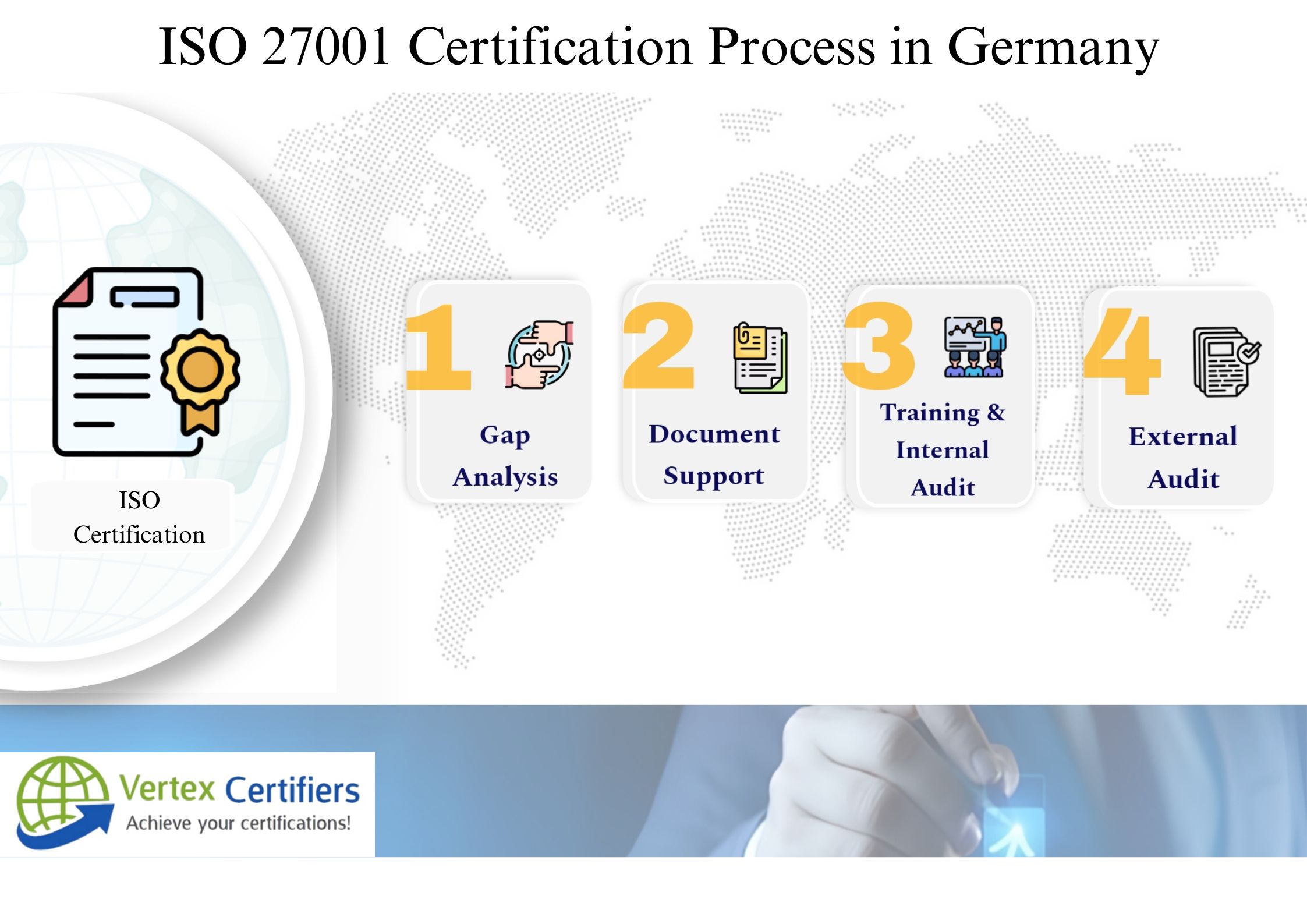
Step 1: Gap Analysis and Project Planning
Conduct a thorough gap analysis to assess your current security practices against ISO 27001:2022 requirements, including leadership, planning, and Annex A controls. Assemble a project team, secure top management commitment, define the ISMS scope (e.g., sites, processes, assets), and create a timeline with milestones for risk assessment and implementation.
Step 2: Build and Implement the ISMS
Perform a risk assessment to identify threats, vulnerabilities, and impacts on information assets. Develop a risk treatment plan selecting appropriate controls from Annex A (e.g., access control, encryption). Create documentation like policies, procedures, Statement of Applicability (SoA), and train staff on security awareness.
Step 3: Internal Audit and Management Review
Run an internal audit to verify ISMS effectiveness, addressing nonconformities through corrective actions. Conduct a management review to evaluate performance, risks, objectives, and continual improvement needs, ensuring alignment with business goals.
Step 4: Certification Audit (Stage 1 & 2)
Engage a IAF-accredited certification body. Stage 1 reviews documentation and readiness; Stage 2 involves on-site verification through interviews, evidence checks, and process observations. Resolve any findings within deadlines.
Step 5: Certification Issuance and Maintenance
Upon successful audit, receive your 3-year certificate. Undergo annual surveillance audits and a recertification audit at year 3. Maintain the ISMS through continual improvement, risk reviews, and updates to sustain compliance
Strengthened Information Security and Risk Management
ISO 27001 requires a comprehensive risk assessment process, identifying threats to information assets—from cyberattacks and insider risks to physical vulnerabilities and supply-chain weaknesses. German organizations benefit from tailored controls in Annex A, covering cryptography, access management, supplier relationships, and incident response, reducing breach likelihood by up to 30% according to industry benchmarks. This structured approach fosters a security-aware culture, with regular audits ensuring ongoing risk mitigation across IT systems, processes, and personnel.
Support for GDPR Compliance and Data Protection Obligations
Germany enforces GDPR rigorously through authorities like the BfDI, mandating data protection impact assessments and breach notifications within 72 hours. ISO 27001 complements this by providing controls for data confidentiality, integrity, and availability, including encryption, access logs, and privacy-by-design principles. Certified organizations streamline GDPR compliance efforts, using ISMS documentation as evidence for audits, minimizing fines that can exceed €20 million or 4% of global turnover. The standard’s risk-based methodology directly supports GDPR’s Article 32 security requirements.
Increased Trust with Customers, Partners, and Regulators
In B2B-heavy Germany, ISO 27001 certification serves as third-party validation of security practices, reassuring clients in finance, cloud services, and consulting. Partners prefer certified suppliers to mitigate shared risks, while regulators view it favorably during inspections. For instance, automotive OEMs and banks often require it in RFPs, enhancing win rates. Publicly displaying the certificate builds brand credibility, with surveys showing 70% of executives prioritizing certified providers for sensitive engagements.
Competitive Advantage in German and EU Markets
ISO 27001 differentiates businesses in competitive tenders, where it’s often a scoring criterion for public and private contracts. In the EU Single Market, it facilitates cross-border operations, especially under NIS2 Directive for critical sectors. German IT firms, SaaS providers, and managed service companies gain an edge, as certification signals maturity amid rising ransomware attacks—over 50,000 incidents reported annually in Germany. It accelerates sales cycles by pre-qualifying for supplier lists at DAX companies.
Improved Business Continuity and Incident Readiness
ISO 27001 mandates business continuity planning (A.17), incident management (A.16), and backup strategies (A.12), ensuring rapid recovery from disruptions like DDoS attacks or hardware failures. German manufacturers and logistics firms, reliant on just-in-time operations, reduce downtime costs—averaging €5,000 per minute—through tested response plans. Regular simulations and post-incident reviews build resilience, with certified organizations reporting 40% faster recovery times.
Eligibility for Public Tenders and Regulated Sectors
Public sector contracts in Germany, governed by VgV and EU rules, favor ISO 27001-certified bidders, particularly for digital services, cloud procurement, and data processing. In regulated areas like healthcare (under BDSG), finance (BaFin), and critical infrastructure (IT-SiG), certification is often de facto required. Automotive suppliers to VW or BMW must comply, while energy operators under BSI standards use it to meet KRITIS obligations, unlocking government funding and long-term frameworks.
Scalable and Integrable Management System
ISO 27001’s high-level structure (Plan-Do-Check-Act) integrates seamlessly with ISO 9001 for quality, ISO 14001 for environment, or ISO 27701 for privacy. German SMEs save 20-30% on implementation by combining audits and documentation, avoiding siloed systems. Scalability suits startups scaling cloud ops to enterprises managing global networks, with modular Annex A controls adaptable to organizational size.
Long-Term Business Resilience and International Recognition
ISO 27001 fosters enduring resilience through continual improvement and leadership commitment, preparing organizations for evolving threats like AI-driven attacks. Its global IAF MLA recognition ensures validity across 130+ countries, aiding German exporters in Asia and the US. For digital transformation leaders like Siemens or SAP partners, it sustains trust amid regulatory shifts, positioning businesses for sustainable growth in a hyper-connected world.