GDP Certification in Philippines:
GDP Certification in Philippines, Vertex Certifiers provides end-to-end GDP certification consulting services in the Philippines, supporting pharmaceutical distributors, healthcare suppliers, logistics providers, and warehousing companies in implementing effective Good Distribution Practice systems. Our services cover the complete journey—from initial gap assessment and documentation development to staff training, internal audits, and final certification support—ensuring practical implementation with minimal operational disruption. Vertex Certifiers serves organizations across major Philippine cities including Metro Manila, Quezon City, Makati, Taguig, Pasig, Cebu, Davao, Iloilo, Bacolod, Cagayan de Oro, and Pampanga, helping businesses establish reliable, compliant, and high-quality distribution operations.
GDP Certification in the Philippines plays a vital role in strengthening the country’s pharmaceutical supply chain, ensuring medicines, vaccines, and medical products reach patients safely despite tropical climate challenges and complex island logistics. As the Philippines expands its healthcare infrastructure and pharmaceutical imports, GDP compliance helps distributors, wholesalers, and logistics providers maintain product integrity from warehouse to end-user.
Introduction to GDP Certification in the Philippines
Good Distribution Practice (GDP) establishes quality standards for storing, handling, and transporting pharmaceutical and healthcare products across the Philippines’ archipelago. In a tropical climate with high humidity, frequent typhoons, and inter-island shipping challenges, GDP certification becomes essential for preventing temperature excursions, contamination, and product degradation that could compromise patient safety.
The Philippine FDA and local health authorities increasingly emphasize GDP compliance for organizations handling registered medicines, vaccines, medical devices, and temperature-sensitive healthcare products. GDP certification demonstrates systematic controls over distribution activities, building trust with manufacturers, hospitals, pharmacies, and international partners while supporting the country’s growing role in ASEAN pharmaceutical trade.
What is GDP (Good Distribution Practice)?
GDP refers to the quality system that governs all distribution activities from manufacturer to patient, ensuring medicines remain safe, effective, and within specifications throughout storage, transportation, and handling. As a complement to Good Manufacturing Practice (GMP), GDP focuses specifically on post-production activities where products face risks like temperature fluctuations, physical damage, mix-ups, and contamination.
Core GDP principles require controlled premises, qualified personnel, validated equipment, documented procedures, and traceability systems. In practice, this means temperature-monitored warehouses (2-8°C for vaccines, 15-25°C for general medicines), calibrated data loggers during transport, first-expiry-first-out (FEFO) inventory rotation, and rapid recall capabilities. These controls ensure product quality remains consistent regardless of complex logistics routes across Luzon, Visayas, and Mindanao.
How to get GDP Certification in Philippines
Achieving GDP certification follows a structured 2-6 month roadmap tailored to each organization’s scale and current practices:
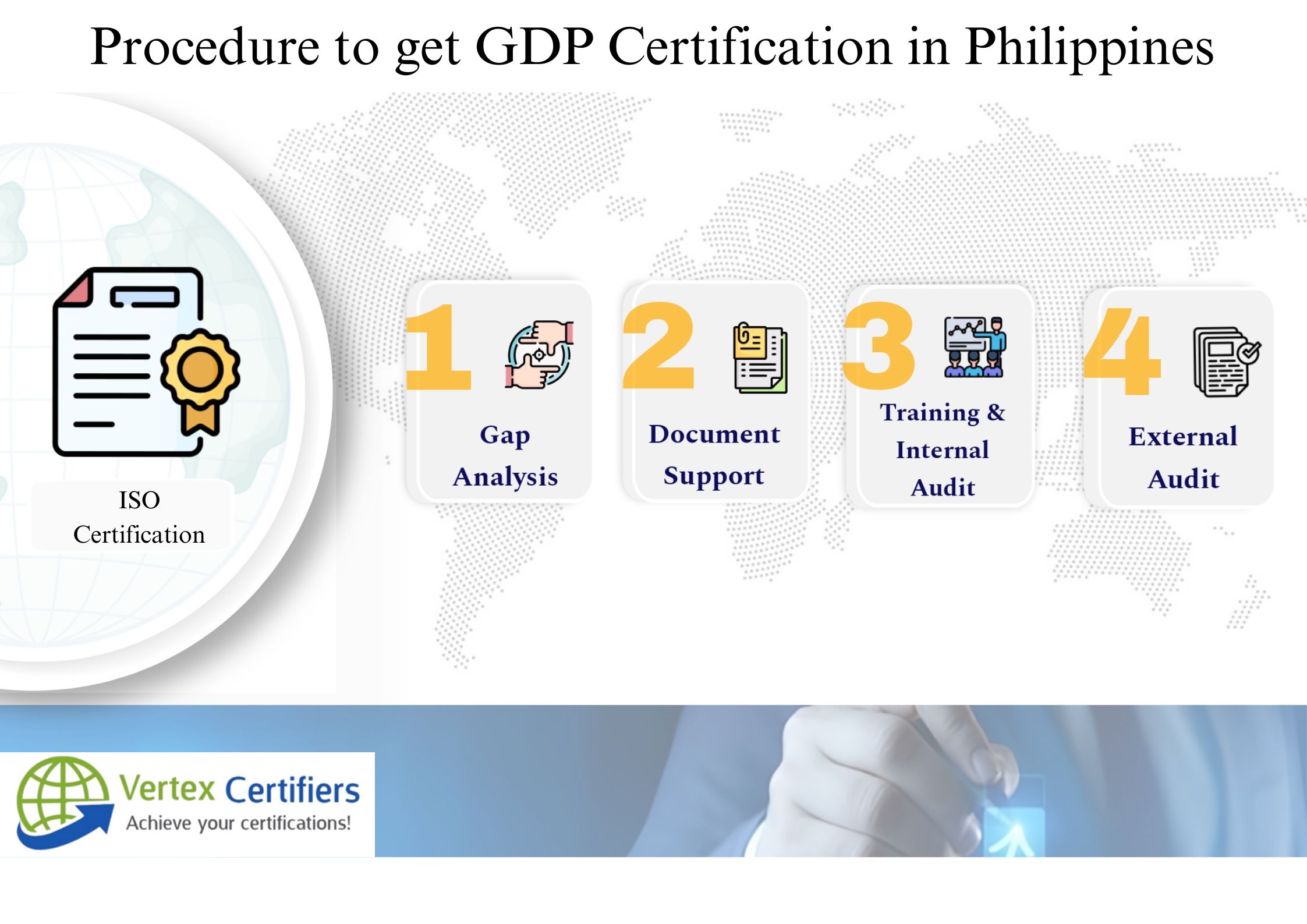
Initial gap assessment of distribution practices (2-3 weeks): Comprehensive audit of warehouses, vehicles, documentation, training records, and supplier contracts against GDP requirements, producing prioritized action plan with timelines and responsibilities.
Development or updating of GDP manuals, SOPs, and records (4-6 weeks): Customized quality manual, 25+ procedures (receipt, storage, dispatch, transport, recalls), work instructions, forms, and templates aligned with existing QMS like ISO 9001.
Implementation of procedures and staff training (6-8 weeks): Rollout across all sites with hands-on training for warehouse staff, drivers, quality controllers; installation of monitoring equipment; and pilot testing of critical processes like cold chain validation.
Internal audit and corrective action implementation (3-4 weeks): Full-system internal audit simulating certification body inspection, followed by CAPA closure with evidence files demonstrating effective implementation and management commitment.
Independent assessment and certification (4 weeks): Stage 1 documentation review followed by Stage 2 on-site audit by accredited certification body. Minor non-conformities closed within 90 days; major issues trigger re-audit. Certificate issued valid for 3 years with annual surveillance.
Why GDP Certification is Important in the Philippines
Philippines' tropical climate (average 26-32°C, 70-90% humidity) and island geography create unique distribution challenges that make GDP certification critical for pharmaceutical supply chain integrity.
- Protecting product quality and patient safety: Proper GDP prevents degradation of heat-sensitive antibiotics, insulin, and vaccines, ensuring patients receive effective treatments rather than compromised products.
- Ensuring proper cold chain management in tropical climate: Continuous temperature monitoring combats ambient heat during road, sea, and air transport between islands, with validated procedures for excursions and equipment failures.
- Reducing distribution errors and operational risks: Standardized picking, packing, and dispatch procedures eliminate mix-ups between similar-looking medicines, while documented training reduces human errors in high-volume pharmacies and hospitals.
- Establishing standardized and documented distribution practices: GDP creates auditable systems that demonstrate compliance to FDA inspections, hospital procurement committees, and multinational manufacturers seeking reliable local partners.
- For Filipino businesses, GDP certification often becomes mandatory for FDA licensing of wholesale dealers and increasingly expected by hospital chains, retail pharmacies, and generic medicine programs serving remote barangays.
Who Needs GDP Certification in the Philippines?
Multiple organizations across the Philippine healthcare supply chain require GDP compliance to handle regulated products legally and competitively.
- Pharmaceutical wholesalers and distributors supply prescription and OTC medicines to over 1,200 hospitals, 40,000+ pharmacies, and rural health units, requiring temperature-controlled storage and island-hopping delivery capabilities.
- Medical device and healthcare product suppliers manage sterile products, diagnostics, and equipment that demand contamination-free handling and precise environmental controls during multi-modal transport.
- Warehousing, logistics, and cold chain service providers operate centralized hubs in Manila, Cebu, and Davao, serving as critical links between importers and nationwide distribution networks.
- Importers, exporters, and third-party logistics (3PL) companies handle ASEAN trade flows and manage bonded warehouses, temperature-controlled containers, and customs clearance for pharmaceutical imports.
- Distribution centers serving hospitals, clinics, and retail pharmacies maintain high-volume inventory for chains like Mercury Drug, Watsons, and Rose Pharmacy, requiring robust stock control and rapid delivery to remote provinces.
- Even companies outsourcing logistics remain accountable for their service providers' GDP compliance, making supplier qualification contracts and periodic audits essential components of responsible distribution.
Key GDP Requirements
Effective GDP systems in the Philippines integrate comprehensive controls across all distribution activities, aligned with international standards and local regulatory expectations.
Documented Quality Management System (QMS)
- Written quality policy, GDP manual, and controlled procedures covering premises management, personnel qualification, equipment validation, and risk assessment for tropical distribution challenges.
Defined roles, responsibilities, and GDP training programs
- Organizational charts identifying Responsible Persons, annual training matrices covering cold chain handling, documentation hygiene, emergency procedures, and typhoon contingency planning.
Controlled storage areas and warehouse management
- Secure premises with quarantine, approved, and rejected stock zones; pest control programs; FIFO/FEFO inventory rotation; and fire safety systems compliant with local building codes.
Temperature-controlled storage and transport monitoring
- Mapped cold rooms and refrigerated vans (2-8°C, 15-25°C, -20°C); calibrated sensors with 24/7 alarms; data logger reports for every shipment; and validated backup generators for power outages.
Product traceability, inventory control, and stock rotation
- Batch/lot tracking from receipt to dispatch; physical inventory reconciliations; automated warehouse management systems; and procedures for returns, near-expiry, and suspected counterfeits.
Deviation management, CAPA, complaint handling, and recalls
- Root cause analysis for temperature excursions; corrective/preventive actions tracked to closure; customer complaint logbooks; and mock recall tests demonstrating 100% batch recovery within 4 hours.
Record keeping and document control
- Version-controlled SOPs, training certificates, temperature charts, transport records retained for 5+ years, with electronic signatures and audit trails for FDA inspections.
Benefits of GDP Certification for Businesses
GDP certification delivers measurable ROI through operational improvements and competitive advantages in the Philippine market.
Improved efficiency and consistency in distribution operations
- Standardized procedures reduce picking errors by 70-90%, automated temperature monitoring eliminates manual charting, and FEFO rotation cuts expiry losses by 50%+.
Reduced product losses, recalls, and temperature-related risks
- Validated cold chain prevents multimillion-peso vaccine losses during typhoon season; traceability enables rapid quarantine of suspect batches; documented CAPA prevents repeat deviations.
Enhanced credibility with customers and supply chain partners
- Hospital procurement committees prefer GDP-certified distributors for critical medicine tenders; multinational manufacturers approve certified partners for exclusive distribution rights.
Better control over outsourced logistics activities
- Formal 3PL qualification process with SLAs, quarterly audits, and performance scorecards ensures compliance extends across entire supply chain network.
Audit readiness and long-term compliance
- Mature GDP systems excel during FDA inspections, customer audits, and international GMP harmonization assessments, avoiding business disruptions and penalties.
Why Choose Vertex Certifiers for GDP Certification in the Philippines
Vertex Certifiers brings proven expertise in delivering GDP certification across Southeast Asia, with deep understanding of Philippine regulatory landscape and tropical logistics challenges.
- End-to-end GDP certification consulting and support: Complete service package from gap analysis through certification, eliminating need for multiple consultants and ensuring seamless project execution.
- Practical, risk-based implementation tailored to business size: Customized approach for small regional distributors through national 3PL networks, focusing resources on highest-risk activities like vaccine cold chain and remote island deliveries.
- Industry-specific documentation and staff training: Templates proven across 500+ pharma projects worldwide, combined with hands-on training using actual client products, vehicles, and warehouse layouts for maximum relevance.
- Cost-effective and time-bound project execution: Fixed-price packages with clear milestones achieve certification 30-40% faster than traditional approaches, minimizing business disruption during implementation.
- Post-certification compliance and improvement support: Annual internal audits, refresher training, surveillance preparation, and GDP evolution consulting to maintain certification and pursue advanced standards.
Start Your GDP Certification Journey in the Philippines Today!
Ensure safe pharmaceutical distribution across Luzon, Visayas, and Mindanao. Build compliance, efficiency, and trust with regulators, hospitals, and patients.
