
GLP Certification in Lebanon:
GLP Certification in Lebanon, Vertex Certifiers provides complete end-to-end support for GLP (Good Laboratory Practice) certification in Lebanon, helping laboratories achieve full compliance with OECD GLP principles efficiently and cost-effectively. Our expert team assists at every stage—from initial gap analysis, documentation development, and SOP implementation to staff training, internal audits, and final certification coordination. We offer both remote and onsite consultation services across major Lebanese cities, including Beirut, Tripoli, Sidon, Zahle, and Byblos, ensuring seamless support for pharmaceutical, environmental, food, and research laboratories seeking internationally recognized GLP compliance.
Introduction to GLP Certification in Lebanon
Laboratories in Lebanon play a vital role in advancing pharmaceuticals, chemicals, and environmental research. GLP Certification in Lebanon ensures these facilities meet Good Laboratory Practice standards, producing reliable data accepted worldwide. As Lebanon strengthens its position in global trade, the demand for GLP-compliant labs grows, especially for export-focused industries.
Good Laboratory Practice (GLP) emphasizes quality, integrity, and traceability in non-clinical studies. For Lebanese labs, research centers, and testing facilities, GLP Certification opens doors to international collaborations and regulatory approvals. Reliable data isn’t just a best practice—it’s essential in a competitive market where regulators demand proof of compliance.
Industries in Lebanon requiring GLP include:
- Pharmaceuticals: Safety testing for drugs destined for export.
- Chemicals: Toxicity assessments for industrial products.
- Cosmetics: Product safety evaluations.
- Food & Agriculture: Contaminant analysis and residue testing.
- Environmental testing: Pollution monitoring and impact studies.
- Academic and contract research laboratories: Collaborative projects with global partners.
With Lebanon’s strategic location bridging Europe, the Middle East, and Africa, GLP Certification in Lebanon positions labs as trusted players in international research.
What is GLP (Good Laboratory Practice)?
GLP stands for Good Laboratory Practice, an international quality system for organizing and conducting non-clinical laboratory studies. Its purpose? To ensure data from safety tests on chemicals, pharmaceuticals, and other products is reliable, reproducible, and traceable.
Rooted in OECD GLP principles, GLP provides a framework adopted by over 40 countries. It applies to studies supporting regulatory submissions, like toxicity or environmental fate tests.
Key objectives of GLP include:
- Data integrity and traceability: Every step documented from raw data to final reports.
- Standardized procedures: Consistent methods reduce variability.
- Reliable and reproducible results: Results hold up under scrutiny.
- Quality assurance oversight: Independent checks prevent errors.
In Lebanon, adopting GLP means labs align with global benchmarks, making their findings credible for international regulators.
Importance of GLP Certification in Lebanon
Lebanon’s laboratories face mounting pressure to meet international standards. GLP Certification ensures compliance with expectations from bodies like the OECD, EU, and US FDA, whose mutual acceptance agreements streamline data recognition.
For export-oriented sectors like pharmaceuticals and chemicals, GLP builds trust. It enhances credibility with global partners, enabling participation in multinational studies. Lebanese labs gain an edge in research collaborations, from joint ventures to tender bids.
GLP also strengthens regulatory submissions. Whether registering products in Europe or the Gulf, certified data speeds approvals and reduces rejections. In a region prioritizing safety and quality, GLP Certification in Lebanon future-proofs labs against evolving regulations.
GLP Certification Process in Lebanon
Securing GLP Certification follows a structured path, typically spanning 2–4 months based on lab readiness:
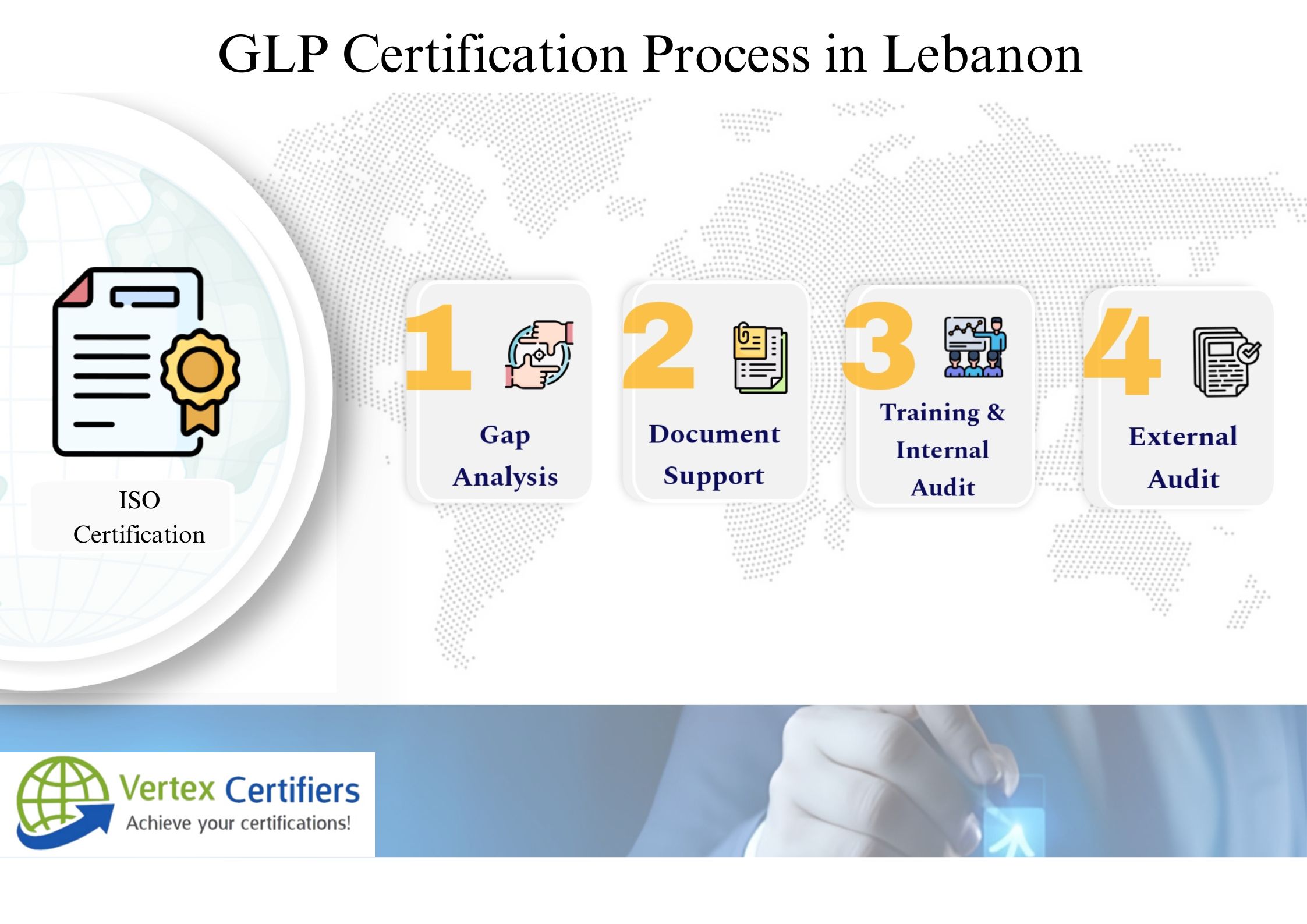
- Step 1: Gap Analysis – Assess current practices against OECD GLP principles to identify deficiencies.
- Step 2: Documentation Development – Create SOPs, a Quality Manual, and study protocols.
- Step 3: Implementation & Staff Training – Roll out systems and train personnel hands-on.
- Step 4: Internal Audit & Management Review – Conduct self-audits and review progress with leadership.
- Step 5: Certification Audit by Accredited Body – Invite an OECD-recognized body for on-site evaluation.
- Step 6: Certification Issuance & Surveillance Audits – Receive certification, followed by annual checks.
Partnering with experts streamlines this process for Lebanese labs.