Vertex Certifiers

GLP Certification in Sri Lanka:

GLP Certification in Sri Lanka, Vertex Certifiers provides GLP certification and compliance services in Sri Lanka, supporting laboratories from initial GLP gap assessment through full inspection readiness in line with OECD Good Laboratory Practice principles. We work with pharmaceutical R&D labs, CROs, toxicology, agrochemical, chemical, and research facilities across key Sri Lankan hubs including Colombo, Gampaha, Kandy, Kurunegala, and the Western Province industrial zones, delivering practical, regulator-focused GLP implementation. Our services cover GLP documentation and SOP development, independent QA unit setup, data integrity controls, staff training, internal audits, and mock inspections, supported by flexible consulting models to ensure efficient compliance and internationally accepted GLP systems.

Good Laboratory Practice (GLP) certification is highly relevant for Sri Lankan laboratories engaged in pharmaceutical research, agrochemical testing, chemical safety studies, and regulatory submissions, supporting both local needs and international market entry. With Sri Lanka’s expanding export-oriented sectors like tea pesticides and generic drugs, GLP ensures data quality aligns with global standards, minimizing re-testing costs and enhancing competitiveness

What is GLP (Good Laboratory Practice)?

GLP represents an internationally recognized quality system that governs the planning, conduct, monitoring, recording, reporting, and archiving of non-clinical studies evaluating chemical safety for health and environment. It mandates stringent data integrity, complete traceability of all records, and scientific reliability to prevent biases or errors in regulatory submissions. OECD GLP Principles form the foundational reference, enabling mutual international acceptance of compliant data from accredited facilities

Who Needs GLP Certification in Sri Lanka?

Pharmaceutical and biotech R&D laboratories developing generics or novel compounds require GLP for preclinical safety data. Contract Research Organizations (CROs) serving global pharma giants need it for contract reliability. Toxicology and safety testing labs, agrochemical and pesticide testing facilities—crucial for Sri Lanka’s agriculture—chemical and environmental testing labs, as well as academic, government, and research institutions submitting to regulators like the US FDA or EU EMA, all stand to gain

Why GLP Certification is Important in Sri Lanka

GLP certification guarantees international acceptance of non-clinical study data, critical for Sri Lanka’s pharma exports and agrochem sector. It supports regulatory compliance for product registrations abroad, elevating data integrity and study credibility. Labs experience reduced regulatory risks, fewer repeat studies, and heightened trust from global sponsors, positioning them advantageously in competitive Asian markets

Process to obtain GLP Certification in Sri Lanka:
GLP Certification in Sri Lanka

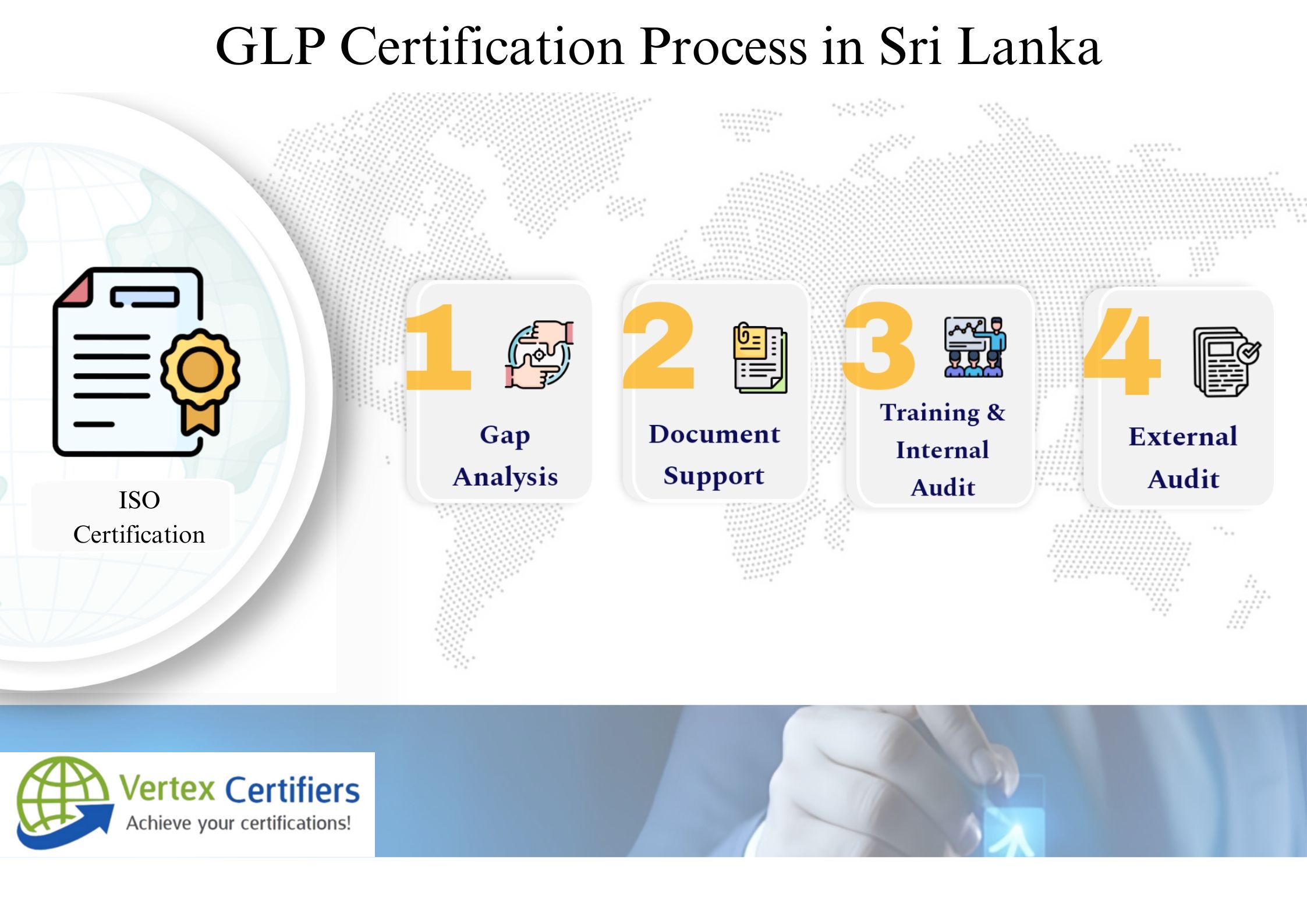
The process commences with a GLP gap assessment against OECD principles, reviewing current practices via Quality Manual drafts. Labs develop comprehensive GLP documentation: Quality Manual, detailed SOPs, and study plans, while establishing an independent QA unit per OECD mandates.

Implementation follows with role-based staff training, often including witnessed study activities. Conduct internal audits and mock inspections mirroring SLAB protocols. Submit for regulatory inspection involving pre-assessment (deficiency identification) and initial assessment (on-site with opening/closing meetings), addressing corrective actions within timelines. Achieve GLP recognition, followed by ongoing surveillance and re-assessments every 2 years


Key GLP Requirements

  • Organizational structure & management responsibilities: Defined roles, documented training records for qualified personnel, and facilities designed to prevent cross-contamination.
  • Independent QA function: Structured QA program conducting process inspections, study audits, and annual reports directly to top management.
  • Study Director roles & accountability: Oversight of protocol adherence, deviation management, raw data integrity, and final study report approval.
  • SOPs & controlled documentation: Approved and version-controlled procedures covering all laboratory operations with revision tracking.
  • Equipment calibration, validation & maintenance: Traceable calibrations and documented IQ/OQ/PQ for instruments and methods.
  • Test & reference item control: Complete characterization, stability data, secure storage, and controlled handling logs.
  • Data integrity, archiving & retention: Contemporaneous, indelible records with secure archiving for 10+ years.
  • Validation of computerized systems (ALCOA+): System suitability checks, access restrictions, and electronic audit trails ensuring compliant digital data.

Timeline for GLP Certification in Sri Lanka

Small to mid-size laboratories typically achieve GLP certification within 3–6 months, including 1–2 months for preparation and application, followed by 1–2 months for assessments and corrective actions. Larger or multi-study facilities may extend to 6–9 months, accounting for SLAB scheduling, scope complexity (such as multi-matrix studies), and extensive witnessing activities. Timelines vary based on initial readiness—laboratories with prior QA audits progress faster—and inspection outcomes, with documentation reviews generally capped at 6 months.

Facility SizeEstimated TimelineCritical Phases
Small / Mid-size1–3 monthsGap analysis to initial assessment
Large / Multi-study3–6 monthsSystem validation, surveillance preparation
High-risk scopes9+ monthsCorrective actions, re-audits

Common GLP Challenges for Sri Lankan Laboratories

Sri Lankan laboratories face persistent shortages of trained GLP QA professionals, particularly outside Colombo, necessitating external recruitment or extended training within a research-centric workforce. Documentation gaps are common in academic environments where publication priorities outweigh SOP discipline. Data integrity risks arise from outdated software lacking validation and audit-trail functionality. Infrastructure constraints in older facilities—especially in regions such as Kandy and Galle—including power instability affecting equipment calibration, further complicate compliance. Aligning academic research freedom with strict GLP discipline often requires significant cultural change.

Why Choose Vertex Certifiers for GLP Certification in Sri Lanka?

Vertex Certifiers delivers OECD-aligned GLP expertise with end-to-end implementation support from application through final recognition. We provide practical SOP libraries, robust QA setup, and intensive mock inspections that simulate expert inspection teams, including witness activities. Our hybrid remote-onsite consulting model supports laboratories across Sri Lanka—from Colombo to Trincomalee—while our cost-effective, timeline-driven methodology accelerates accreditation with minimal operational disruption for export-oriented labs.

Conclusion

GLP certification strengthens Sri Lankan laboratories by enhancing regulatory credibility, data reliability, and international collaboration opportunities. Through SLAB-OECD alignment, GLP transforms compliance into a strategic asset, enabling sustainable global engagement across pharmaceuticals, agrochemicals, and related sectors.

Planning GLP Certification in Sri Lanka?

Contact Vertex Certifiers for a free GLP gap assessment and a customized GLP implementation roadmap tailored to your laboratory.

📧 Email: info@vertexcertifiers.com

Get Started Today

    Get Free
    Consultation


    Our Services

      Company Logo

      Get ISO certification


      Fill the details below, one of our executives will contact you shortly


      This will close in 0 seconds

      Call Now Button