GMP Certification in Ghana:
GMP Certification in Ghana, Vertex Certifiers is a leading GMP certification and consulting partner in Ghana, supporting manufacturers across pharmaceuticals, food and beverages, cosmetics, supplements, and medical devices. With strong expertise in internationally aligned GMP principles, Vertex helps organizations implement robust quality and manufacturing systems that ensure consistent product quality, safety, and regulatory readiness. We provide end-to-end GMP support, including gap assessment, GMP documentation and SOP development, facility and process compliance guidance, staff training, internal audits, and inspection readiness. Vertex Certifiers works closely with manufacturers across key industrial and commercial hubs such as Accra, Tema, Kumasi, Takoradi, and nationwide Ghana, enabling businesses to achieve GMP certification efficiently and maintain long-term compliance.
GMP Certification in Ghana plays a critical role in helping manufacturers deliver safe, consistent, and high-quality products while meeting regulatory expectations and unlocking export opportunities across regional and global markets. By implementing structured Good Manufacturing Practice systems, companies in Ghana can reduce operational risks, build customer trust, and position themselves competitively in sectors such as pharmaceuticals, food, cosmetics, and healthcare products.
Introduction
Ghana’s growing manufacturing and healthcare ecosystem increasingly depends on robust quality systems to protect public health and support economic growth. GMP certification provides a formal assurance that a facility operates under controlled conditions, with appropriate procedures, documentation, and trained personnel to consistently produce safe products.
For manufacturers targeting local regulatory approval, tenders, and export markets, GMP certification serves as a gateway requirement rather than a mere quality “add-on.” It demonstrates that management is committed to strong quality governance, risk management, and continuous improvement in line with internationally accepted practices.
What is GMP Certification?
Good Manufacturing Practice (GMP) is a set of principles and controls that govern how products are manufactured, tested, stored, and distributed to ensure safety, quality, and consistency. It covers every aspect of production—from facility design and equipment through materials, people, procedures, documentation, and corrective actions.
GMP principles include:
- Quality control and assurance throughout the product lifecycle, not just final testing.
- Hygiene and contamination control, focusing on clean environments, gowning, cleaning, and pest control.
- Comprehensive documentation, ensuring that “what is written is done, and what is done is recorded,” supporting traceability and accountability.
- Risk management, using structured assessment to identify, control, and monitor factors that could affect product quality.
- Continuous improvement through internal audits, CAPA, and management review to strengthen systems over time.
GMP certification is the formal recognition by an independent body or competent authority that a facility’s systems align with these principles and are effectively implemented in day-to-day operations.
What is the Procedure to get GMP Certification in Ghana ?
The path to GMP certification in Ghana typically follows a structured, step-by-step implementation and assessment journey. While details may vary by sector and certifying body, the core stages are similar.:
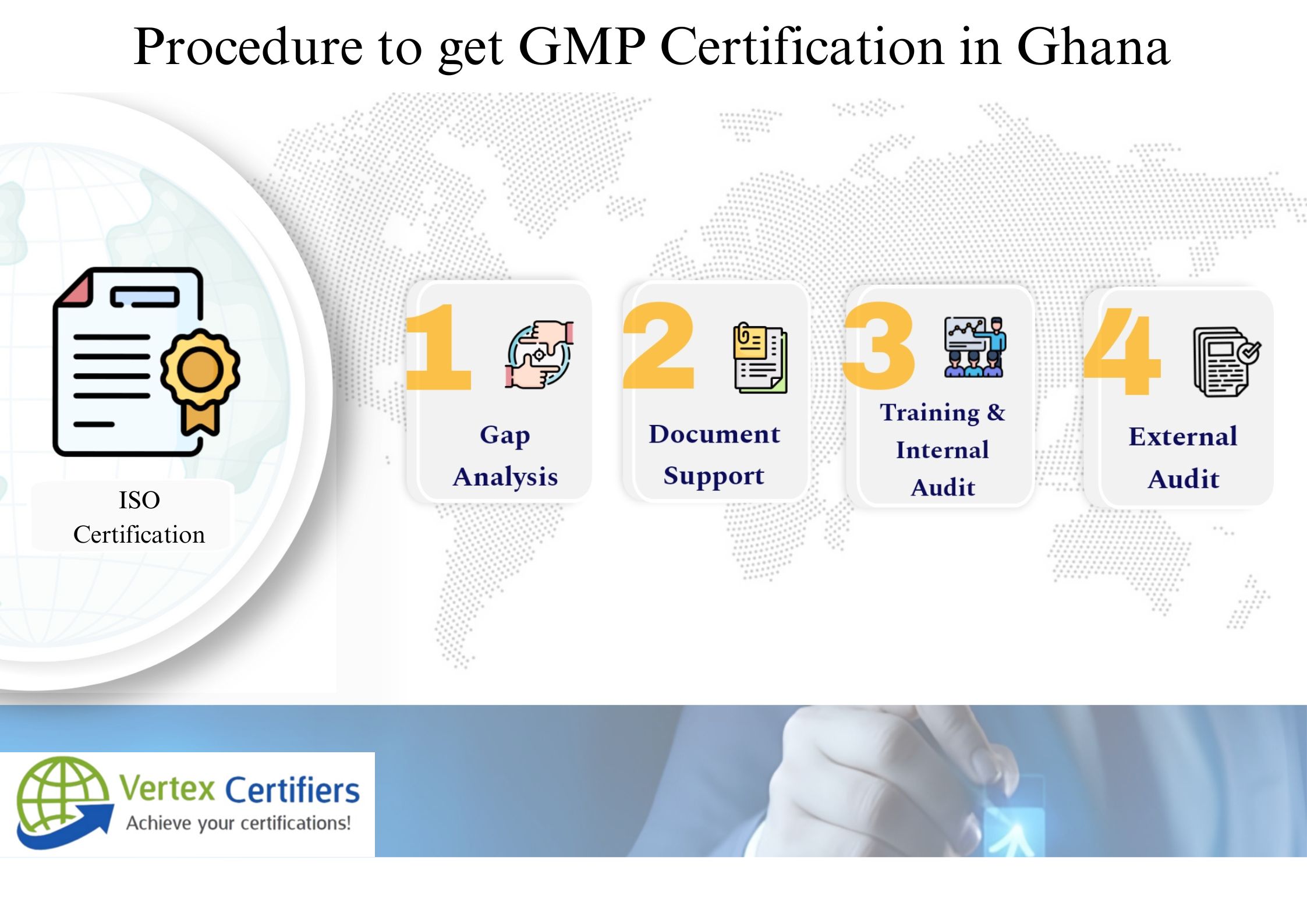
1. Identify applicable GMP scope and product category
Organizations begin by defining the scope of GMP certification: which site, product lines, dosage forms, or categories are included. This step clarifies the regulatory expectations, documentation needed, and depth of qualification/validation.
2. Conduct GMP gap assessment
A detailed gap assessment compares current practices against GMP requirements for the chosen sector. It evaluates facilities, equipment, procedures, training, and documentation to identify strengths, weaknesses, and areas needing corrective action.
3. Develop and implement a GMP-compliant QMS
Based on the gap analysis, the organization designs and implements a GMP-aligned Quality Management System (QMS) covering quality policy, responsibilities, procedures, and records. This includes drafting SOPs, forms, and templates tailored to the actual processes on site.
4. Facility and equipment qualification
Facilities and equipment are assessed and, where needed, upgraded, validated, or qualified to ensure they are fit for purpose and capable of consistent performance. Activities can include HVAC improvements, zoning, IQ/OQ/PQ, and calibration programs.
5. Personnel training and competency development
All relevant staff receive structured training on GMP principles, SOPs, hygiene practices, and their specific job responsibilities. Competency is confirmed through assessments, supervision, and ongoing refresher programs.
6. Documentation and record management
Controlled documentation systems are implemented for SOPs, batch records, logs, and registers to ensure data integrity and traceability. This phase often involves heavy standardization, version control, and archival processes.
7. Internal audits and mock inspections
Internal GMP audits and mock inspections are conducted to test the readiness of systems, people, and documentation. Findings feed into CAPA programs that address gaps before the external certification or regulatory audit.
8. Inspection readiness and certification approval
After closing internal gaps, the organization undergoes a formal audit by a certification body or regulatory inspectorate. Successful closure of raised observations leads to issuance of GMP certification covering the defined scope.
- GMP Certification
- GLP Certification
- GDP Certification
- Halal Certificate
- Organic Certificate
- CE Marking Certification
- RoHS Certification
- FDA Certification
- CMMI Certification
- Cyber Security
- VAPT Testing
- Security Assessment
Our Services
Why GMP Certification is Important in Ghana
GMP certification offers tangible technical and commercial benefits for Ghanaian manufacturers across regulated sectors. It goes beyond basic compliance and becomes a strategic tool for competitiveness, risk reduction, and long-term growth.
- Ensures safe and high-quality products by minimizing contamination, mix-ups, and process deviations, protecting public health and reducing product failure risks.
- Supports regulatory compliance and licensing by demonstrating structured, documented manufacturing and quality systems aligned with internationally recognized GMP expectations.
- Enhances credibility with distributors and partners, including hospitals, pharmacies, and export buyers who increasingly require GMP status for supplier qualification.
- Reduces recalls, rework, and quality failures through improved process control, preventive maintenance, and effective CAPA systems, lowering overall cost of quality.
- Enables access to regional and international markets where GMP-compliant manufacturing is often a prerequisite for trade, partnerships, and donor-funded programs.
For Ghanaian companies targeting ECOWAS markets or collaboration with global brands, GMP certification acts as a key differentiator and a strong risk-mitigation mechanism.
Who Needs GMP Certification in Ghana
GMP certification is especially relevant for organizations manufacturing products that directly impact human health and safety. In Ghana, the following sectors commonly require or strongly benefit from GMP implementation:
- Pharmaceutical and herbal medicine manufacturers
- Food and beverage processing companies
- Cosmetic and personal care product manufacturers
- Medical device and healthcare product manufacturers
- Nutraceutical and dietary supplement producers
Even organizations not yet legally required to hold GMP certification can adopt GMP principles to strengthen internal controls and prepare for future regulatory or customer demands.
Applicable GMP Standards & Frameworks
Ghanaian manufacturers typically align their GMP systems with widely accepted international frameworks recognized by global partners and customers. While specific requirements vary by product category, core GMP expectations remain consistent.
- WHO-aligned GMP principles for pharmaceutical and healthcare products
- Sector-specific GMP frameworks for food, beverages, and nutraceuticals
- Cosmetic GMP guidelines emphasizing hygiene, microbiological control, and ingredient safety
Alignment with these frameworks allows Ghanaian manufacturers to harmonize operations with global expectations and participate more easily in export-driven supply chains.
GMP Requirements
To achieve and maintain GMP certification in Ghana, organizations must demonstrate compliance across multiple technical and managerial areas.
- Documented quality management system and GMP policy
- Facility design, hygiene, and contamination control measures
- Equipment qualification, calibration, and maintenance programs
- Raw material control and supplier qualification systems
- Defined production procedures and in-process controls
- Data integrity and document control mechanisms
- Complaint handling, investigations, and recall procedures
Together, these elements ensure consistent quality from raw materials through finished products and distribution.
Timeline for GMP Certification in Ghana
- Gap assessment and implementation: 2–4 months, covering diagnostics, documentation, facility improvements, and training.
- Inspection and approval: 1–2 months, including audit scheduling and closure of minor observations.
Most manufacturers complete GMP certification within 3–6 months, assuming effective project management and timely CAPA implementation.
Common Challenges in GMP Implementation
- Inadequate facility layout, zoning, or utilities
- Poor documentation control and inconsistent records
- Limited GMP awareness and incomplete training
- Delayed or weak CAPA implementation
Identifying these risks early allows organizations to allocate resources wisely and implement sustainable solutions.
Maintaining GMP Compliance
GMP certification is an ongoing commitment that requires continuous monitoring and improvement. Maintaining compliance protects certification status and long-term market credibility.
- Regular internal audits and management reviews
- Continuous GMP training and refresher programs
- Structured change control and risk assessment
- Periodic mock audits and inspection preparedness
Why Choose Vertex Certifiers for GMP Certification in Ghana
Vertex Certifiers provides specialized GMP consulting and implementation support tailored to Ghanaian manufacturers across pharmaceuticals, food, cosmetics, nutraceuticals, and healthcare products.
- End-to-end GMP gap analysis and implementation support
- Industry-specific SOPs and practical documentation
- Training, internal audits, and mock inspections
- Focused support for SMEs and export-oriented businesses
Partnering with Vertex Certifiers helps organizations accelerate certification, reduce compliance risks, and build a sustainable culture of quality.
Get GMP Certified in Ghana with Confidence
Transform GMP compliance into a competitive advantage. Vertex Certifiers delivers expert GMP gap analysis, documentation, training, internal audits, and inspection-ready support tailored to your industry, facility, and growth goals.
- ✔ Free GMP readiness discussion
- ✔ Confidential gap assessment
- ✔ Clear GMP roadmap with timelines & milestones
✉️ info@vertexcertifiers.com
Accra · Tema · Kumasi · Takoradi · Nationwide Ghana
