

GMP Certification in Philippines | GMP Consultation in Philippines:
GMP Certification in the Philippines — Vertex Certifiers offers comprehensive, end-to-end GMP certification and compliance services throughout the Philippines. We support pharmaceutical, food, cosmetics, medical device, and nutraceutical manufacturers right from initial gap assessment to full regulatory inspection readiness.
Our services include GMP documentation and SOP development, facility and process compliance reviews, staff training, internal audits, corrective action implementation, and complete assistance for Philippines and related regulatory inspections in line with WHO GMP requirements. With deep knowledge of local regulatory frameworks and practical implementation experience, Vertex Certifiers helps organizations across major cities including Manila, Cebu, Davao, Quezon City, Caloocan, Baguio, Iloilo, Zamboanga, and Angeles, Pasig, Cagayan de Ore achieve faster approvals, sustainable compliance, and export-ready GMP systems.
Achieving GMP certification is a major accomplishment for regulated industry organizations. This will strengthen the credibility of the organization, consumer safety, and market access in terms of satisfying regulatory requirements. Organizations should partner with a credible certification body, and each certification body will guide them accordingly through industry-specific requirements.
How to get GMP certification in the Philippines?
Good Manufacturing Practices (GMP) certification plays a critical role in ensuring product quality, safety, and consistency across regulated manufacturing industries in the Philippines. As businesses expand into competitive domestic and international markets, GMP has become an essential framework for building trust, meeting compliance expectations, and achieving sustainable growth.
From food and pharmaceuticals to cosmetics, medical devices, and nutraceuticals, GMP certification provides structured controls that minimize risks related to contamination, mix-ups, deviations, and product failures. For manufacturers operating in the Philippines, adopting GMP is not just about compliance—it is a strategic investment in operational excellence and brand credibility.
What is GMP Certification?
Good Manufacturing Practices (GMP) is a quality management system that defines the minimum standards required for manufacturing processes to ensure products are consistently produced and controlled according to quality and safety requirements.
GMP covers the entire production lifecycle, including:
Facility design and maintenance
Personnel hygiene, training, and competency
Raw material sourcing and handling
Manufacturing and processing controls
Equipment qualification and calibration
Documentation and record-keeping
Storage, distribution, and traceability
Complaint handling and corrective actions
Unlike product testing alone, GMP focuses on process control and prevention, ensuring quality is built into every stage of manufacturing rather than inspected only at the end.
How to get GMP Certification in Philippines:
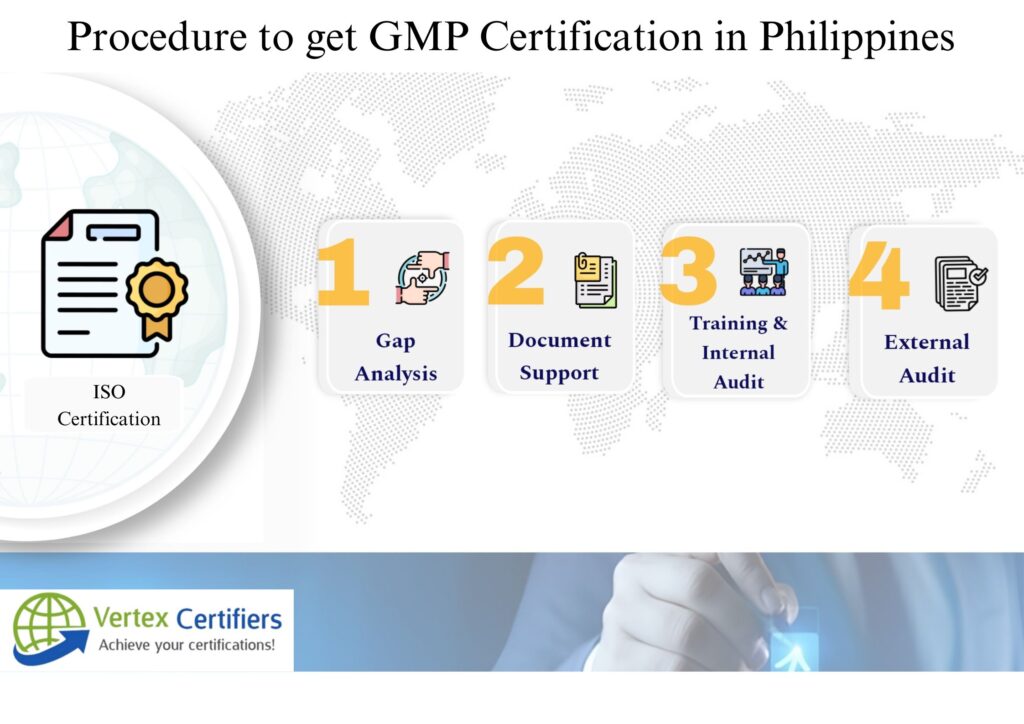
GMP Certification Process in Philippines
The GMP certification journey typically follows a structured and phased approach. While timelines may vary depending on the organization’s readiness and scope, the general process includes:
1. GMP Gap Assessment
An initial review of existing practices against GMP requirements to identify gaps in facilities, documentation, processes, and training.
2. Documentation Development
Preparation or revision of GMP-compliant documents such as quality manuals, standard operating procedures (SOPs), work instructions, and formats.
3. Facility and Process Alignment
Improvements to layout, hygiene controls, equipment, and workflows to meet GMP expectations.
4. Training and Awareness
Comprehensive GMP training for management and operational staff to ensure understanding and effective implementation.
5. System Implementation
Rollout of documented procedures into daily operations with defined controls and responsibilities.
6. Internal Audits and Compliance Review
Periodic audits to verify implementation effectiveness and identify areas for improvement.
7. Corrective Actions
Addressing audit findings, deviations, and gaps through structured corrective and preventive actions.
8. Certification Audit
An independent assessment to verify GMP compliance before certification is granted.
Who Needs GMP Certification in Philippines?
GMP certification is applicable to any organization involved in manufacturing, processing, packing, labeling, or storing products that impact human or animal health. Common sectors in the Philippines that require or strongly benefit from GMP include:
Food and Beverage Manufacturers
Processed foods, beverages, dairy products, ready-to-eat items, and packaged foods require strict hygiene, sanitation, and process controls to ensure safety and shelf stability.
Pharmaceutical Manufacturers
Manufacturers of medicines, vaccines, active ingredients, and dosage forms rely on GMP to maintain consistency, efficacy, and patient safety.
Cosmetic and Personal Care Companies
Skincare, haircare, fragrances, and beauty products must be produced under controlled conditions to prevent contamination and ensure product stability.
Medical Device Manufacturers
Devices, kits, and consumables used for medical purposes require GMP-aligned systems to ensure performance, traceability, and patient safety.
Nutraceutical and Herbal Product Manufacturers
Supplements, vitamins, and herbal products benefit from GMP by ensuring controlled sourcing, accurate labeling, and consistent product quality.
Contract Manufacturers and Exporters
Organizations manufacturing on behalf of other brands or supplying international markets often require GMP certification to meet contractual and regulatory expectations.
Importance of GMP Certification in Philippines:
The Philippine manufacturing sector serves both local consumers and international markets, many of which demand strict quality and safety standards. GMP certification helps organizations demonstrate that their operations follow globally accepted best practices.
Key reasons GMP certification is important include:
Ensuring consumer safety and product integrity
Reducing risks of contamination, errors, and recalls
Supporting market access and export readiness
Strengthening internal quality systems
Enhancing customer confidence and brand reputation
In highly regulated and competitive sectors, GMP often acts as a baseline requirement for doing business with distributors, retailers, hospitals, and global buyers.
Our GMP Certification services in cities of Philippines:
GMP Certification in Manila, GMP Consultants in Manila, GMP Certification in Pampanga, GMP Certification in Cebu city, GMP Certification in Quezon city, GMP Certification in Pasig, GMP Certification in Antipolo, GMP Consultants in Pampanga, GMP Consultants in Cebu city, GMP Consultants in Quezon city, GMP Consultants in Antipolo, GMP Consultants in Pasig.
The benefits mentioned can vary according to the industry as well as the firm’s efforts and commitment toward developing and maintaining the GMP norms. GMP certification is strategic investment that is primarily aimed at getting regulatory compliance. It, therefore, enhances an organization’s chances of being around for the long haul as well as gaining prestige.
Benefits of GMP Certification in Philippines
MP certification offers both technical and commercial advantages for manufacturers:
Improved Product Quality and Safety
Controlled processes reduce variability, contamination risks, and defects, ensuring consistent output.
Reduced Operational Risks
Structured systems minimize errors, deviations, and costly recalls.
Enhanced Market Acceptance
GMP certification builds trust among customers, distributors, and business partners.
Export and Business Growth Support
Many international buyers and supply chains require GMP compliance as a prerequisite.
Better Operational Efficiency
Standardized processes, clear responsibilities, and preventive controls improve productivity and reduce waste.
Stronger Compliance Culture
GMP fosters accountability, discipline, and continuous improvement across the organization.
Key GMP Requirements in Philippines
To achieve GMP certification in the Philippines, organizations must implement comprehensive systems covering the following core areas in line with FDA Philippines, PIC/S, and WHO GMP guidelines.
Quality Management System (QMS)
- GMP policy and quality objectives
- Defined organizational roles and responsibilities
- Change control, deviation handling, and CAPA
Facility Design & Environmental Controls
- Hygienic layout and material/personnel flow
- Controlled areas to prevent cross-contamination
- HVAC, water systems, and waste management
Equipment Qualification & Maintenance
- Installation, Operational & Performance Qualification (IQ/OQ/PQ)
- Preventive maintenance schedules
- Calibration programs
Personnel Hygiene, Training & Competence
- GMP induction and periodic training
- Health checks and hygiene practices
- Defined competency requirements
Documentation & Record Control
- SOPs, work instructions, and manuals
- Batch manufacturing and packaging records
- Data integrity and traceability
Quality Control & Testing
- In-process and finished product testing
- Stability studies (where applicable)
- Control of non-conforming products
Internal Audits & Management Review
- Regular GMP internal audits
- Corrective and preventive actions
- Management oversight and continuous improvement
Benefits of GMP Certification for Philippine Businesses
- Regulatory Compliance: FDA Philippines LTO, CPR approvals, and reduced risk of regulatory penalties or shutdowns.
- Improved Product Quality & Safety: Consistent processes with reduced contamination and defects.
- Market Access & Export Readiness: PIC/S GMP compliance for ASEAN, US FDA, and international markets.
- Business Credibility & Customer Confidence: Enhanced brand reputation and trust from hospitals, distributors, and consumers.
- Operational Efficiency: Reduced waste, rework, and improved accountability.
Challenges in GMP Implementation in Philippines
Organizations often face challenges such as limited GMP awareness among staff, infrastructure constraints, documentation overload, and FDA Philippines regulatory interpretation gaps. These challenges can be effectively managed through structured implementation, expert guidance, and phased compliance planning, ensuring cost-effective and sustainable GMP systems.
Why Choose Vertex Certifiers for GMP Certification in Philippines
Vertex Certifiers provides comprehensive, end-to-end GMP certification and compliance services in the Philippines, supporting pharmaceutical, food, cosmetics, medical device, and nutraceutical manufacturers from initial gap assessment to FDA Philippines inspection readiness. Our services include GMP gap analysis, SOP and documentation development, facility and process compliance, staff training, internal audits, CAPA implementation, and complete support during FDA Philippines GMP inspections in alignment with PIC/S and WHO GMP requirements.
We support organizations across Manila, Cebu City, Davao City, Quezon City, Caloocan, Iloilo City, Cagayan de Oro, Baguio City, Laguna, and Batangas—ensuring faster LTO/CPR approvals, sustainable compliance, and export-ready manufacturing systems.
Get GMP Certified in Philippines
Start your GMP certification journey in the Philippines with a structured gap assessment and a customized compliance roadmap aligned with FDA Philippines, PIC/S, and WHO GMP requirements. Vertex Certifiers offers a FREE initial GMP consultation to define scope, timelines, and regulatory expectations.
We provide end-to-end GMP consulting and audit support across Manila, Cebu, Davao, Quezon City, Caloocan, Iloilo, Cagayan de Oro, Baguio, Laguna, and Batangas, ensuring faster approvals and sustainable GMP compliance.
📧 Email us at info@vertexcertifiers.com
Request Free GMP ConsultationGet In Touch With Us
- All ISO standards under one consultation
- Applicable for SMEs & corporates
- End-to-end certification support
- City-wise ISO implementation guide
- Ideal for startups & enterprises
- Fast-track documentation support
- Quality management system
- Improves customer satisfaction
- Required for tenders & exports
- Environmental management system
- Legal compliance & sustainability
- Suitable for manufacturing units
- Occupational health & safety
- Reduces workplace incidents
- Mandatory for high-risk sectors
- Information security management
- Protects customer & business data
- Essential for IT & BPO companies
- Food safety management system
- HACCP-based compliance
- For food processors & exporters
- Medical devices quality system
- Regulatory compliance support
- For manufacturers & suppliers
- Educational organizations standard
- Improves learning services
- For schools & training institutes
- Facility management system
- Optimizes infrastructure operations
- For corporate & facility managers
- Good Manufacturing Practices
- Ensures product quality & safety
- Pharma & food industry focused
- Good Laboratory Practices
- Data integrity & compliance
- For testing & research labs
- Eligibility & documentation
- Audit & implementation steps
- Applicable to all industries
- Cost factors explained clearly
- Budget-friendly certification
- No hidden charges