
How to Get ISO 22000 Certification in Philippines ?
How to Get ISO 22000 Certification in Philippines, Vertex Certifiers, we provide end-to-end consulting for ISO 22000 Certification in Philippines, helping food manufacturers, processors, restaurants, and exporters achieve internationally recognized Food Safety Management System compliance. Our expert consultants support organizations across Manila, Cebu City, Davao City, and other major regions with gap analysis, documentation, implementation, internal audits, and certification coordination—ensuring a smooth, fast, and cost-effective certification process.
Food safety stands as a cornerstone for businesses in the Philippines’ thriving food industry, from bustling manufacturers in Manila to seafood processors in Cebu. With rising global demands and stringent import regulations, ISO 22000 Certification in Philippines empowers companies to safeguard products, comply with standards, and unlock international markets. This certification signals unwavering commitment to quality, helping restaurants, exporters, and processors build trust with customers and regulators alike.
Whether you’re based in the vibrant food hubs of Manila, Cebu City, Davao City, Quezon City, or Makati, navigating the certification process can seem daunting. This complete guide breaks it down step-by-step, drawing on the latest ISO 22000 requirements tailored for Philippine businesses. By the end, you’ll know exactly how to achieve ISO 22000 Certification in Philippines, avoid common pitfalls, and position your operation for long-term success in a competitive landscape.
What is ISO 22000 Certification?
ISO 22000 represents the gold standard for Food Safety Management Systems (FSMS), developed by the International Organization for Standardization (ISO). First published in 2005 and updated in recent editions, it provides a robust framework for organizations handling food at any stage of the supply chain. Unlike basic hygiene protocols, ISO 22000 Certification integrates multiple layers of protection to prevent contamination and ensure consistent safety.
Key elements include:
- HACCP Principles: Hazard Analysis and Critical Control Points (HACCP) systematically identifies, evaluates, and controls food safety hazards like biological, chemical, and physical risks.
- Prerequisite Programs (PRPs): Foundational controls such as pest management, sanitation, and supplier verification that support HACCP.
- Risk-Based Thinking: Proactive identification of potential issues, from supply chain disruptions to climate-related spoilage risks prevalent in the tropical Philippines.
- Continuous Improvement: PDCA (Plan-Do-Check-Act) cycle for ongoing enhancements, ensuring adaptability to evolving threats like emerging pathogens.
This standard applies broadly to:
- Food manufacturers producing packaged goods or ready-to-eat meals.
- Food processing units handling fruits, seafood, or meat.
- Catering services for events and institutions.
- Restaurants and quick-service outlets serving high volumes.
- Cold storage facilities managing perishables in humid climates.
- Food exporters targeting EU, US, or ASEAN markets.
For Philippine businesses, ISO 22000 Certification in Philippines aligns seamlessly with local laws like the Food Safety Act of 2013 and FDA regulations, making it indispensable for growth.
Why ISO 22000 Certification is Important in Philippines
The Philippines’ food sector faces unique challenges: tropical weather accelerating spoilage, extensive archipelago logistics, and booming exports of bananas, pineapples, and tuna. ISO 22000 Certification in Philippines addresses these head-on, delivering tangible advantages.
First, it ensures compliance with local regulations from the Department of Agriculture (DA), Bureau of Food and Drugs (BFAD), and National Food Authority (NFA). Non-compliance risks fines or shutdowns, but certification proves proactive safety measures.
Export opportunities explode—over 70% of Philippine food exports demand internationally recognized FSMS. Markets like Japan, the EU, and the US prioritize ISO 22000, opening doors for agribusiness in Davao or processors in Cebu.
Customer trust surges as certification displays your logo on packaging, websites, and tenders, differentiating you in crowded markets. Contamination risks drop dramatically; studies show certified firms reduce recalls by up to 50%, vital amid rising consumer awareness post-pandemic.
Competitive edges shine in government tenders and retail partnerships. In hospitality-heavy Manila and Makati, restaurants gain loyalty from health-conscious diners. Cebu and Davao’s export-driven economies see manufacturers outpacing uncertified rivals, fostering sustainable growth.
Step-by-Step Process of How to Get ISO 22000 Certification in Philippines
Securing ISO 22000 Certification in Philippines follows a structured path by ISO 22000 Consultants in Philippines:
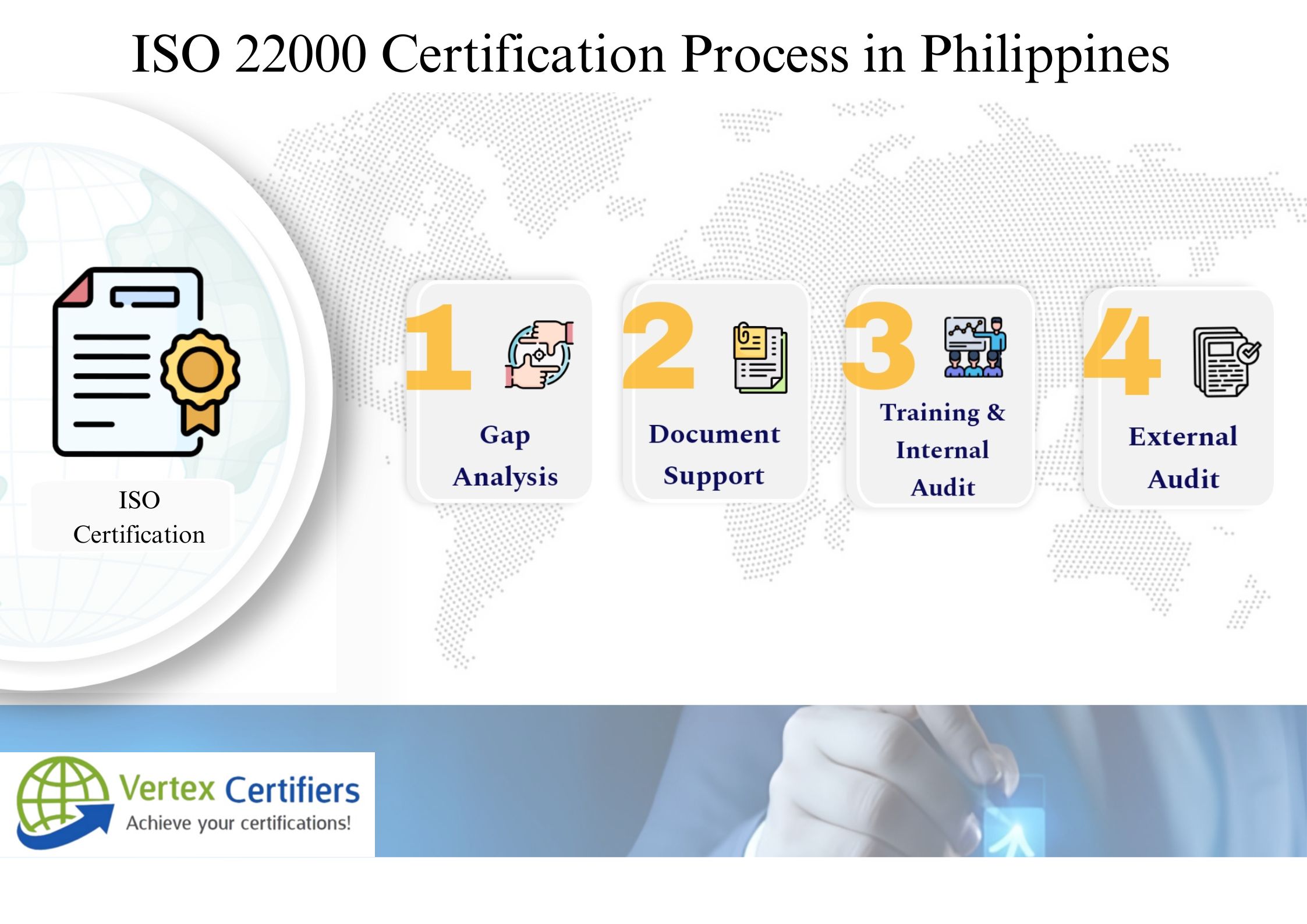
Step 1: Gap Analysis
Start with a thorough self-assessment or hire a consultant to benchmark your operations against ISO 22000:2018 clauses. Review current practices in hygiene, hazard controls, and traceability.
Step 2: Documentation Development
Compile a comprehensive Food Safety Management System manual. Essential documents include:
- Food Safety Policy signed by top management, outlining commitment.
- HACCP Plan detailing hazard analysis, critical control points (CCPs), and monitoring.
- Standard Operating Procedures (SOPs)
- Risk Assessment Records
Tailor to Philippine contexts, like typhoon preparedness or sourcing from wet markets. Use digital templates for easy updates.
Step 3: Implementation
Roll out procedures organization-wide. Train employees via workshops—mandatory for production, procurement, quality control, storage, and distribution teams.
Step 4: Internal Audit
Assemble an internal audit team to verify implementation.
Step 5: Management Review
Convene top leadership for a formal review. Discuss audit findings, KPIs (e.g., incident rates), risk updates, and improvement plans. Outputs include resource allocation and policy tweaks, demonstrating leadership commitment required by ISO 22000.
Step 6: Certification Audit
Engage a IAF-accredited body. Stage 1: Remote documentation review (1 day). Stage 2: On-site audit (2-5 days), observing operations and interviewing personnel. Address any major non-conformities within 90 days. Success grants a three-year certificate with annual surveillance audits.