Vertex Certifiers

ISO 9001 Certification in Germany:

ISO 9001 Certification in Germany, Vertex Certifiers provides end-to-end ISO 9001 certification services in Germany, supporting organizations across major industrial and commercial cities such as Berlin, Munich, Hamburg, Frankfurt, Stuttgart, Cologne, Düsseldorf, Hanover, Nuremberg, Mannheim, Bremen, Leipzig, Essen, Dortmund, and Karlsruhe. We deliver complete ISO 9001 solutions—from gap analysis and documentation development to implementation, staff training, internal audits, and coordination with IAF-accredited certification bodies—ensuring a smooth, compliant, and time-bound certification process. With a practical, fast-track approach tailored to German business environments, Vertex Certifiers helps SMEs, startups, and large enterprises achieve ISO 9001 certification efficiently while strengthening quality performance, customer confidence, and market competitiveness.

ISO 9001 certification in Germany is a widely adopted quality standard that helps organizations demonstrate consistent service delivery, customer focus, and continual improvement in line with Germany’s strong reputation for precision, reliability, and operational excellence. From manufacturing and engineering to IT services, construction, logistics, and startups, ISO 9001 enables German businesses to meet EU market expectations, qualify for supplier approvals and public tenders, and strengthen credibility with international customers. By implementing a structured Quality Management System aligned with ISO 9001 requirements, organizations operating in Germany can improve process efficiency, reduce errors and rework, and build a sustainable foundation for long-term growth and global competitiveness.

Germany is Europe’s largest industrial economy, with major strengths in automotive, machinery, chemicals, electronics, and high-value services. An export-driven model means German companies must continually demonstrate reliable quality and conformity to EU directives and international supply-chain requirements. ISO 9001 certification provides a globally recognized framework to formalize quality management, reduce errors, and prove consistency to customers and regulators

What is ISO 9001?

ISO 9001 is the world’s most widely used Quality Management System standard, defining requirements for how an organization plans, controls, monitors, and improves processes that affect customer satisfaction. Rather than prescribing exact methods, ISO 9001 sets a flexible framework that organizations adapt to their context, products, and risks

Core principles include:

  • Customer focus – understanding needs, meeting requirements, and enhancing satisfaction through consistent delivery.​
  • Leadership – top management sets direction, provides resources, and fosters a culture of quality.​
  • Process approach – managing activities and resources as interrelated processes that function as a coherent system.​
  • Risk-based thinking – identifying risks and opportunities that could affect quality and planning appropriate actions.​
  • Continual improvement – using data, audits, and feedback to drive ongoing enhancements.​

ISO 9001 is applicable to organizations of all sizes and sectors in Germany—from small engineering shops and software firms to multinational manufacturers and service providers.

Step by Step Process to get ISO 9001 Certification in Germany:
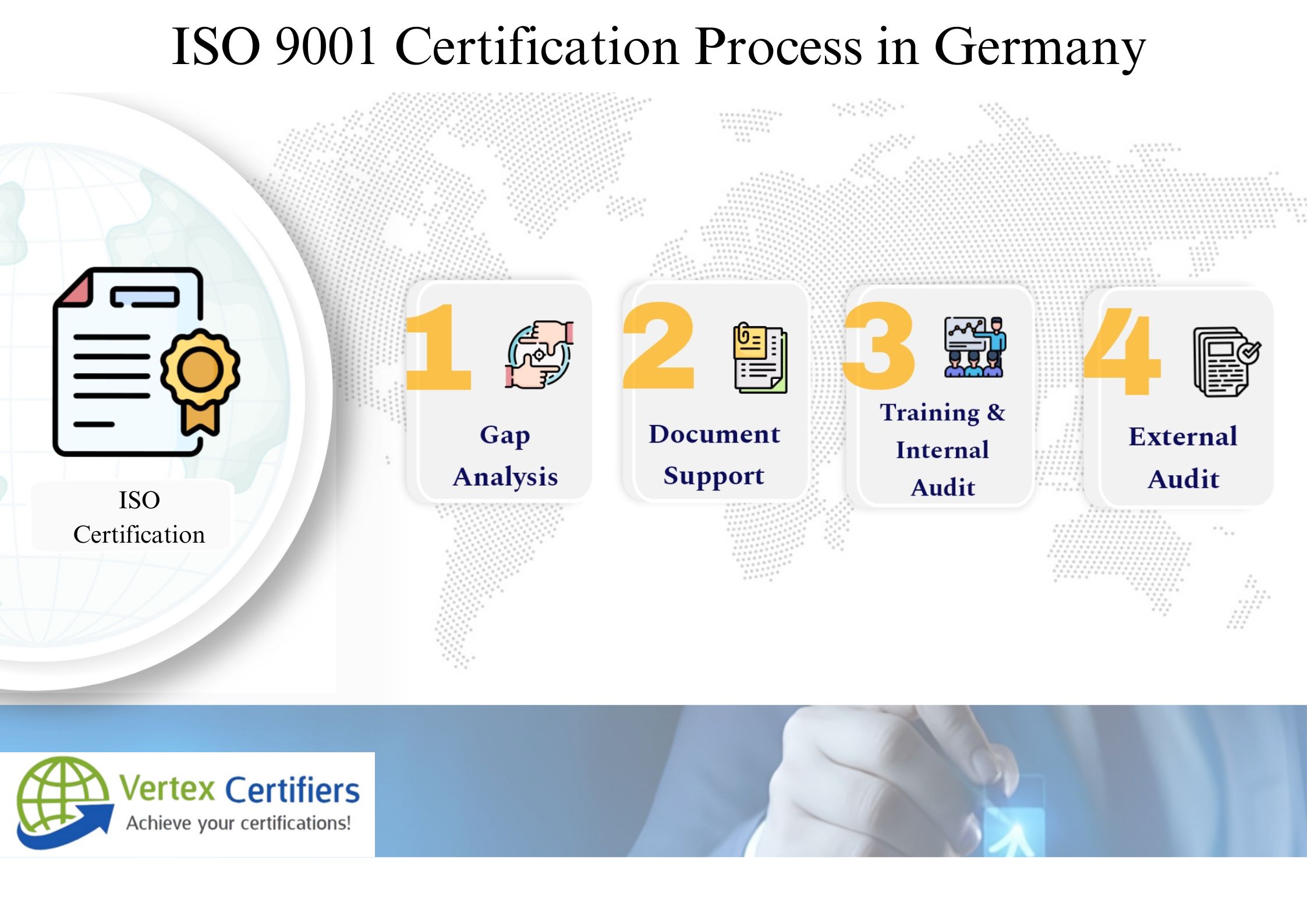
ISO 9001 Certification in Germany

While each project is unique, the certification journey usually follows several structured steps:

  1. Gap analysis against ISO 9001 requirements
    An initial review compares current processes and documentation against ISO 9001, identifying gaps, strengths, and priorities.​
  2. Documentation development
    Quality manual (if used), policies, process descriptions, procedures, and forms are created or updated to align with the standard and the organization’s real practices.​
  3. Implementation and staff training
    New or updated processes are rolled out; employees are trained on procedures, roles, and quality objectives; and records begin to accumulate as evidence.​
  4. Internal audit and corrective action
    Internal auditors check the implemented system, raise nonconformities or observations, and the organization implements corrective actions to fix gaps before the external audit.​
  5. Certification audit (Stage 1 & Stage 2)
    • Stage 1: The certification body reviews documented information and readiness (scope, sites, implementation status).
    • Stage 2: Auditors visit relevant sites, examine records, and verify practical implementation and effectiveness.​
  6. Certificate issuance and surveillance audits
    Once major nonconformities are resolved, the certification body issues a certificate valid for three years, subject to annual surveillance audits to confirm ongoing conformity.

    Get Free
    Consultation


    Our Services

    Why ISO 9001 Certification is Important for Businesses in Germany

    ISO 9001 brings both external market advantages and internal performance improvements for organizations operating in Germany. Key benefits include:

    • Access to EU and international markets: Many global customers in automotive, aerospace, and industrial equipment require ISO 9001 as a minimum supplier qualification, enabling easier entry into new markets.
    • Supplier approval by OEMs and large corporations: German OEMs and industrial groups often mandate ISO 9001 for approved supplier lists and long-term partnerships.
    • Eligibility for public tenders and contracts: ISO-certified companies often score higher in public and semi-public tenders for construction, technical, and service projects.
    • Improved operational efficiency and customer satisfaction: Standardized processes reduce rework, scrap, delays, and complaints, improving delivery performance and customer loyalty.
    • Competitive advantage: ISO 9001 acts as a visible differentiator, especially for SMEs competing for large domestic and international clients.

    Who Needs ISO 9001 Certification in Germany

    • Manufacturing and engineering: Metalworking, machining, electronics, industrial equipment, and precision component manufacturers.
    • Automotive OEMs and Tier suppliers: Organizations integrating into global automotive supply chains.
    • Construction and infrastructure firms: Contractors managing quality across projects, sites, and subcontractors.
    • IT, software, and professional services: Service providers managing delivery, development, and customer support.
    • Logistics and supply-chain organizations: Transport, warehousing, and 3PL companies improving reliability and documentation.
    • Startups and export-oriented SMEs: Growing companies building early credibility with large buyers.

    ISO 9001 Certification Requirements in Germany

    • Management commitment and quality policy: Defined policy, objectives, responsibilities, and allocation of resources.
    • Process identification and risk assessment: Mapping core processes and evaluating risks and opportunities affecting quality.
    • Documented information and record control: Controlled procedures, work instructions, and records such as inspections and training.
    • Customer satisfaction monitoring: Feedback, complaints analysis, and performance indicators.
    • Internal audits and management review: Regular audits and leadership reviews to ensure effectiveness.
    • Continual improvement: Corrective actions, root-cause analysis, and measurable improvement over time.

    Cost and Time for ISO 9001 Certification in Germany

    Costs and timelines depend on organization size, scope, and existing process maturity. Influencing factors include employee numbers, number of sites, scope of activities, and internal resources.

    • Small companies: ~4–6 weeks
    • Medium organizations: ~6–10 weeks
    • Large or multi-site organizations: ~10–16 weeks or more

    Total cost includes internal effort, optional consulting support, and certification body audit fees.

    ISO 9001 Certification Bodies in Germany

    • IAF-accredited bodies: Certification bodies accredited by the national accreditation system and recognized internationally ensure global acceptance.
    • ISO/IEC 17021 compliance: Ensures auditor competence, impartiality, and credible certification decisions.
    • Selection criteria: Accreditation status, sector experience, auditor language skills, reputation, and audit approach.
    • Risks of unaccredited certificates: Potential rejection by customers, OEMs, or authorities.

    ISO 9001 Certification for SMEs and Startups in Germany

    • Business scalability: Structured processes reduce dependency on individuals and support growth.
    • Simplified implementation: Lean, practical documentation while remaining fully compliant.
    • Integrated management systems: Combine ISO 9001 with other standards to reduce cost and effort.
    • Export and growth tool: Certification supports entry into new markets and long-term contracts.

    Why Choose Vertex Certifiers for ISO 9001 Certification in Germany

    • End-to-end ISO 9001 consulting: From gap analysis to certification support.
    • Remote and onsite services: Flexible support across major German cities and regions.
    • Fast-track methodology: Proven templates and clear implementation roadmaps.
    • Audit readiness & coordination: Support through internal audits and liaison with accredited certification bodies.

    Cities We Serve in Germany

    • ISO 9001 Certification in Berlin
    • ISO 9001 Certification in Munich
    • ISO 9001 Certification in Hamburg
    • ISO 9001 Certification in Frankfurt
    • ISO 9001 Certification in Stuttgart
    • ISO 9001 Certification in Cologne

    FAQs on ISO 9001 Certification in Germany

    Is ISO 9001 mandatory in Germany?
    No, but many customers and tenders make it a practical requirement.

    Is ISO 9001 valid across the EU?
    Yes, certificates issued by accredited bodies are widely accepted across the EU.

    How long is ISO 9001 certification valid?
    Three years, with annual surveillance audits.

    Can foreign companies get ISO 9001 in Germany?
    Yes, foreign-owned organizations with German operations can be certified.

    Get ISO 9001 Certified in Germany

    Start your ISO 9001 journey with a structured gap analysis and a tailored implementation roadmap. Vertex Certifiers offers a FREE initial consultation to define scope, timelines, and costs.

    📧 Email us at info@vertexcertifiers.com

    Request Free Consultation

      Company Logo

      Get ISO certification


      Fill the details below, one of our executives will contact you shortly


      This will close in 0 seconds

      Call Now Button