
ISO 22000 Certification in Italy:
ISO 22000 Certification in Italy, Italy’s food and beverage sector is globally recognized for its quality, tradition, and strict regulatory compliance, making food safety management a critical requirement for businesses operating in this space. Vertex Certifiers offers professional ISO 22000 certification services across Italy, supporting food manufacturers, processors, exporters, logistics providers, and HoReCa businesses in key cities such as Rome, Milan, Turin, Bologna, Parma, Naples, Florence, Venice, and Bari. Our ISO 22000 solutions are aligned with EU food safety regulations and HACCP principles, ensuring effective control of food safety hazards across the supply chain. With end-to-end support—from gap analysis and FSMS documentation to training and certification audit assistance—Vertex Certifiers helps Italian organizations achieve ISO 22000 certification efficiently, strengthen consumer trust, and expand confidently into domestic and international markets.
Italy boasts a world-renowned food industry, from pasta and olive oil to wine and cheese. Yet, food safety challenges persist—think contamination risks in supply chains, seasonal outbreaks like Salmonella in dairy, or Listeria in ready-to-eat products. The European Food Safety Authority (EFSA) reports over 2,500 foodborne illness cases annually in Italy, underscoring the need for robust safeguards.
ISO 22000 certification emerges as a vital solution for Italian food businesses. This international standard ensures systematic food safety management, protecting consumers and boosting competitiveness. For Italy’s food sector, it aligns perfectly with EU mandates like Regulation on food hygiene and HACCP principles.
What Is ISO 22000 Certification?
ISO 22000 defines a Food Safety Management System (FSMS) that prevents contamination from farm to fork. Published by the International Organization for Standardization, its latest 2018 version emphasizes risk-based thinking for proactive hazard control.
Key objectives include ensuring safe products, complying with regulations, and fostering continual improvement. Core principles revolve around leadership commitment, planning, support, operation, performance evaluation, and improvement—mirroring ISO 9001’s structure for easy integration.
It seamlessly integrates HACCP (Hazard Analysis and Critical Control Points), Prerequisite Programs (PRPs) like sanitation, and Operational PRPs (OPRPs) for specific risks. This holistic approach makes ISO 22000 ideal for Italy’s diverse food chains, from vineyards to export logistics.
Who Needs ISO 22000 Certification in Italy?
ISO 22000 suits any organization in Italy’s food ecosystem touching the supply chain.
- Food manufacturers: Pasta producers in Gragnano, dairy plants in Lombardy, meat processors in Parma, bakeries, and olive oil mills.
- Wine and beverage producers: Chianti wineries and prosecco makers needing contaminant-free bottling.
- Food processors and packers: Canners of tomatoes or seafood packers in Sicily.
- Cold storage and logistics companies: Refrigerated warehouses in Genoa ports handling exports.
- Restaurants, catering, and HoReCa sector: High-volume kitchens in Milan or Rome serving tourists.
- Agricultural cooperatives and exporters: Olive and fruit co-ops in Puglia shipping to the Middle East.
Even SMEs benefit, as certification scales to operation size.
Requirements of ISO 22000 Standard
ISO 22000 demands a structured FSMS with these pillars:
- Food Safety Policy and objectives: Top management commits to measurable goals, like zero contamination incidents.
- Hazard analysis and HACCP plan: Identify biological, chemical, physical hazards via flow diagrams.
- Prerequisite Programs (PRPs): Basic hygiene, pest control, supplier verification per Codex Alimentarius.
- Operational PRPs (OPRPs): Controls for significant hazards, like temperature monitoring in dairy.
- Traceability and recall procedures: One-up, one-down tracking with mock recalls tested yearly.
- Emergency preparedness: Plans for outbreaks, floods, or supply disruptions.
- Management review and continual improvement: Annual reviews using data from audits and KPIs.
Italian firms must adapt these to local risks, like mycotoxins in grains.
How to get ISO 22000 Certification in Italy
Achieving certification in Italy follows a proven path, often with accredited bodies like ACCREDIA-approved certifiers of ISO 22000 Consultants in Italy:
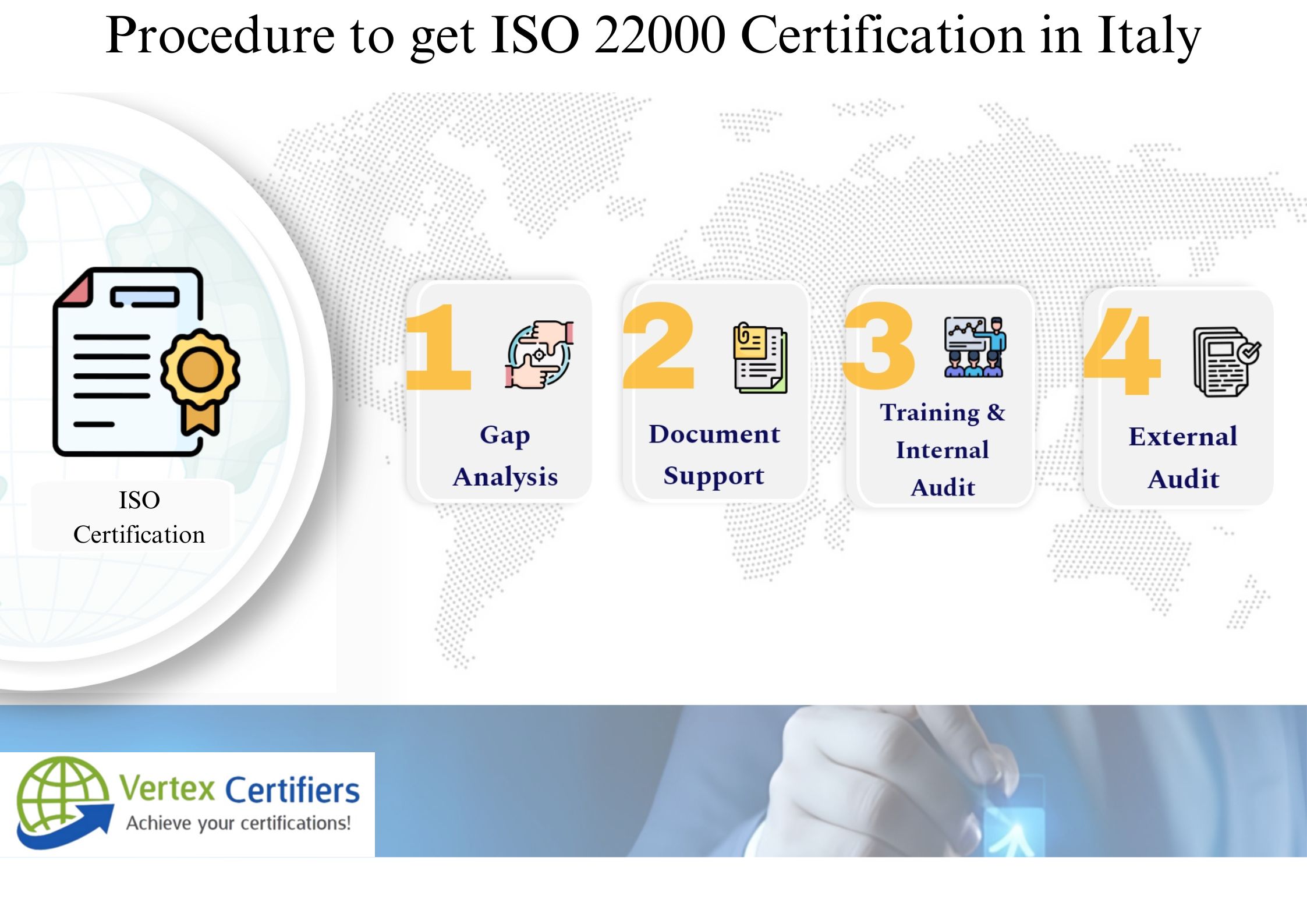
- Gap analysis and FSMS assessment: Consultants evaluate current practices against the standard.
- FSMS documentation and HACCP development: Create manuals, procedures, and hazard plans tailored to Italy’s regs.
- Implementation and employee training: Train staff on PRPs; rollout takes 4-6 weeks.
- Internal audit and management review: Identify non-conformities; fix via corrective actions.
- Stage 1 audit: Remote review of documentation by certifier.
- Stage 2 audit: Onsite verification of implementation (2-5 days).
- Certification issuance and surveillance: Three-year validity with annual audits.
Vertex Certifiers streamlines this for Italian clients.