
ISO 22000 Certification in Laos:
ISO 22000 Certification in Laos, Vertex Certifiers is a leading ISO consulting firm providing end-to-end ISO certification services across major cities in Laos, including Vientiane, Luang Prabang, Savannakhet, and Pakse. With a strong team of experienced consultants and lead auditors, Vertex delivers complete support—from gap analysis, documentation, training, implementation, internal audits, to final certification—ensuring a smooth and hassle-free process. The company specializes in a wide range of international standards including ISO 9001 (Quality Management), ISO 14001 (Environmental Management), ISO 45001 (Occupational Health & Safety), ISO 27001 (Information Security), ISO 22000 (Food Safety), ISO 22301 (Business Continuity), ISO 50001 (Energy Management), ISO 13485 (Medical Devices), ISO 20000-1 (IT Service Management), ISO 21001 (Educational Organizations), ISO 37001 (Anti-Bribery), and ISO 27701 (Privacy Information Management), making Vertex Certifiers a one-stop solution for organizations in Laos seeking global compliance and operational excellence.
ISO 22000 certification in Laos has emerged as a game-changer for food businesses striving to uphold top-tier food safety standards. As Laos ramps up its food production and export activities, companies face mounting pressure to comply with global regulations while building trust with international partners. This certification establishes a robust Food Safety Management System (FSMS) that integrates Hazard Analysis and Critical Control Points (HACCP) principles, ensuring hazards are controlled throughout the supply chain—from raw material sourcing to final consumption.
In Laos, where agriculture and food processing drive economic growth, adopting ISO 22000 Laos standards helps businesses navigate local regulations like those from the Ministry of Health and Industry and Commerce. It positions your company for seamless market access in ASEAN and beyond, reducing risks like recalls or rejections. Whether you’re a rice miller, spice processor, or beverage producer, this guide breaks down everything you need to know about ISO 22000 certification in Laos.
What is ISO 22000 Certification?
ISO 22000 certification represents the gold standard for food safety management systems worldwide. Developed by the International Organization for Standardization (ISO), it provides a framework for organizations to systematically identify, evaluate, and control food safety hazards at every stage of the food chain.
At its core, ISO 22000 certification combines several key elements:
- HACCP Principles: Focuses on critical control points to prevent hazards like microbial contamination or chemical residues.
- Prerequisite Programs (PRPs): Basic hygiene and operational conditions, such as pest control and facility maintenance.
- Risk-Based Thinking: Proactive identification of potential risks using tools like FMEA (Failure Mode and Effects Analysis).
- Continuous Improvement: PDCA (Plan-Do-Check-Act) cycle for ongoing enhancements.
Unlike standalone food safety protocols, ISO 22000 Laos emphasizes a holistic FSMS that aligns with other standards like ISO 9001 for quality management. For Lao businesses, this means not just compliance but a competitive edge in exporting sticky rice, coffee, or processed fruits to demanding markets like Europe and the US.
Importance of ISO 22000 Certification in Laos
The surge in demand for ISO 22000 certification in Laos stems from the country’s booming food sector and evolving regulatory landscape. With Laos targeting higher agricultural exports under ASEAN agreements, food safety certification Laos is no longer a luxury—it’s essential for survival.
Key benefits include:
- Superior Food Safety: Systematic hazard controls minimize outbreaks, protecting consumers and your reputation.
- Buyer Confidence: International partners prefer certified suppliers, streamlining contracts.
- Regulatory Alignment: Meets Laos’ Food Law and aligns with Codex Alimentarius guidelines.
- Efficiency Gains: Streamlined processes cut waste and downtime.
- Risk Reduction: Prevents costly contaminations, like those seen in past regional aflatoxin scares.
- Brand Boost: Certification signals commitment, attracting premium clients.
Lao exporters of organic teas or fish products report fewer border delays post-certification, proving its tangible value.
ISO 22000 Certification Process in Laos
The ISO 22000 certification process Laos follows a clear, phased path by ISO 22000 Certification in Laos:
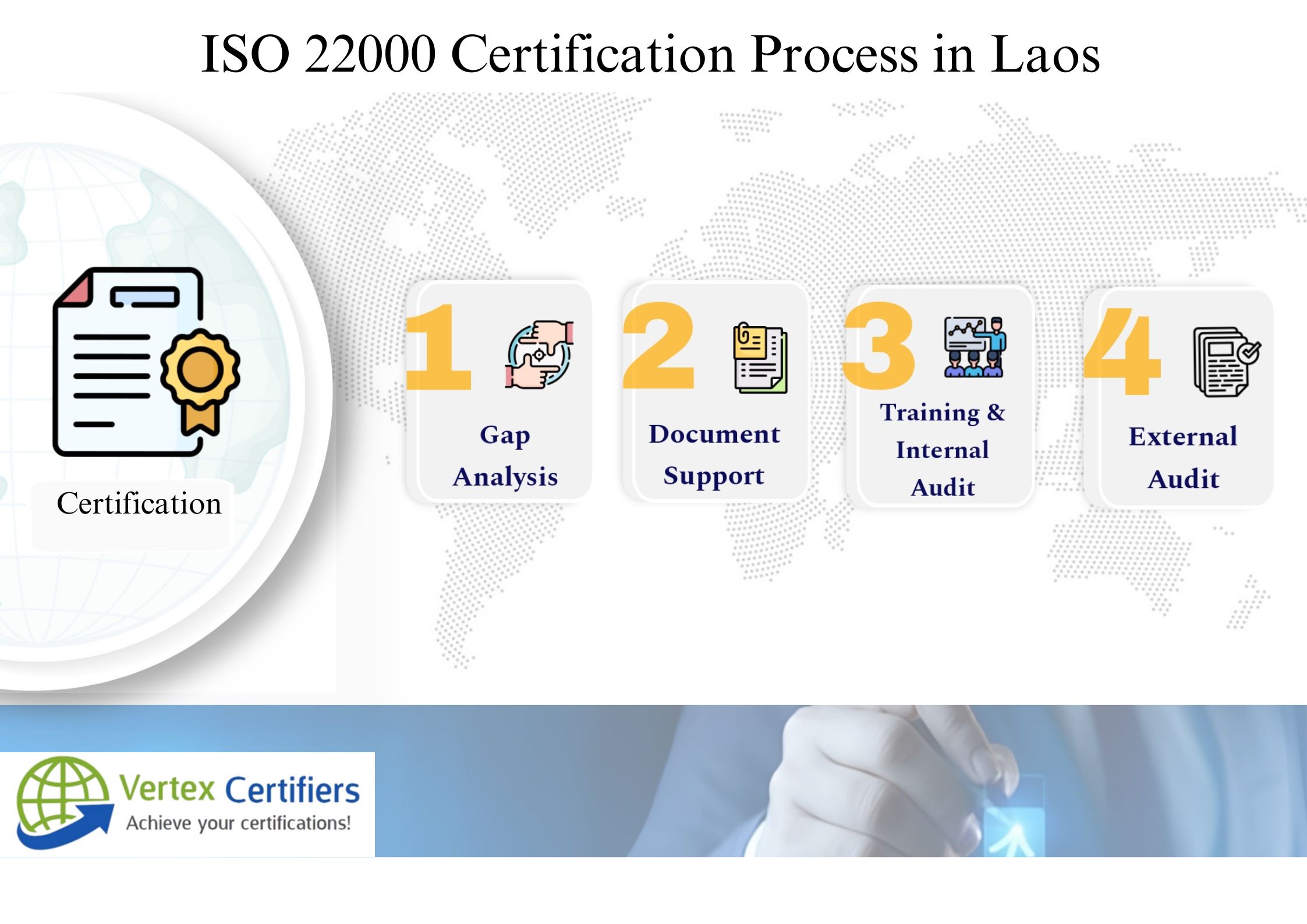
- Step 1: Gap Analysis
Assess current practices against ISO 22000 requirements using checklists. Identify gaps in hygiene or documentation. - Step 2: Documentation
Create FSMS manual, HACCP plans, SOPs, and forms. Tailor to Lao contexts like tropical pest risks. - Step 3: Implementation
Roll out controls, train staff, and monitor via KPIs like defect rates. - Step 4: Internal Audit
Conduct mock audits to fix non-conformities. - Step 5: Certification Audit
Accredited bodies with IAF partners perform:
Stage 1: Review docs remotely.
Stage 2: On-site verification of implementation. - Step 6: Certification Issuance
Receive certificate valid for 3 years, with annual surveillance.
Choose Laos-based auditors familiar with local supply chains for smoother audits.