
ISO 27001 Certification in Iran:
ISO 27001 Certification in Iran, Vertex Certifiers delivers comprehensive end-to-end ISO consulting and certification support for organizations across major cities in Iran, including Tehran, Mashhad, Isfahan, Shiraz, and Tabriz. Our expert team provides complete assistance—from gap analysis, documentation, implementation, training, and internal audits to final certification coordination—ensuring a smooth and time-bound process. In addition to ISO 14001, we support a wide range of international standards such as ISO 9001 (Quality Management), ISO 27001 (Information Security), ISO 45001 (Occupational Health & Safety), ISO 22000 (Food Safety), and other industry-specific certifications. With a practical, cost-effective approach and remote/onsite support options, Vertex Certifiers helps Iranian businesses achieve global compliance, improve operational performance, and strengthen their market credibility.
Iran’s digital economy is surging, fueled by advancements in IT, finance, telecom, and e-commerce. Yet, this growth amplifies cyber risks—from ransomware attacks to data breaches. ISO 27001 certification emerges as the gold standard for safeguarding sensitive information, helping Iranian businesses build resilient Information Security Management Systems (ISMS).
With rising threats like state-sponsored hacks and regulatory scrutiny from bodies such as the IRGC and Iran’s FATA (Foreign Assets Tracking Agency), ISO 27001 certification in Iran is no longer optional. It’s vital for industries handling customer data, financial transactions, or government contracts. This complete guide covers everything: from the certification process and timeline to costs, benefits, and why Vertex Certifiers is your ideal partner.
What is ISO 27001?
ISO 27001 is the internationally recognized standard for establishing, implementing, maintaining, and continually improving an ISMS. Published by the International Organization for Standardization (ISO) and updated in 2022, it focuses on protecting the confidentiality, integrity, and availability (CIA triad) of information assets.
At its heart, ISO 27001 provides a systematic approach to managing information security risks. Organizations define their scope, conduct risk assessments, and apply controls from Annex A—a catalog of 93 safeguards spanning organizational, people, physical, and technological domains. It complements ISO 27002, which offers detailed implementation guidance for those controls.
In Iran, where digital transformation accelerates amid geopolitical tensions, ISO 27001 certification in Iran ensures robust defenses against evolving threats, from phishing in banking apps to supply chain vulnerabilities in telecom networks.
Why ISO 27001 is Important for Iran
Cyber threats in Iran have escalated, with reports of increased attacks on critical infrastructure. Digital banking, e-government portals, and oil sector IT systems are prime targets. Regulatory bodies like the Central Bank of Iran (CBI) and Supreme Council of Cyberspace enforce data protection policies, aligning with global norms.
International partners demand ISO 27001 for collaborations—European firms won’t engage without it. For Iranian exporters in IT services or fintech, certification unlocks doors. It also supports national cybersecurity strategies, reducing breach risks in a landscape where incidents can cost millions and erode trust.
Industries that Need ISO 27001 Certification in Iran
Demand for ISO 27001 certification in Iran spikes in data-heavy sectors:
- IT & Software: Developers protecting code and client data.
- Finance & Banking: Securing transactions amid CBI regulations.
- Telecom: Safeguarding networks from interception.
- Healthcare & Pharma: Protecting patient records.
- Government & Public Sector: E-government platforms.
- E-Commerce & Cloud Services: Handling user data securely.
These verticals face long-tail risks like “ISO 27001 for banking in Iran,” making certification a priority.
ISO 27001 Implementation & Certification Process
Achieve certification through these structured steps, often with expert guidance by ISO 27001 Consultants in Iran:
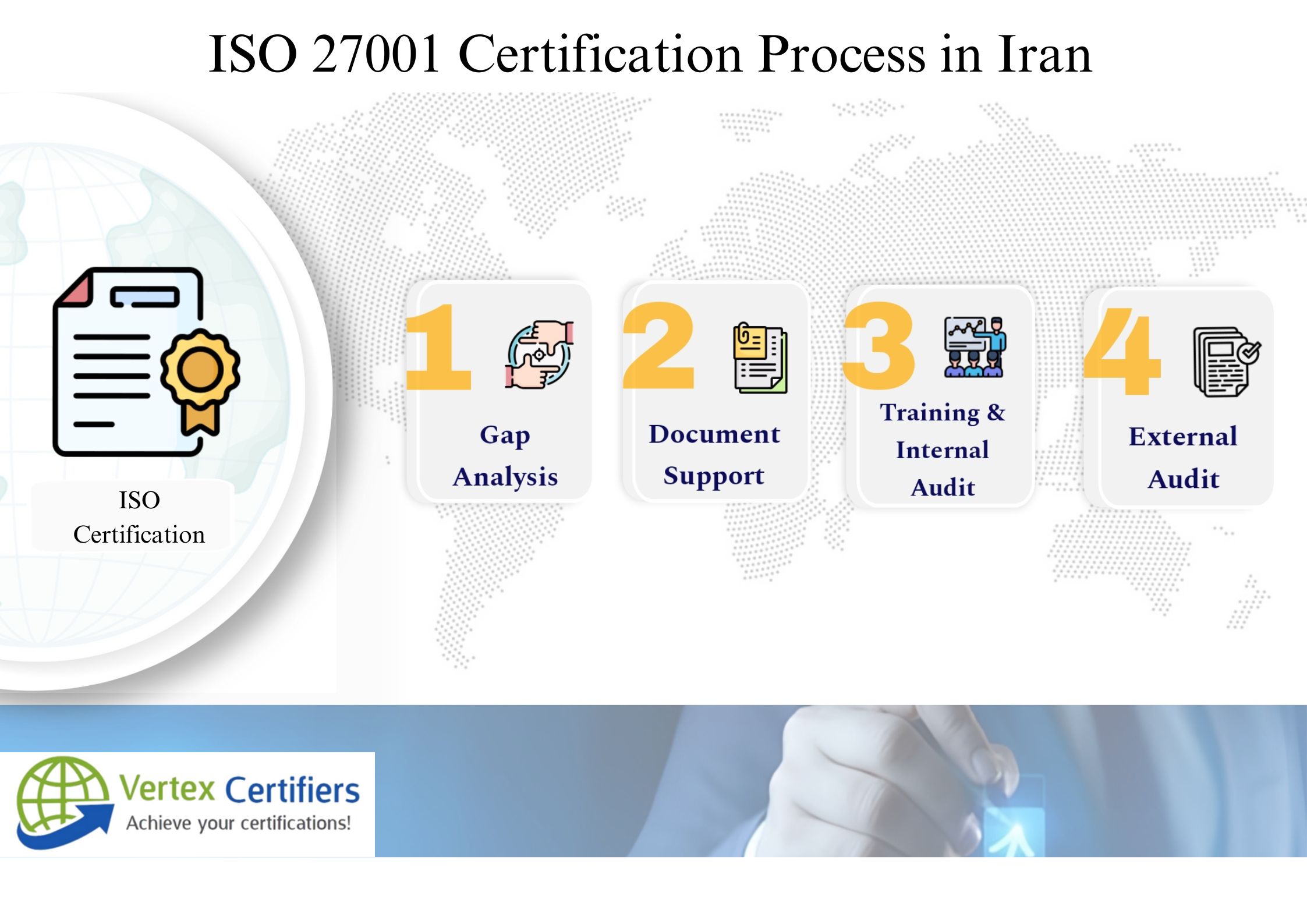
Step 1 – Preparation & Commitment
Secure top management buy-in. Define ISMS scope (e.g., specific departments) and draft the ISMS policy outlining security objectives.
Step 2 – Risk Assessment & Treatment
Catalog assets (servers, databases), threats (hackers, insiders), and vulnerabilities (weak passwords). Develop a treatment plan prioritizing high risks.
Step 3 – Document Controls & Policies
Select Annex A controls or use the organization-specific approach. Create SoA (Statement of Applicability) justifying inclusions/exclusions.
Step 4 – Training & Awareness
Roll out mandatory programs—simulations, phishing drills—to embed a security culture.
Step 5 – Internal Audit & Management Review
Audit for gaps; review metrics like incident rates with leadership for refinements.
Step 6 – Certification Audit
- Stage 1: Desk review of documents.
- Stage 2: On-site validation of implementation.
Iranian certifiers like those accredited by IAS ensure smooth audits.