Vertex Certifiers

ISO 27001 Certification in Lithuania:


ISO 27001 Certification in Lithuania, Vertex Certifiers provides comprehensive end-to-end ISO 27001 certification services across Lithuania, helping businesses strengthen information security, ensure GDPR compliance, and protect sensitive data. Our expert ISMS consultants support organizations in Vilnius, Kaunas, Klaipėda, Šiauliai, Panevėžys, and Alytus with complete guidance—risk assessments, documentation, security controls implementation, internal audits, employee training, and final certification support. As a trusted global ISO consulting firm, we assist companies in IT, fintech, telecommunications, SaaS, manufacturing, logistics, healthcare, and public sectors to implement ISO 27001:2022 effectively. Vertex Certifiers empowers Lithuanian organizations to achieve robust information security, reduce cyber risks, and build customer confidence with internationally recognized certification.

ISO 27001 stands as the premier international standard for Information Security Management Systems (ISMS), vital for safeguarding sensitive data in today’s digital era. Lithuania, witnessing rapid growth in IT, fintech, and digital services sectors, regards cybersecurity and data protection as top priorities. Alignment with GDPR and EU cybersecurity directives solidifies ISO 27001’s relevance as organizations embrace robust frameworks to counter rising cyber threats and regulatory demands.

What is ISO 27001 Certification in Lithuania ?

ISO 27001:2022 defines requirements for establishing, implementing, maintaining, and continually improving an ISMS. It centers around risk assessment, risk treatment plans, controls, security policies, and ongoing improvement cycles. Globally recognized, ISO 27001 certification assures clients and partners of an organization’s commitment to protecting confidentiality, integrity, and availability of information assets.

Why ISO 27001 Matters for Lithuanian Businesses

With increasing cyber threats across the Baltic region and Europe, Lithuanian companies face elevated risks. Export-oriented digital services, fintech, and ICT sectors demand stringent data handling practices to satisfy customers and regulators. Government and EU mandates such as NIS2 and GDPR emphasize compliance, while ISO 27001 enhances business resilience, mitigates legal risks, and strengthens client confidence—especially for firms handling sensitive, financial, or personal data.

ISO 27001 Certification Process in Lithuania
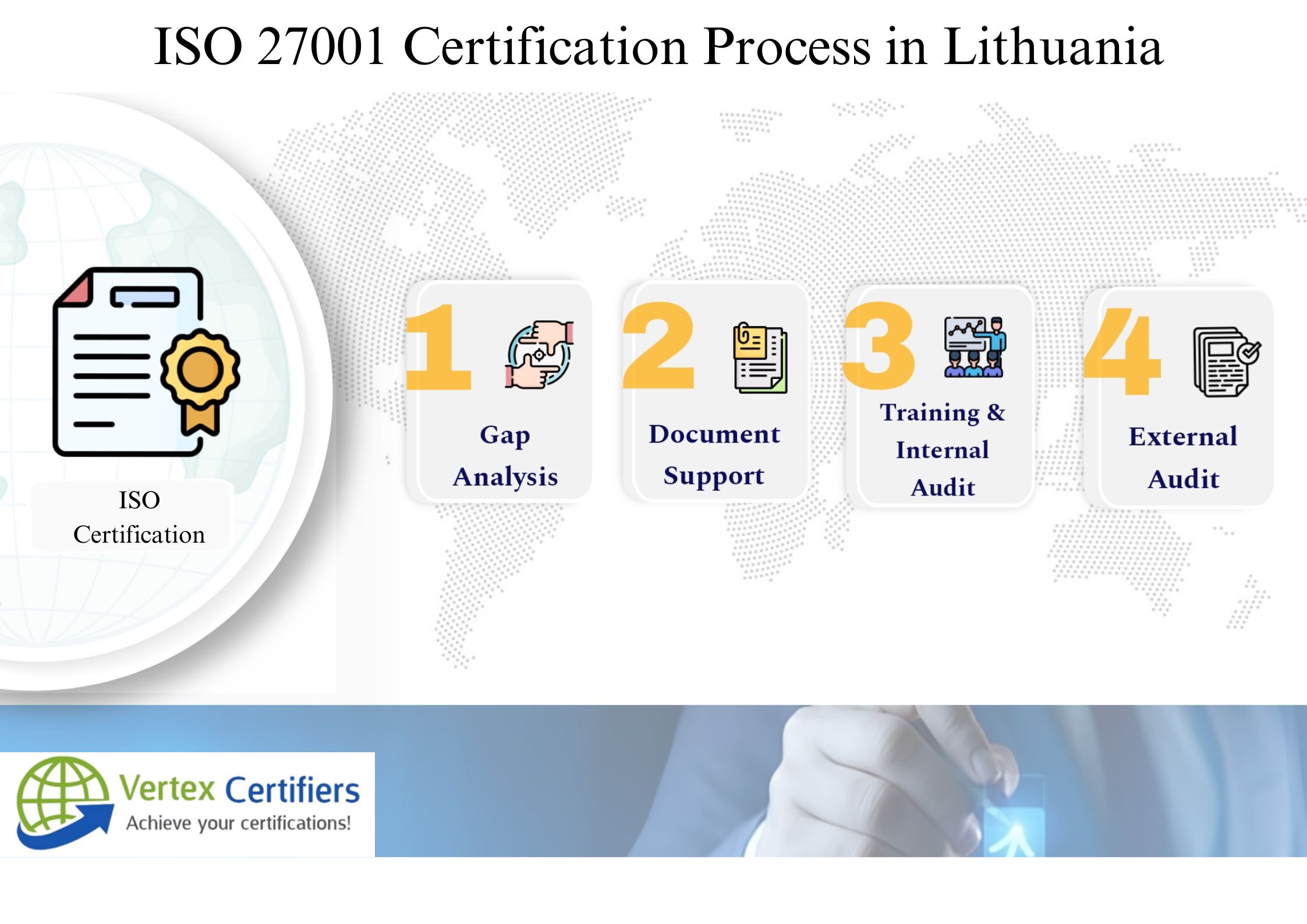
ISO 27001 Certification in Lithuania
  1. Initial Gap Analysis — Evaluate current security posture versus ISO 27001 requirements.
  2. Scope Definition — Clearly outline the ISMS boundaries.
  3. Risk Assessment & Treatment Plan — Identify risks and appropriate controls.
  4. Documentation Development — Create policies, procedures, and evidence of compliance.
  5. Implementation of Security Controls — Apply technical and organizational measures.
  6. Employee Security Training — Educate staff on security protocols and responsibilities.
  7. Internal Audit — Conduct an internal review of the ISMS for effectiveness.
  8. Management Review — Assess audit outcomes and plan improvements.
  9. Stage 1 Audit — Readiness assessment by certification body focusing on documentation.
  10. Stage 2 Audit — On-site verification of ISMS effectiveness.
  11. Certification Issuance — Awarded upon full compliance.
  12. Surveillance Audits — Annual evaluations to maintain certification validity.

    Get Free
    Consultation


    Our Services

    ISO 27001 Certification in Lithuania — Benefits, Requirements & Process

    ISO 27001 Certification in Lithuania — Protect Data & Build Trust

    A practical guide to the benefits, mandatory requirements, industries, cost, timeline and FAQs about ISO 27001 in Lithuania. Vertex Certifiers offers end-to-end ISMS implementation and certification support across Vilnius, Kaunas, Klaipėda, Šiauliai, Panevėžys, Alytus and beyond.

    Key Benefits of ISO 27001 Certification in Lithuania

    ISO 27001 gives Lithuanian organisations a structured, auditable framework to manage information risk and demonstrate compliance to clients and regulators.

    • Protects against cyberattacks, breaches, and data leaks through structured controls and processes.
    • Ensures compliance with GDPR, NIS2, and other EU security regulations—helping organisations meet legal obligations.
    • Improves operational efficiency by standardising risk management and security processes across the organisation.
    • Boosts reputation and client trust in cybersecurity-conscious markets and industries.
    • Provides a competitive advantage for IT, fintech, BPO, SaaS, and cloud service providers tendering for secure contracts.
    • Reduces financial and reputational risk associated with data breaches and incident response costs.
    • Cultivates a strong security culture through documented policies, procedures and awareness training.

    ISO 27001 Mandatory Requirements (Key Clauses & Controls)

    ISO 27001 is structured as management system clauses complemented by Annex A controls. Below are the high-level requirements you must address:

    Management System Clauses

    • Clause 4: Context of the organization — Analyze internal and external issues impacting the ISMS.
    • Clause 5: Leadership — Demonstrate top management commitment to information security.
    • Clause 6: Planning — Develop risk assessment methodology and risk treatment plans.
    • Clause 7: Support — Allocate resources, ensure staff competency, and manage communication.
    • Clause 8: Operation — Implement planned risk treatment and security controls.
    • Clause 9: Performance evaluation — Monitor, audit, and review ISMS performance.
    • Clause 10: Improvement — Manage nonconformities and continuous improvement.

    Annex A Controls (Examples)

    Organizational Controls: policies, roles & responsibilities.
    People Controls: access control, training & awareness.
    Physical Controls: secure areas, visitor controls.
    Technological Controls: encryption, network security, monitoring, incident response.

    Controls such as asset management, supplier security, access management and incident handling are especially relevant in Lithuania’s regulated sectors.


    Industries in Lithuania Adopting ISO 27001

    ISO 27001 is widely adopted where data confidentiality, integrity and availability are critical:

    • ICT, SaaS and software development companies
    • Fintech firms and financial institutions
    • Telecommunications providers and data centers
    • E-commerce and online platforms
    • Healthcare and medical IT systems
    • Manufacturing with digital/Industry 4.0 systems
    • Government agencies and public-sector contractors
    • Logistics and supply-chain companies handling sensitive data

    ISO 27001 Cost & Timeline in Lithuania

    High level guidance on budget and schedule — actual values depend on scope, people, sites and complexity.

    • Cost: Depends on scope, number of employees/systems, and chosen certification body. SMEs typically have lower costs; larger organisations with complex IT environments pay more. Expect additional expenses for training, risk assessments, documentation and audits.
    • Timeline: Most organisations complete certification in 3 to 6 months. Time depends on readiness, existing security maturity, and quality of documentation. Working with experienced consultants can accelerate the process.

    FAQs — Quick Answers

    Q1: Is ISO 27001 certification mandatory in Lithuania?
    A1: No — it is voluntary, but strongly recommended and often required by clients or to meet EU cybersecurity expectations.
    Q2: How long is ISO 27001 certification valid?
    A2: Certification is typically valid for three years, with mandatory annual surveillance audits.
    Q3: Can startups achieve ISO 27001 certification?
    A3: Yes. ISO 27001 is scalable and can be implemented by startups as well as large enterprises.
    Q4: Is remote consultation available?
    A4: Yes — many consultancy and certification services offer both remote and on-site support.
    Q5: How does ISO 27001 help with GDPR?
    A5: ISO 27001’s controls align with GDPR principles—helping organisations demonstrate technical and organisational measures to protect personal data.
    Q6: What documents are required?
    A6: Typical documents include ISMS scope, information security policy, risk assessment and treatment records, incident response procedures, training records and internal audit reports.
    Q7: Can ISO 27001 be integrated with other standards?
    A7: Yes — common integrations include ISO 9001 (QMS), ISO 22301 (BCM) and ISO 27017/27701 for cloud and privacy extensions.

    Conclusion

    ISO 27001 certification helps Lithuanian organisations secure critical information, comply with EU regulations, and strengthen client trust. Whether you are a startup or an enterprise, implementing an ISMS is a proactive step toward resilience and business continuity.

    This guide provides an overview for Lithuanian organisations interested in ISO 27001. For a customised roadmap, contact Vertex Certifiers at .

      Company Logo

      Get ISO certification


      Fill the details below, one of our executives will contact you shortly


      This will close in 0 seconds

      Call Now Button