
ISO 27001 Certification in South Korea:
ISO 27001 Certification in South Korea, Vertex Certifiers is a trusted global ISO consulting firm offering end-to-end certification services across major South Korean cities such as Seoul, Busan, Incheon, Daegu, Daejeon, and Gwangju. We specialize in ISO 27001 certification along with a wide range of other standards including ISO 9001 (Quality Management), ISO 14001 (Environmental Management), ISO 45001 (Occupational Health & Safety), ISO 22000 (Food Safety), ISO 22301 (Business Continuity) and many more. With experienced lead auditors and a proven implementation approach, Vertex Certifiers helps organizations achieve fast, cost-effective, and globally recognized ISO certifications tailored to their industry needs.
South Korea stands as one of Asia’s most digitally advanced economies, with cutting-edge tech hubs in Seoul and Busan driving innovation in AI, semiconductors, and fintech. Yet, this digital prowess comes with heightened cyber threats—ransomware attacks rose 25% in 2025 alone, per local reports. Businesses face mounting pressure from data breaches, supply chain vulnerabilities, and stringent regulations, making information security non-negotiable.
Enter ISO 27001 certification in South Korea. This globally recognized standard equips organizations with a robust Information Security Management System (ISMS), helping them protect sensitive data, ensure compliance, and build unbreakable trust with clients and partners. Whether you’re an IT startup in Gangnam or a multinational in Incheon, achieving ISMS certification South Korea positions your business for growth amid rising cyber risks and global competition.
What is ISO 27001 Certification?
ISO 27001 is the gold standard for Information Security Management Systems (ISMS), developed by the International Organization for Standardization (ISO). Updated in its 2022 edition (with minor 2026 clarifications on cloud security), it outlines a systematic framework to manage confidential information so that it remains secure, accurate, and accessible only to authorized users—the CIA triad: Confidentiality, Integrity, and Availability.
At its core, ISO 27001 isn’t a one-time checklist; it’s a living system promoting proactive risk management. Businesses implement 93 controls from Annex A, tailored to their needs, covering everything from cryptography to supplier relationships.
Key Elements:
- Risk assessment and treatment: Identify threats like phishing or insider leaks, then apply controls.
- Information security policies: High-level commitments from leadership.
- Asset management: Inventory hardware, software, and data.
- Access control: Limit who sees what, using multi-factor authentication.
- Incident management: Rapid response to breaches, minimizing damage.
- Continuous improvement: Regular reviews via PDCA (Plan-Do-Check-Act) cycle.
For South Korean firms eyeing information security certification South Korea, ISO 27001 bridges local needs with international benchmarks.
Benefits of ISO 27001 certification in South Korea:
- Protects against cyber threats and data breaches: Proactive controls reduce attack surfaces by up to 40%, per ISO studies.
- Enhances customer trust and brand reputation: Certified logos signal reliability, vital for B2B deals.
- Ensures compliance with local regulations like PIPA: Maps directly to PIPA’s breach notification and consent rules.
- Improves business continuity: ISMS keeps operations humming during disruptions.
- Increases chances of winning global tenders: Samsung and LG suppliers often demand it.
In a market where 70% of enterprises prioritize cybersecurity (2026 Deloitte survey), ISO certification South Korea like ISO 27001 delivers a competitive edge.
ISO 27001 Certification Process in South Korea
Securing ISO 27001 certification process South Korea follows a proven, phased roadmap accredited by bodies like IAF members (e.g., KAB in Korea). Partner with ISO 27001 consultants South Korea to streamline it.
Step-by-Step Process:
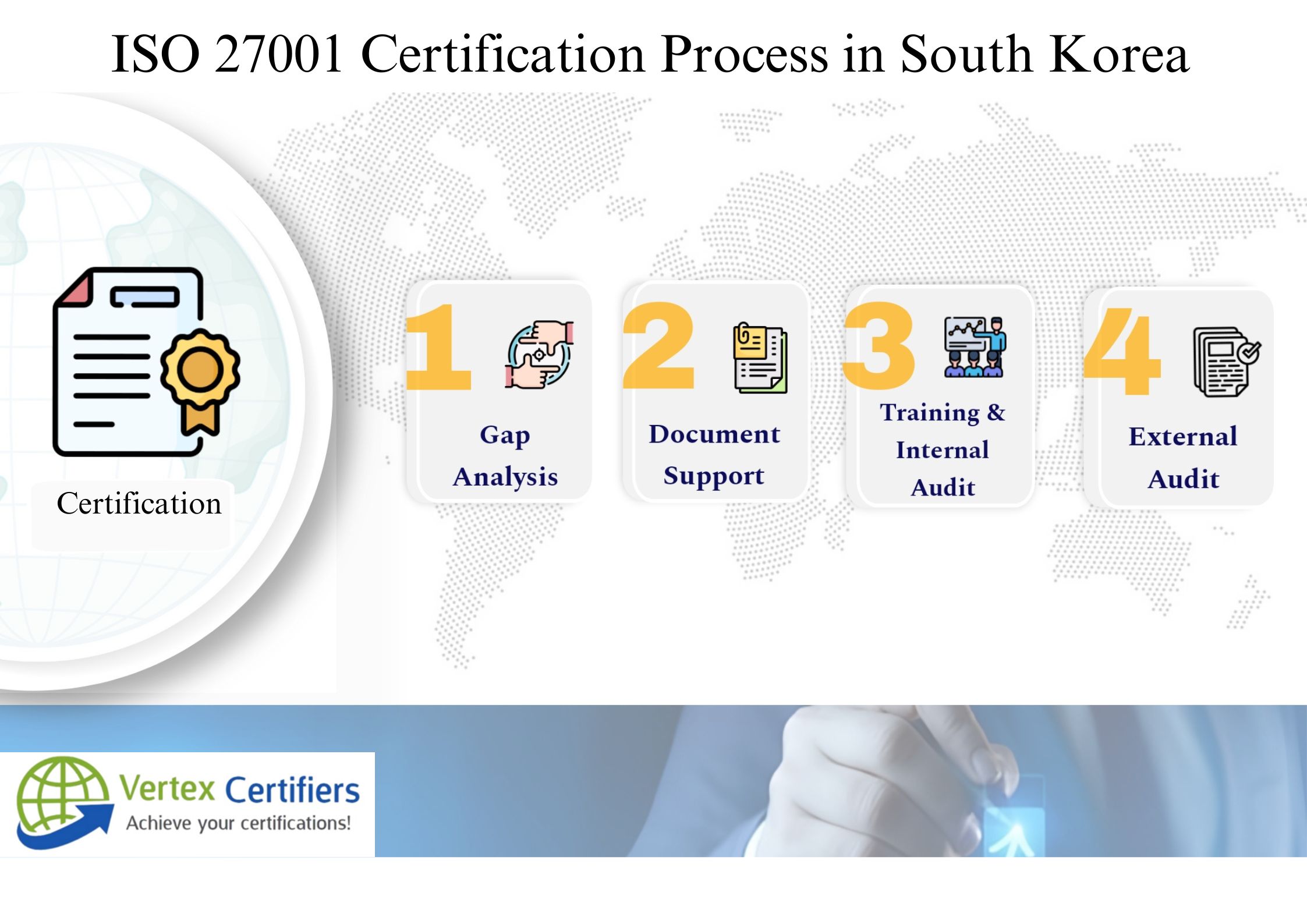
- Gap Analysis: Audit current practices against ISO 27001 clauses. Tools like Vertex Certifiers’ readiness checklists spot issues fast.
- Scope Definition: Outline ISMS boundaries—e.g., “IT department and cloud servers.”
- Risk Assessment & Treatment: Use methods like OCTAVE or ISO 27005 to score risks (likelihood x impact) and select controls.
- Documentation Development: Build mandatory records (detailed below).
- Implementation: Roll out across teams via training and tech upgrades.
- Internal Audit: Independent check for conformance.
- Management Review: Leadership assesses metrics like incident rates.
- Certification Audit: Stage 1 (documentation review) + Stage 2 (on-site verification) by accredited bodies like BSI Korea or TÜV.


