
ISO 45001 Certification in Malaysia:
ISO 45001 Certification in Malaysia, Vertex Certifiers is a leading ISO consulting and certification support firm providing end-to-end ISO 45001 Occupational Health & Safety Management System services across Malaysia, including Kuala Lumpur, Selangor, Penang, Johor Bahru, Melaka, Negeri Sembilan, Perak, Kedah, Sabah, and Sarawak. We support organizations across manufacturing, construction, oil & gas, engineering, logistics, healthcare, and service sectors with complete assistance from gap analysis, hazard identification and risk assessment (HIRA), OHS documentation, implementation, employee training, internal audit, and certification audit coordination through to final ISO 45001 certificate issuance. With a practical, risk-based approach and cost-effective solutions, Vertex Certifiers helps Malaysian businesses achieve legal compliance, safer workplaces, and internationally recognized ISO 45001 certification efficiently.
Ensuring employee health and safety is a legal and moral responsibility for every Malaysian organization. With growing enforcement by the Department of Occupational Safety and Health (DOSH) and stricter expectations from clients and stakeholders, companies can no longer afford reactive safety management.
ISO 45001 Certification in Malaysia offers a proactive and systematic approach to identifying hazards, managing risks, and improving the overall safety culture at the workplace. As an internationally recognized standard for Occupational Health and Safety Management Systems (OHSMS), ISO 45001 can be applied to any sector, including manufacturing, construction, logistics, healthcare, and oil and gas
What is ISO 45001 Certification?
ISO 45001 is the global standard that specifies requirements for an Occupational Health and Safety Management System (OHSMS), designed to prevent work-related injury and ill health and to provide safe and healthy workplaces.
It follows the Annex SL high-level structure, making it easy to integrate with other ISO standards such as ISO 9001 and ISO 14001.
The standard emphasizes:
- Context of the organization and leadership commitment
- Worker participation in safety decisions and reporting
- Hazard identification, risk assessment, and operational controls
- Compliance obligations, performance evaluation, and continual improvement
When implemented effectively, ISO 45001 helps organizations embed safety into daily operations rather than treating it as a standalone compliance activity.
Why ISO 45001 is Important in Malaysia
Malaysia’s Occupational Safety and Health Act 1994 (OSHA 1994) places clear responsibilities on employers to ensure the safety, health, and welfare of employees. The Department of Occupational Safety and Health (DOSH) actively monitors compliance through inspections and enforcement actions.
ISO 45001 is especially important in Malaysia due to:
- Legal Compliance: Alignment with OSHA 1994 and DOSH guidelines
- Accident Reduction: Systematic control of workplace hazards
- Improved Morale & Productivity: Safer workplaces improve engagement
- Tender & Contract Requirements: Preferred for high-risk projects
- ESG & Governance: Supports strong social and governance performance
For Malaysian businesses, ISO 45001 is not just a certification—it is a strategic tool to manage operational risk and protect people.
Industries That Need ISO 45001 in Malaysia
Any organization with occupational safety risks can implement ISO 45001, but it is particularly critical in high-risk sectors such as:
- Manufacturing and industrial units (automotive, steel, electronics, food processing)
- Construction and large infrastructure projects
- Oil & gas, petrochemical, and offshore operations
- Engineering, fabrication, and heavy equipment operations
- Logistics, warehousing, and transportation providers
- Power plants and energy sector operations
- Chemical and pharmaceutical industries
- Mining and quarrying activities
- Hospitals, healthcare, and facility management services
These industries often involve heavy machinery, hazardous materials, or complex processes, making a robust OHSMS essential.
Key Requirements of ISO 45001
Occupational Health & Safety Management System (OHSMS)
Establish an OH&S policy, objectives, roles, and responsibilities aligned with organizational strategy.
Hazard Identification & Risk Assessment (HIRA)
Identify hazards related to activities, equipment, and workplaces, and assess risks using methods such as HIRARC.
Legal & Regulatory Compliance
Determine applicable laws such as OSHA 1994 and the Factories and Machinery Act and integrate them into operational controls.
Operational Control
Implement SOPs, permits-to-work, lockout/tagout systems, and safe work practices.
Emergency Preparedness & Response
Plan and test responses for fires, chemical spills, explosions, and medical emergencies.
Worker Participation & Consultation
Involve employees in safety committees, hazard reporting, and decision-making.
Monitoring, Measurement & Improvement
Track safety KPIs, incidents, near misses, and audit findings to drive continual improvement.
Timeline for ISO 45001 Certification
- Small organizations: 30–45 days
- Medium-sized organizations: 45–60 days
- Large or high-risk operations: 60–90 days or more
Realistic timelines ensure thorough implementation rather than a rushed, audit-only approach.
Benefits of ISO 45001 Certification in Malaysia
- Reduced workplace accidents and injuries
- Improved legal compliance and lower risk of penalties
- Stronger employee morale and safety culture
- Lower insurance costs and reduced downtime
- Enhanced brand reputation and stakeholder trust
- Improved tender and contract eligibility
- Strong support for ESG and CSR objectives
Documents Required for ISO 45001
- Occupational health and safety policy and objectives
- Hazard identification and risk assessment (HIRA / HIRARC)
- Legal and compliance register
- Operational control procedures and SOPs
- Emergency preparedness and response plans
- Incident and accident investigation records
- Training, competence, and induction records
- Internal audit and management review reports
Choosing the Right ISO 45001 Consultant in Malaysia
- Strong knowledge of OSHA 1994, FMA 1967, and DOSH requirements
- Industry-specific safety expertise
- End-to-end implementation and audit support
- Clear timelines and structured methodology
- Post-certification and surveillance audit support
Why Choose Vertex Certifiers?
Vertex Certifiers helps Malaysian organizations transform workplace safety into a strategic advantage through effective ISO 45001 implementation.
- Experienced ISO 45001 consultants and safety auditors
- Practical, risk-based implementation approach
- End-to-end support from gap analysis to certification
- SME-friendly engagement and fast-track timelines
- Coverage across Kuala Lumpur, Selangor, Penang, Johor, and other regions
Conclusion
ISO 45001 Certification in Malaysia provides a structured framework for protecting employees, ensuring legal compliance, and strengthening business resilience.
By implementing a robust OHSMS, organizations foster a strong safety culture, reduce risks, and build long-term operational sustainability.
Ready to Achieve ISO 45001 Certification in Malaysia?
Speak with our occupational health & safety experts for a free consultation and implementation roadmap.
Process to get ISO 45001 Certification in Malaysia
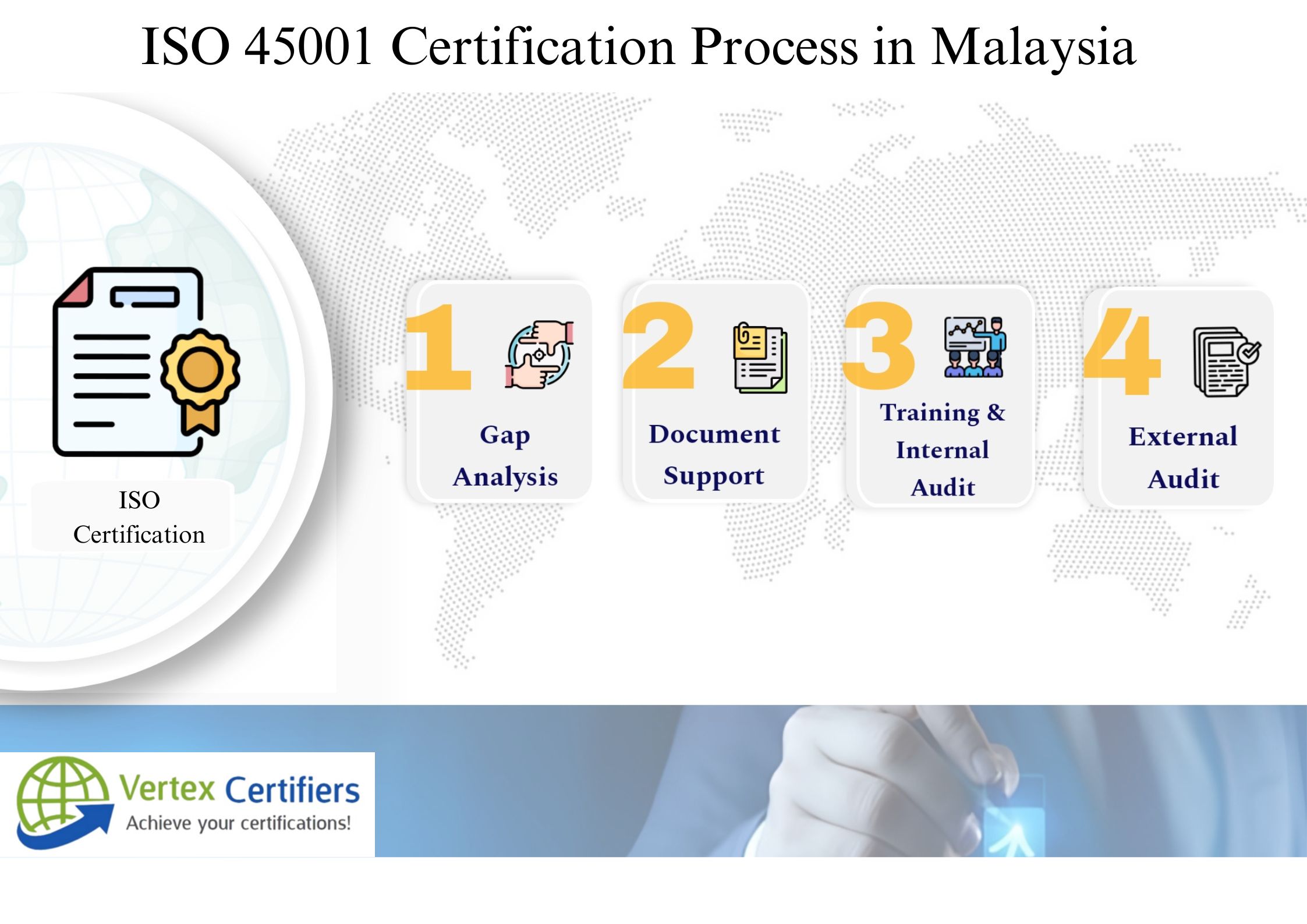
ISO 45001 Certification Process in Malaysia
The ISO 45001 certification journey in Malaysia follows a structured and systematic approach aligned with international best practices and the expectations of the Department of Occupational Safety and Health (DOSH). Each phase ensures that occupational health and safety is effectively embedded into daily operations.
1. Gap Analysis
Review existing health and safety practices against ISO 45001 requirements to identify gaps, risks, and areas for improvement.
2. Documentation Development
Develop or update OHS policy, HIRA / HIRARC records, legal registers, SOPs, emergency plans, and reporting formats aligned with Malaysian regulatory requirements.
3. Implementation & Training
Implement the OHSMS across departments and conduct safety inductions, toolbox talks, and awareness training for employees and contractors.
4. Internal Audit
Perform internal audits to evaluate control effectiveness, worker participation, and legal compliance before external assessment.
5. Management Review
Top management reviews OHS performance, incident trends, audit results, and improvement opportunities to demonstrate leadership commitment.
6. Certification Audit (Stage 1 & Stage 2)
An accredited certification body conducts Stage 1 (documentation review) and Stage 2 (on-site implementation audit) to verify ISO 45001 conformity.
After certification, organizations undergo periodic surveillance audits to ensure ongoing compliance and continual improvement of the Occupational Health & Safety Management System (OHSMS).