
ISO 9001 Certification in South Korea:
ISO 9001 Certification in South Korea, Vertex Certifiers provides comprehensive end-to-end ISO certification services in South Korea, supporting organizations across major business hubs such as Seoul, Busan, Incheon, Daegu, Daejeon, Ulsan, and Gwangju. Our expert consultants manage the entire certification journey—from initial gap analysis and customized implementation planning to documentation, employee training, internal audits, and coordination with accredited certification bodies for successful certification. We offer both remote and onsite support to ensure a smooth, fast, and cost-effective process with minimal disruption to your operations. Vertex Certifiers delivers integrated services for a wide range of international standards, including ISO 9001, ISO 14001, ISO 45001, ISO 27001, ISO 22000, ISO 22301, ISO 20000-1, ISO 50001, ISO 13485, ISO 37001, ISO 41001, and other industry-specific ISO standards, helping South Korean businesses enhance compliance, operational excellence, and global market credibility.
South Korea stands as a global economic titan, fueled by its dynamic industrial landscape. From cutting-edge manufacturing and electronics giants like Samsung and LG to powerhouse automotive leaders such as Hyundai and Kia, and thriving sectors in shipbuilding, IT, and services, the nation dominates international trade. In 2025, South Korea exported over $680 billion worth of goods, with manufacturing alone accounting for nearly 30% of GDP. This export-driven economy demands unwavering quality to integrate seamlessly into global supply chains.
In this competitive arena, quality management becomes non-negotiable. Businesses face rigorous standards from international buyers, partners, and regulators who prioritize reliability and consistency. Enter ISO 9001, the world’s leading Quality Management System (QMS) standard, adopted by over 1 million organizations globally. It equips South Korean companies with a proven framework to deliver superior products and services, boost customer trust, and unlock new markets.
Major business hubs like Seoul (the tech and finance epicenter), Busan (shipping and logistics gateway), Incheon (airport-driven trade), Daegu (textiles and machinery), Daejeon (research and innovation), Ulsan (petrochemicals and heavy industry), and Gwangju (aerospace and biotech) are hotspots for ISO 9001 adoption. Whether you’re in Seoul’s bustling startup scene or Ulsan’s industrial complexes, ISO 9001 certification positions your business for sustained success in South Korea’s high-stakes environment.
What is ISO 9001?
ISO 9001 is an internationally recognized standard for Quality Management Systems (QMS), developed by the International Organization for Standardization (ISO). Its core purpose? To help organizations consistently meet customer and regulatory requirements while pursuing continual improvement.
At its heart, ISO 9001 emphasizes customer satisfaction by ensuring products and services align with expectations. It promotes process efficiency through streamlined operations that minimize errors and redundancies. Risk-based thinking is a cornerstone—organizations identify potential risks and opportunities proactively, turning challenges into advantages. Finally, continuous improvement via the Plan-Do-Check-Act (PDCA) cycle drives ongoing enhancement.
The current version, ISO 9001:2015, reflects modern business realities with a flexible, process-oriented approach. Unlike rigid checklists, it focuses on leadership commitment, engaged employees, and evidence-based decision-making. For South Korean firms navigating complex supply chains, this standard provides a universal language of quality, applicable from small IT startups in Daejeon to massive shipyards in Busan.
Why ISO 9001 is Important in South Korea
South Korea’s economy thrives on exports, with over 80% of its manufacturing output destined for global markets. International buyers, original equipment manufacturers (OEMs), and multinational corporations demand ISO 9001 certification as a baseline for partnerships. Without it, suppliers risk exclusion from lucrative contracts.
This is especially critical in export-oriented industries like electronics, automotive, and shipbuilding. For instance, global giants such as Apple, Volkswagen, and Boeing require certified suppliers to ensure quality consistency. In Samsung and Hyundai’s vast ecosystems, ISO 9001 enhances eligibility, opening doors to tier-1 supply chains.
Domestically, it aligns with Korean quality expectations under frameworks like the Korea Standards Association (KSA) and industry-specific regulations. It strengthens competitiveness, helping firms win government tenders and stand out in saturated markets. In a nation where “ppalli ppalli” (hurry hurry) culture drives innovation, ISO 9001 balances speed with reliability, future-proofing businesses against disruptions like supply chain volatility or trade tensions.
How to get ISO 9001 Certification in South Korea
Securing ISO 9001 in South Korea follows a structured, efficient path, often completed with local or remote support by ISO 9001 Consultants in South Korea:
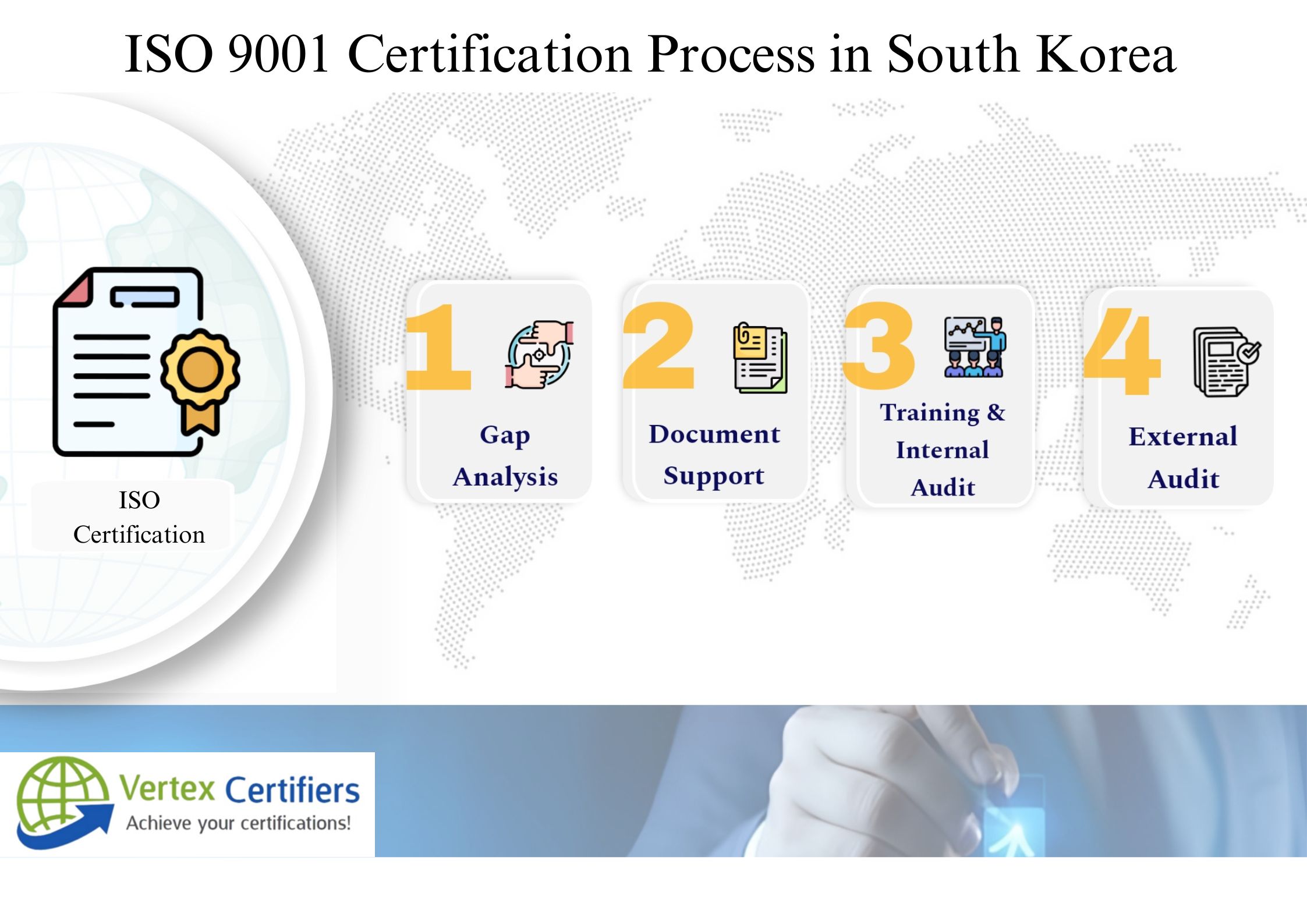
Start with Gap Analysis: Assess current practices against ISO 9001:2015 requirements to identify gaps.
Next, QMS Documentation Development: Craft policies, procedures, and records aligned with the standard.
Implementation and Employee Training follows, embedding QMS into daily operations with hands-on training.
Conduct an Internal Audit to verify effectiveness and address issues.
Hold a Management Review for leadership to evaluate performance and plan improvements.
The Certification Audit has two stages: Stage 1 (documentation review) and Stage 2 (on-site verification) by an accredited body like KSA or international certifiers.
Upon success, receive your ISO 9001 Certificate, valid for three years with annual surveillance audits. Vertex Certifiers streamlines this for minimal disruption across South Korea.