Vertex Certifiers

How to Get ISO Certification in Abuja Nigeria

ISO Certification in Abuja:

ISO Certification in Abuja – Procedure, Cost & Timeline, Vertex Certifiers is a trusted ISO consulting and certification support firm providing end-to-end ISO certification services in Abuja and across Nigeria, including Lagos, Port Harcourt, Ibadan, Benin City, Onitsha, Aba, Enugu, Asaba, and other key commercial locations. We support organizations with multiple ISO standards such as ISO 9001, ISO 14001, ISO 45001, ISO 27001, ISO 22000, ISO 13485, ISO 22301, ISO 37001, ISO 20000-1, ISO 50001, ISO 21001, ISO 41001, ISO 55001, ISO 27701, and ISO 39001. With experienced ISO consultants and lead auditors, Vertex Certifiers delivers gap analysis, documentation, implementation, internal audits, training, and certification coordination, ensuring a smooth, cost-effective, and time-bound ISO certification process aligned with Nigerian regulatory expectations and international best practices.

Abuja is Nigeria’s administrative capital, home to federal ministries, regulatory bodies, public sector undertakings, embassies, development partners, and national headquarters of many private companies. Businesses in Abuja face stringent requirements around transparency, documentation, and compliance, especially when dealing with government projects and donor-funded programs. ISO certification provides a structured and globally recognized framework that helps Abuja-based organizations demonstrate reliability, accountability, and process discipline

What is ISO Certification?

ISO (International Organization for Standardization) develops globally accepted standards that define how organizations should manage quality, environment, health and safety, information security, and more. ISO certification is the process where an independent third-party certification body audits your management system and confirms that it meets the requirements of a specific ISO standard. This certification results in a formal ISO certificate that is widely accepted by government agencies, large corporates, and international partners as proof of robust systems and compliance

How to Get ISO Certification in Abuja – Procedure

A typical ISO certification journey in Abuja follows a structured, stepwise approach:
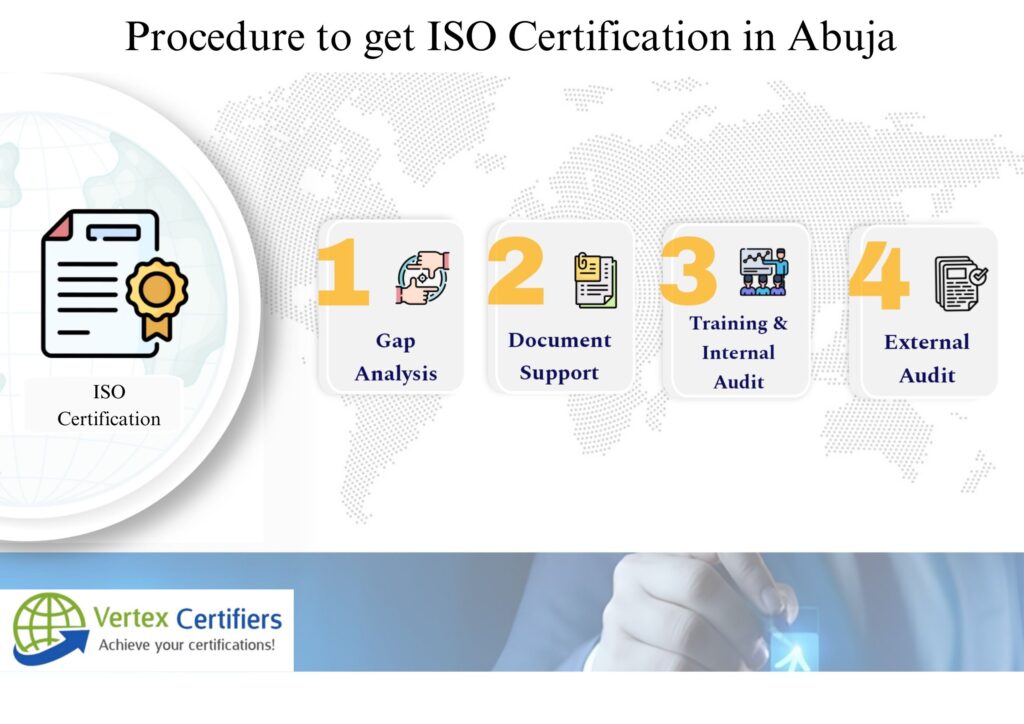
What is the Procedure to get ISO Certification in Abuja
  1. Initial gap analysis
    • Current processes, documentation, and controls are compared against the selected ISO standard’s requirements.
    • Gaps and improvement opportunities are identified and prioritized based on tender needs, regulatory risk, and business impact.
  2. Scope definition and planning
    • Define which locations, departments, services, or projects are included in the ISO scope (e.g., “Provision of consulting and training services from Abuja office”).
    • Prepare an implementation plan covering responsibilities, timelines, and resources.
  3. Documentation and system design
    • Develop or refine policies, objectives, procedures, SOPs, templates, and forms aligned to ISO requirements and Abuja-specific tender or regulatory expectations.
    • Ensure documentation reflects how the organization actually works, not just generic manuals.
  4. Implementation and staff training
    • Roll out the new or updated processes and ensure staff understand their roles through awareness and role-based training.
    • Start using the documented procedures, forms, and records in daily operations.
  5. Internal audit and management review
    • Conduct internal audits to verify implementation, identify nonconformities, and capture improvement actions.
    • Hold a management review meeting to evaluate performance, risks, opportunities, resource needs, and readiness for certification.
  6. Certification audit (Stage 1 & Stage 2)
    • Stage 1 focuses on document review, scope confirmation, and readiness assessment by the certification body.
    • Stage 2 is an on-site audit where auditors check implementation, records, and effectiveness of the management system.
  7. ISO certificate issuance
    • After closing any nonconformities, the certification body issues an ISO certificate valid for a defined period, usually three years, recognized by clients and authorities

    Get Free
    Consultation


    Our Services

    Who Needs ISO Certification in Abuja?

    ISO certification is relevant to a wide range of organizations operating in and around Abuja, especially those working with federal ministries, agencies, donors, and large private clients.

    Government Contractors & Consultancy Firms

    • Firms providing advisory, engineering, monitoring & evaluation, audit, legal, or other professional services to ministries, departments, agencies, and development partners can adopt ISO 9001 to showcase consistent quality and reliable project delivery.
    • ISO certification helps consultants stand out in technical evaluations and qualify for long-term framework agreements and donor-funded assignments.

    Construction & Infrastructure Companies

    • EPC contractors, road builders, housing developers, and public works contractors benefit from ISO 9001 for stronger project controls, documentation, and quality assurance.
    • ISO 45001 and ISO 14001 support compliance with health, safety, and environmental requirements on construction and infrastructure sites.

    Oil & Gas Support Services and Energy Firms

    • Companies providing technical services, maintenance, logistics, and project support to oil, gas, and power sectors typically require ISO 9001, ISO 14001, and ISO 45001 as part of their bid eligibility.
    • These standards demonstrate robust controls over safety, environment, and service quality for high-risk projects.

    IT, Software & Technology Companies

    • Abuja-based ICT firms, data centers, fintech back-offices, and software providers can use ISO 27001 to assure information security and data protection for government and private clients.
    • ISO 9001 supports controlled delivery, helpdesk support, and software development processes, improving client confidence and contract renewals.

    Healthcare, Hospitals, Diagnostics & Labs

    • Hospitals, specialized clinics, and diagnostic centers in Abuja can implement ISO 9001 to strengthen patient-focused processes and quality control.
    • ISO 13485 is relevant for medical device suppliers and service providers working closely with health facilities, defense, and national health programs.

    Logistics, Warehousing & Trading Companies

    • Organizations involved in government goods supply, donor-funded logistics, and regional distribution can adopt ISO 9001 to improve reliability, documentation, and on-time performance.
    • For food, pharmaceutical, and temperature-sensitive products, ISO 22000 helps manage food safety risks and regulatory compliance across the supply chain.

    Training Institutes, Universities & Service Providers

    • Professional training centers, universities, and skills-development institutes can use ISO 9001 to prove structured course design, delivery, and feedback processes.
    • Governance-related standards help these organizations demonstrate accountability and transparency to regulators, sponsors, and international partners.

    ISO Certification Cost in Abuja

    ISO certification cost in Abuja depends on multiple business and operational factors rather than a single fixed price.

    • ISO standard(s) selected: A single standard such as ISO 9001 usually costs less than a combination like ISO 9001 + ISO 27001 or ISO 9001 + ISO 37001 + ISO 22301.
    • Organization size and manpower: The number of employees and departments influences audit duration, training needs, and consulting effort.
    • Number of locations and sites: Multi-site setups (Abuja HQ plus regional offices) require more audit days, increasing certification fees.
    • Operational and regulatory complexity: Highly regulated sectors such as healthcare, energy, financial services, and public projects require deeper audits and more controls.
    • Accreditation and certification body: Certificates from well-recognized accredited bodies may involve higher fees but enjoy stronger acceptance in federal tenders and international contexts.
    • Consultant involvement: Engaging a specialist ISO consultant in Abuja adds professional fees but often reduces internal trial-and-error, delays, and audit failures.

    When budgeting, consider consulting fees, certification body fees, staff training and workshops, internal man-hours, and ongoing surveillance and maintenance costs over the full certification cycle.

    ISO Certification Timeline in Abuja

    Implementation timelines vary with organization size, complexity, and management commitment.

    • Small organizations: Single-office consulting firms, small contractors, and small ICT firms can often complete ISO 9001 or ISO 27001 within about 4–8 weeks if decisions are quick and documentation is lean.
    • Medium-sized organizations: Medium consultancies, mid-size contractors, hospitals, and training institutes usually take around 2–4 months to design, implement, stabilize, and undergo audits.
    • Large or multi-site organizations: Large contractors, national NGOs, and multi-location service providers may require 4–9 months or more, especially when implementing multiple standards and complex governance structures.

    Fast-track certification can be achieved when there is strong top management support, existing process maturity, and experienced consultants guiding implementation and audit preparation.

    Documents Required for ISO Certification

    Each ISO standard has specific documentation expectations, but common document categories for Abuja-based organizations include:

    Policies and Objectives

    • Quality, environment, health & safety, information security, anti-bribery, or business continuity policies as applicable.
    • Documented objectives and KPIs aligned with client, donor, and tender expectations.

    Scope and Organizational Structure

    • ISO scope statement clearly defining covered services, locations, and functions.
    • Organization chart, defined roles and responsibilities, and a process interaction map.

    Process Procedures and SOPs

    • Core procedures for service delivery, project management, procurement, HR, finance, and daily operations.
    • Supporting procedures for document control, record control, internal audit, corrective action, risk management, and management review.

    Risk Assessments and Registers

    • Risk registers for operational, financial, compliance, and project risks.
    • Specific registers for information security (ISO 27001), anti-bribery (ISO 37001), and business continuity (ISO 22301) where applicable.

    Training, Audit & Corrective Action Records

    • Records of staff training, competence evaluations, and awareness sessions.
    • Internal audit reports, nonconformity reports, corrective actions, and follow-up evidence.

    Standard-Specific Documentation

    • Statement of Applicability, asset inventory, and risk treatment plans for ISO 27001.
    • Business impact analyses (BIA) and continuity plans for ISO 22301.
    • Anti-bribery risk assessments, due diligence records, and investigation procedures for ISO 37001.
    • HACCP plans for ISO 22000 and technical documentation for ISO 13485.

    Validity, Surveillance & Recertification

    Certificate Validity Period

    • Most ISO management system certificates are valid for a three-year cycle, subject to ongoing compliance.

    Annual Surveillance Audits

    • Typically conducted once a year to verify that the management system remains implemented, effective, and continually improving.
    • Major lapses or persistent nonconformities can result in suspension or withdrawal of the certificate.

    Recertification After 3 Years

    • At the end of the three-year cycle, a more comprehensive recertification audit is carried out by the certification body.
    • Successful recertification renews the ISO certificate for another three-year period.

    Why Choose Vertex Certifiers for ISO Certification in Abuja

    Vertex Certifiers can be your specialized ISO partner for organizations operating in Nigeria’s administrative capital.

    Experience with Government & Private Sector

    • Familiarity with expectations of ministries, agencies, development partners, and corporate headquarters based in Abuja.
    • Experience supporting consulting firms, contractors, NGOs, ICT companies, and service providers.

    Understanding of Abuja Regulatory & Tender Requirements

    • Alignment of ISO processes and documentation with public procurement criteria and donor compliance frameworks.
    • Focus on risk management, transparency, and traceability demanded in Abuja tenders.

    Practical, Audit-Ready Documentation

    • Emphasis on simple, implementable procedures and records that work in day-to-day operations.
    • Systems designed to pass audits confidently while genuinely improving internal controls.

    Cost-Effective & Time-Bound Implementation

    • Tailored packages for small consultancies, medium contractors, hospitals, NGOs, and ICT firms with clear scope, timelines, and deliverables.
    • Support for both single standards and integrated management systems.

    Support Across Multiple ISO Standards

    • Capability to design integrated systems covering ISO 9001, ISO 14001, ISO 45001, ISO 27001, ISO 22000, ISO 13485, ISO 22301, and ISO 37001 as per Abuja clients’ needs.

    FAQs on ISO Certification in Abuja

    Is ISO certification mandatory for government tenders in Abuja?

    ISO certification is not always legally mandatory, but many ministries, agencies, and public projects strongly prefer or award higher scores to ISO-certified bidders, particularly for consulting, infrastructure, and ICT contracts.

    How much does ISO certification cost for a small firm in Abuja?

    Costs depend on the chosen standards, staff size, and complexity. Small single-office firms usually face lower consulting and audit fees than large, multi-site organizations, making ISO certification accessible with the right planning.

    Can NGOs and donor-funded projects in Abuja get ISO certified?

    Yes. NGOs, foundations, and implementing partners can adopt standards like ISO 9001, ISO 27001, ISO 22301, or ISO 37001 to strengthen governance, transparency, and donor confidence.

    How long will it take my company to get ISO certified?

    Small organizations may complete certification in 4–8 weeks, medium organizations in 2–4 months, and large or multi-site entities in 4–9 months or more, depending on readiness, scope, and leadership commitment.

    Do we need a dedicated ISO manager?

    A dedicated full-time ISO manager is not mandatory. Many Abuja-based organizations assign ISO responsibilities to existing staff as long as roles are clear and internal audits and management reviews are conducted regularly.

    Start Your ISO Certification Journey in Abuja

    Organizations in Abuja looking to qualify for more tenders, build trust with regulators and donors, and improve internal governance should start their ISO certification journey now.

    Get a free consultation and ISO roadmap from Vertex Certifiers.

    Contact Vertex Certifiers for a Free Quote

    Get ISO Certified in Abuja, Nigeria

    Start your ISO certification journey in Abuja with a structured gap assessment and a customized implementation roadmap aligned with federal tender, regulatory, and donor requirements. Vertex Certifiers offers a FREE initial ISO consultation to define scope, timelines, and compliance expectations for your organization.

    We provide end-to-end ISO consulting and audit support across Abuja city, Gwarinpa, Wuse, Maitama, Asokoro, Central Business District, Jabi, Utako, Lugbe, and surrounding FCT areas, helping you qualify for more tenders and strengthen governance and service quality.

    📧 Email us at info@vertexcertifiers.com

    Request Free ISO Consultation

      Company Logo

      Get ISO certification


      Fill the details below, one of our executives will contact you shortly


      This will close in 0 seconds

      Call Now Button