Vertex Certifiers

ISO Certification in Turkey:

ISO Certification in Turkey, Vertex Certifiers is a globally trusted ISO consulting and certification support firm providing end-to-end ISO certification services across Turkey, helping organizations achieve internationally recognized standards in a practical, timely, and cost-effective manner. We support companies from initial gap analysis and system design through documentation development, implementation, employee training, internal audit, management review, and coordination with accredited certification bodies for Stage 1 and Stage 2 audits. Vertex Certifiers works with organizations across major Turkish (Turkiye) cities including Istanbul, Ankara, Izmir, Bursa, Antalya, Kocaeli, Gaziantep, Konya, Adana, Mersin, Kayseri, and Denizli, as well as multi-site and export-oriented businesses serving EU and global markets. Our ISO services cover all major standards such as ISO 9001, ISO 14001, ISO 45001, ISO 27001, ISO 22000, ISO 13485, ISO 17025, ISO 50001, ISO 22301, ISO 20000-1, and ISO 37001, delivered by experienced ISO lead auditors and consultants with a strong focus on compliance, operational improvement, and long-term certification success in the Turkish market.

ISO Certification in Turkey helps organizations demonstrate internationally recognized quality, safety, environmental performance, and information security while aligning with Turkish regulations and EU trade requirements. It has become a strategic necessity for companies in Istanbul, Ankara, Izmir, Bursa, Antalya, Kocaeli, Gaziantep, Konya, Adana, Mersin, Kayseri, and Denizli that serve export markets, multinational customers, and large local buyers.

Introduction: ISO Certification in Turkey

Turkey is a key manufacturing and export hub connecting Europe, Asia, and the Middle East, with strong capabilities in automotive, textiles, construction, machinery, food processing, healthcare, logistics, and IT services. In this competitive environment, ISO Certification in Turkey enables companies to standardize operations, comply with regulations, and meet tender and supplier approval requirements across local and international markets.

For businesses in major cities such as Istanbul, Ankara, Izmir, Bursa, Antalya, Kocaeli, Gaziantep, Konya, Adana, Mersin, Kayseri, and Denizli, ISO standards help structure processes, reduce errors, and provide reliable documentation to satisfy customer audits and regulatory inspections. This is particularly important for organizations engaged in EU exports, where conformity with recognized management system standards supports smoother trade and long-term partnerships.

Why ISO Certification Is Important in Turkey

ISO Certification in Turkey is not only a marketing advantage; in many sectors it is a prerequisite for doing business with government bodies, large contractors, and foreign customers.

  • Required or preferred for public sector and state-related tenders, where ISO 9001, ISO 14001 or ISO 45001 are often listed as eligibility or scoring criteria.
  • Essential for EU exports and international trade, as buyers expect suppliers to hold recognized certifications for quality, environment, safety, and information security.
  • Improves supplier approval prospects in automotive, aerospace, white goods, and high-precision manufacturing, where strong process control and risk management are mandatory.
  • Enhances operational efficiency by defining responsibilities, standardizing workflows, and using data for corrective and preventive actions.
  • Builds trust with global customers, logistics partners, investors, and financial institutions by showing that the organization follows a structured, audited management system.

Companies in Istanbul, Izmir, Bursa, Kocaeli, and other industrial centers use ISO certification as a foundation for continuous improvement and international competitiveness.

Step by Step Process to get ISO Certification in Turkey

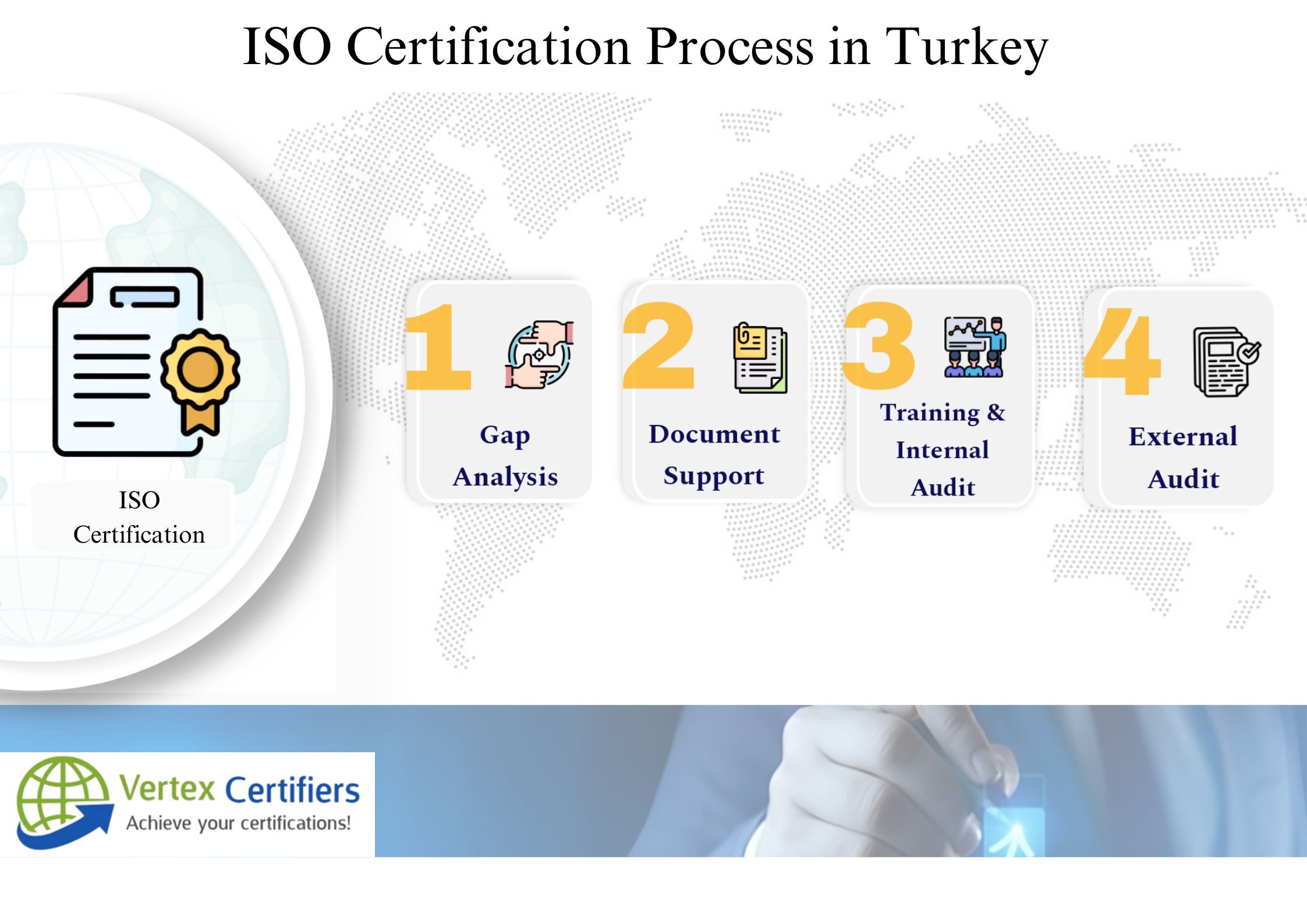
Although details vary by standard and sector, the ISO certification process in Turkey typically follows a clear, structured sequence.
ISO Certification in Turkey
  1. Gap Analysis
    • Review current processes, documents, and records against the chosen ISO standard’s requirements.
    • Identify strengths, weaknesses, and missing elements across sites in cities such as Istanbul, Ankara, Izmir, Bursa, and others.
  2. Documentation Development
    • Prepare or refine policies, SOPs, manuals, process maps, risk registers, and record formats aligned with the standard.
    • Ensure that documentation is practical, reflects real working practices, and supports compliance during audits.
  3. Implementation & Training
    • Roll out the new or updated procedures, assign responsibilities, and start generating evidence (records, logs, reports).
    • Conduct awareness and role-based training so employees understand why the system is changing and how to follow it daily.
  4. Internal Audit & Management Review
    • Perform internal audits to check compliance, effectiveness, and readiness for external certification.
    • Management reviews audit findings, performance indicators, customer feedback, and risks, then approves improvement actions.
  5. Certification Audit (Stage 1 & Stage 2)
    • Stage 1: The certification body reviews your documented system and assesses preparedness.
    • Stage 2: Auditors visit sites, interview staff, review records, and confirm that the system is implemented and effective.
  6. ISO Certificate Issuance & Surveillance
    • Once any nonconformities are addressed, the accredited certification body issues the ISO certificate, typically valid for three years.
    • Surveillance audits (usually annual) verify ongoing compliance and continual improvement throughout the certification cycle.

    Get Free
    Consultation


    Our Services

    Popular ISO Standards in Turkey

    Different industries in Turkey adopt specific ISO standards depending on their sector, risk profile, and customer expectations. The following are among the most widely implemented.

    ISO 9001 – Quality Management System

    ISO 9001 is the most common ISO standard in Turkey, implemented by manufacturing, automotive, textile, trading, logistics, and service companies.

    • Supports process consistency, documentation, and control of nonconformities across plants in Istanbul, Bursa, Kocaeli, Izmir, and other industrial zones.
    • Enhances customer satisfaction through improved delivery performance and complaint handling.
    • A basic supplier requirement for many OEMs and Tier-1 suppliers in Turkey’s automotive and machinery sectors.

    ISO 14001 – Environmental Management System

    ISO 14001 is widely adopted by manufacturing, construction, chemical, and energy companies managing emissions, waste, and environmental risks.

    • Helps demonstrate compliance with environmental legislation in Izmir, Kocaeli, Adana, Mersin, and Gaziantep.
    • Supports sustainability goals such as resource efficiency and pollution prevention.
    • Reduces risk of fines, operational disruptions, and community issues.

    ISO 45001 – Occupational Health & Safety

    ISO 45001 is critical for construction, heavy industry, logistics, and warehousing operations across Turkey.

    • Used by construction companies in Istanbul, Ankara, Antalya, and Konya to manage site safety.
    • Helps factories and logistics centers reduce accidents and meet legal obligations.
    • Promotes proactive risk assessment and continual safety improvement.

    ISO 27001 – Information Security Management

    ISO 27001 is increasingly adopted by IT companies, fintechs, telecom operators, and data centers.

    • Protects confidential data and intellectual property in Istanbul, Ankara, and Izmir.
    • Supports GDPR-aligned practices for EU and global clients.
    • Highly valuable for software, cloud hosting, and payment service providers.

    ISO 22000 – Food Safety Management

    ISO 22000 is a HACCP-based food safety standard widely used across Turkey’s food and agriculture sector.

    • Used by food manufacturers, exporters, and logistics providers in Mersin, Adana, Gaziantep, and Denizli.
    • Implemented by restaurants, hotels, and catering businesses in Istanbul and Antalya.
    • Improves regulatory compliance and access to supermarkets and export markets.

    ISO 13485 – Medical Devices Quality Management

    ISO 13485 supports quality and regulatory compliance for medical device manufacturers and suppliers.

    • Preferred by hospitals, clinics, and public procurement authorities.
    • Strengthens design control, traceability, and risk management.
    • Improves patient safety and supplier credibility.

    ISO 50001 – Energy Management System

    ISO 50001 is ideal for energy-intensive industries such as steel, cement, automotive, and large facilities.

    • Helps identify major energy users and improve efficiency.
    • Reduces energy costs and carbon footprint.
    • Works effectively when integrated with ISO 14001.

    ISO 17025 – Testing & Calibration Laboratories

    ISO 17025 ensures technical competence and impartiality of laboratories.

    • Used by industrial, environmental, and product testing laboratories.
    • Improves international acceptance of test and calibration results.
    • Enhances confidence for regulators, manufacturers, and clients.

    ISO 22301 – Business Continuity Management

    ISO 22301 supports operational resilience for organizations facing disruption risks.

    • Adopted by banks, logistics firms, IT service providers, and large enterprises.
    • Defines recovery strategies, crisis communication, and continuity testing.
    • Critical for meeting uptime and service-level commitments.

    ISO Certification Cost in Turkey

    ISO certification cost in Turkey varies based on operational and certification-related factors:

    • Organization size and number of employees
    • Type and number of ISO standards implemented
    • Number of locations, warehouses, and production lines
    • Maturity of existing systems and documentation

    SMEs generally incur lower costs due to simpler structures, while large and multi-site organizations require more audit and consulting effort. Final pricing is typically confirmed after a gap analysis.

    Industries Using ISO Standards in Turkey

    IndustryKey ISO StandardsTypical Focus
    Manufacturing & AutomotiveISO 9001, ISO 14001, ISO 45001Quality, environmental impact, occupational safety
    Construction & InfrastructureISO 9001, ISO 14001, ISO 45001Project control, compliance, site safety
    Food & AgricultureISO 22000HACCP-based food safety
    Textile & ApparelISO 9001, ISO 14001Consistent quality and eco-friendly production
    IT & SoftwareISO 27001Information security and data protection
    Healthcare & Medical DevicesISO 13485Regulatory compliance and patient safety
    Energy & UtilitiesISO 50001Energy efficiency and cost reduction
    LaboratoriesISO 17025Technical competence and reliable test results

    Why Choose a Professional ISO Consultant in Turkey

    • Faster certification with fewer nonconformities
    • Documentation aligned with Turkish regulations and industry needs
    • Support for EU export and international audit expectations
    • Reduced internal workload with strong audit readiness
    • ISO systems aligned to real business goals, not just certification

    Get ISO Certified in Turkey

    Organizations in Istanbul, Ankara, Izmir, Bursa, Antalya, Kocaeli, Gaziantep, Konya, Adana, Mersin, Kayseri, and Denizli can strengthen their competitiveness through ISO certification.

    With the right standards, a structured process, and professional support, ISO certification can be achieved smoothly, cost-effectively, and in line with international best practices.

    Contact Us for Free ISO Consultation

    📧 Email Us for ISO Certification Support

    info@vertexcertifiers.com

      Company Logo

      Get ISO certification


      Fill the details below, one of our executives will contact you shortly


      This will close in 0 seconds

      Call Now Button