
Procedure to get ISO 14001 Certification in Germany:
Procedure to get ISO 14001 Certification in Germany, Vertex Certifiers provides end-to-end ISO 14001 certification consulting services across Germany, supporting organizations at every stage—from initial gap analysis and EMS documentation to implementation, internal audits, and coordination with IAF-accredited certification bodies. With experience across manufacturing, construction, logistics, energy, IT, and service sectors, Vertex helps businesses build practical, compliant environmental management systems aligned with German and EU regulations. Our team delivers flexible remote and onsite support in major German cities including Berlin, Munich, Hamburg, Frankfurt, Stuttgart, and Cologne, enabling companies of all sizes to achieve ISO 14001 certification efficiently while strengthening environmental performance, regulatory compliance, and sustainability credentials.
Introduction to ISO 14001 Certification in Germany
Germany is known for advanced industry and equally strong environmental regulations, climate policies, and circular economy initiatives. German authorities place tight controls on emissions, waste, hazardous substances, energy use, and environmental risks across manufacturing, construction, energy, and logistics sectors.
ISO 14001 certification gives German organizations a structured way to manage these requirements through an Environmental Management System (EMS). It aligns business processes with EU environmental directives and Germany’s national climate goals, while also supporting corporate sustainability and ESG reporting. For manufacturers, construction companies, logistics providers, and service organizations, ISO 14001 becomes a practical tool to prove responsible operations to regulators, customers, and investors.
What is ISO 14001?
ISO 14001 is an international standard that specifies requirements for an Environmental Management System (EMS). It helps organizations identify environmental aspects, manage risks and opportunities, control impacts, and continually improve their environmental performance.
Key principles of ISO 14001 include:
- Environmental policy
Top management defines a clear environmental policy, including commitments to protection of the environment, compliance with legal requirements, and continual improvement. - Lifecycle perspective
Organizations consider environmental impacts across the lifecycle of products and services—from raw materials and production to use, transport, and end-of-life. - Risk and opportunity management
Environmental risks (e.g., spills, non-compliance, emissions) and opportunities (e.g., energy efficiency, waste reduction) are systematically identified and addressed. - Continual improvement
Objectives, targets, monitoring, and reviews are used to improve environmental performance over time.
ISO 14001 is written to be applicable to any organization, regardless of size, sector, or location. In Germany, this means everything from small engineering workshops and logistics firms to large industrial plants, utilities, and service providers can implement ISO 14001 and seek certification.
Why ISO 14001 Certification is Important for Businesses in Germany
For German organizations, ISO 14001 offers both compliance support and strategic business advantages.
Key benefits include:
- Compliance with German and EU environmental regulations
The EMS structure helps maintain a register of legal and other requirements, plan controls, and monitor compliance. This reduces the risk of fines, sanctions, and reputational damage from environmental violations. - Improved control over emissions, waste, and resource usage
Through systematic aspects/impacts analysis and operational controls, companies reduce air and water emissions, minimize waste, and optimize energy, water, and raw material consumption. This often leads to direct cost savings. - Enhanced reputation and stakeholder trust
Customers, investors, financial institutions, and communities increasingly expect clear environmental responsibility. ISO 14001 certification acts as independent proof that the organization manages its impacts in a structured way. - Competitive advantage in tenders and supply chains
Many large buyers and project owners prefer or require suppliers with certified EMSs, especially in construction, infrastructure, automotive, energy, and public contracts. ISO 14001 can improve scores in tender evaluations and supplier approvals. - Support for sustainability and ESG objectives
ISO 14001 provides data, processes, and governance that feed into ESG reporting, sustainability KPIs, and climate-related disclosures. This is especially valuable for German companies under investor and regulatory pressure to show measurable environmental performance.
Procedure to get ISO 14001 Certification in Germany
While details vary by company, the certification journey usually follows a clear sequence that you can present to prospects:
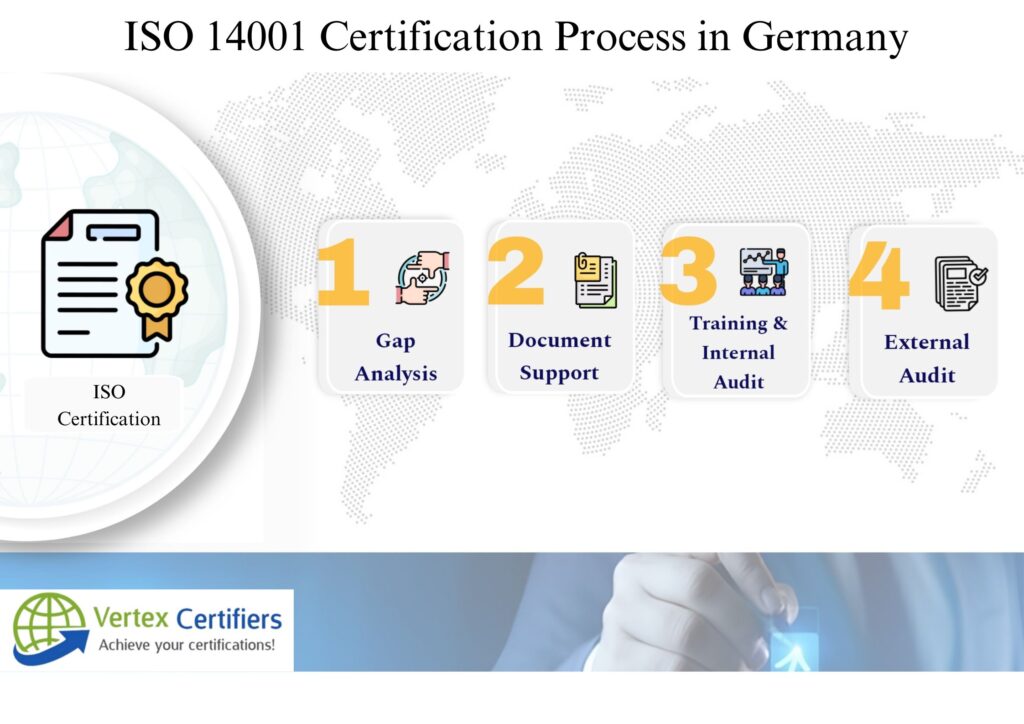
- Gap analysis against ISO 14001 requirements
Initial assessment comparing existing practices, documentation, and controls to the standard. This identifies gaps, risks, and priorities, and forms the basis of the implementation plan. - EMS documentation and register development
Development or updating of key EMS documents: environmental policy, aspects/impacts register, legal register, objectives and programs, procedures, roles, and emergency plans. Documentation should be lean and suited to the German regulatory context. - Implementation and employee awareness training
Processes and controls are implemented in operations, responsibilities are communicated, and staff receive awareness training on environmental aspects, legal obligations, and EMS procedures. - Internal audit and corrective actions
Internal audits are carried out to test the EMS against ISO 14001 and organizational requirements. Findings lead to corrective actions, closing gaps before the external certification audit. - Certification audit (Stage 1 & Stage 2)
- Stage 1: The certification body reviews documentation, scope, and readiness; it checks legal registers, aspects analysis, and the basic EMS design.
- Stage 2: Auditors visit relevant sites, review records, interview personnel, and verify that the EMS is effectively implemented and compliant.
- Certificate issuance and surveillance audits
After addressing any nonconformities, the organization receives an ISO 14001 certificate typically valid for three years. Annual surveillance audits confirm that the EMS is maintained and continually improved.