
ISO 22000 Certification in Thailand:
ISO 22000 Certification in Thailand, Vertex Certifiers is a global ISO consulting firm delivering end-to-end ISO 22000 Food Safety Management System (FSMS) services across Thailand’s major business hubs, including Bangkok, Chiang Mai, Phuket, Pattaya, Rayong, Ayutthaya, and Chonburi. Our expert food safety consultants support businesses in food manufacturing, seafood processing, hospitality, catering, packaging, agriculture, frozen foods, and retail sectors to achieve internationally recognized ISO 22000 certification. We offer complete solutions—from gap analysis, HACCP alignment, documentation, training, internal audits, and implementation to final certification—tailored to Thai regulatory requirements and global export standards. Along with ISO 22000, Vertex Certifiers also provides consultation for ISO 9001, ISO 14001, ISO 45001, ISO 27001, ISO 22301, ISO 20000-1, ISO 50001, ISO 37001, ISO 13485, ISO 17025, HACCP, and GMP, ensuring comprehensive support for all food safety and quality compliance needs.
ISO 22000 is a globally recognized Food Safety Management System (FSMS) standard, vital for guaranteeing food safety throughout the supply chain. For Thailand, a rapidly growing food industry leader and major global food exporter, implementing ISO 22000:2018 certification is essential. Food safety compliance not only meets regulatory requirements but also fosters trust among consumers and international trade partners, making FSMS a cornerstone of success in the competitive global food market.
The process to get ISO 22000 certification in Thailand typically involves the following key steps:
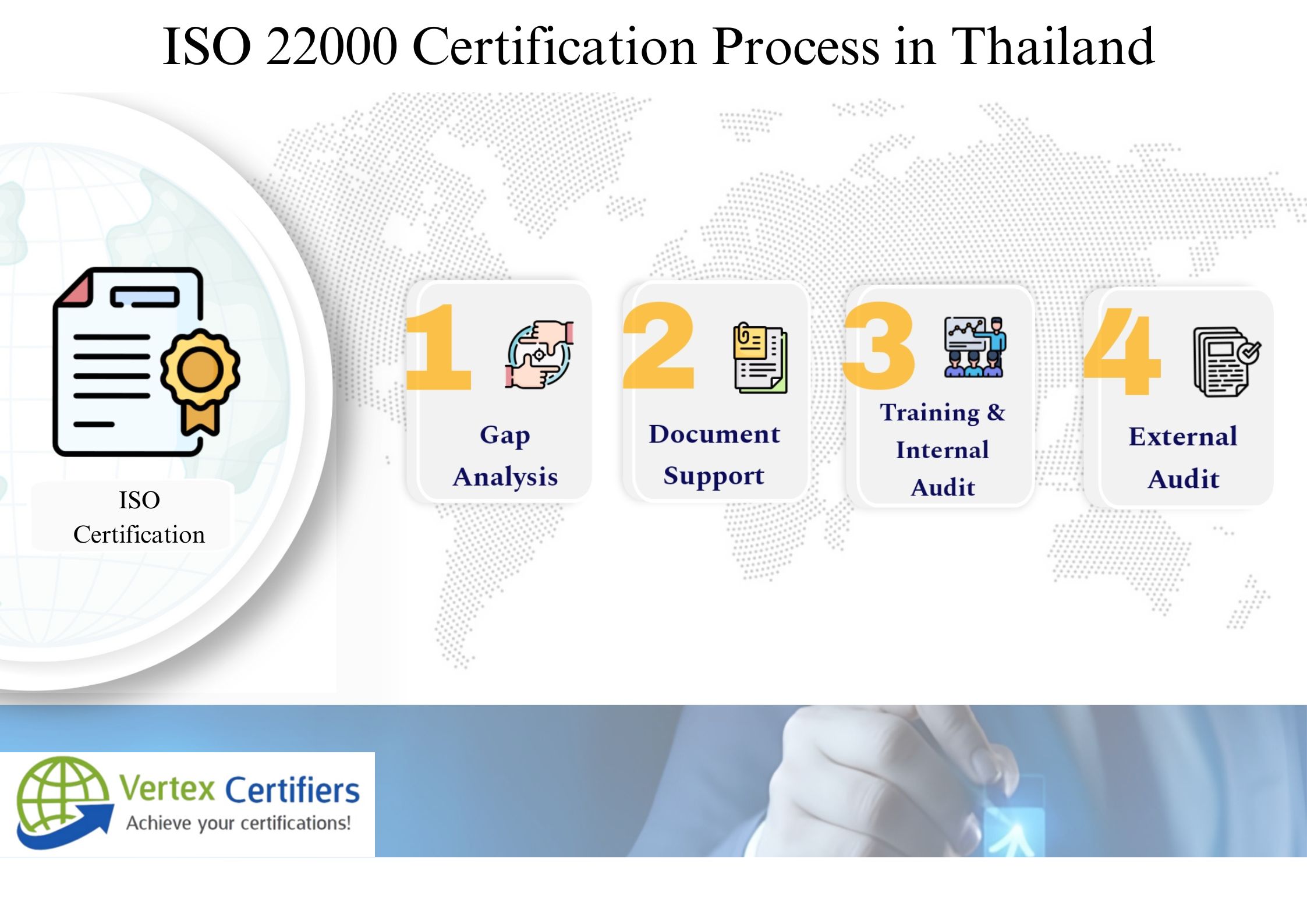
- Gap Analysis
Conduct an initial assessment to identify the current food safety management practices and gaps compared to ISO 22000 requirements. This helps determine areas needing improvement. - Develop FSMS Documentation
Create the Food Safety Management System documents, including policies, procedures, work instructions, and records aligned with ISO 22000:2018 standards and HACCP principles. - Implementation and Training
Put the FSMS into practice throughout the organization by training employees on food safety procedures, control measures, and their roles in maintaining compliance. - Internal Audit
Perform internal audits to evaluate the effectiveness of the FSMS and ensure conformity with ISO 22000 requirements. Address any nonconformities through corrective actions. - Management Review
Top management reviews the FSMS performance, audits, and resource adequacy to ensure continuous improvement and alignment with business objectives. - Certification Audit by Accredited Body
Engage an accredited certification body to conduct a two-stage audit:- Stage 1: Documentation review and readiness assessment
- Stage 2: On-site audit to verify implementation and effectiveness
Upon successful completion, the certification is granted.
- Continual Improvement
After certification, maintain and continually improve the FSMS through periodic internal audits, monitoring, and management reviews to uphold food safety standards.
Thailand is one of Southeast Asia’s leading food manufacturing and export economies, supplying processed foods, seafood products, beverages, agricultural goods, frozen foods, and packaged food products to international markets. As global food safety regulations continue to become stricter, food businesses in Thailand are increasingly adopting ISO 22000 certification to strengthen food safety management systems and improve international market acceptance.
ISO 22000 certification helps organizations establish a structured framework for identifying, controlling, monitoring, and reducing food safety hazards throughout the food supply chain. The standard integrates HACCP principles with internationally recognized food safety management requirements, helping organizations maintain product quality, regulatory compliance, and consumer confidence.
Food manufacturers, exporters, restaurants, catering companies, storage facilities, logistics providers, and food packaging businesses in Thailand benefit from ISO 22000 implementation by improving operational consistency, reducing contamination risks, strengthening traceability systems, and enhancing global customer trust.
For Thai businesses exporting food products to international markets, ISO 22000 certification also supports compliance with buyer expectations, international food safety requirements, and supply chain qualification standards.