ISO 9001 Certification in Egypt:
ISO 9001 Certification in Egypt, Achieving ISO 9001 certification in Egypt has become a strategic priority for organizations aiming to strengthen quality, enhance customer satisfaction, and remain competitive in fast-growing markets like Cairo, Alexandria, Giza, Sharm El-Sheikh, Port Said, and Suez. Vertex Certifiers is a global consulting and auditing firm supporting Egyptian companies with complete end-to-end solutions for ISO certification—including quality, environmental, information security, food safety, occupational health and safety, and other internationally recognized standards such as ISO 9001, ISO 14001, ISO 45001, ISO 27001, ISO 22000, ISO 22301, and more. With expert consultants, tailored documentation, structured implementation, internal audits, and certification support, Vertex helps organizations of all sizes achieve ISO compliance efficiently and cost-effectively in alignment with global best practices.
ISO 9001 certification in Egypt has become a key requirement for companies that want to improve quality, increase customer satisfaction, and compete in both local and international markets. In 2025, Egyptian businesses across Cairo, Giza, Alexandria, Port Said, Suez, Mansoura, Tanta, Asyut, Luxor, Hurghada, and Sharm El Sheikh are increasingly adopting ISO 9001 to standardize their processes and win more tenders and B2B contracts. This detailed SEO-optimized guide explains everything Egyptian organizations need to know about ISO 9001 certification, from requirements and process to benefits, costs, and timelines.
Introduction to ISO 9001 in Egypt
ISO 9001 is the world’s most widely used Quality Management System (QMS) standard, recognized in more than 170 countries and applied by millions of organizations of all sizes. It provides a structured framework for managing processes so that products and services consistently meet customer and regulatory requirements. For Egyptian businesses, this is critical in an environment where competition is rising and customer expectations are increasing.
In major business hubs such as Cairo, Giza, and Alexandria, ISO 9001 helps companies systemize their operations, reduce rework, and build stronger customer trust. Export-oriented industries operating through ports like Port Said and Suez also rely on ISO 9001 to meet international buyer requirements and enhance their reputation in global supply chains. Cities like Mansoura, Tanta, Asyut, Luxor, Hurghada, and Sharm El Sheikh benefit as well, especially in services, tourism, and hospitality where service quality directly impacts revenue.
What Is ISO 9001?
ISO 9001 is an international standard that sets out the criteria for a Quality Management System based on a set of core principles. These principles include customer focus, leadership, engagement of people, process approach, improvement, evidence-based decision making, and relationship management. Together, they ensure that the organization continually improves and consistently delivers value to its customers.
The standard follows a clause-based structure aligned with the high-level structure (Annex SL), which makes it compatible with other ISO standards. Key clauses cover areas such as leadership and commitment, planning with a focus on risk-based thinking, operational control of processes, performance evaluation, and continual improvement. Risk-based thinking is particularly important; organizations are required to identify risks and opportunities that could affect product or service quality and take appropriate actions. ISO 9001 is applicable to all types of organizations in Egypt – manufacturing, services, government entities, educational institutions, healthcare organizations, and more.
Process to obtain ISO 9001 Certification in Egypt
The ISO 9001 certification process in Egypt generally follows a structured sequence, which can be adapted based on the size and maturity of the organization:
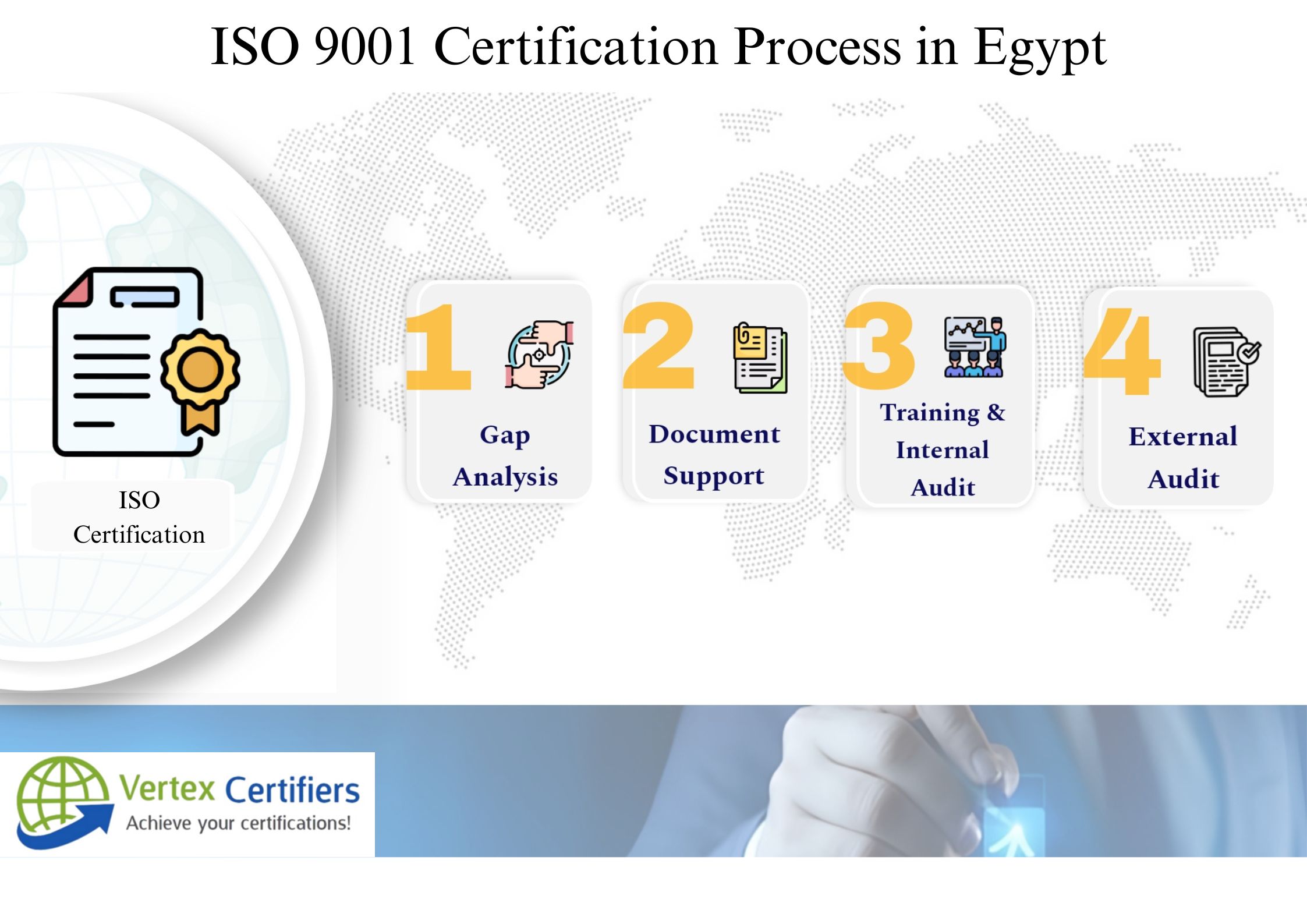
- Gap Analysis
An initial assessment compares your existing practices with ISO 9001 requirements. This identifies strengths, weaknesses, and areas needing improvement. - Documentation (Policies, Procedures, SOPs, QMS Manual)
Develop or update documents such as the QMS manual, quality policy, objectives, procedures, work instructions, process maps, and forms to match the standard and your actual operations. - Implementation of QMS Processes
The documented processes must be implemented in daily operations. Employees start using new forms, logs, and controls, and responsibilities are formally assigned. - Employee Training & Awareness
Staff at all levels are trained on ISO 9001 principles, procedures relevant to their roles, and the importance of following the QMS. This step is crucial to avoid a “paper-only” system. - Internal Audit
Internal auditors (either internal staff trained for this or external consultants) conduct audits to verify that processes meet both ISO 9001 and your own documented requirements. - Management Review
Top management reviews audit results, performance data, customer feedback, risks and opportunities, and decides on actions for improvement, resource allocation, and strategic direction. - Stage 1 Audit – Documentation Audit
The chosen certification body reviews your documented QMS to ensure that it meets the standard’s requirements and your declared scope. - Stage 2 Audit – Implementation Audit
Auditors visit your sites to verify implementation, interview employees, review records, observe operations, and confirm that the system is effectively working. - Certification Issuance
If all requirements are met and nonconformities (if any) are closed, the certification body issues an ISO 9001 certificate, typically valid for three years. - Surveillance Audits (Year 1 & 2)
Annual surveillance audits are conducted to ensure ongoing compliance and continual improvement until the recertification audit in the third year.
ISO 9001 Certification in Egypt
Comprehensive guide: benefits, requirements, industries, documentation, costs, timelines and city-specific services (Cairo, Alexandria, Giza, Port Said, Suez, Hurghada, Sharm El Sheikh).
Why ISO 9001 Certification Is Important for Businesses in Egypt
In Egypt, markets in cities like Cairo, Giza, and Alexandria are becoming more competitive as both local and international players enter key sectors such as manufacturing, healthcare, logistics, and retail. ISO 9001 certification helps companies stand out by demonstrating that they follow internationally accepted quality practices and are committed to continuous improvement. This is particularly important when clients compare multiple suppliers; certified companies are often perceived as lower risk and more reliable.
For exporters operating via Port Said and Suez, ISO 9001 plays an important role in meeting the quality and documentation expectations of foreign buyers. Many international procurement processes and supply chains either prefer or require ISO 9001-certified suppliers. Locally, sectors such as healthcare, manufacturing, trading, retail, and hospitality benefit from better process control, fewer customer complaints, and more consistent service delivery, which directly improves customer confidence and brand reputation.
Key Benefits of ISO 9001 Certification in Egypt
Egyptian companies that implement ISO 9001 QMS correctly can experience a wide range of tangible and intangible benefits. Some of the most important advantages include:
Higher customer satisfaction and retention
By controlling processes and measuring performance, organizations are better able to deliver on time, in spec, and within expected quality, leading to fewer complaints and higher repeat business.
Standardized processes and reduced errors
ISO 9001 requires documented procedures, clarity of roles, and defined process flows, which reduces confusion, rework, and variability between different employees or branches.
Compliance with Egyptian and international requirements
Many regulators, large buyers, and multinational partners expect structured quality management. ISO 9001 helps align internal practices with these expectations and supports compliance with relevant legal and sectoral requirements.
Better productivity and waste reduction
Through process mapping, performance indicators, and continual improvement, organizations can identify bottlenecks, non-value-added steps, and sources of waste, improving efficiency and reducing costs.
Competitive advantage in major cities and export industries
In Cairo and Alexandria, where many companies compete for the same corporate and government clients, ISO 9001 functions as a strong differentiator. Export-oriented businesses also use certification as evidence of reliability when dealing with international partners.
Eligibility for government tenders and B2B contracts
Many government tenders and large B2B contracts in Egypt either require or strongly favor ISO 9001-certified bidders. Having certification can open doors that might be closed to non-certified competitors.
Improved documentation, monitoring, and continual improvement
ISO 9001 promotes a culture of data-driven decision making with regular monitoring, measurement, internal audits, and management reviews, helping organizations continuously refine their operations.
Industries in Egypt That Need ISO 9001
ISO 9001 is relevant across almost every industry in Egypt, but some sectors see particularly strong value:
Manufacturing
(Cairo, Alexandria, 10th of Ramadan City) — Factories producing food, plastics, chemicals, textiles, and engineering goods use ISO 9001 to stabilize production, reduce rejection rates, and meet export requirements.
Food Processing & Packaging
Food companies combine ISO 9001 with food safety standards, using QMS to control documentation, traceability, and supplier approvals.
Construction & Engineering
Construction companies rely on ISO 9001 to manage projects, control subcontractors, and meet contractual specifications and timelines.
Oil & Gas
(Alexandria, Suez, Port Said) — Quality management supports operational reliability, safety, and regulatory compliance in high-risk environments.
Healthcare & Hospitals
Hospitals, clinics, laboratories, and diagnostic centers benefit from process standardization, patient safety initiatives, and better documentation.
Trading & Retail
Retailers and trading companies use ISO 9001 to manage supply chains, inventory accuracy, and customer service quality.
Logistics & Warehousing
(Cairo, Suez, Port Said) — Logistics operators improve delivery reliability, warehouse accuracy, and service transparency, important for import/export activities.
Tourism & Hospitality
(Sharm El Sheikh, Hurghada) — Hotels, resorts, travel agencies, and tour operators utilize QMS to deliver consistent guest experiences and handle customer feedback effectively.
Education & Training
Universities and training institutes adopt ISO 9001 to manage course delivery, examinations, student services, and continual improvement of curricula.
While ISO 9001:2015 is less prescriptive about mandatory documents than older versions, auditors still expect clear, controlled documentation that accurately reflects how the organization operates.
ISO 9001 Certification Cost in Egypt
The cost of ISO 9001 certification in Egypt depends on several factors and can vary significantly from one organization to another:
- Company size and number of employees — Larger organizations typically incur higher audit and implementation costs due to more sites, departments, and processes.
- Location (Cairo vs regional cities) — Travel and logistics for auditors and consultants can influence costs; companies in remote areas might pay slightly more than those in Cairo or Alexandria.
- Number and complexity of processes — Highly complex, regulated, or multi-site operations require more audit days and deeper consulting efforts.
- Documentation readiness — Organizations starting from scratch will need more support time compared to those with existing systems or partial documentation.
- Certification body selected — Internationally recognized bodies may charge higher fees but bring stronger global recognition and acceptance.
- Consultant engagement — Using experienced consultants adds cost but usually reduces internal effort, shortens timelines, and improves audit success rates.
You may position your services with a line such as: “For many small and medium Egyptian companies, ISO 9001 certification can start from an affordable range, and exact pricing depends on scope and requirements.”
How Long Does ISO 9001 Certification Take in Egypt?
The typical timeline for ISO 9001 certification is:
- Small companies: around 30–45 days, assuming management commitment and quick decision-making.
- Medium organizations: approximately 45–60 days, especially where multiple departments need alignment.
- Large enterprises: about 60–90 days, depending on the complexity of processes, number of locations, and existing systems.
Faster timelines are possible with expert consultancy, especially when documentation templates, ready-made formats, and trained auditors are provided. Realistically, the actual duration depends on how quickly the organization can implement changes, close nonconformities, and provide necessary records.
Major Cities in Egypt Where We Provide ISO 9001 Services
To maximize SEO and reach relevant search intent, include city-specific phrases throughout your page and headings such as:
- ISO 9001 Certification in Cairo
- ISO 9001 Certification in Alexandria
- ISO 9001 Certification in Giza
- ISO 9001 Certification in Port Said
- ISO 9001 Certification in Suez
- ISO 9001 Certification in Hurghada
- ISO 9001 Certification in Sharm El Sheikh
- ISO 9001 Certification in Asyut
- ISO 9001 Certification in Luxor
Highlight that services cover audits, documentation support, training, and certification assistance for organizations across these and other Egyptian cities.
Why Choose Vertex Certifiers for ISO 9001 Certification in Egypt?
- Experienced ISO consultants with global expertise
Consultants who understand both international requirements and local Egyptian business practices. - Customized documentation templates
Industry-specific formats for procedures, forms, and manuals that save time and reduce internal workload. - Fast and affordable certification support
Optimized project plans that reduce unnecessary steps and focus on what is required for successful certification. - End-to-end services
Support from gap analysis to implementation, training, internal audits, corrective actions, and coordination with certification bodies. - Coverage across all major Egyptian cities
On-site and remote support for Cairo, Giza, Alexandria, Port Said, Suez, Mansoura, Tanta, Asyut, Luxor, Hurghada, Sharm El Sheikh, and other locations. - Strong track record across sectors
Experience in manufacturing, trading, services, healthcare, logistics, hospitality, and education, demonstrating versatility and competence.
Frequently Asked Questions (FAQ)
- What is ISO 9001 certification?
ISO 9001 certification is formal recognition from an accredited certification body that your organization’s Quality Management System meets the requirements of the ISO 9001 standard. It verifies that you consistently control your processes, meet customer requirements, and pursue continual improvement. - Is ISO 9001 certification mandatory in Egypt?
ISO 9001 is not legally mandatory in Egypt, but it is often a requirement or strong advantage for government tenders, large B2B projects, and contracts with multinational companies. Many organizations seek certification to stay competitive and access more business opportunities. - How long does ISO 9001 certification take?
The duration typically ranges from 30 to 90 days, depending on the size of the company, complexity of operations, and level of readiness. With clear leadership commitment and professional guidance, timelines can be shortened. - How much does ISO 9001 cost in Egypt?
Costs vary based on company size, scope, number of locations, and chosen certification body. Additional expenses may include consulting, training, and internal resource time. The best way to know is to request a tailored quotation. - Do you help with documentation and audits?
Yes. A full-service consultancy like Vertex Certifiers provides assistance with documentation development, implementation, employee training, internal audits, and closing nonconformities before the certification audit.
Get ISO 9001 Certification in Egypt — Contact Us
If your organization in Egypt is ready to improve quality, win more tenders, and build stronger customer trust, ISO 9001 certification is the right step. Use the CTAs below to get started.
