ISO 9001 Certification in Myanmar :
ISO 9001 Certification in Myanmar has become a key requirement for businesses aiming to improve quality, strengthen customer trust, and compete in international markets. As Myanmar’s industries expand across Yangon, Mandalay, Naypyidaw, Taunggyi, Mawlamyine, Bago, Pathein, and Monywa, companies are increasingly adopting globally recognized quality management practices to enhance operational efficiency and win high-value contracts.
Vertex Certifiers supports companies across Myanmar with complete ISO consultation, documentation, implementation, training, and certification assistance. In addition to ISO 9001, we offer services for a wide range of ISO standards, including ISO 14001, ISO 45001, ISO 27001, ISO 22000, ISO 22301, ISO 50001, ISO 20000-1, ISO 13485, ISO 37001, and ISO 41001.
With expert auditors and industry specialists, Vertex Certifiers ensures smooth and effective certification for businesses of all sizes, helping them achieve compliance and continuous improvement across Myanmar’s key business hubs.
Myanmar’s business landscape is rapidly evolving, with companies increasingly seeking ways to improve operational efficiency, enhance customer satisfaction, and compete on both regional and global stages. One of the most effective tools for achieving these goals is ISO 9001 certification. Recognized worldwide, ISO 9001 sets the international benchmark for quality management systems (QMS). This guide provides a comprehensive overview of ISO 9001 certification in Myanmar, covering its definition, benefits, requirements, process, costs, and practical advice for organizations considering certification.
What is ISO 9001?
ISO 9001 is an internationally recognized standard for quality management systems. Developed by the International Organization for Standardization (ISO), it provides a framework for organizations to consistently deliver products and services that meet customer and regulatory requirements. At its core, ISO 9001 emphasizes a process-based approach, continual improvement, and customer focus.
A Quality Management System (QMS) refers to the policies, procedures, and processes an organization uses to ensure quality in its operations. ISO 9001 helps businesses systematically manage their processes, improve efficiency, and foster a culture of quality.
The standard is built on seven key principles:
- Customer focus
- Leadership
- Engagement of people
- Process approach
- Improvement
- Evidence-based decision making
- Relationship management
These principles guide organizations to not only meet customer expectations but also drive ongoing improvement.
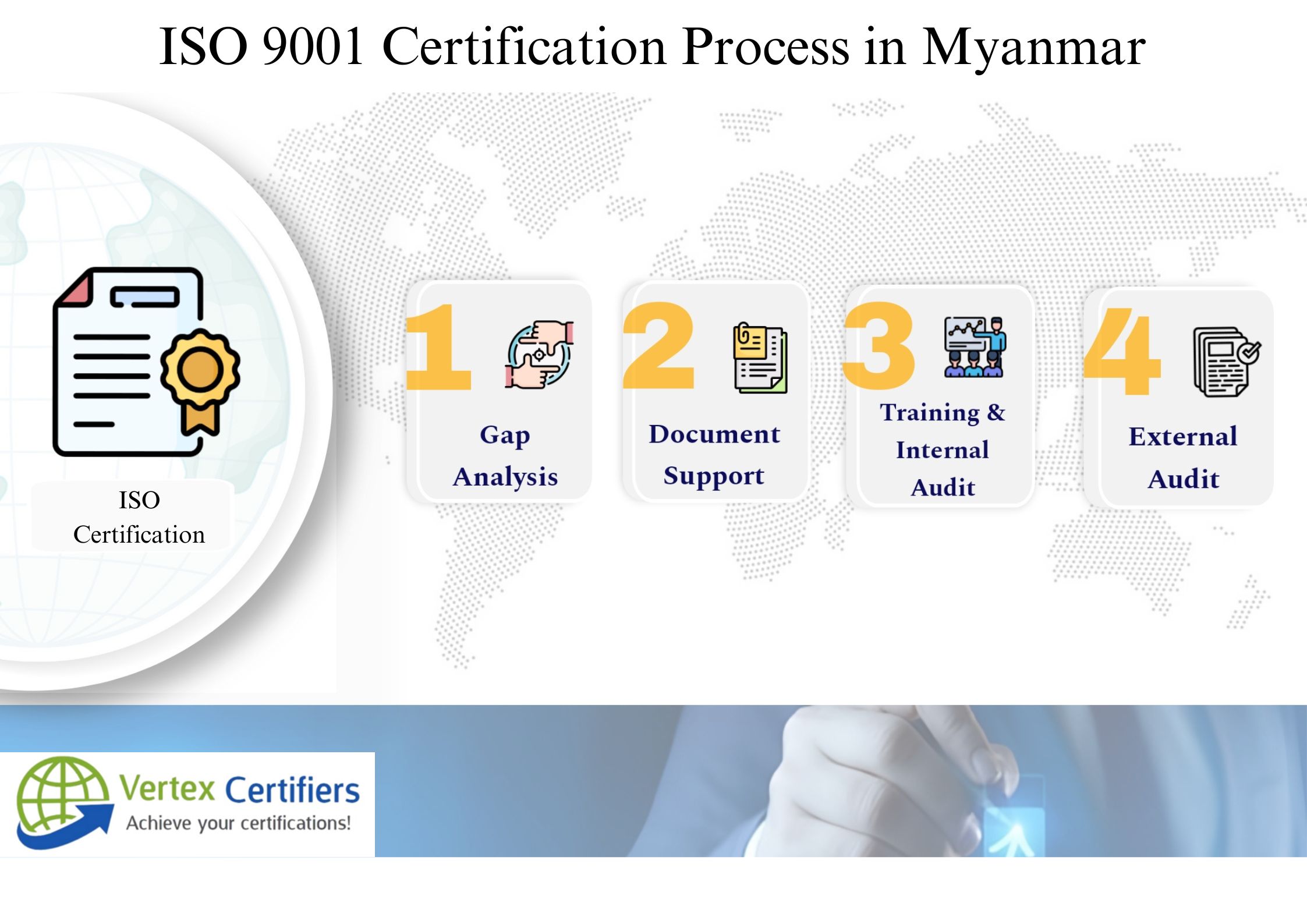
Step by Step Procedure to get ISO 9001 Certification in Myanmar:
Our Services
- GMP Certification
- GLP Certification
- GDP Certification
- Halal Certificate
- Organic Certificate
- CE Marking Certification
- RoHS Certification
- FDA Certification
- CMMI Certification
- Cyber Security
- VAPT Testing
- Security Assessment
ISO 9001 Certification in Myanmar — Vertex Certifiers
Practical guidance and a clear certification roadmap for organisations across Myanmar’s major cities.
Introduction
ISO 9001 certification is a strategic step for Myanmar businesses that want to improve quality, build customer confidence, and compete in international markets. Organisations across Yangon, Mandalay, Naypyidaw, Taunggyi, Mawlamyine, Bago, Pathein, Monywa, Sittwe and Dawei are adopting quality management systems to streamline operations and meet tender or investor requirements.
ISO 9001 Certification Process in Myanmar
- Gap Analysis — Assess current processes against ISO 9001 requirements and identify improvement areas.
- Documentation Development — Create or update QMS documents such as the quality manual, SOPs and work instructions.
- Implementation of QMS — Roll out the QMS and align operational processes with the standard.
- Employee Training — Train teams on QMS processes, roles and responsibilities to ensure consistent adoption.
- Internal Audit — Conduct internal audits to verify compliance and identify improvement opportunities.
- Corrective Actions — Close gaps and resolve non-conformities found during audits.
-
Certification Audit (Stage 1 & Stage 2)
- Stage 1: Documentation review and readiness assessment by the certification body.
- Stage 2: On-site assessment of implementation and QMS effectiveness.
- Award of ISO 9001 Certificate — Certificate issued after successful audits and closure of any findings.
- Surveillance Audits — Periodic audits to ensure ongoing compliance and continual improvement.
Why ISO 9001 Certification is Important in Myanmar
Certification signals a commitment to quality — helping win government tenders and international contracts.
Customers prefer suppliers who deliver consistent, reliable products and services.
Many tenders and investor requirements list ISO 9001 as a baseline credential.
Improves efficiency, reduces errors, and supports better resource management.
Benefits of ISO 9001 Certification
For Businesses
- Streamlined processes and reduced operational costs
- Improved documentation and accountability
- Better risk identification and mitigation
- Greater consistency in products and services
For Customers
- Higher trust and confidence
- Predictable quality and performance
- Faster response to queries and complaints
For Employees
- Clear roles and expectations
- Increased motivation and job satisfaction
- Access to training and career development
Requirements for ISO 9001 Certification
The ISO 9001:2015 standard sets out requirements for an effective QMS. Key expectations include documented procedures, maintained records (internal audits, management reviews, corrective actions, training), regular internal audits, and periodic management reviews to ensure the system remains effective and aligned with business goals.
Cost of ISO 9001 Certification in Myanmar
Certification costs depend on company size, scope, number of locations, and whether you use external consultants. Typical cost elements:
- Consultant fees (if engaged)
- Certification body audit fees
- Documentation and training expenses
- Ongoing surveillance audit fees
Budgeting for both initial certification and ongoing maintenance is essential.
Industries in Myanmar That Benefit from ISO 9001
- Manufacturing
- Construction
- Oil & Gas
- Trading Companies
- Logistics and Warehousing
- Hospitality
- Educational Institutions
- Healthcare and Clinics
Challenges Faced by Myanmar Organisations
- Limited in-house expertise on QMS
- Time-intensive documentation effort
- Employee resistance to process changes
- Implementation timelines that vary by size and complexity
Addressing these challenges requires leadership commitment, clear communication and, often, external support.
How to Choose an ISO 9001 Certification Body in Myanmar
- Accreditation: Prefer certification bodies recognised by established accreditation schemes.
- Reputation & Experience: Look for a proven track record in your industry.
- Local Presence: Local offices or partners offer better on-the-ground support.
- Cost vs Value: Consider the overall value and audit approach, not just price.
How an ISO Consultant Can Help
An experienced consultant speeds up implementation, assists with documentation, delivers training, prepares teams for audits, and helps close non-conformities — reducing risk and creating a smoother path to certification.
Conclusion
ISO 9001 certification is more than compliance — it’s a strategic advantage for Myanmar businesses pursuing operational excellence and market access. The benefits in efficiency, trust and competitiveness make it a worthwhile investment for organisations of all sizes.
FAQ
How long does it take to get ISO 9001 certified in Myanmar?
The timeline typically ranges from 6 to 12 months, depending on company size and readiness.
Is ISO 9001 mandatory in Myanmar?
ISO 9001 is not mandatory for all businesses but is often required for tenders and international contracts.
Can small businesses get ISO 9001 certified?
Yes — ISO 9001 is scalable and suitable for organisations of any size.
What happens after certification?
After certification, organisations undergo regular surveillance audits to retain validity and ensure continual improvement.
