Key Elements of GMP
Good Manufacturing Practice (GMP) is built on a structured system of controls that ensure products are consistently manufactured to meet quality and safety standards. Core elements of GMP include raw material handling and supplier control, covering approval, sampling, testing, and proper storage of incoming materials. Equally important is facility layout and hygiene, which requires clear segregation of clean and dirty areas, effective pest control, and documented sanitation procedures to prevent contamination.
GMP also emphasizes equipment qualification, calibration, and preventive maintenance to ensure reliable and reproducible performance. Robust process controls, in-process checks, and validation of critical steps are required to maintain consistent product quality. Staff training and hygiene programs define responsibilities and ensure personnel understand GMP expectations. Finally, comprehensive documentation systems—including batch records, deviation management, and traceability—support investigations and product recalls when necessary.
In Thailand, GMP requirements are issued and enforced by the Thai FDA and are aligned with WHO GMP, ASEAN GMP, and PIC/S GMP, depending on the product category such as medicines, food, or cosmetics.
Importance of GMP Certification in Thailand
For regulated industries in Thailand, GMP certification is both a legal obligation and a strategic business advantage. The Thai FDA requires pharmaceutical manufacturers and many food producers to operate under GMP before granting marketing authorization or product registration.
- Ensures product safety and quality by minimizing contamination, cross-contamination, and human error.
- Demonstrates compliance with Thai FDA regulations, supporting licenses, site registration, and product approvals.
- Reduces defects, batch failures, and recalls, protecting revenue and brand reputation.
- Builds consumer and buyer trust for sensitive products such as medicines, functional foods, cosmetics, and medical devices.
- Supports exports to ASEAN and international markets through ASEAN GMP and PIC/S-aligned systems.
- Improves operational efficiency and risk management through standardized procedures and continuous improvement.
Why GMP is Required for Manufacturing
Regulators worldwide, including in Thailand, mandate GMP because poor manufacturing practices can directly threaten public health. Contaminated, mislabeled, or substandard products can lead to serious adverse events, product recalls, and loss of life—risks that GMP systems are designed to prevent.
- Prevents contamination, mix-ups, and process errors through structured cleaning and segregation.
- Ensures regulatory compliance, as Thai FDA product registration and site licensing are closely linked to GMP evidence.
- Protects consumers through full traceability, batch documentation, and recall readiness.
- Ensures consistent quality between batches, critical for pharmaceuticals, food safety, and cosmetics.
- Supports international recognition under WHO and PIC/S-based GMP frameworks.
Without GMP, manufacturers risk penalties, license suspension, product bans, and rejection of export applications.
GMP Certification – Applicable Industries in Thailand
The Thai FDA oversees multiple regulated product categories, and GMP has become a central requirement across industries:
- Pharmaceuticals: Prescription, OTC, and certain traditional medicines.
- Food & Beverage Processing: Mandatory baseline for food factory safety.
- Dietary Supplements & Nutraceuticals: Control of formulation and contamination risks.
- Cosmetics & Personal Care: Required under the ASEAN Cosmetic Directive.
- Medical Devices: Increasingly tied to GMP or QMS compliance.
- Herbal & Traditional Medicines: Subject to pharma or sector-specific GMP rules.
- Animal Feed & Veterinary Products: Prevents contamination and protects animal health.
How Vertex Certifiers Supports GMP Certification in Thailand
Working with an experienced GMP consulting partner significantly reduces approval timelines and compliance risk. Vertex Certifiers guides manufacturers through Thai FDA and international GMP requirements in a practical, business-focused manner.
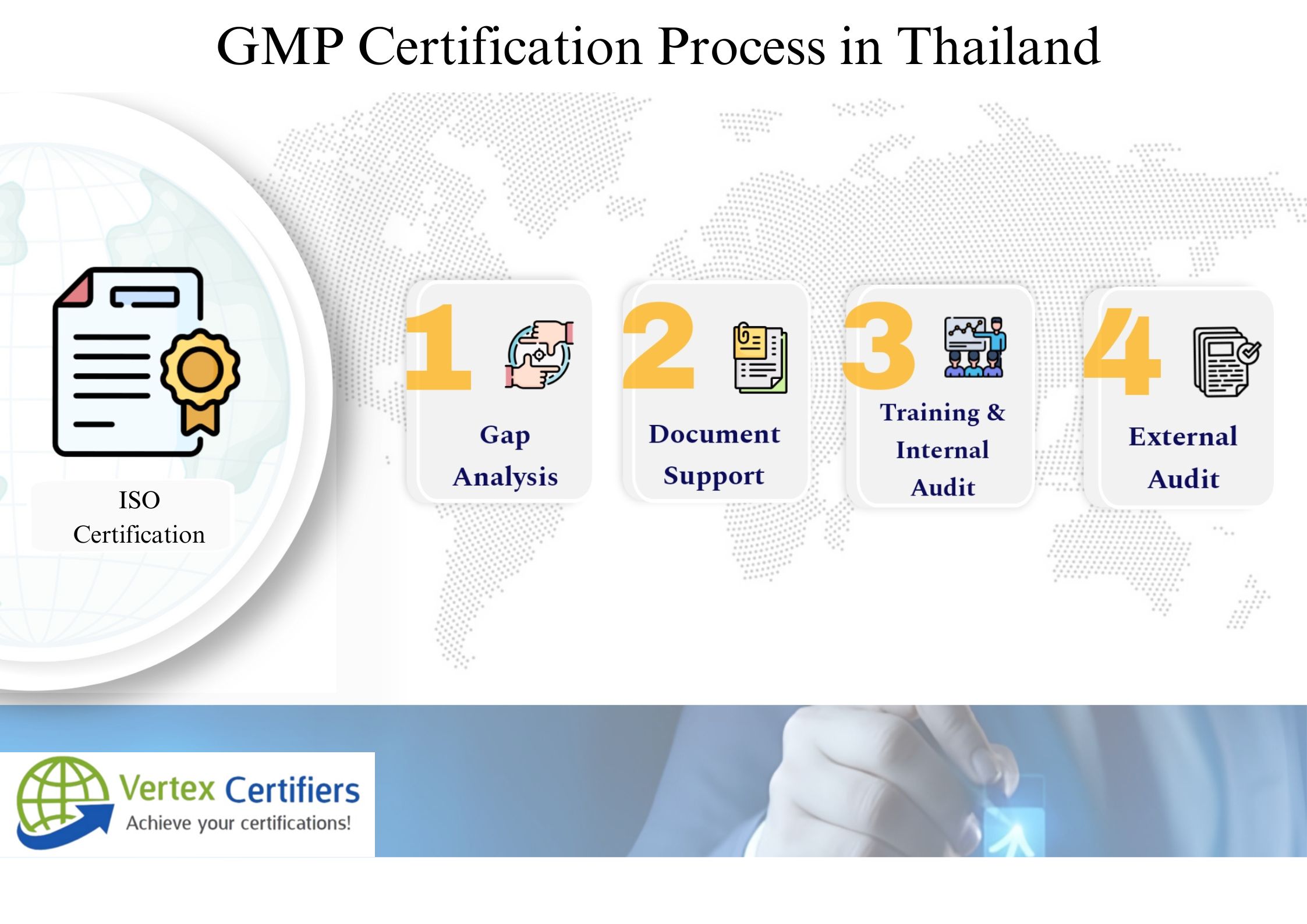
- Free initial GMP gap assessment aligned with Thai FDA, WHO GMP, ASEAN GMP, and PIC/S concepts.
- Customized GMP documentation: Quality Manuals, SOPs, batch records, cleaning and validation templates.
- Regulatory guidance for Thai FDA submissions, cosmetic notifications, and pharmaceutical site licensing.
- Staff training and GMP implementation workshops.
- Audit preparation, mock inspections, and support for closing regulatory observations.
Vertex Certifiers helps organizations embed GMP into their quality culture—not just meet inspection requirements.
Why Choose Vertex Certifiers for GMP in Thailand?
- Experienced GMP consultants with strong ASEAN and Thai FDA expertise.
- Integrated approach covering WHO, PIC/S, and ASEAN GMP alignment.
- Industry-specific GMP solutions for pharma, food, cosmetics, nutraceuticals, and medical products.
- Faster approvals through structured planning and pre-inspection readiness.
- Transparent, SME-friendly pricing with long-term compliance support.
Start Your GMP Journey in Thailand
Planning to obtain GMP Certification in Thailand for your manufacturing facility or contract unit?
Build GMP readiness early to simplify Thai FDA inspections and strengthen your local and export market position.
📧 Email us at
info@vertexcertifiers.com
🌐
Contact Vertex Certifiers
for a free GMP consultation and customized proposal.