
GMP Certification in Myanmar:
GMP Certification in Myanmar, Vertex Certifiers provides end-to-end certification and compliance solutions for organizations across Myanmar, supporting businesses in Yangon, Mandalay, Naypyidaw, Bago, and other major industrial hubs. Our expert team delivers complete implementation support for Good Manufacturing Practice certification, helping pharmaceutical, food, cosmetics, and healthcare manufacturers achieve regulatory compliance and consistent product quality. In addition to GMP implementation support, we offer integrated ISO services including ISO 9001 (Quality Management), ISO 22000 (Food Safety), ISO 14001 (Environmental Management), ISO 45001 (Occupational Health & Safety), and ISO 27001 (Information Security). From gap analysis and documentation to training, internal audits, and certification coordination with accredited bodies, we ensure a smooth, cost-effective, and timely certification process tailored to your industry needs.
Myanmar’s pharmaceutical, food processing, cosmetics, and healthcare sectors are booming, fueled by economic reforms, urbanization, and rising consumer demand. From Yangon factories to Mandalay herbal producers, the nation produces everything from generic drugs to traditional remedies and packaged foods. Yet, this growth demands rigorous standards amid increasing regulatory scrutiny.
Good Manufacturing Practice (GMP) certification stands as the gold standard for product safety, hygiene, and compliance. Mandated by Myanmar’s Food and Drug Administration (FDA) and Ministry of Health, GMP ensures consistent quality that meets national laws and international expectations. For exporters, it’s a passport to ASEAN markets like Thailand, Vietnam, and beyond—where non-certified goods face rejection.
Integrating GMP with ISO 9001 enhances quality management through structured processes, while GMP + ISO 22000 fortifies food safety. These combinations help Myanmar businesses scale globally, reduce recalls, and build trust in competitive regional trade.
What is Good Manufacturing Practice (GMP)?
Good Manufacturing Practice (GMP) is a comprehensive system that ensures products are consistently produced and controlled according to quality standards suitable for their intended use. Guided by WHO principles and adapted locally, GMP covers the entire production lifecycle—from raw materials to final packaging.
Key elements include:
- Hygiene and sanitation controls: Cleanrooms, pest management, and cross-contamination prevention.
- Process standardization: Validated recipes, batch controls, and change management.
- Equipment validation and maintenance: Calibrated machinery with preventive servicing.
- Documentation and record keeping: Batch records, deviation logs, and traceability systems.
- Personnel training and competency: Regular skill assessments and hygiene protocols.
- Quality control and traceability: Testing labs, sampling, and recall procedures.
GMP applies to pharmaceuticals and medical devices, food and beverages, cosmetics and personal care, plus nutraceuticals and herbal products. In Myanmar, GMP certification Myanmar is essential for FDA registration and export viability.
Why GMP Compliance is Important in Myanmar
Myanmar’s health and food authorities, including the FDA and Department of Food and Drug Administration, enforce strict GMP for product registration and licensing. Imported and local drugs must prove GMP compliance to hit shelves, with penalties for violations rising amid public health concerns.
International buyers—from ASEAN distributors to EU importers—demand GMP-verified suppliers. Local manufacturers competing with Thai or Indian rivals need it to secure contracts. GMP slashes contamination risks, product failures, and recalls, which have plagued herbal and food sectors.
Ultimately, GMP compliance Myanmar positions businesses for sustainable growth, protecting consumers and enabling market expansion.
GMP Certification Process in Myanmar
The GMP journey in Myanmar is systematic and achievable by GMP Consultants in Myanmar:
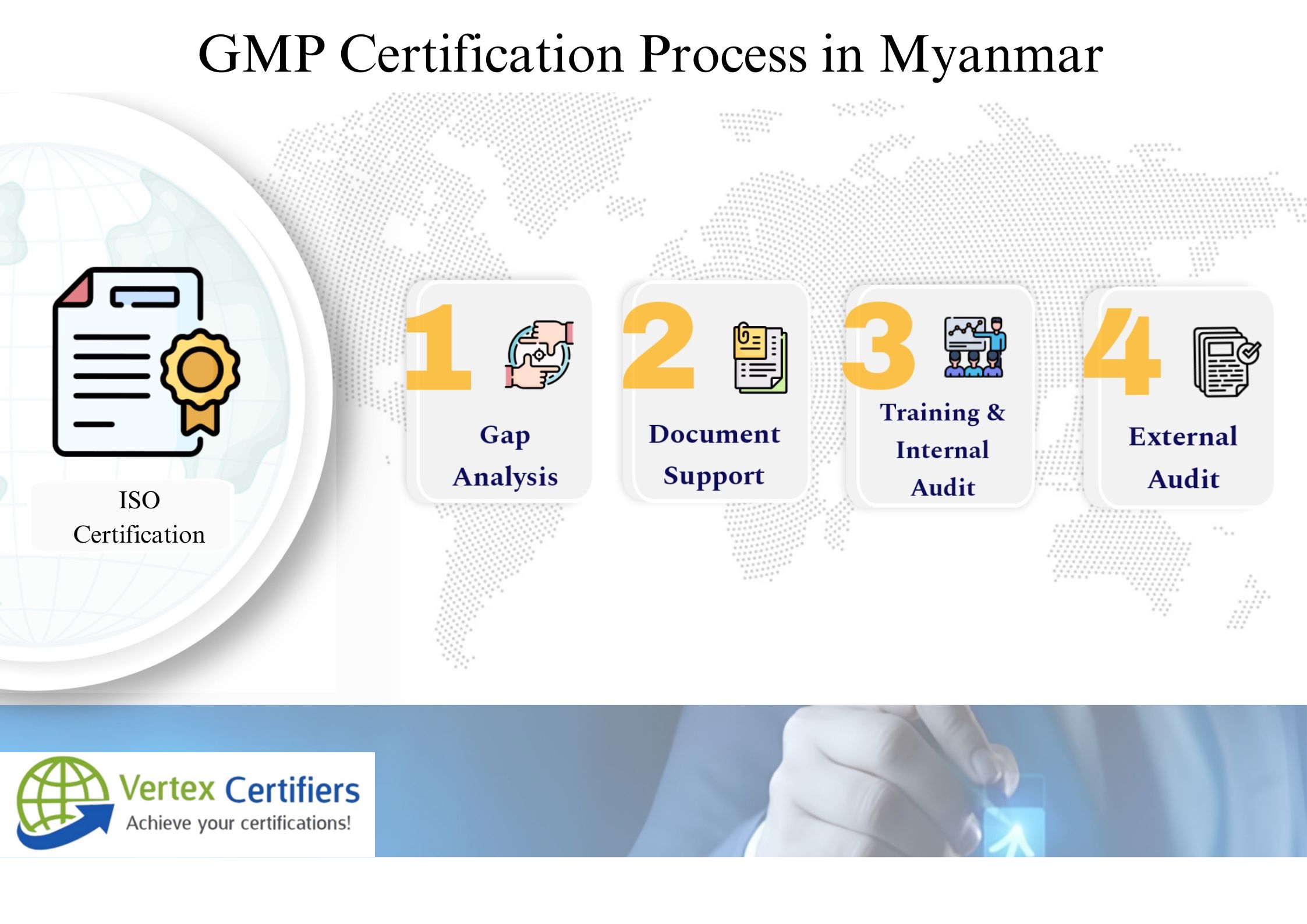
Initial Gap Analysis and Readiness Assessment
Experts evaluate facilities against WHO GMP and local FDA guidelines.
Documentation Development
Craft Quality Manuals, SOPs, and records—integrating ISO where needed.
Facility and Process Improvements
Upgrade sanitation, HVAC, and validation systems.
Employee Training and Awareness
Hands-on programs on GMP hygiene and compliance.
Internal Audit and Management Review
Identify fixes before external eyes.
Certification Audit by an Accredited Body
Stage 1 (docs) and Stage 2 (site) audits by bodies like SGS or local partners.
Issue of GMP Certification
Receive your certificate, valid 1-3 years with annual surveillance.
Simultaneous ISO 9001 or ISO 22000 implementation accelerates results.
Integration with ISO Standards
Combining GMP with ISO creates synergistic systems that amplify benefits.
GMP + ISO 9001
This integration delivers process consistency via ISO 9001’s PDCA cycle and GMP’s controls. Risk-based quality management identifies threats early, while robust internal audits and corrective actions drive improvement. Pharmaceutical and general manufacturing companies in Naypyidaw thrive with this setup.
GMP + ISO 22000
GMP + ISO 22000 merges hygiene with food safety hazard controls and HACCP principles. It prevents biological, chemical, and physical risks in processing. Food processors, packaging firms, and distributors in Mandalay gain efficiency without overlap.
Integrated GMP ISO 22000 or GMP ISO 9001 reduces duplication, cuts costs, and streamlines audits—perfect for Myanmar’s diverse industries.