ISO 14001 Certification in Tunisia:
ISO 14001 Certification in Tunisia, Vertex Certifiers is a globally recognized ISO consulting and certification service provider, offering end-to-end support for ISO 14001 Certification in Tunisia. With a strong focus on environmental responsibility, regulatory compliance, and continual improvement, we help organizations of all sizes implement effective Environmental Management Systems (EMS) that meet international standards. Our team of experienced ISO 14001 lead auditors and environmental management consultants works closely with businesses across Tunisia — including Tunis, Sfax, Sousse, Kairouan, Bizerte, Gabès, Ariana, Gafsa, Monastir, Nabeul, and Ben Arous — to achieve certification efficiently while reducing environmental impact, optimizing resource use, and enhancing sustainability performance.
ISO 14001 Certification in Tunisia: A Guide for Sustainable Business Growth
Are you a Tunisian business leader in manufacturing, oil & gas, agriculture, chemicals, or export-oriented SMEs looking to elevate your environmental performance? ISO 14001 Certification in Tunisia offers a proven framework to manage environmental responsibilities while boosting competitiveness. This internationally recognized standard, updated in 2015, emphasizes proactive environmental management systems (EMS) that align with Tunisia’s push toward sustainable development.
Tunisia’s economy, driven by industrial hubs like Sfax, Sousse, and Tunis, faces mounting pressure to adopt green practices amid EU export demands and national sustainability goals. With ISO 14001, companies reduce risks, cut waste, and unlock global opportunities. In this guide, explore why ISO 14001 Tunisia is essential and how to achieve it efficiently.
Introduction to ISO 14001 in Tunisia
ISO 14001:2015 sets the global benchmark for environmental management, helping organizations minimize their ecological footprint through structured processes. In Tunisia, where industries contribute over 30% to GDP, this certification resonates deeply with sectors like manufacturing (textiles and automotive parts), oil & gas services in the Gulf of Gabès, agriculture (olive oil and dates), chemicals production, and export-focused SMEs targeting Europe.
The standard promotes a Plan-Do-Check-Act (PDCA) cycle for continual improvement, focusing on pollution prevention, resource conservation, and legal compliance. Tunisia’s government, via the Ministry of Environment and the National Agency for Environmental Protection (ANPE), increasingly prioritizes sustainability. Recent initiatives like the National Strategy for Sustainable Development (2017-2030) align perfectly with ISO 14001, encouraging businesses to certify for incentives like tax rebates and easier permitting.
For Tunisian exporters, ISO 14001 Certification in Tunisia signals commitment to green standards, vital as the EU’s Green Deal imposes stricter import rules. Local firms in Bizerte’s industrial zone or Kairouan’s agro-processing plants have seen certification drive efficiency gains of up to 20% in energy use.
Why ISO 14001 Is Important for Tunisian Businesses
Tunisian companies operate in a resource-constrained environment where environmental mismanagement can lead to hefty fines, shutdowns, or lost contracts. ISO 14001 equips businesses with tools to identify, control, and mitigate risks, ensuring operations remain resilient.
At its core, the standard fosters a culture of environmental accountability. Organizations conduct aspect-impact analyses to pinpoint high-risk activities—like wastewater discharge in chemical plants—and implement controls. This directly supports compliance with Tunisia’s Law No. 2001-14 on environmental protection, avoiding penalties from ANPE inspections.
Beyond regulations, ISO 14001 aligns Tunisian firms with global sustainability trends. International buyers, especially in Europe and North America, demand certified suppliers. For oil & gas service providers in Sfax, certification enhances bid success rates in tenders requiring EMS proof. SMEs gain a competitive edge, proving they meet ESG (Environmental, Social, Governance) criteria that investors scrutinize.
Key Environmental Challenges Faced by Companies in Tunisia
Tunisia grapples with unique ecological pressures that ISO 14001 directly addresses. Water scarcity tops the list—affecting 90% of the territory—pushing manufacturers and agribusinesses to optimize usage amid annual deficits of 500 million cubic meters.
- Water scarcity and resource efficiency: Industries in arid regions like Tataouine consume vast amounts; ISO 14001 drives recycling and monitoring for 15-30% savings.
- Industrial waste management: Zones like Ben Arous generate hazardous waste; the standard mandates safe handling, reducing landfill reliance per Decree No. 1155/2014.
- Emissions control in manufacturing zones: Factories in Gabès emit pollutants; certification enforces air quality controls aligned with EU norms.
- Environmental compliance for EU exports: Over 70% of Tunisian exports go to Europe; non-compliance risks REACH-like barriers, making ISO 14001 a gateway.
Addressing these builds resilience against climate events like droughts, which disrupted 2024 olive harvests.
Benefits of ISO 14001 Certification in Tunisia
Certified Tunisian firms reap tangible rewards. Reduced environmental incidents drop liability risks, with many reporting zero spills post-certification.
Energy and water efficiency improvements yield cost savings—textile plants in Monastir cut bills by 25%. Enhanced corporate image attracts stakeholders; banks favor green loans, and consumers prefer eco-brands amid Tunisia’s rising sustainability awareness.
- Lower penalties and operational disruptions
- Quantifiable efficiency gains (e.g., 10-20% resource reduction)
- Boosted trust from partners and regulators
- Edge in tenders—certified bidders win 40% more EU contracts
Long-term, it future-proofs businesses against tightening regs like the 2025 ANPE emission caps.
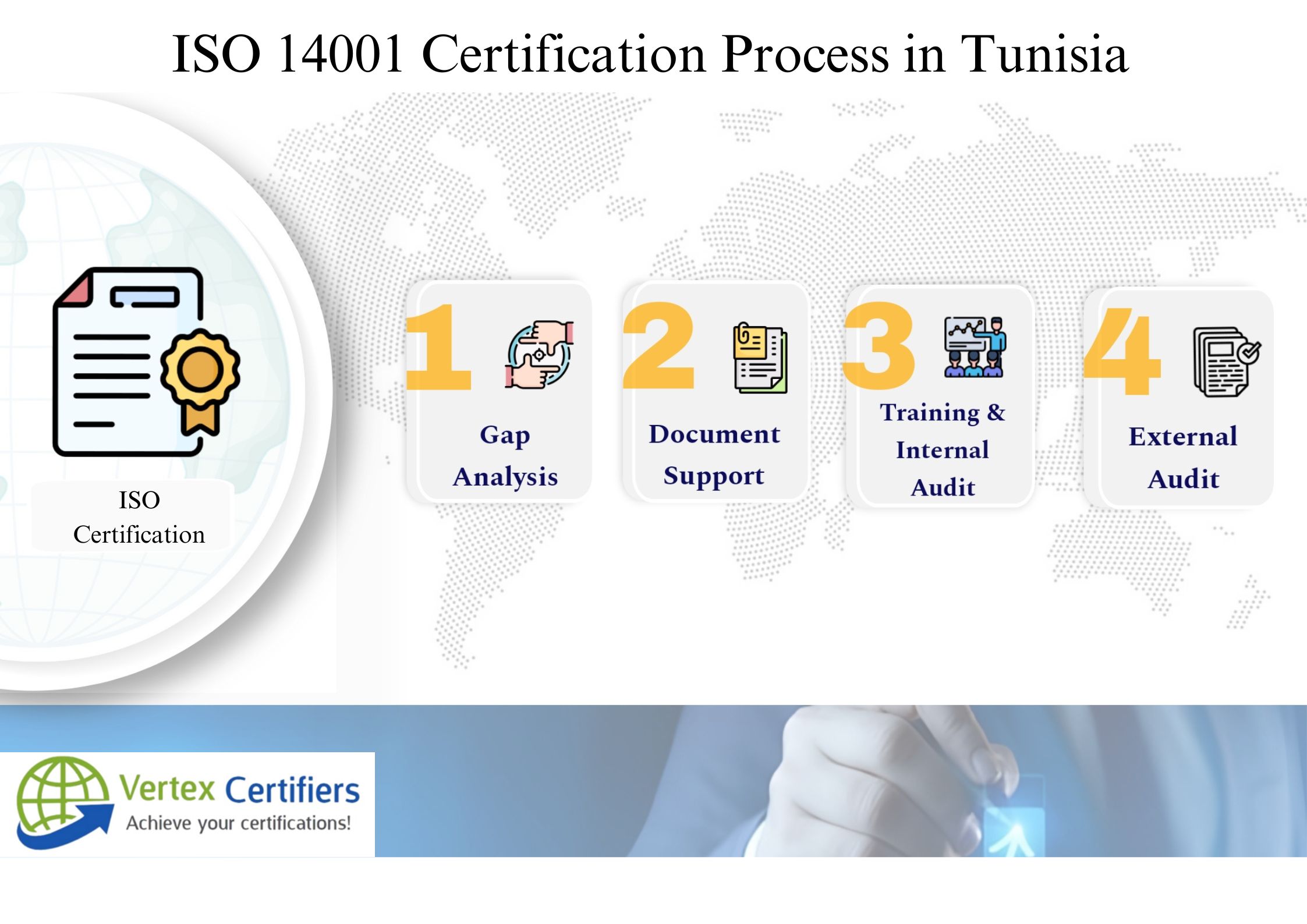
ISO 14001 Certification Process in Tunisia
Achieving ISO 14001 Certification in Tunisia follows a structured path, typically coordinated with accredited bodies like TUNAC or international auditors.
- Gap analysis and environmental review: Assess current practices against ISO 14001 clauses.
- Identification of environmental aspects & impacts: Map operations (e.g., emissions from oil refineries) and prioritize risks.
- Legal compliance evaluation: Review ANPE regs and international obligations.
- EMS documentation and implementation: Develop policies, objectives, and training programs.
- Internal audit and management review: Verify effectiveness and correct gaps.
- Stage 1 & Stage 2 certification audits: Documentation review followed by on-site validation; certification issued within weeks if successful.
Post-certification, annual surveillance ensures ongoing compliance. Tunisian firms often integrate this with existing ISO 9001 systems for synergy.
Cost and Timeline for ISO 14001 Certification in Tunisia
Timelines vary by organization size and complexity:
- Small companies (under 50 employees): 4–6 weeks, ideal for SMEs.
- Medium enterprises (50-250 employees): 6–8 weeks, common for manufacturers.
- Large or high-risk industries (e.g., chemicals/oil & gas): 8–12 weeks due to multi-site audits.
Factors influencing timeline and effort include organizational scope, number of sites, risk levels (e.g., hazardous waste), and workforce size. Streamlined consultants accelerate this without compromising quality.
ISO 14001 Compliance with Tunisian Regulations and Global Markets
ISO 14001 seamlessly integrates with Tunisia’s framework, including ANPE’s Integrated Pollution Prevention and Control (IPPC) permits and Law No. 2017-52 on waste. It exceeds basics by embedding continual improvement.
For exports, it matches EU Eco-Management and Audit Scheme (EMAS) expectations and CBAM carbon border taxes. Global buyers in North America and the Middle East value it for supply chain audits. ESG reporting under frameworks like GRI becomes straightforward, appealing to investors tracking Tunisia’s green transition.
Why Choose Vertex Certifiers for ISO 14001 Certification in Tunisia
Vertex Certifiers stands out as your trusted partner for ISO 14001 Tunisia. With expertise across manufacturing, oil & gas, and agriculture, we deliver end-to-end EMS implementation tailored to Tunisian contexts.
- Local audit coordination with ANPE and TUNAC
- Industry-specific solutions, from Sfax refineries to Sousse exporters
- Fast-track processes minimizing downtime
- Proven track record in multi-site, high-risk certifications
Our practical approach ensures certification without overheads. Ready to go green? Contact Vertex Certifiers today for a free gap analysis and fast-track your ISO 14001 Certification in Tunisia.
Frequently Asked Questions (FAQ)
What is ISO 14001 Certification in Tunisia?
It’s an international standard for EMS, helping Tunisian businesses manage environmental impacts while complying with ANPE regs.
How long does ISO 14001 certification take in Tunisia?
4-12 weeks, depending on company size and risk profile.
Is ISO 14001 mandatory in Tunisia?
Not yet, but essential for EU exports and ANPE compliance.
Which Tunisian industries benefit most?
Manufacturing, oil & gas, agriculture, chemicals, and SMEs.
How does Vertex Certifiers support ISO 14001 in Tunisia?
We provide full implementation, audits, and local expertise for quick results.
Start your ISO 14001 journey today—Get a Free Consultation with Vertex Certifiers!
Procedure to get ISO 14001 Certification in Tunisia: