Vertex Certifiers

ISO 9001 Certification in Tunisia:

ISO 9001 Certification in Tunisia, Vertex Certifiers is a globally recognized ISO consulting and certification service provider, offering end-to-end support for ISO Certification in Tunisia. With a strong focus on quality, customer satisfaction, and continuous improvement, we assist organizations of all sizes in implementing robust Quality Management Systems (QMS) that meet international standards. Our team of experienced ISO 9001 lead auditors and consultants works closely with businesses across Tunisia — including Tunis, Sfax, Sousse, Kairouan, Bizerte, Gabès, Ariana, Gafsa, Monastir, Nabeul, and Ben Arous — to help them achieve certification efficiently and effectively.

ISO 9001 is an internationally recognized standard for Quality Management Systems (QMS), crucial for organizations aiming to deliver consistent quality, improve customer satisfaction, and boost operational efficiency. In Tunisia, adopting ISO 9001 helps businesses align with global quality benchmarks, enabling them to compete effectively in both local and international markets. Many Tunisian companies across diverse industries pursue this certification to strengthen their market position and meet increasing customer expectations

What is ISO 9001 Certification?

ISO 9001:2015 outlines requirements for a QMS that emphasizes several key principles:

  • Customer focus: Prioritizing customer needs and satisfaction.
  • Leadership and engagement of people: Ensuring management commitment and workforce involvement.
  • Process approach: Managing activities as processes to achieve efficient results.
  • Continuous improvement: Constantly enhancing products, services, and processes.
  • Evidence-based decision-making: Using data and facts to guide decisions.

This standard is applicable to organizations of all sizes and sectors, establishing a systematic approach to quality that leads to consistent delivery of products and services

Why ISO 9001 Certification is Important in Tunisia ?

Tunisia’s growing economy and expanding business landscape drive the need for adherence to global quality standards. ISO 9001 certification lends credibility and trust to organizations by assuring customers and partners of high-quality products or services. It improves operational efficiency through better process control, increases customer satisfaction and loyalty, and opens doors to global markets and valuable partnerships—essential for Tunisian businesses aiming to expand beyond local boundaries.

Industries Benefiting from ISO 9001 Certification in Tunisia:

ISO 9001 applies broadly, but is especially significant in the following industries in Tunisia:

  • Manufacturing and Engineering: Enhances product quality and process reliability.
  • Food Processing and Agribusiness: Ensures safety, quality, and compliance with standards.
  • Healthcare and Pharmaceuticals: Supports patient safety and regulatory adherence.
  • Construction and Real Estate: Improves project quality and client satisfaction.
  • Education and Training Services: Guarantees standardization and quality of services.
  • IT and Business Process Outsourcing: Boosts process efficiency and customer trust.
  • Transportation and Logistics: Optimizes operations and service delivery

Process of Getting ISO 9001 Certification in Tunisia:

The certification journey involves the following steps:
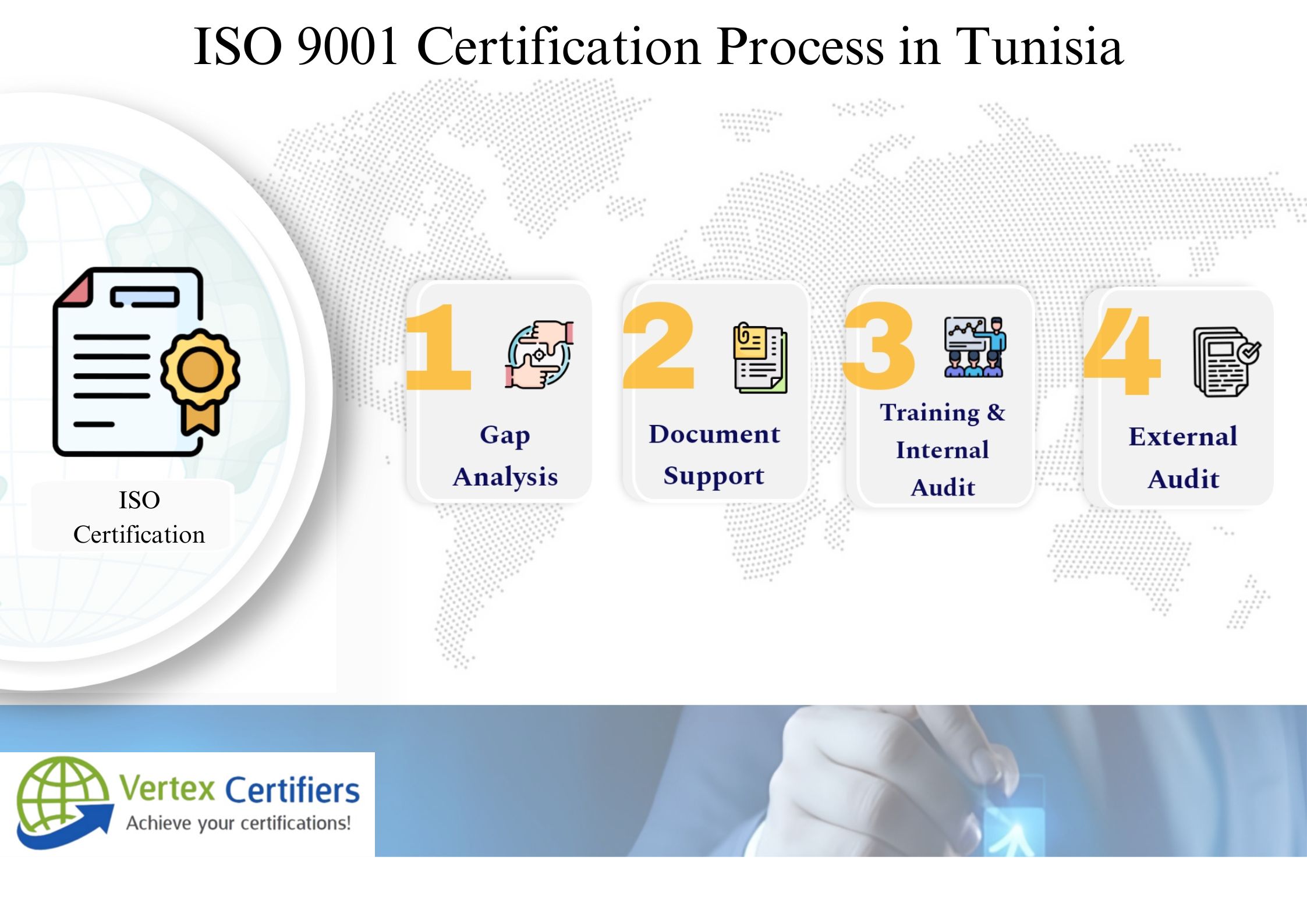
ISO 9001 Certification in Tunisia
  1. Gap Analysis: Assess existing quality management practices against ISO 9001 requirements to identify areas needing improvement.
  2. Documentation and Implementation: Develop necessary policies, procedures, and quality manuals aligned with the standard.
  3. Internal Audit: Conduct audits internally to confirm compliance and detect any deficiencies.
  4. Management Review: Evaluate the system’s performance and readiness for certification.
  5. External Audit and Certification: An accredited certification body performs the final audit and issues the ISO 9001 certificate upon successful compliance


ISO 9001 Certification Services in Tunisia

Tunisia has growing industries in manufacturing, textiles, automotive components, food processing, construction, tourism, healthcare, and export-oriented businesses. ISO 9001 Certification helps organizations in Tunisia improve quality management systems, customer satisfaction, operational consistency, and international business credibility.

Many Tunisian organizations implement ISO 9001 standards to improve process efficiency, reduce operational risks, strengthen quality controls, and improve competitiveness in international and European markets.

Industries Benefiting from ISO 9001 Certification in Tunisia

  • Manufacturing and industrial companies
  • Textile and garment export businesses
  • Automotive component suppliers
  • Food processing and agricultural industries
  • Construction and infrastructure organizations
  • Healthcare and medical service providers
  • Tourism and hospitality businesses
  • Logistics and supply chain companies

ISO 9001 for Manufacturing and Export Businesses in Tunisia

Tunisia has a strong manufacturing and export sector including textiles, industrial production, automotive components, food processing, and supply chain operations. ISO 9001 helps organizations improve product quality, operational controls, customer satisfaction, and international business confidence.

Many export-oriented organizations implement ISO 9001 to improve supplier reliability, process management, and competitiveness in global markets.

    Get Free
    Consultation


    Our Services

    Benefits of ISO 9001 Certification

    Tunisian organizations enjoy numerous benefits from ISO 9001 certification:

    • Strengthened brand image and increased customer confidence.
    • Improved consistency in quality and operational processes.
    • Reduction in rework, waste, and operational costs.
    • Enhanced employee engagement and clearer communication.
    • Better relationships with suppliers and stakeholders.

    The ISO 9001:2015 certification requires organizations to establish and maintain a Quality Management System (QMS) that meets specific international standards focused on consistent quality and continual improvement. The core requirements are organized into key clauses as follows:

    • Context of the Organization (Clause 4): Understand the organization’s external and internal context, identify relevant interested parties, and determine the scope and processes of the QMS.
    • Leadership (Clause 5): Top management must demonstrate commitment and leadership in the QMS, define a clear quality policy, and assign organizational roles and responsibilities to support quality objectives.
    • Planning (Clause 6): Address risks and opportunities that can affect product or service conformity, set measurable quality objectives, and plan changes to the QMS carefully.
    • Support (Clause 7): Provide necessary resources, ensure workforce competence, raise awareness about QMS goals, manage communication internally and externally, and maintain required documented information.
    • Operation (Clause 8): Control operational processes from product/service design to delivery, including customer communication, determination and review of requirements, process control, identification and traceability, and management of external providers.
    • Performance Evaluation (Clause 9): Monitor, measure, analyze, and evaluate the QMS performance via internal audits, customer satisfaction assessments, data analysis, and management reviews.
    • Improvement (Clause 10): Take corrective actions to address nonconformance, focus on continual improvement of the QMS, and enhance product and service quality.

    Additional essentials include ensuring competence of personnel, using a process approach with risk-based thinking, maintaining documented evidence of compliance, and fostering a culture of continuous improvement. The certification confirms that an organization can consistently provide products and services that meet customer and regulatory requirements while enhancing customer satisfaction.

    Cost of ISO 9001 Certification in Tunisia

    The cost varies substantially depending on several factors such as:

    • The organization’s size and complexity.
    • Number of employees and operational sites.
    • The maturity level of current quality processes.
    • Choice of certification body and scope of QMS services.

    While exact prices differ, costs include consultancy, training, documentation, audits, and certification fees. Businesses are encouraged to focus on value and long-term benefits rather than just upfront costs.

    How Vertex Certifiers Can Help

    Vertex Certifiers offers comprehensive ISO 9001 consultation and certification support in Tunisia, covering:

    • Performing gap analysis and assisting with documentation.
    • Conducting implementation training and internal audits.
    • Providing guidance for pre-certification assessments and certification audits.
    • Offering post-certification support to foster continual improvement.

    Professional support from Vertex Certifiers can streamline certification, reduce risks, and ensure a successful, timely achievement of ISO 9001 certification.

    Get ISO 9001 Certified in Tunisia Today!

    Achieve excellence and global competitiveness by partnering with Vertex Certifiers for ISO 9001 certification in Tunisia. Ensure your organization meets international quality standards and gains a strategic advantage in your industry.

    ✉️ Contact Us: info@vertexcertifiers.com

    ISO 9001 Documentation Checklist — Tunisia

    Essential documented information your organization should maintain to achieve and demonstrate conformity to ISO 9001:2015.

    Note: Keep records in a retrievable format (electronic or paper). Ensure retention times meet legal, contractual and internal requirements. Adapt the checklist to your organization's scope and complexity.

    Why Businesses in Tunisia Choose ISO 9001 Certification

    Organizations across Tunisia are increasingly focusing on quality management to improve operational efficiency, strengthen customer confidence, and support sustainable business growth. Whether operating in manufacturing, textiles, food processing, logistics, tourism, healthcare, or professional services, businesses are seeking structured approaches to managing their processes and delivering consistent outcomes.

    ISO 9001 provides an internationally recognized framework for establishing an effective Quality Management System (QMS). The standard encourages organizations to adopt process-based thinking, focus on customer satisfaction, monitor performance indicators, and pursue continual improvement throughout their operations.

    By implementing ISO 9001, organizations can demonstrate their commitment to quality while improving internal coordination and enhancing stakeholder trust.

    Benefits of ISO 9001 Certification for Organizations in Tunisia

    📌 Improved Process Control

    Clearly defined responsibilities and documented procedures help improve consistency across business operations.

    😊 Enhanced Customer Satisfaction

    Organizations can better understand customer needs and work systematically to meet expectations.

    📈 Increased Operational Efficiency

    Monitoring and improving key processes can reduce inefficiencies and support productivity improvements.

    🤝 Greater Stakeholder Confidence

    Demonstrating a commitment to quality management practices can strengthen business relationships.

    🔄 Continual Improvement

    Regular reviews and performance evaluations encourage organizations to identify improvement opportunities.

    📊 Evidence-Based Decision Making

    Using performance data enables organizations to make informed and objective business decisions.

    Industries in Tunisia That Can Benefit from ISO 9001

    • ✔ Manufacturing and industrial organizations.
    • ✔ Textile and garment businesses.
    • ✔ Food processing and agricultural enterprises.
    • ✔ Healthcare providers and laboratories.
    • ✔ Logistics and transportation companies.
    • ✔ Hospitality and tourism businesses.
    • ✔ Educational institutions and training providers.
    • ✔ Information technology and professional service organizations.
    • ✔ Construction and engineering firms.
    • ✔ Small and medium-sized enterprises aiming to improve quality performance.

    The flexibility of ISO 9001 enables organizations of various sizes and sectors to adapt the standard to their operational requirements.

    How Vertex Certifiers Supports ISO 9001 Implementation

    Vertex Certifiers provides end-to-end consulting services to support organizations throughout their ISO 9001 journey. Our consultants work collaboratively with businesses to establish practical Quality Management Systems aligned with organizational goals.

    • ✔ Gap assessment and implementation planning.
    • ✔ Documentation development and review support.
    • ✔ Employee awareness and implementation guidance.
    • ✔ Internal audit assistance.
    • ✔ Management review facilitation.
    • ✔ Corrective action planning.
    • ✔ Certification audit coordination.
    • ✔ Ongoing support for continual improvement initiatives.

    Frequently Asked Questions

    How long does ISO 9001 implementation typically take?

    The implementation timeline depends on factors such as organizational size, operational complexity, and the maturity of existing management practices.

    Can small businesses in Tunisia implement ISO 9001?

    Yes. ISO 9001 is scalable and can be adapted to organizations of different sizes, including startups and SMEs.

    Does ISO 9001 apply only to manufacturing companies?

    No. The standard is applicable to service providers, educational institutions, healthcare organizations, logistics companies, and many other sectors.

    How often are audits conducted after certification?

    Organizations generally undergo periodic surveillance audits to assess the ongoing effectiveness of their Quality Management System.

    Looking for ISO 9001 Certification Support in Tunisia?

    Vertex Certifiers provides practical consulting support, documentation assistance, internal audit guidance, and certification coordination to help organizations establish effective Quality Management Systems.

      Company Logo

      Get ISO certification


      Fill the details below, one of our executives will contact you shortly


      This will close in 0 seconds

      Call Now Button