ISO Certification & Consulting Services in Nigeria:
ISO Certification & Consulting Services in Nigeria, Vertex Certifiers provides end-to-end ISO certification and consulting services in Nigeria, supporting organizations from initial gap analysis to successful certification and ongoing compliance. With a team of experienced ISO lead auditors and implementers, Vertex delivers practical, business-focused solutions tailored to Nigerian regulatory requirements and global ISO standards. We offer complete support including documentation development, employee training, implementation assistance, internal audits, and coordination with accredited certification bodies. Our services are available across all major Nigerian cities including Lagos, Abuja, Port Harcourt, Ibadan, Benin City, Onitsha, Aba, Enugu, Owerri, Uyo, Calabar, Warri, Asaba, Akure, Ado-Ekiti, Ilorin, Osogbo, Abeokuta, Ogbomosho, Oyo, Ibadan, Lokoja, Minna, Jos, Makurdi, Lafia, Yola, Bauchi, Gombe, Damaturu, Maiduguri, Zaria, Kaduna, Kano, Katsina, Sokoto, Kebbi, Birnin Kebbi, Gusau, Jalingo, and Uyo, ensuring seamless ISO certification support through both onsite and remote consulting models for organizations of all sizes.
ISO Certification & Consulting Services in Nigeria
ISO certification is surging in popularity among Nigerian businesses, driven by needs for regulatory compliance, oil and gas sector mandates, export readiness, and seamless global integration. Demand is particularly high in major hubs like Lagos, Abuja, Port Harcourt, Ibadan, and Onitsha, where companies seek to boost credibility and competitiveness
Introduction to ISO Certification in Nigeria
Nigeria’s economy, fueled by oil, manufacturing, and emerging sectors like fintech and agriculture, increasingly requires ISO certification for sustainable growth. Regulatory bodies and multinational partners demand these standards to ensure quality, safety, and environmental responsibility, especially in oil and gas operations. Businesses in Lagos handle bustling trade, Abuja focuses on government tenders, Port Harcourt drives energy projects, Ibadan supports manufacturing, and Onitsha thrives on commerce—all benefiting from ISO to meet export rules and attract investments.\
What ISO Certification Means for Businesses
ISO standards represent globally recognized frameworks for management systems that promote quality, safety, security, and sustainability across operations. They provide structured approaches to consistent performance, minimizing risks and aligning with best practices. For Nigerian organizations, these certifications build credibility, enabling participation in tenders and international supply chains previously out of reach
Adopting ISO ensures operational control, from process optimization to stakeholder satisfaction, fostering a culture of continuous improvement. In a market prone to supply disruptions, ISO equips businesses with tools for resilience and efficiency. Ultimately, it positions Nigerian firms as reliable partners on the world stage, where non-certified competitors face exclusion
How to get ISO Certification in Nigeria:
Â
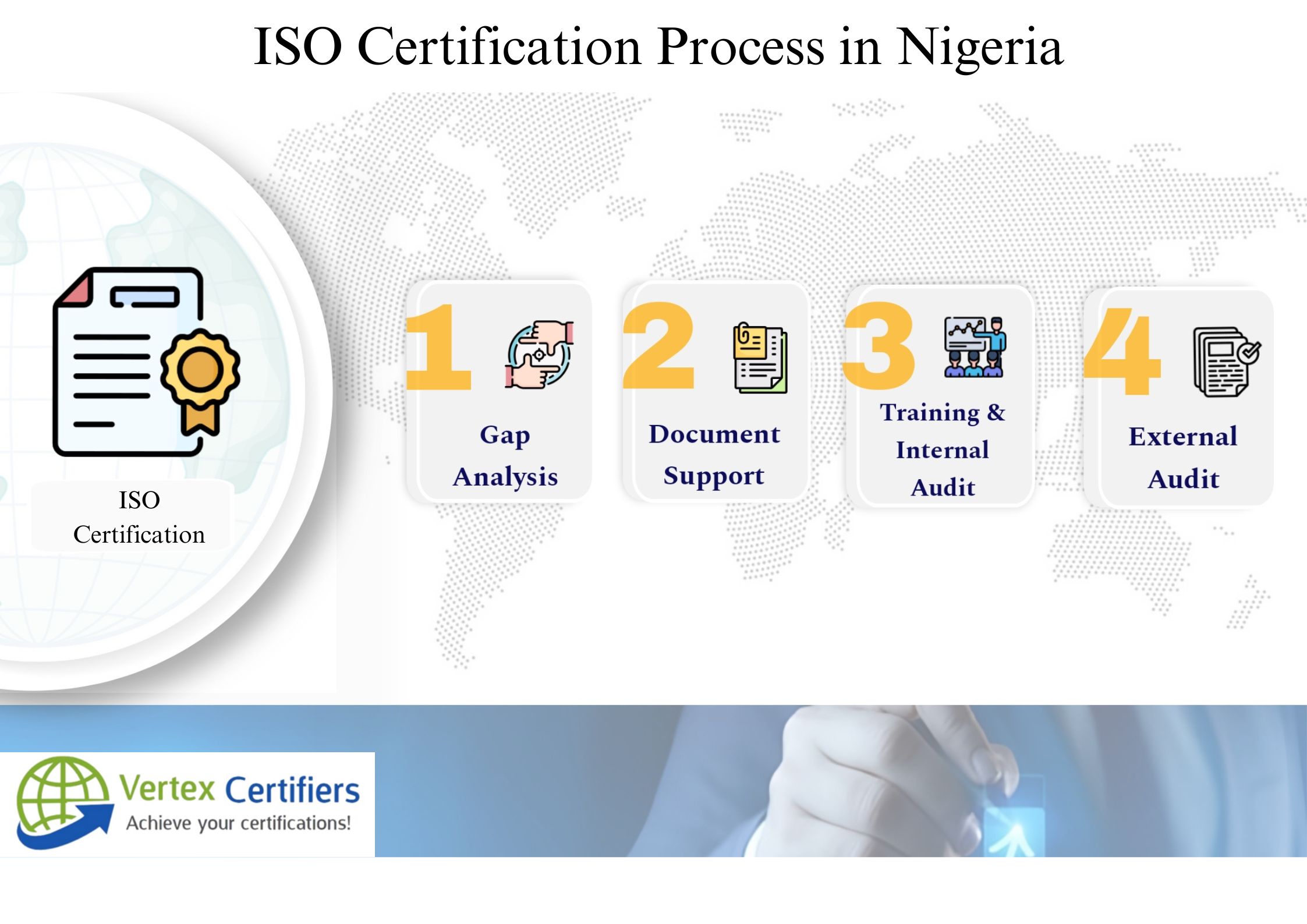
Step-by-Step ISO Certification Process in Nigeria
Achieve ISO certification through a structured and proven roadmap designed for Nigerian organizations:
- Standard Selection: Identify the right ISO standard based on business needs (e.g., ISO 9001 for quality management).
- Gap Analysis: Assess existing processes against ISO requirements to identify gaps.
- Documentation: Develop ISO manuals, policies, procedures, and records.
- Implementation & Training: Embed ISO systems into daily operations and train employees.
- Internal Audit: Evaluate system effectiveness and compliance.
- Management Review: Top management reviews performance and improvement areas.
- Certification Audit: Stage 1 (documentation review) and Stage 2 (on-site audit).
- Issuance & Surveillance: Certificate issuance followed by annual surveillance and recertification every 3 years.
Industries Requiring ISO Certification in Nigeria
Nigeria’s diverse economy includes several sectors where ISO certification is essential for compliance, safety, and global growth:
- Oil & Gas and Energy: ISO 9001, ISO 14001, and ISO 45001 support quality, environmental compliance, and safety.
- Manufacturing & FMCG: ISO 9001 ensures product consistency and export readiness.
- Construction & Infrastructure: ISO 45001 and ISO 9001 mitigate project and workplace risks.
- Healthcare & Pharmaceuticals: ISO 13485 or ISO 9001 supports patient safety and regulatory compliance.
- IT, Fintech & Telecom: ISO 27001 protects sensitive data and digital infrastructure.
- Agriculture & Food Processing: ISO 22000/HACCP prevents contamination and supports agro-exports.
- Logistics, Warehousing & Exporters: ISO 9001 improves supply chain efficiency under AfCFTA.
- Government Agencies & NGOs: ISO builds transparency and funding eligibility.
Popular ISO Standards in Nigeria
- ISO 9001 – Quality Management: Most widely adopted standard across all sectors.
- ISO 14001 – Environmental Management: Critical for pollution control and sustainability.
- ISO 45001 – Occupational Health & Safety: Reduces workplace accidents and hazards.
- ISO 27001 – Information Security: Essential for fintech, IT, and telecom companies.
- ISO 22000 / HACCP – Food Safety: Ensures safe food production and exports.
- ISO 37001 – Anti-Bribery Management: Strengthens governance and ethics.
- ISO 50001 – Energy Management: Improves energy efficiency and cost control.
Benefits of ISO Certification for Nigerian Organizations
ISO certification delivers measurable advantages aligned with Nigeria’s regulatory and business environment:
- Improved eligibility for government and multinational tenders.
- Enhanced process efficiency and reduced operational waste.
- Increased customer confidence and brand credibility.
- Stronger regulatory compliance and reduced legal risks.
- Improved risk management and business continuity.
- Competitive advantage in export and international markets.
Role of ISO Consultants in Nigeria
ISO consultants simplify certification by translating international standards into practical, locally applicable systems. They customize documentation for Nigerian operations, train teams, prepare organizations for audits, and significantly reduce certification timelines and non-conformities.
ISO Certification Timelines in Nigeria
The ISO certification timeline depends on organization size, complexity, and selected standards. With professional consulting support, most organizations achieve certification within a structured and manageable timeframe.
Why Vertex Certifiers Excels in Nigeria
Vertex Certifiers is a multinational ISO consulting and certification support firm headquartered in Bangalore, with active ISO projects across Nigeria including Lagos, Abuja, Port Harcourt, and beyond. Our experienced ISO lead auditors and implementers deliver end-to-end services with a 100% success-focused approach. We offer affordable, transparent solutions through onsite and remote models, partnering only with accredited certification bodies and tailoring implementations for industries ranging from oil & gas to IT and fintech.
✔ 2,000+ ISO projects delivered
✔ 800+ clients served globally
Start Your ISO Certification Journey Today
Get a free consultation and gap assessment from Vertex Certifiers. Receive a tailored ISO implementation plan designed for fast-track certification in Nigeria.
Email Us WhatsApp Nigeria SupportOur Services
- GMP Certification
- GLP Certification
- GDP Certification
- Halal Certificate
- Organic Certificate
- CE Marking Certification
- RoHS Certification
- FDA Certification
- CMMI Certification
- Cyber Security
- VAPT Testing
- Security Assessment
