ISO Certification in Tunisia:
ISO Certification in Tunisia, Vertex Certifiers is a globally recognized ISO consulting and certification assistance provider, offering end-to-end solutions for organizations across Tunisia, including Tunis, Sfax, Sousse, Kairouan, Gabès, Bizerte, and Nabeul. Our expert consultants help businesses implement and achieve compliance with a wide range of international standards such as ISO 9001 (, ISO 14001, ISO 45001, ISO 27001, ISO 22000, ISO 41001, ISO 27701, ISO 22301, ISO 13485, ISO 21001, ISO 50001.
With a commitment to excellence and customer satisfaction, Vertex Certifiers ensures a seamless certification process that enhances business performance, global recognition, and regulatory compliance across all sectors in Tunisia.
ISO certification is a globally recognized mark of quality, safety, and operational excellence. In Tunisia, businesses across major cities such as Tunis, Sfax, Sousse, Kairouan, Gabès, Bizerte, and Nabeul are increasingly adopting ISO standards to improve their competitiveness, comply with regulations, and meet international market demands. Whether you operate in manufacturing, construction, IT, food processing, or healthcare, ISO certification can help your organization achieve higher efficiency, customer satisfaction, and regulatory compliance.
What is ISO Certification?
ISO certification is a formal recognition that an organization meets the requirements of specific international standards developed by the International Organization for Standardization (ISO). These standards provide frameworks for managing quality, environmental impact, occupational health and safety, information security, food safety, and energy efficiency. Certification is awarded by accredited third-party bodies after a thorough audit of the organization’s processes and systems.
Industries Requiring ISO Certification in Tunisia
- Manufacturing: ISO 9001, ISO 14001, and ISO 45001 are widely used to ensure product quality, environmental compliance, and workplace safety.
- Construction & Real Estate: ISO 9001 and ISO 45001 help construction firms deliver quality projects and maintain safe working environments.
- Oil & Gas: ISO 9001, ISO 14001, and ISO 45001 are critical for operational excellence and regulatory compliance.
- Information Technology: ISO 27001 is essential for data security and regulatory compliance in the IT sector.
- Food Processing & Agriculture: ISO 22000 ensures food safety and quality throughout the supply chain.
- Healthcare & Pharmaceuticals: ISO 9001, ISO 14001, and ISO 27001 help healthcare providers deliver quality care and protect patient data.
- Education & Logistics: ISO 9001 and ISO 14001 are used to improve service quality and environmental performance.
ISO Certification Process in Tunisia:
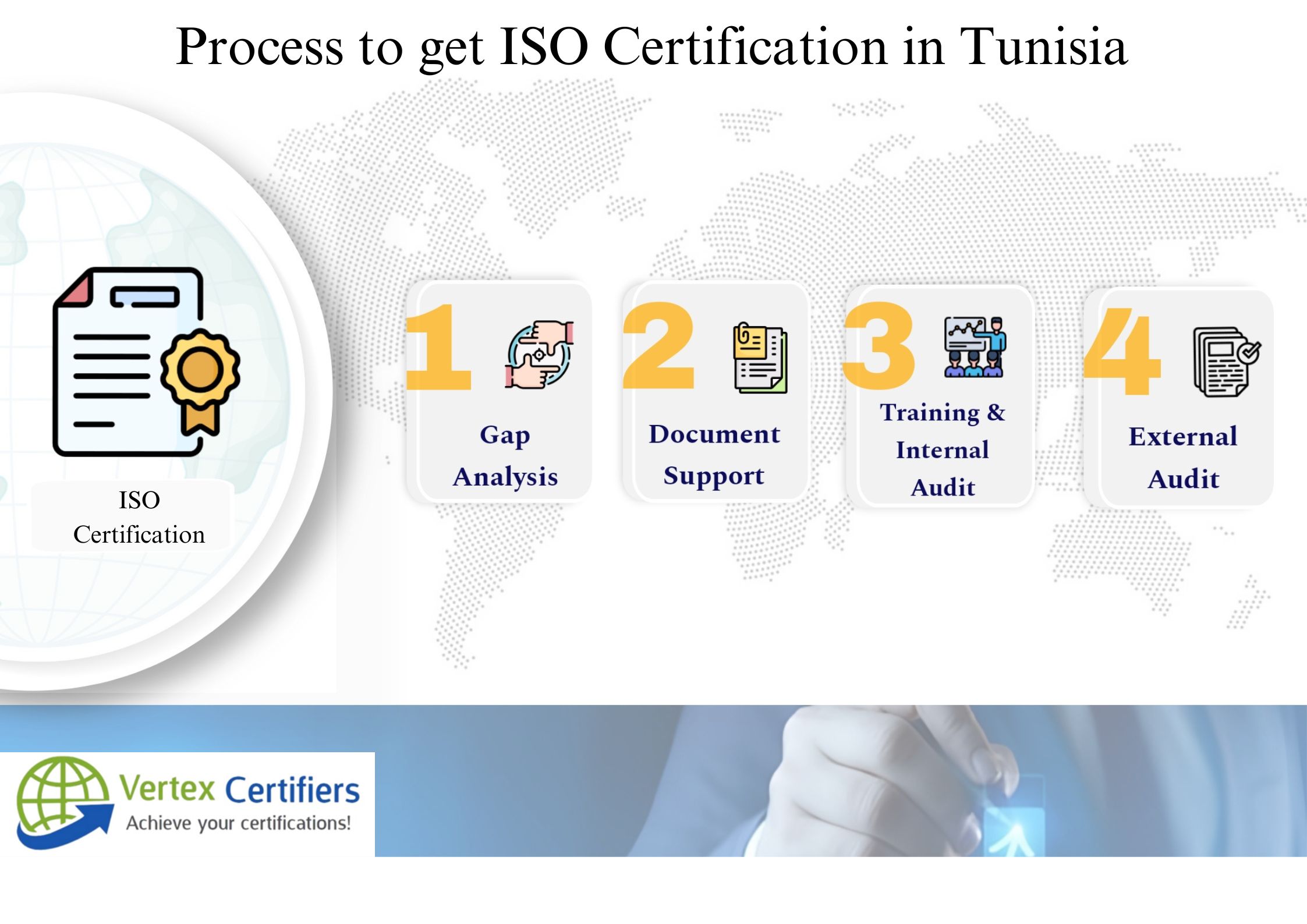
- Gap Analysis: Assess current processes against ISO requirements to identify areas for improvement.
- Documentation: Develop and implement policies, procedures, and records required by the standard.
- Implementation: Train staff and implement the management system across the organization.
- Internal Audit: Conduct internal audits to ensure compliance and readiness for certification.
- Certification Audit: An accredited certification body audits the organization to verify compliance.
- Surveillance & Continual Improvement: Maintain certification through regular surveillance audits and continual improvement of the management system.
Our Services
- GMP Certification
- GLP Certification
- GDP Certification
- Halal Certificate
- Organic Certificate
- CE Marking Certification
- RoHS Certification
- FDA Certification
- CMMI Certification
- Cyber Security
- VAPT Testing
- Security Assessment
ISO Certification in Tunisia
Vertex Certifiers is a globally recognized ISO consulting and certification assistance provider, offering end-to-end solutions for organizations across Tunisia — including Tunis, Sfax, Sousse, Kairouan, Gabès, Bizerte, and Nabeul. Our team specializes in implementing and achieving compliance with international standards such as ISO 9001 (Quality Management), ISO 14001 (Environmental Management), ISO 45001 (Occupational Health & Safety), ISO 27001 (Information Security), ISO 22000 (Food Safety), and ISO 50001 (Energy Management).
With a focus on quality, sustainability, and continual improvement, we ensure that Tunisian businesses achieve certification efficiently and build global credibility.
Top ISO Standards in Tunisia
ISO 9001:2015 – Quality Management System
ISO 9001 is the most widely adopted standard for quality management. It ensures consistent product and service quality, enhances customer satisfaction, and streamlines internal processes across Tunisia’s manufacturing and service sectors.
ISO 14001:2015 – Environmental Management System
ISO 14001 enables organizations to manage environmental responsibilities systematically. Tunisian companies in manufacturing, construction, and energy sectors use this standard to reduce impact and improve sustainability.
ISO 45001:2018 – Occupational Health & Safety Management System
ISO 45001 helps organizations provide safe and healthy workplaces by minimizing risks. This is essential for high-risk sectors like construction, oil & gas, and manufacturing.
ISO 27001:2022 – Information Security Management System
With the rise of digital transformation, ISO 27001 protects sensitive data and ensures cybersecurity. IT companies, financial institutions, and healthcare providers in Tunisia increasingly adopt this standard.
ISO 22000:2018 – Food Safety Management System
ISO 22000 ensures that food safety hazards are controlled throughout the supply chain. It’s vital for Tunisia’s food processing and agriculture industries.
ISO 50001:2018 – Energy Management System
ISO 50001 helps organizations optimize energy use, cut costs, and lower carbon emissions — driving sustainability in Tunisia’s industrial landscape.
Benefits of ISO Certification in Tunisia
- Efficiency & Quality Improvement: Streamline operations and improve product quality.
- Compliance & Customer Trust: Meet international standards and build client confidence.
- Market Competitiveness: Gain an edge in domestic and international markets.
- Tender Eligibility: Many Tunisian tenders require ISO certification for participation.
ISO Certification in Major Cities of Tunisia
ISO Certification in Tunis
Tunis is the capital and business hub where ISO certification strengthens regulatory compliance and international trade opportunities.
ISO Certification in Sfax
Sfax’s industries in manufacturing and agriculture adopt ISO standards to enhance quality, efficiency, and competitiveness.
ISO Certification in Sousse
Sousse’s tourism and manufacturing sectors benefit from ISO certification to improve service delivery and product reliability.
ISO Certification in Gabès
Gabès, a key industrial city, uses ISO standards to boost compliance and operational excellence.
ISO Certification in Kairouan
Kairouan’s growing agricultural and industrial sectors leverage ISO certification for sustainability and quality assurance.
ISO Certification in Bizerte
Bizerte’s port-based industries utilize ISO certification to ensure process efficiency and adherence to global standards.
ISO Certification in Nabeul
Nabeul’s tourism, crafts, and agriculture industries benefit from ISO certification to meet domestic and export quality demands.
Why Choose Vertex Certifiers for ISO Certification in Tunisia
Vertex Certifiers is a trusted ISO consulting partner providing tailored solutions across all Tunisian cities. Our experienced consultants guide organizations through gap analysis, documentation, implementation, audits, and continual improvement — ensuring a smooth path to ISO certification.
Ready to Get ISO Certified in Tunisia?
Contact Vertex Certifiers today for expert guidance and complete certification support.
📧 Email Us: info@vertexcertifiers.comUnderstanding ISO Certification Costs in Tunisia
Below is a clear explanation of the cost components and the main factors that influence how much an organisation might spend to obtain and maintain ISO certification in Tunisia. This overview intentionally does not include price ranges — it focuses on the elements that drive cost so you can estimate and plan accurately.
Primary cost components
Certification involves several distinct expense categories. Each organisation will combine these differently depending on its readiness and chosen route to certification.
- Certification Body (CB) FeesFees charged by the accredited certification body for initial certification audits, surveillance audits and recertification audits. These typically depend on auditor time, audit days, and the CB’s pricing model.
- Consultancy & Implementation SupportOptional professional services to help with gap analysis, system design, documentation, implementation and internal audit preparation. Consultancy engagement scope and duration strongly influence cost.
- TrainingTraining for management, auditors, and staff (e.g., awareness, internal auditor, lead implementer/lead auditor). Delivery mode (in-house, public course, online) affects pricing.
- Internal Resource TimeThe value of staff time spent on system development, documentation, meetings, corrective actions and audit support. This is a hidden but significant cost for most organisations.
- Remediation & Corrective ActionsCosts to fix nonconformities found during audits — could include new equipment, process changes, external expertise or additional training.
- Surveillance & RecertificationOngoing audit activity after initial certification (usually annual surveillance and periodic recertification) — an ongoing budget line, not a one-off expense.
- Administrative & MiscellaneousDocument translation, travel and accommodation for auditors or consultants, management system software or tools, and any regulatory fees or local taxes.
Key factors that influence total cost
Understand these factors to identify where you can optimize spend and what will require investment.
-
Scope & Complexity of CertificationNumber of processes, products/services, legal entities and locations included in the scope. Wider or multi-site scopes require more audit time and coordination, increasing costs.
-
Organisation Size & Number of SitesMore employees, departments or geographic locations usually mean longer audits and higher CB and travel costs.
-
Existing Management System MaturityAn organisation with well-documented, functioning processes will need less consultancy and fewer corrective actions compared with one starting from scratch.
-
Chosen Standard(s)Different ISO standards have different complexity levels (for example, integrated multi-standard projects vs a single standard). Implementing multiple standards together may be more efficient but can increase initial effort.
-
Sector Risk & Regulatory RequirementsHigh-risk industries (e.g., oil & gas, healthcare, food processing) may require more detailed audits, technical controls and evidencing — this affects auditor time and remediation costs.
-
Need for External Consultancy & TrainingOrganisations that prefer hands-on external support will budget for consultant days and tailored training; self-implementation reduces consultancy costs but increases internal staff time.
-
Audit Language & LocalisationIf documentation requires translation or auditors need language support, add translation and interpretation costs. Local regulatory or industry-specific documentation may also increase effort.
-
Travel, Logistics & Remote LocationsAuditor/consultant travel, accommodation and per diems for remote or multi-site audits will increase outlays.
-
Integration with Other SystemsIntegrating ISO systems with existing quality, safety, information security or environmental tools can reduce duplication but may require technical work or software licensing.
How organisations typically plan the budget (process, not numbers)
- Define the scope and objectives for certification (standards, sites, exclusions).
- Complete a gap analysis to estimate effort needed for documentation and implementation.
- Decide on in-house vs external consultancy and training; obtain proposals from consultants and CBs.
- Factor in internal resource allocation and likely remediation items identified during pre-assessment.
- Include recurring costs for surveillance audits, maintenance, and continuous improvement.
- Add contingency for unexpected corrective actions, translation or travel expenses.
Practical tips to control cost
- Start with a focused, well-defined scope and expand later rather than over-scoping initially.
- Perform an honest internal gap analysis to target consultancy where it’s most needed.
- Consider combined audits or integrated management systems if implementing multiple standards.
- Use online training and remote consultancy where appropriate to reduce travel and logistics.
- Document existing good practices — audit evidence is often already present and saves time.
If you would like, we can prepare a customised checklist and a non-binding proposal that maps these components and factors to your organisation’s specific context in Tunisia (scope, sites, and preferred implementation route).
Request a tailored cost plan — Email: info@vertexcertifiers.com