
ISO 9001 Certification in Japan:
ISO 9001 Certification in Japan is a vital requirement for organizations aiming to enhance quality, consistency, and customer satisfaction in one of the world’s most precision-driven and competitive markets. With Japan’s strong emphasis on excellence, Kaizen culture, and global manufacturing leadership, businesses across major cities such as Tokyo, Osaka, Yokohama, Nagoya, Fukuoka, Sapporo, Hiroshima, Kyoto, Kobe, and Sendai are increasingly adopting ISO 9001 to strengthen their processes and meet international standards. Vertex Certifiers offers end-to-end ISO 9001 certification services in Japan—including gap analysis, documentation, training, implementation support, internal audits, and certification assistance—ensuring that companies of all sizes achieve a robust Quality Management System quickly, efficiently, and in full compliance with global requirements.
ISO 9001 Certification in Japan helps Japanese companies formalize their culture of quality, Kaizen, and customer focus into a globally recognized Quality Management System (QMS) that supports both domestic growth and export competitiveness. By aligning with ISO 9001, businesses in Japan can improve efficiency, reduce errors, and meet the strict expectations of global supply chains in automotive, electronics, robotics, and other high-precision sectors
Japan is known worldwide for its commitment to craftsmanship, precision, and continuous improvement, supported by philosophies like Kaizen and Just-in-Time production. ISO 9001 Certification in Japan ensures that this quality mindset is backed by structured processes, documented systems, and measurable performance, making companies more trusted partners globally. In one of the world’s most quality-driven and competitive markets, ISO 9001 Japan certification strengthens credibility with customers, regulators, and international buyers.
What is ISO 9001 Certification?
ISO 9001 is an international standard that defines the requirements for a Quality Management System (QMS) applicable to any type and size of organization. It is built on core principles such as customer focus, strong leadership, involvement of people, process approach, evidence-based decision making, and continuous improvement. For Japanese industries, ISO 9001 aligns well with existing process discipline and Kaizen practices, allowing companies to standardize quality while remaining flexible and innovative
A certified QMS under ISO 9001 helps organizations define processes, responsibilities, controls, and performance indicators so that quality is built into daily operations rather than checked only at the end. Because ISO 9001 is globally recognized, Japanese companies can use the same system to satisfy local stakeholders and foreign customers across markets such as Europe, North America, and Asia.
Why ISO 9001 Matters in Japan
Japan is a global leader in automotive, electronics, robotics, precision machinery, and advanced materials, where quality and reliability are non‑negotiable. In these sectors, customers and OEMs often require suppliers to demonstrate a certified QMS as a condition to participate in long-term contracts and global supply chains. ISO 9001 Certification in Japan thus becomes a powerful tool for meeting the expectations of multinational buyers and Tier‑1 manufacturers.
The standard also supports Japan’s lean and Kaizen methodologies by formalizing waste reduction, error prevention, and root-cause analysis within business processes. By adopting ISO 9001 Japan, companies can enhance internal efficiency, reduce rework and scrap, and improve coordination across departments, which strengthens both profitability and customer satisfaction
ISO 9001 Certification Process in Japan
The typical ISO 9001 Certification process in Japan follows a structured sequence that can be adapted to different company sizes:
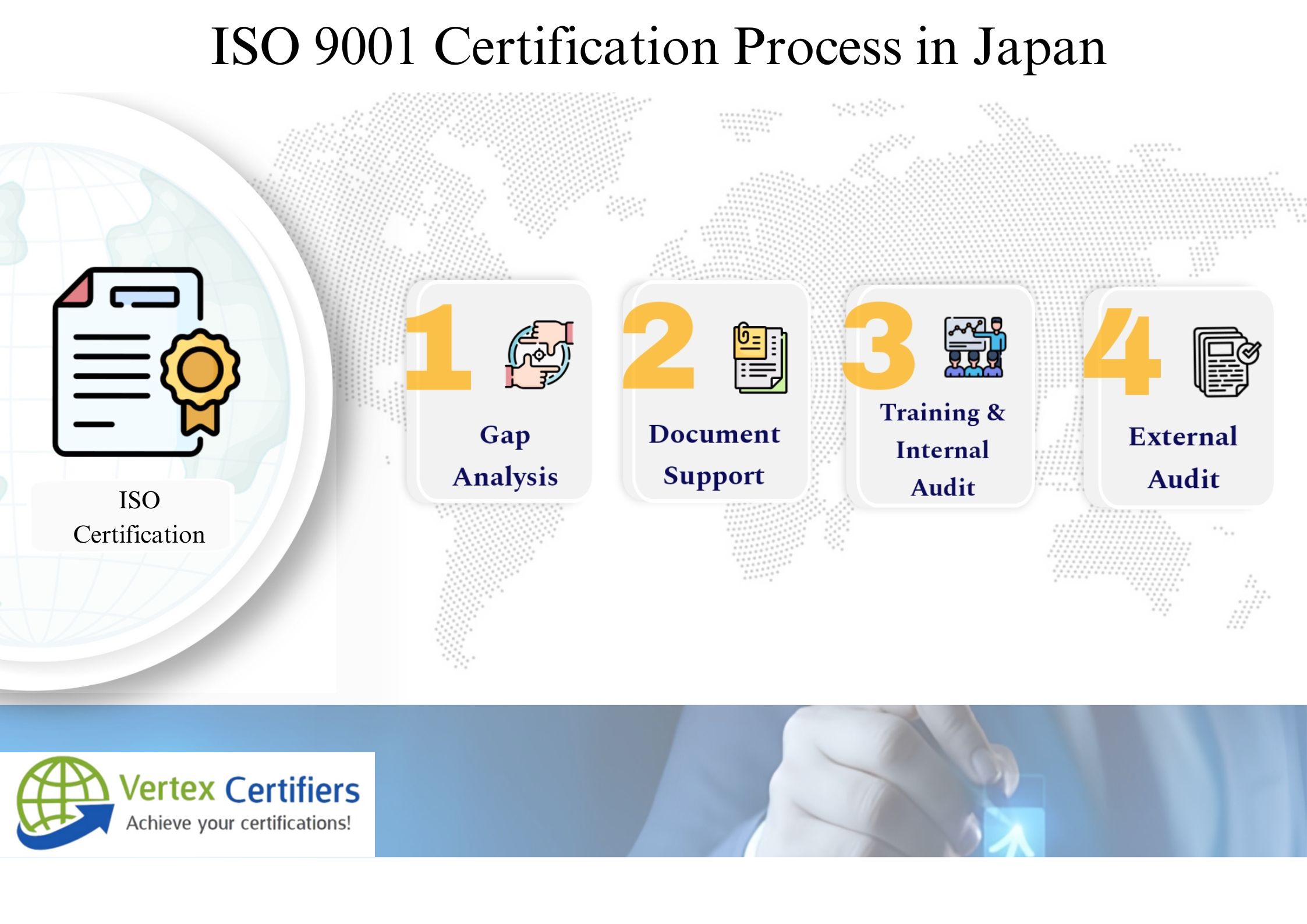
- Gap Analysis
- Assess current processes, documents, and controls against ISO 9001 requirements and best practices to identify gaps
- Documentation Development: Prepare or update the Quality Manual, policies, procedures, process maps, and forms so they reflect how the business actually operates while meeting the standard.
- Staff Training & QMS Implementation: Train employees and managers on QMS roles, procedures, and records; integrate these requirements into daily operations and IT systems
- Internal Audit: Conduct internal audits to verify that processes are followed, records exist, and nonconformities are identified systematically.
- Corrective Actions: Analyze root causes of nonconformities and implement corrective and preventive measures, documenting evidence of closure
- Stage 1 Audit – Document Review: The external certification body reviews documented information and readiness, often remotely or through a short onsite visit
- Stage 2 Audit – Onsite Evaluation: Auditors evaluate practical implementation at the workplace, interview staff, sample records, and verify compliance with ISO 9001 requirements
- Issuance of ISO 9001 Certificate: If all requirements are met and nonconformities are resolved, the certification body issues the ISO 9001 certificate, typically valid for three years


