
ISO 50001 Certification in UAE:
ISO 50001 Certification in UAE, Vertex Certifiers is a globally recognized ISO consulting and certification service provider, offering end-to-end ISO 50001 Energy Management System (EnMS) certification along with other ISO standards such as ISO 9001, ISO 14001, ISO 27001, ISO 45001, ISO 22000, and ISO 13485 across the UAE. We support organizations from energy review and baseline analysis to documentation, implementation, internal audits, and final certification. Our experienced ISO 50001 consultants assist businesses in Dubai, Abu Dhabi, Sharjah, Ajman, Ras Al Khaimah, Fujairah, and Umm Al Quwain, helping them reduce energy costs, improve efficiency, meet sustainability goals, and achieve internationally recognized compliance in a practical and cost-effective manner.
How to get ISO 50001 Certification in UAE
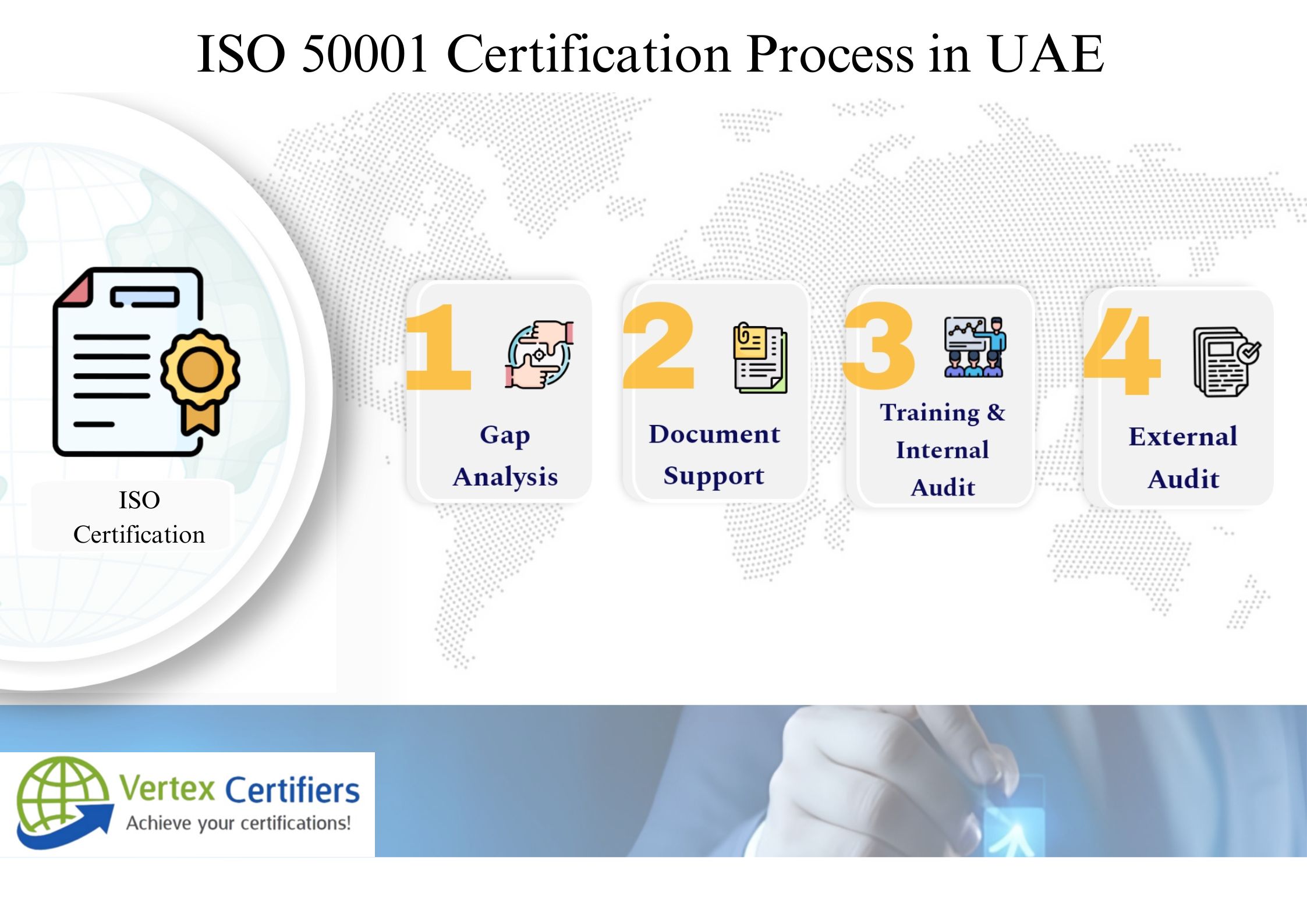
ISO 50001 Certification in UAE – Energy Management for Sustainable Growth
1. Introduction to ISO 50001 Certification in UAE
The UAE is rapidly transforming into a global leader in clean energy, sustainability, and efficient resource management. With ambitious national strategies such as the UAE Energy Strategy 2050 and Net Zero 2050, organizations are under increasing pressure to optimize energy usage, reduce wastage, and cut greenhouse gas emissions. ISO 50001 Certification in UAE provides a structured, globally recognized framework to manage energy performance efficiently and sustainably.
Energy is a critical cost driver in sectors like manufacturing, oil and gas, utilities, construction, logistics, real estate, and commercial facilities. Rising tariffs, operational expansion, and increased reliance on technology have made energy efficiency a board-level priority. ISO 50001 helps organizations in the UAE systematically manage energy use, reduce utility bills, and support national climate and sustainability goals.
ISO 50001:2018 is applicable to organizations of all sizes and industries, including:
- Manufacturing plants and industrial facilities.
- Oil and gas companies, refineries, and petrochemical complexes.
- Power generation and utilities providers.
- Construction and infrastructure companies.
- Logistics, cold chain, warehousing, and transport operations.
- Commercial buildings, malls, hotels, hospitals, and office complexes.
By implementing ISO 50001, organizations in the UAE can align with national and international sustainability expectations, reduce operating expenses, and demonstrate a strong commitment to responsible energy management.
2. What is ISO 50001 Energy Management System (EnMS)?
ISO 50001 is the international standard that specifies requirements for establishing, implementing, maintaining, and improving an Energy Management System (EnMS). The primary objective of ISO 50001 is to enable organizations to follow a systematic approach to continually improve energy performance, including energy efficiency, energy use, and energy consumption.
The EnMS framework encourages organizations to:
- Understand how and where energy is consumed.
- Identify significant energy uses (SEUs) and opportunities for improvement.
- Set policies, objectives, and targets related to energy performance.
- Implement controls, monitoring, and operational practices to optimize energy usage.
ISO 50001 is built around the principle of continual improvement. It does not require specific energy performance levels but ensures that organizations have a robust system to consistently improve energy performance over time.
PDCA (Plan–Do–Check–Act) approach
Just like other ISO management system standards, ISO 50001 is based on the PDCA (Plan–Do–Check–Act) cycle:
- Plan: Conduct an energy review, establish baseline and energy performance indicators (EnPIs), set objectives and targets, and develop action plans.
- Do: Implement the action plans, operational controls, and projects that improve energy performance.
- Check: Monitor and measure key parameters, track progress, conduct internal audits, and evaluate compliance with legal and other requirements.
- Act: Take corrective actions, update plans, and drive continual improvement of the EnMS and energy performance.
This structured, cyclical approach ensures that energy management becomes an ongoing process rather than a one-time initiative.
3. Why ISO 50001 is Important for Organizations in the UAE
In the UAE, energy consumption per capita is among the highest in the world due to rapid industrial growth, extensive cooling requirements, large infrastructure projects, and energy-intensive industries. ISO 50001 helps organizations manage these challenges in a strategic and cost-effective way.
Rising energy consumption and operational costs
Electricity, fuel, and utility costs directly impact profitability, especially in high-consumption sectors. ISO 50001 enables organizations to:
- Identify where energy is being wasted or used inefficiently.
- Optimize equipment operation, maintenance, and scheduling.
- Improve process efficiency and reduce energy-related losses.
- Achieve measurable cost savings on energy bills.
Reduction of carbon footprint and emissions
ISO 50001 supports organizations in reducing their carbon footprint and aligning with UAE climate and emissions reduction initiatives. By improving energy efficiency, organizations can:
- Lower greenhouse gas (GHG) emissions associated with electricity and fuel use.
- Support corporate decarbonization and net-zero strategies.
- Contribute to national sustainability and climate commitments.
Support for ESG and sustainability goals
Environmental, Social, and Governance (ESG) performance is increasingly important to investors, lenders, regulators, and international partners. ISO 50001 provides a practical way to:
- Demonstrate strong energy governance and environmental responsibility.
- Provide data and evidence for ESG reporting and sustainability disclosures.
- Enhance credibility with stakeholders focused on sustainable operations.
Improved compliance with energy and environmental expectations
ISO 50001 helps organizations in the UAE stay ahead of evolving regulatory expectations and market pressures related to energy and environment. It supports:
- Alignment with government guidelines, sectoral energy programs, and green building requirements.
- Compliance with customer-specific energy and sustainability clauses in contracts.
- Support for participation in energy efficiency, rebate, or incentive schemes where applicable.
4. Benefits of ISO 50001 Certification in UAE
ISO 50001 Certification in UAE offers both financial and non-financial benefits that strengthen competitiveness, sustainability, and operational performance.
Improved energy efficiency and reduced utility costs
One of the most direct benefits of ISO 50001 is a sustained reduction in energy consumption and utility costs. Through targeted projects and optimized operations, organizations can:
- Reduce electricity and fuel consumption across facilities and processes.
- Improve performance of HVAC, chiller plants, compressors, pumps, and production lines.
- Achieve a clear return on investment (ROI) from energy efficiency initiatives.
Enhanced monitoring of energy performance
ISO 50001 requires organizations to establish energy performance indicators, baselines, and monitoring systems. This leads to:
- Better visibility of energy usage patterns across locations and assets.
- Data-driven decision-making based on accurate metering and analysis.
- Early detection of abnormal consumption, leakages, or equipment issues.
Better control of energy use and consumption
With an EnMS in place, organizations gain better operational control over how energy is used. This includes:
- Standard operating procedures (SOPs) that consider energy efficiency.
- Design and procurement decisions based on lifecycle energy performance.
- Improved maintenance practices that sustain optimal equipment efficiency.
Improved corporate image and regulatory confidence
ISO 50001 Certification enhances how organizations are perceived by government entities, regulators, customers, and investors. It:
- Demonstrates commitment to environmental responsibility and sustainability.
- Builds trust among stakeholders in energy-intensive and sensitive sectors.
- Supports corporate branding as a responsible, forward-thinking organization.
Competitive advantage in government and large-scale projects
For many government, semi-government, and large private projects in the UAE, sustainability and energy performance are key evaluation criteria. ISO 50001 provides:
- A strong differentiator in tenders and RFPs where energy management is evaluated.
- Better alignment with green building, sustainable construction, and smart city initiatives.
- Increased chances of winning long-term contracts with energy-conscious clients.
5. ISO 50001 Certification Process in UAE
The ISO 50001 Certification process in the UAE follows a structured, step-by-step approach. While the exact activities may vary by organization, the typical stages include:
Energy review and baseline establishment
The first step is to conduct a comprehensive energy review, which involves:
- Collecting data on energy consumption, tariffs, and operating conditions.
- Mapping energy flows across equipment, processes, and facilities.
- Identifying patterns, inefficiencies, and key influencing factors.
- Establishing the energy baseline and defining energy performance indicators (EnPIs).
Identification of significant energy uses (SEUs)
Organizations must identify SEUs – areas, systems, or processes that consume substantial energy or offer high potential for savings. This allows targeted improvement actions and investments.
EnMS documentation and implementation
The next step is to develop and implement the core elements of the EnMS, including:
- Energy policy, roles, responsibilities, and organizational structure.
- Documented procedures, controls, and operational criteria for energy-efficient operation.
- Action plans and projects aimed at improving energy performance.
Training and awareness programs
Employees at all levels must be aware of their role in energy management. Training programs cover:
- Basic awareness of ISO 50001 and the organization’s energy policy.
- Operational practices that influence energy efficiency.
- Responsibilities of energy teams, maintenance staff, and process owners.
Internal audit and management review
Before certification, organizations conduct internal audits to verify that the EnMS meets ISO 50001 requirements and is effectively implemented. Management reviews are held to:
- Evaluate overall EnMS performance.
- Review energy objectives, targets, and results.
- Decide on improvements, resources, and strategic priorities.
Stage 1 and Stage 2 certification audits
An accredited certification body then conducts:
- Stage 1 audit: Review of documentation, scope, and readiness for implementation audit.
- Stage 2 audit: On-site evaluation of implementation, records, and evidence of energy performance improvement.
Upon successful completion, the organization receives ISO 50001 Certification, typically valid for three years with annual surveillance audits.
6. ISO 50001 Requirements for UAE Organizations
ISO 50001 outlines specific requirements that organizations must fulfill to establish an effective EnMS. Key requirements include:
Energy policy and leadership commitment
- Top management must define and approve an energy policy.
- Commitment to continual improvement of energy performance and compliance with requirements.
- Allocation of resources, roles, and responsibilities for EnMS implementation.
Energy objectives, targets, and action plans
Organizations must establish measurable objectives and targets aligned with the energy policy. Action plans should:
- Describe how objectives and targets will be achieved.
- Specify responsibilities, timelines, and required resources.
- Be regularly reviewed and updated based on performance and changing conditions.
Operational controls and design considerations
ISO 50001 requires controls to ensure energy-efficient operation of equipment and processes, including:
- Standard operating procedures that consider energy performance.
- Design and procurement practices favoring energy-efficient technologies.
- Consideration of energy performance over the lifecycle of assets and systems.
Monitoring, measurement, and energy performance evaluation
- Regular monitoring and measurement of energy consumption and EnPIs.
- Evaluation of performance against baseline, objectives, and targets.
- Use of data to identify deviations, opportunities, and improvements.
Continual improvement of energy performance
Organizations must demonstrate that their EnMS leads to continual improvement, through:
- Implementation of projects that deliver measurable energy savings.
- Corrective actions based on audits, reviews, and performance analysis.
- Regular updates to the energy review, action plans, and controls.
7. Cost and Timeline for ISO 50001 Certification in UAE
The cost of ISO 50001 Certification in UAE depends on several factors:
- Total energy consumption and diversity of energy sources.
- Size and complexity of operations and processes.
- Number of sites, plants, and facilities included in the scope.
- Existing level of energy management and data availability.
- Extent of external consulting, training, and implementation support required.
For small and medium-sized enterprises (SMEs), the typical implementation timeline ranges from 6 to 10 weeks, assuming active management involvement and cross-functional participation. Larger and more complex organizations may require a longer period for detailed energy reviews, metering, and optimization projects.
Accredited certification bodies in the UAE conduct independent audits, issue certificates, and carry out surveillance audits. Partnering with recognized bodies ensures your ISO 50001 certificate is widely accepted by government entities, large corporations, and international stakeholders.
8. Why Choose Vertex Certifiers for ISO 50001 Certification in UAE
Selecting the right partner is crucial for a successful and value-driven ISO 50001 implementation. Vertex Certifiers offers specialized expertise in Energy Management Systems and ISO 50001 Certification across the UAE.
Experienced ISO 50001 energy management consultants
- Consultants with strong technical and regulatory understanding of energy management.
- Experience across manufacturing, oil and gas, utilities, logistics, and commercial sectors.
- Ability to blend engineering insights with ISO compliance requirements.
End-to-end EnMS implementation and certification support
- Support from initial energy review and gap analysis to certification audits.
- Facilitation of energy data collection, SEU identification, and baseline establishment.
- Development of policies, procedures, KPIs, and action plans tailored to your operations.
Practical, data-driven documentation and compliance approach
- EnMS documentation that is practical, clear, and aligned with real-world operations.
- Focus on measurable energy performance improvement, not just paperwork.
- Guidance on metering, monitoring tools, and performance dashboards.
Affordable, audit-ready ISO 50001 solutions across the UAE
- Cost-effective packages for SMEs and large enterprises.
- Support across all Emirates and major industrial and commercial hubs.
- Emphasis on fast, efficient implementation with long-term energy savings.