
GMP Certification in Afghanistan:
GMP Certification in Afghanistan, Vertex Certifiers provides end-to-end certification and compliance solutions for organizations across Afghanistan, supporting businesses in Kabul, Kandahar, Herat, Mazar-i-Sharif, Jalalabad, and other major cities. Our expert team delivers complete implementation support for Good Manufacturing Practice certification, along with integrated management system solutions such as ISO 9001 (Quality Management), ISO 22000 (Food Safety), ISO 14001 (Environmental Management), ISO 45001 (Occupational Health & Safety), and ISO 27001 (Information Security). From gap analysis and documentation to training, internal audits, and certification coordination with accredited bodies, we ensure a smooth, cost-effective, and timely certification process tailored to your industry and operational needs.
Afghanistan’s pharmaceutical, food, and healthcare sectors are expanding rapidly amid post-conflict reconstruction and growing international trade. With increasing demand for safe medicines, processed foods, and medical supplies, manufacturers face pressure to uphold global standards. Good Manufacturing Practice (GMP) certification emerges as a cornerstone, ensuring product quality, safety, and regulatory acceptance.
GMP compliance is vital for pharmaceutical companies and food manufacturers in Afghanistan. It guarantees hygienic production, contamination prevention, and consistent quality—key to gaining trust from regulators, exporters, and consumers. Without it, products risk rejection at borders or in markets like Pakistan, India, and the EU.
Integrating GMP with ISO 9001 (Quality Management Systems) streamlines processes and drives continuous improvement, while pairing it with ISO 22000 (Food Safety Management) bolsters hazard controls for food and nutraceuticals. This positions GMP as an essential regulatory certification for exports, government approvals, and competing in regulated industries.
What is GMP Certification?
Good Manufacturing Practice (GMP) certification refers to a set of guidelines ensuring products are consistently produced and controlled to quality standards appropriate for their intended use. Enforced by bodies like the WHO and national regulators, GMP minimizes risks from production to consumption.
Key focus areas include:
- Hygienic production environments with cleanrooms, pest control, and sanitation protocols.
- Controlled processes and documentation, such as batch records and change controls.
- Qualified personnel and ongoing training to handle operations safely.
- Equipment validation and maintenance to prevent failures.
- Traceability and recall systems for swift issue resolution.
GMP applies across sectors like pharmaceuticals and medical devices, food and beverages, cosmetics, and nutraceuticals. In Afghanistan, where local production is rising, GMP certification Afghanistan ensures compliance with international benchmarks, protecting public health.
Why GMP Compliance Matters in Afghanistan
Afghanistan’s regulators are ramping up scrutiny on medicines and food products due to past contamination incidents and import dependency. The Ministry of Public Health mandates GMP for drug licensing, while food safety laws align with WHO standards.
For import/export, GMP is non-negotiable. Neighboring markets like Central Asia demand certified products, and global trade requires it for FDA or EMA approvals. GMP compliance builds trust with healthcare providers, distributors, and consumers wary of substandard goods.
Local manufacturers gain a competitive edge, scaling from Kabul factories to international shelves. It slashes product failures, contamination outbreaks, and costly recalls—critical in a market where one incident can erode years of goodwill.
Who Needs GMP Implementation Support?
Several Afghan industries require GMP to thrive:
- Pharmaceutical manufacturers producing tablets, injectables, or generics.
- Food processing companies handling dairy, grains, or canned goods.
- Nutraceutical and herbal product producers tapping traditional remedies.
- Cosmetics manufacturers blending local ingredients.
- Medical device companies assembling diagnostics or equipment.
- Packaging and storage facilities for regulated products.
Even small-scale operations in Kandahar or Herat need support to meet these standards.
GMP Certification Process in Afghanistan
Achieving GMP certification in Afghanistan follows a structured path by GMP Consultants in Afghanistan, often integrated with ISO 9001 or ISO 22000:
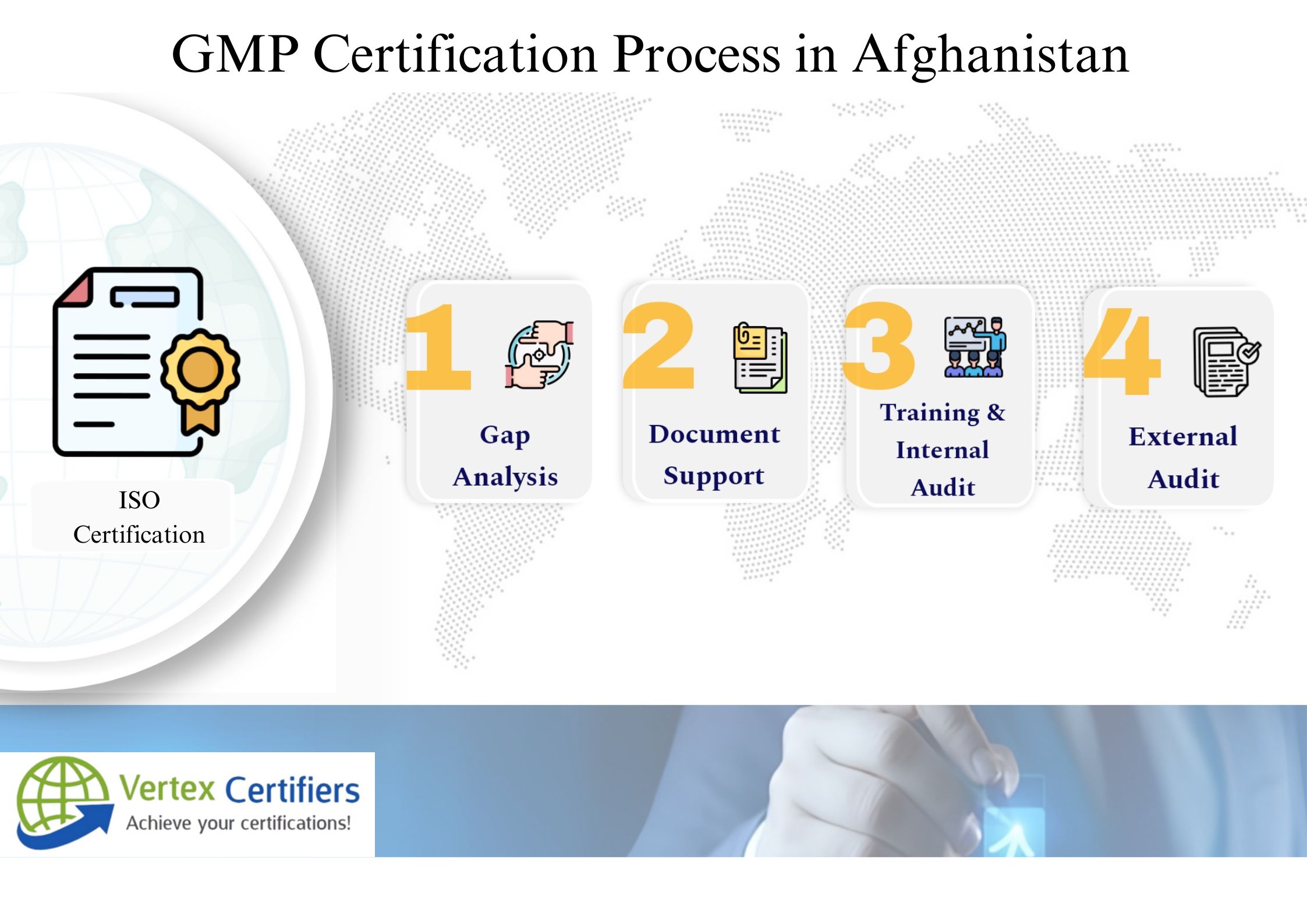
Gap Analysis and Initial Assessment
Consultants review facilities against GMP/WHO guidelines, identifying gaps in hygiene, documentation, or training.
Documentation Development
Create SOPs (Standard Operating Procedures), Quality Manuals, batch records, and validation protocols. Integration adds ISO clauses seamlessly.
Facility and Process Improvements
Upgrade cleanrooms, install HVAC systems, and validate equipment for compliance.
Staff Training and Awareness
Conduct hands-on sessions on GMP principles, hygiene, and traceability.
Internal Audit and Management Review
Simulate audits to fix issues, followed by leadership reviews.
Certification Audit by an Accredited Body
Third-party auditors (e.g., aligned with WHO or local bodies) verify compliance in two stages: documentation and full-site audit.
Issue of GMP Certification
Successful audits yield the certificate, valid 1-3 years with surveillance.
Simultaneous GMP ISO 22000 integration shortens timelines for food firms.
Integration with ISO Standards
Integrating GMP with ISO standards creates a robust, efficient system without redundant efforts.
GMP + ISO 9001 Certification in Afghanistan
This duo standardizes processes via ISO 9001’s Plan-Do-Check-Act cycle, enhancing GMP’s controls. Risk-based thinking identifies vulnerabilities early, while customer satisfaction metrics track performance. Strong documentation and internal audits ensure ongoing compliance. Pharmaceutical and medical product manufacturers in Afghanistan benefit most, achieving seamless quality management.
GMP + ISO 22000 Certification in Afghanistan
GMP pairs powerfully with ISO 22000 for food safety, incorporating HACCP (Hazard Analysis Critical Control Points) principles. Hygiene practices align with preventive controls for biological, chemical, and physical hazards. Food processing, packaging, and distribution businesses thrive, as seen in Afghan nutraceutical firms exporting to the Middle East.
Integrated GMP ISO 22000 or GMP ISO 9001 systems cut duplication, lower costs, and speed implementation—ideal for resource-limited Afghan enterprises.