GMP Certification in Vietnam:
GMP Certification in Vietnam, Good Manufacturing Practices (GMP) play a critical role in Vietnam’s fast-growing pharmaceutical, food, cosmetics, and herbal product industries. As manufacturers across the country work to meet strict hygiene, safety, and regulatory requirements, achieving GMP certification has become essential for ensuring quality, earning customer trust, and expanding into global markets. Vertex Certifiers is a trusted international ISO and GMP consulting firm helping organizations across Vietnam implement, document, and maintain full GMP compliance. Our expert consultants support businesses in Hanoi, Ho Chi Minh City, Da Nang, Hai Phong, Can Tho, Nha Trang, and Binh Duong, ensuring seamless alignment with Vietnam’s Ministry of Health regulations and global GMP guidelines.
Whether you’re setting up new manufacturing facilities or upgrading existing processes, Vertex Certifiers provides comprehensive services—from gap analysis and documentation support to internal audits and certification readiness—ensuring your GMP certification journey in Vietnam is efficient, compliant, and cost-effective.
Vietnam is witnessing rapid growth in its manufacturing ecosystem, notably in the pharmaceutical, food, cosmetics, and herbal industries. This growth brings increasing scrutiny from regulators and global markets that demand safe, high-quality products. Good Manufacturing Practices (GMP) certification is essential for companies to ensure product safety, regulatory compliance, and enhanced market readiness. As a global leader, Vertex Certifiers supports Vietnamese manufacturers by guiding them through the complexities of GMP certification to help them compete confidently in both local and international markets.
Why GMP Certification is Essential in Vietnam
The Vietnamese government is prioritizing hygiene, product safety, and controlled production processes, reflected in the increased enforcement of GMP standards. Vietnam’s pharmaceutical and nutraceutical markets are growing swiftly, driven by both domestic demand and export opportunities. Global buyers increasingly require GMP compliance to trust Vietnamese products, making standardized and safe manufacturing environments a business imperative for manufacturers striving to expand their reach internationally.
Step-by-Step Process to get GMP Certification in Vietnam
The GMP certification implementation in Vietnam involves:
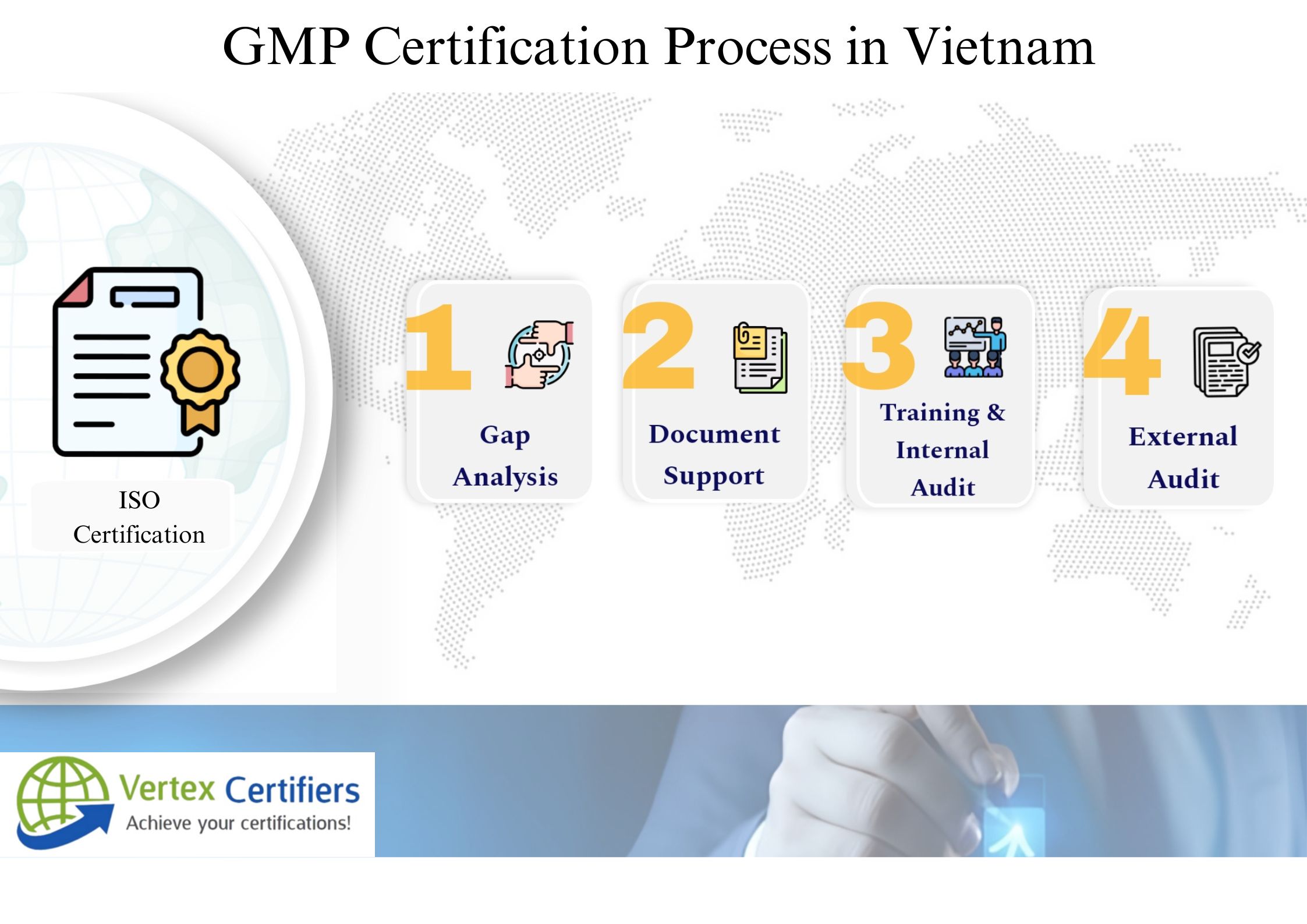
- Initial assessment and gap analysis to identify compliance shortfalls.
- Facility layout review and establishment of hygiene controls.
- Development of required documentation such as SOPs, policies, and batch records.
- Validation of processes and calibration of equipment.
- Employee training programs focused on GMP principles.
- Internal audits and corrective action plan implementation.
- Pre-final mock audit to prepare for the official inspection.
- Final certification audit conducted by accredited bodies.
Key Challenges Faced by Vietnamese Manufacturers
Many Vietnamese manufacturers struggle with inconsistent quality control practices, incomplete documentation, and weak traceability mechanisms. These gaps heighten risks of contamination and non-compliance with the Ministry of Health (MOH) standards. Consequently, manufacturers face customer complaints and batch rejections in export destinations. Additionally, the lack of adequately trained staff in regulated production environments compromises consistency and compliance, making GMP certification both a challenge and a necessity.
How GMP Certification Solves These Issues
GMP certification provides practical solutions to these challenges: establishing controlled and hygienic production environments significantly reduces contamination risks. Well-defined Standard Operating Procedures (SOPs) and detailed batch records close documentation gaps, while enhanced quality control protocols reduce product defects and customer complaints. Traceability systems improve the ability to manage quality issues and inspections. Ultimately, GMP certification opens doors to premium international markets that demand regulatory compliance as a prerequisite.
Vietnam’s Regulatory Environment for GMP
The Ministry of Health (MOH) leads Vietnam’s regulatory framework for GMP enforcement. Vietnam aligns its GMP regulations with ASEAN GMP, WHO GMP, and the European Union GMP standards, each applicable based on the product type and market. The approval process involves thorough inspections by MOH authorities, requiring manufacturing sites to comply with rigorous hygiene, documentation, and process validation criteria. Different sectors, from pharmaceuticals to cosmetics and food, must meet specific compliance expectations tailored to their risk profiles.
Industries in Vietnam That Benefit Most from GMP
- Pharmaceutical manufacturers ensuring drug safety and efficacy.
- Herbal and traditional medicine units embracing modern production controls.
- Food and beverage processors meeting hygiene and safety regulations.
- Nutraceutical and supplement companies aligning with international quality standards.
- Cosmetics and personal care product manufacturers enhancing consumer trust.
- Veterinary medicine and animal feed producers complying with safety norms.
City-Wise Demand for GMP Certification in Vietnam
- Ho Chi Minh City (HCMC): Large pharmaceutical and chemical sectors.
- Hanoi: Industrial hub with increasing manufacturing activities.
- Da Nang: Growing hub for food and cosmetic production.
- Hai Phong: Major port city with export-driven industries.
- Binh Duong & Dong Nai: Large clusters of manufacturing facilities.
- Can Tho: Agro-product processing center in the Mekong Delta.
Cost of GMP Certification in Vietnam
GMP certification costs vary depending on:
- The size and complexity of manufacturing units.
- Industry-specific requirements and number of production lines.
- Volume and complexity of necessary documentation.
- The scope of employee training programs.
- The type of GMP standard—WHO, ASEAN, or EU GMP—to be met.
Vertex Certifiers offers customized cost proposals tailored to the unique needs of each client.
Timeline for GMP Certification
- Small units: 30–45 days
- Medium-sized operations: 60–75 days
- Large manufacturers: 90–120 days
Vertex Certifiers’ fast-track programs can shorten timelines without compromising compliance and quality.
Why Choose Vertex Certifiers for GMP in Vietnam
Vertex Certifiers stands out with experienced GMP consultants well-versed in MOH and ASEAN regulatory standards. We provide end-to-end documentation support—including SOPs, manuals, forms, and checklists—and offer a flexible onsite and virtual hybrid consultation model. Clients benefit from dedicated project consultants who ensure smooth implementation and 100% audit readiness through comprehensive mock inspections. Our combination of global expertise and local understanding makes Vertex the preferred partner for GMP certification in Vietnam.
Conclusion
GMP certification is crucial for Vietnamese manufacturers to meet rising safety standards, enhance product quality, and unlock international market opportunities. With Vietnam’s growing manufacturing ecosystem, adhering to GMP reinforces competitiveness and regulatory compliance, ensuring safer products and strong business growth.
Ready to Get GMP Certified in Vietnam?
Contact Vertex Certifiers today to receive expert consulting, documentation support, and complete certification assistance.
Email us: info@vertexcertifiers.com
Contact us: to get a customized proposal
GMP vs ISO Standards – Which Certification Does Your Business Need?
Many manufacturers in Vietnam are unsure whether they need GMP, an ISO standard, or a combination of both. The right choice depends on the type of product you manufacture, the regulatory environment you operate in, your target market, and whether your priority is product quality, food safety, medical device compliance, information security, or overall manufacturing good practices.
In general, GMP is especially important for regulated manufacturing environments such as pharmaceuticals, food, cosmetics, medical devices, nutraceuticals, and related sectors where hygiene, process control, traceability, facility conditions, and product safety are critical. ISO standards, on the other hand, are management system standards that help organizations improve broader systems such as quality, food safety, medical device quality management, or information security.
| Standard | Best for |
|---|---|
| ISO 9001 | General quality management for organizations that want stronger process control, customer satisfaction, and continual improvement. |
| ISO 22000 | Food safety management for food manufacturers, processors, packaging companies, logistics providers, and food supply chain businesses. |
| ISO 13485 | Medical device quality management for medical device manufacturers, OEMs, contract manufacturers, diagnostic companies, and related suppliers. |
| GMP | Good manufacturing practices for pharmaceuticals, food, cosmetics, nutraceuticals, medical devices, and other regulated manufacturing environments where hygiene, consistency, traceability, and controlled production are essential. |
| ISO 27001 | Information security management for organizations that need to protect sensitive information, digital systems, intellectual property, and customer or business data. |
In many cases, businesses do not have to choose only one certification. A pharmaceutical manufacturer may require GMP for regulatory manufacturing compliance while also using ISO 9001 for broader quality management. A food manufacturer may combine GMP and ISO 22000, and a medical device company may combine GMP-related regulatory requirements with ISO 13485 depending on product scope and market expectations.
Frequently Asked Questions about GMP Certification in Vietnam
1. Is GMP mandatory in Vietnam?
GMP requirements can be mandatory in Vietnam depending on the product category, sector regulations, and the authority governing that industry. This is especially relevant in regulated areas such as pharmaceuticals, food, cosmetics, and certain medical or healthcare-related products.
2. Who issues GMP certification or approval?
GMP approval or recognition is generally issued by the relevant regulatory authority, inspection authority, or competent body applicable to the sector, or assessed against a recognized GMP framework depending on the product category and market.
3. How long does GMP implementation take?
The timeline depends on facility readiness, documentation maturity, production complexity, hygiene controls, utilities, training, and inspection preparedness. Smaller or better-prepared operations may move faster, while regulated and highly controlled manufacturing environments may take longer.
4. How much does GMP certification cost in Vietnam?
The cost depends on the size of the facility, number of production lines, product type, cleanroom or hygiene requirements, documentation status, equipment qualification needs, staff training, and the inspection or certification route involved.
5. What is the difference between GMP and ISO 22000?
GMP focuses on good manufacturing practices such as hygiene, facility control, equipment suitability, personnel practices, cleaning, sanitation, traceability, and controlled production conditions. ISO 22000 is a food safety management system standard focused on hazard control, food safety planning, communication, and system management across the food chain.
6. What is the difference between WHO GMP and EU GMP?
WHO GMP and EU GMP are based on similar GMP principles, but comparison sources indicate that EU GMP is generally considered more detailed or stricter in some areas, while WHO GMP can be more practical for certain developing-market applications. Available comparison material highlights differences in areas such as validation depth, documentation expectations, contract manufacturing controls, and complaint or recall detail. [web:71][web:73]
7. Can SMEs get GMP certification?
Yes. Small and medium-sized enterprises can implement GMP, provided they establish suitable premises, process controls, documentation, hygiene practices, traceability, staff training, and product safety controls appropriate to their product category and scale.
8. Is GMP required for exports?
In many sectors, GMP is highly important or effectively required for exports, especially when the destination market or buyer expects compliance with recognized manufacturing and regulatory standards. Export expectations vary by country, customer, and product category.
9. Can GMP be integrated with ISO 9001?
Yes. Many businesses integrate GMP with ISO 9001 to combine regulated manufacturing controls with a broader quality management system that supports consistency, customer focus, corrective action, and continual improvement.
10. How often are GMP inspections conducted?
GMP inspections are often planned on a risk-based basis rather than a single universal frequency. Risk-based inspection guidance indicates that higher-risk sites may be inspected more frequently, including at least annually in some cases, depending on product risk, compliance history, and regulatory expectations. [web:74][web:76]
11. Which industries in Vietnam usually need GMP the most?
GMP is especially relevant for pharmaceutical manufacturers, food manufacturers, cosmetics producers, nutraceutical businesses, medical product manufacturers, packaging operations for regulated products, and other sectors where product safety, hygiene, and controlled manufacturing conditions are critical.
12. What documents are usually needed for GMP compliance?
Common GMP documentation may include quality manuals, SOPs, cleaning procedures, production records, batch records, training records, maintenance logs, sanitation records, traceability records, deviation records, complaint handling procedures, and validation-related documents depending on the sector.
13. Does GMP help improve product quality?
Yes. GMP helps improve consistency, reduce contamination and defects, strengthen traceability, improve documentation, and support safer and more controlled manufacturing practices.
14. Should a company choose GMP or ISO certification?
That depends on the business model and regulatory needs. Regulated manufacturers often need GMP, while ISO standards are useful for structured management systems. In many cases, the best solution is a combination of GMP and the relevant ISO standard for the industry.
15. How can Vertex help with GMP certification in Vietnam?
Vertex can support businesses with GMP gap analysis, documentation, implementation guidance, training, internal review, inspection readiness, and end-to-end consulting support tailored to pharmaceutical, food, cosmetics, medical device, and other regulated manufacturing operations in Vietnam.
Our Services
- GMP Certification
- GLP Certification
- GDP Certification
- Halal Certificate
- Organic Certificate
- CE Marking Certification
- RoHS Certification
- FDA Certification
- CMMI Certification
- Cyber Security
- VAPT Testing
- Security Assessment
Our Local Cities

