
ISO Certification in Ho Chi Minh City
ISO Certification in Ho Chi Minh City, Vietnam Vertex Certifiers is a globally trusted ISO certification and consulting firm, offering expert services in Ho Chi Minh City and other key cities across Vietnam such as Hanoi, Da Nang, and Can Tho. With extensive experience in management system certifications, product testing, and training, Vertex Certifiers supports businesses in achieving international standards like ISO 9001, ISO 14001, ISO 27001, ISO 45001, and ISO 22000. The dedicated team of professionals guides organizations through every stage of the certification process, ensuring compliance, operational excellence, and enhanced market credibility. By combining global expertise with local insights, Vertex Certifiers helps Vietnamese businesses streamline processes, improve quality, and gain a competitive advantage both domestically and internationally.
Business Culture in Ho Chi Minh City
Ho Chi Minh City, Vietnam’s economic powerhouse, is known for its dynamic and fast-growing business environment. The city’s culture blends traditional Vietnamese values with modern entrepreneurial spirit. Building trust and long-term relationships is central to business interactions, with a strong emphasis on respect, hierarchy, and face-saving. Meetings often start with polite greetings and small talk before progressing to business discussions. While punctuality is valued, flexibility is common due to the fast-paced nature of the market. Decision-making is typically centralized, with senior leaders playing a key role. Networking and personal connections are crucial for success, and foreign businesses often benefit from understanding local customs and communication styles. Ho Chi Minh City’s diverse economy spans manufacturing, technology, finance, and retail, making ISO certification an important tool for companies aiming to enhance quality and credibility in this competitive landscape.
Why companies in Ho Chi Minh City need ISO Certification
ISO certification in Ho Chi Minh City has become a vital asset for organizations committed to meeting international quality, safety, environmental, and information security standards. The International Organization for Standardization (ISO) provides globally recognized frameworks that help businesses optimize operations, reduce risks, and boost customer confidence. In Ho Chi Minh City’s competitive marketplace, ISO certification signals a company’s dedication to excellence and regulatory compliance.
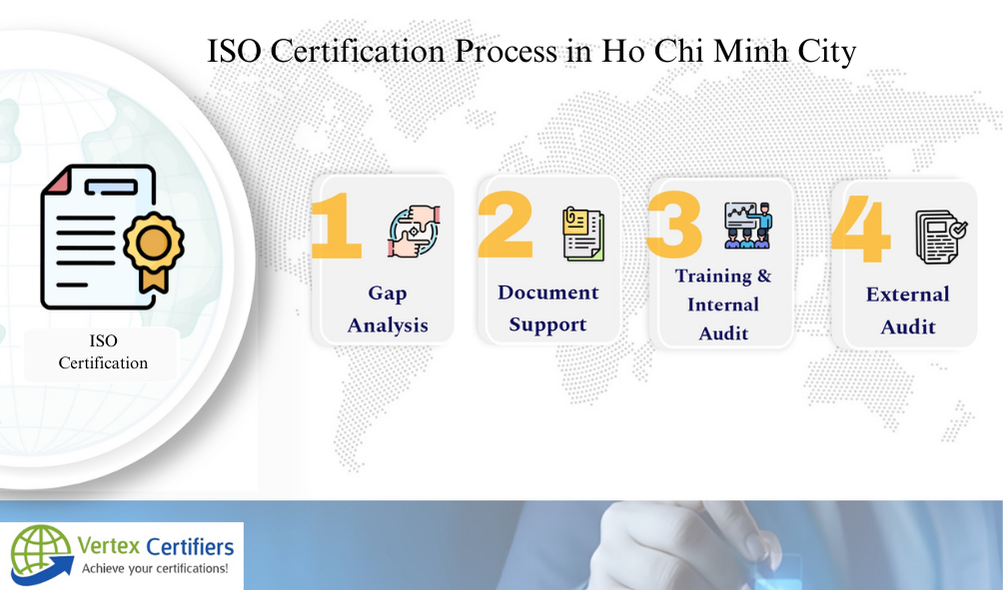
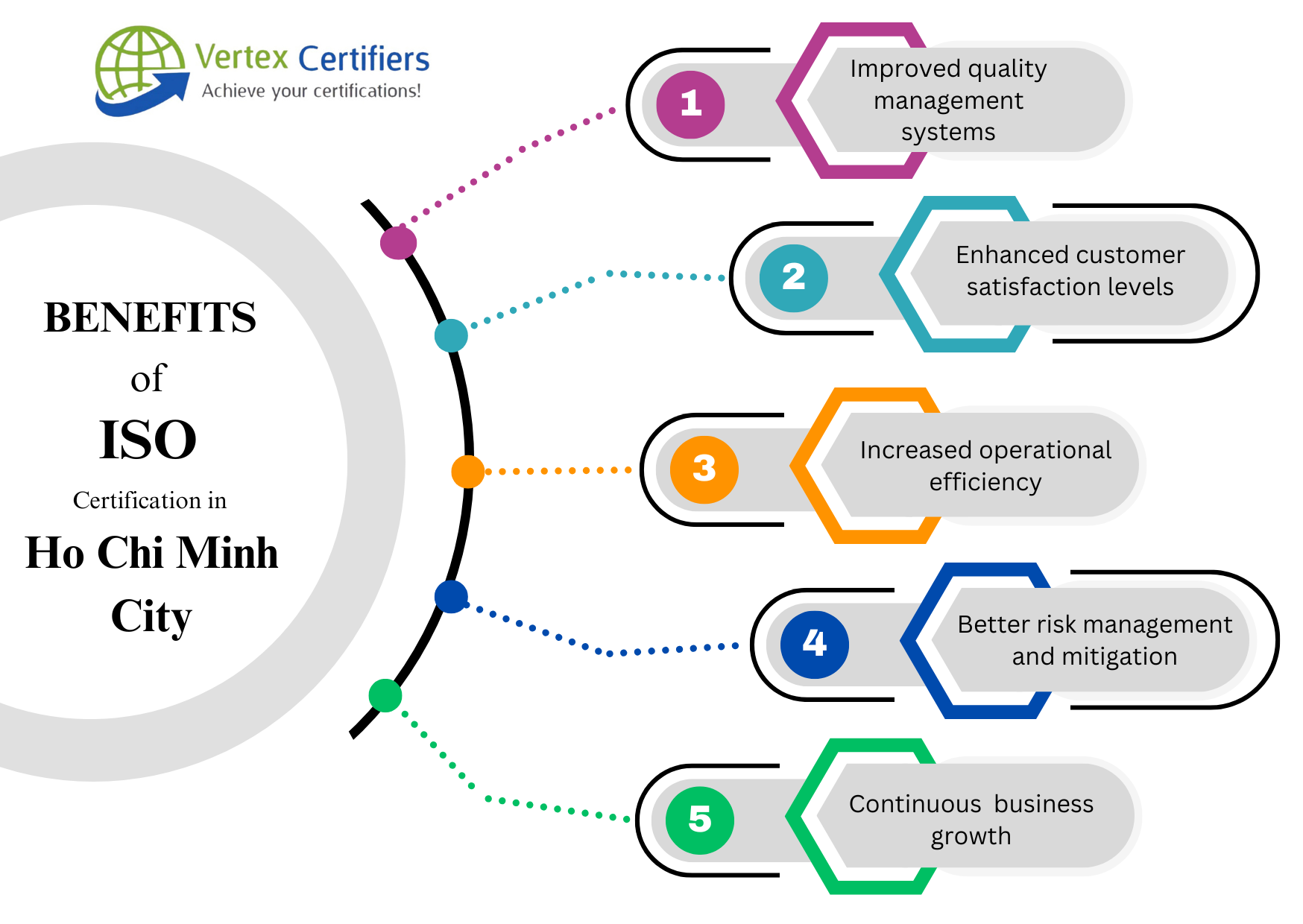
The certification process typically begins with a detailed gap analysis to assess current practices against ISO standards. Organizations then develop and implement management systems, document procedures, and train employees to ensure consistent application. Internal audits verify readiness before an accredited certification body conducts the external audit. Vertex Certifiers offers expert guidance throughout this process, helping businesses navigate complexities and achieve certification efficiently. Benefits of ISO certification in Ho Chi Minh City include improved operational efficiency, enhanced reputation, increased customer trust, and expanded access to global markets. As Vietnam’s economy continues to grow and integrate internationally, ISO certification is a strategic investment for sustainable success.
How to get ISO Certification in Ho Chi Minh City?
Benefits of ISO Certification in Ho Chi Minh City
ISO Consultation | Consultants in Ho Chi Minh City
ISO consultants in Ho Chi Minh City play a crucial role in helping organizations achieve certification smoothly and effectively. These professionals provide comprehensive services including gap analysis, system design, documentation, staff training, and audit preparation. Vertex Certifiers’ consultants combine deep knowledge of ISO standards with local market understanding to deliver customized solutions tailored to each client’s unique needs.
Consultants begin by assessing the organization’s current processes to identify areas needing improvement. They then assist in developing and implementing management systems aligned with standards such as ISO 9001, ISO 14001, ISO 27001, ISO 45001, and ISO 22000. Training sessions ensure employees understand and adhere to new procedures, fostering a culture of quality and compliance. Consultants also prepare organizations for external audits, minimizing risks of non-conformities and delays. Post-certification, they provide ongoing support to maintain compliance and promote continuous improvement. Partnering with ISO consultants in Ho Chi Minh City accelerates certification timelines, reduces costs, and maximizes the benefits of ISO standards, making them indispensable allies for businesses aiming for excellence.
ISO 27001 Certification In Ho Chi Minh City
ISO 27001 certification in Ho Chi Minh City is essential for organizations focused on protecting sensitive information and managing information security risks. This internationally recognized standard provides a framework for establishing, implementing, maintaining, and continually improving an Information Security Management System (ISMS).
Achieving ISO 27001 involves conducting risk assessments, defining security controls, and documenting policies and procedures. Certified organizations demonstrate their commitment to data confidentiality, integrity, and availability, which is critical in Vietnam’s increasingly digital economy. ISO 27001 certification helps businesses comply with data protection laws, reduce cyber threats, and build trust with customers and partners. The certification process includes internal audits and a formal external audit by an accredited body, ensuring robust information security practices.
ISO 14001 Certification in Ho Chi Minh City
ISO 14001 certification supports organizations in Ho Chi Minh City committed to environmental management and sustainability. This standard enables businesses to systematically identify and control environmental impacts, comply with regulations, and pursue continual improvement.
The certification process involves developing an Environmental Management System (EMS), setting environmental objectives, implementing control measures, and conducting audits. ISO 14001 certification helps companies reduce waste, lower costs through efficient resource use, and enhance their reputation among environmentally conscious customers and regulators. It also positions businesses favorably in global markets increasingly focused on sustainability.
ISO 9001 Certification in Ho Chi Minh City
ISO 9001 certification is the most widely recognized quality management standard, applicable to organizations of all sizes and sectors in Ho Chi Minh City. It provides a framework for consistent quality, customer satisfaction, and continuous improvement.
The certification process requires defining quality objectives, documenting processes, training staff, and conducting internal audits. ISO 9001 certification helps businesses improve efficiency, reduce errors, and increase customer loyalty. It also opens doors to new markets and government contracts. Achieving ISO 9001 demonstrates a company’s commitment to delivering high-quality products and services, critical in Ho Chi Minh City’s competitive business environment.
ISO 45001 Certification in Ho Chi Minh City
ISO 45001 certification focuses on occupational health and safety management, helping organizations create safer workplaces and reduce work-related injuries. This standard is increasingly important for companies in Ho Chi Minh City’s manufacturing, construction, and service sectors.
The certification process involves hazard identification, risk assessment, implementation of safety controls, and employee training. ISO 45001 certification demonstrates a company’s dedication to employee well-being, legal compliance, and continuous safety improvements. Benefits include fewer accidents, lower insurance costs, improved morale, and enhanced reputation.
ISO 22000 Certification in Ho Chi Minh City
ISO 22000 certification is critical for food industry businesses in Ho Chi Minh City, ensuring food safety management systems meet international standards. This standard covers all aspects of the food supply chain, from production to consumption.
Achieving ISO 22000 involves hazard analysis, establishing control measures, documentation, and regular audits. Certified organizations demonstrate their commitment to preventing food safety hazards, complying with regulations, and protecting consumer health. ISO 22000 certification enhances market access and customer confidence in Ho Chi Minh City’s growing food industry.
Cost of ISO Certification in Ho Chi Minh City
The cost of ISO certification in Ho Chi Minh City varies based on factors such as company size, scope of certification, industry complexity, and the certification body chosen. Typical expenses include consultancy fees, certification audits, staff training, and ongoing surveillance audits.
For small to medium enterprises, costs generally range from a few thousand to several thousand USD. Larger organizations or those pursuing multiple certifications may face higher costs. Despite the investment, ISO certification delivers significant returns through improved efficiency, risk reduction, and enhanced market competitiveness. Vertex Certifiers offers transparent pricing and customized packages to ensure businesses in Ho Chi Minh City maximize the value of their certification journey.
Why ISO Certification is Important in Ho Chi Minh City
Ho Chi Minh City is widely recognized as Vietnam’s largest commercial and financial hub and one of the country’s most important business centers. It is home to a large concentration of manufacturing operations, industrial parks, exporters, service providers, and foreign-invested companies, which makes ISO certification highly relevant for businesses seeking growth, operational control, and international market credibility. [web:80][web:87]
For businesses operating in Ho Chi Minh City, ISO certification is not only about documentation or audit readiness. It is often a practical requirement for working with international buyers, meeting supply chain expectations, supporting export operations, strengthening ESG positioning, and building confidence with customers, partners, investors, and regulators.
The city’s business environment includes strong activity in electronics, textiles and garments, food processing, logistics, warehousing, IT and software, healthcare, construction, pharmaceuticals, and other sectors where quality, safety, environmental performance, information security, and continuity expectations are increasingly important. Recent reporting on the city’s export processing and industrial zones also highlights continued investment in electronics, chemicals, engineering, and food processing, which supports the relevance of ISO-based systems in these sectors. [web:87]
As more businesses in Ho Chi Minh City serve global customers or operate within regulated supply chains, ISO certification can help standardize operations, improve governance, reduce risk, and demonstrate that the company is ready to meet international expectations in a structured and measurable way.
Industries That Need ISO Certification in Ho Chi Minh City
ISO certification is useful across many industries in Ho Chi Minh City because businesses often need stronger internal control, customer assurance, regulatory alignment, and export readiness.
- Manufacturing: For process standardization, quality consistency, safety, and compliance.
- Electronics: For quality control, environmental management, and customer-driven supplier compliance.
- Textile & Apparel: For export credibility, process consistency, workplace safety, and sustainability expectations.
- Automotive Components: For supplier quality, traceability, and operational reliability.
- Logistics & Freight: For service quality, continuity, safety, and process control.
- IT Companies: For information security, service management, and continuity planning.
- BPO: For data security, business continuity, and customer service consistency.
- Banks & Financial Services: For information security, operational resilience, and service governance.
- Hospitals: For quality systems, patient safety-related process control, and service consistency.
- Medical Devices: For regulated quality management and customer confidence.
- Food & Beverage: For food safety, GMP-related discipline, and export compliance.
- Construction: For quality, safety, environmental performance, and tender eligibility.
- Chemical Industries: For process control, risk management, and environmental and safety compliance.
- Export Companies: For meeting buyer requirements and improving international business credibility.
ISO Standards We Offer
Vertex Certifiers provides consulting and implementation support for a wide range of ISO standards and related certifications for businesses in Ho Chi Minh City.
| Standard | Description |
|---|---|
| ISO 9001 | Quality Management System for improving process control, customer satisfaction, and continual improvement. |
| ISO 14001 | Environmental Management System for controlling environmental impacts, compliance, and sustainability performance. |
| ISO 45001 | Occupational Health and Safety Management System for reducing workplace risks and improving employee safety. |
| ISO 22000 | Food Safety Management System for food manufacturers, processors, suppliers, and food chain businesses. |
| ISO 27001 | Information Security Management System for protecting confidential business, customer, and digital information. |
| ISO 13485 | Quality Management System for medical device manufacturers and related healthcare suppliers. |
| ISO 22301 | Business Continuity Management System for improving resilience and recovery from disruption. |
| GMP | Good Manufacturing Practices for pharmaceuticals, food, cosmetics, medical products, and regulated manufacturing environments. |
| ISO 50001 | Energy Management System for improving energy performance and reducing energy-related costs. |
| ISO 20000-1 | IT Service Management System for improving service delivery, support processes, and service governance. |
| ISO 17025 | Competence standard for testing and calibration laboratories seeking reliable technical results. |
| ISO 41001 | Facility Management System for improving workplace support, infrastructure management, and operational efficiency. |
ISO Certification Process in Ho Chi Minh City
Gap Analysis
The first step in the ISO certification process is understanding where your organization currently stands compared with the requirements of the chosen standard. A gap analysis reviews your existing systems, documents, records, operational controls, and management practices to identify areas that already meet the standard and areas that need improvement.
This stage is important because it helps define project scope, implementation priorities, and realistic timelines. For companies in Ho Chi Minh City operating in fast-moving industrial or service environments, a clear gap analysis helps avoid delays and unnecessary rework.
Documentation
Once gaps are identified, the next step is preparing the required documentation. Depending on the ISO standard, this may include policies, procedures, manuals, risk registers, objectives, work instructions, forms, and operational records.
Good documentation should reflect how the business actually works. The goal is not to create paperwork for its own sake, but to establish a practical system that supports consistent implementation, traceability, and audit readiness.
Implementation
After documentation is developed, the organization must implement the system in day-to-day operations. This means putting the approved procedures into practice, assigning responsibilities, maintaining records, monitoring performance, and ensuring that the system becomes part of the business rather than remaining only on paper.
Effective implementation often requires coordination across departments such as operations, quality, HR, procurement, IT, maintenance, EHS, and senior management depending on the standard selected.
Training
Employee training is a critical part of successful ISO implementation. Team members need to understand the purpose of the standard, their responsibilities, the required procedures, and the records they must maintain.
Awareness training, role-based training, and internal auditor training help ensure that the management system is understood and followed consistently across the organization.
Internal Audit
Before the external certification audit, the organization should conduct an internal audit to assess whether the system has been implemented correctly and whether it conforms to the chosen ISO standard. Internal audits help detect nonconformities, missing records, inconsistent practices, and opportunities for improvement before the certification body visits.
This step improves confidence and gives management a more realistic view of certification readiness.
Management Review
Management review is a formal evaluation by top management of the performance and effectiveness of the ISO management system. During this review, leadership typically examines objectives, audit findings, compliance issues, risks, resource needs, customer feedback, incidents, and opportunities for improvement.
Management review is important because ISO certification expects active leadership involvement, not just delegation to one coordinator or department.
Certification Audit
The certification audit is usually conducted in two stages by the chosen certification body. Stage 1 generally reviews the organization’s documentation, scope, and readiness, while Stage 2 evaluates actual implementation and evidence of conformity in practice. Sources describing ISO certification commonly outline this multi-stage process as part of the broader certification cycle. [web:40][web:82][web:88]
If the organization meets the requirements and closes any identified nonconformities, the certification body issues the certificate for the applicable standard.
Surveillance Audit
ISO certification is not a one-time event. After certification, surveillance audits are typically conducted during the certification cycle to confirm that the system continues to be maintained and improved over time. Sources describing the ISO certification process commonly refer to a three-year cycle that includes surveillance audits and later recertification. [web:40][web:82][web:88]
This ongoing review helps organizations maintain consistency, address changes in operations, and remain aligned with customer, regulatory, and business expectations.
Benefits of ISO Certification
ISO certification can deliver meaningful business benefits for companies in Ho Chi Minh City, especially those serving competitive domestic and international markets.
- Better quality: Improves consistency, process control, and output reliability.
- Higher productivity: Reduces inefficiencies, duplication, and avoidable process gaps.
- Customer satisfaction: Builds trust through more reliable performance and documented systems.
- Regulatory compliance: Helps organizations structure legal, operational, and sector-specific controls.
- Export opportunities: Supports credibility with international buyers and supply chain partners.
- Reduced operational risks: Encourages structured risk identification and corrective action.
- Improved safety: Important for workplaces with operational, employee, or contractor risks.
- Better environmental performance: Helps reduce waste, emissions, and environmental impact where relevant.
- Stronger brand image: Demonstrates professionalism, governance, and commitment to internationally recognized practices.
- Eligibility for tenders: Many projects and procurement opportunities prefer or require certified systems.
Industrial Areas in Ho Chi Minh City
Ho Chi Minh City has a strong industrial base supported by export processing zones, industrial parks, and high-tech production areas. Public investment and industrial-zone reporting highlight the city’s importance as an industrial and export platform, with continued capital flow into export processing and industrial zones. [web:87]
Major industrial and export-oriented areas include:
- Saigon Hi-Tech Park: Important for high-tech manufacturing, electronics, innovation, and export-driven operations.
- Tan Thuan Export Processing Zone: A well-known export-focused zone supporting manufacturing and international business activity.
- Linh Trung Export Processing Zone: Relevant for export manufacturers and supporting industrial supply chains.
- Hiep Phuoc Industrial Park: Important for industrial production, logistics, and large-scale operations. [web:85]
- Vinh Loc Industrial Park: Supports manufacturing businesses requiring structured management systems and customer confidence. [web:85]
- Tan Tao Industrial Park: A recognized industrial area for diverse manufacturing and export-related operations. [web:85]
Businesses in these zones often benefit from ISO certification because they work with export markets, foreign-invested partners, regulated supply chains, and large buyers that expect stronger process consistency, risk control, and compliance discipline.
Why Choose Vertex Certifiers
Vertex Certifiers provides practical ISO consulting and implementation support for businesses in Ho Chi Minh City across manufacturing, service, healthcare, IT, logistics, food, and other sectors.
- Lead Auditors: Support from experienced professionals who understand certification expectations and audit readiness.
- End-to-end consulting: Assistance from gap analysis to certification and post-certification support.
- Affordable pricing: Flexible support models designed around organization size and project scope.
- Online & onsite implementation: Practical delivery options for different business needs and locations.
- Documentation support: Help with policies, procedures, manuals, records, and system alignment.
- Internal audits: Pre-certification audit support to identify and close gaps early.
- Certification coordination: Guidance in preparing for Stage 1, Stage 2, and surveillance audits.
- Post-certification support: Continued support for maintenance, improvement, surveillance, and recertification readiness.
Frequently Asked Questions
Is ISO certification mandatory in Ho Chi Minh City?
ISO certification is generally not mandatory unless it is required by customers, tenders, contracts, regulators, or supply chain expectations. Many businesses still pursue it because it improves credibility and operational control.
How much does ISO certification cost?
The cost depends on the standard selected, business size, number of employees, number of sites, documentation readiness, complexity, and certification body fees.
How long does ISO certification take?
The timeline varies by standard and readiness, but many businesses take a few weeks to several months depending on scope, implementation maturity, and audit preparation needs.
Which ISO standard is best for manufacturers?
ISO 9001 is a strong starting point for most manufacturers, while ISO 14001, ISO 45001, ISO 22000, ISO 13485, or GMP may also be important depending on industry and customer requirements.
Which industries need ISO 27001?
ISO 27001 is especially relevant for IT companies, BPOs, financial services, healthcare providers, software businesses, data-driven organizations, and companies handling confidential information.
Can SMEs get ISO certified?
Yes. Small and medium-sized enterprises can implement ISO systems in a scalable way that matches their size, resources, and operational requirements.
Is training included in ISO implementation?
In most consulting projects, training is an important part of implementation because employees need to understand the system, their responsibilities, and how to maintain required records.
Can multiple ISO standards be integrated?
Yes. Many businesses integrate standards such as ISO 9001, ISO 14001, ISO 45001, ISO 27001, or ISO 22301 to reduce duplication and improve management efficiency.
Which certification body should I choose?
It is best to choose an accredited certification body with relevant industry experience, transparent audit practices, and recognition in your target market.
Do export companies in Ho Chi Minh City need ISO certification?
Many export companies benefit from ISO certification because overseas buyers often expect stronger process control, traceability, consistency, and compliance documentation.
Can ISO help with tender eligibility?
Yes. ISO certification can improve eligibility for tenders and procurement opportunities where structured management systems are preferred or required.
What happens after certification?
After certification, the organization must maintain the management system and prepare for surveillance audits during the certification cycle. Process overviews commonly describe surveillance and recertification as part of the ongoing ISO cycle. [web:40][web:88]
Get ISO Certification Support in Ho Chi Minh City
Vertex Certifiers helps businesses in Ho Chi Minh City with ISO consulting, documentation, training, internal audits, certification coordination, and post-certification support across multiple ISO standards.
Contact Vertex Certifiers today for end-to-end ISO certification consulting tailored to your industry, business size, and market requirements.
Get In Touch With Us
Our Services
- GMP Certification
- GLP Certification
- GDP Certification
- Halal Certificate
- Organic Certificate
- CE Marking Certification
- RoHS Certification
- FDA Certification
- CMMI Certification
- Cyber Security
- VAPT Testing
- Security Assessment
Our Local Cities
