Requirements for ISO 22301 Certification in Vietnam
ISO 22301 certification in Vietnam requires organizations to establish, implement, maintain, and continually improve a Business Continuity Management System (BCMS) that can protect critical operations, reduce the impact of disruption, and support faster recovery. ISO 22301 is generally described as a structured management system for protecting against, reducing the likelihood of, preparing for, responding to, and recovering from disruptive incidents. [web:63][web:69]
For organizations in Vietnam, the requirements of ISO 22301 are especially relevant where operational interruptions can affect export commitments, customer confidence, IT services, manufacturing continuity, logistics flow, or essential business functions. The extent of implementation depends on the organization’s operating environment, size, and complexity, which makes the standard suitable for both growing businesses and large enterprises. [web:63]
One of the first requirements is understanding the context of the organization. This means identifying internal and external issues that can affect business continuity, such as supply chain dependence, critical vendors, regulatory obligations, technology reliance, physical location risks, and customer delivery expectations. Organizations should also identify interested parties, such as clients, regulators, investors, business partners, and internal teams, whose needs may influence continuity planning.
Leadership commitment is another core requirement. Top management must actively support the BCMS, allocate resources, define business continuity responsibilities, and ensure that continuity planning is aligned with strategic direction. Without visible leadership involvement, business continuity often remains a paper exercise rather than an operational capability.
A central part of ISO 22301 implementation is conducting a Business Impact Analysis (BIA). The BIA helps the organization identify critical activities, understand the consequences of disruption, define acceptable downtime, and prioritize recovery actions. This allows management to determine which processes, systems, facilities, or services must be restored first to avoid significant financial, operational, contractual, or reputational damage. [web:69]
Alongside the BIA, organizations must perform a risk assessment to identify threats that could disrupt operations. These may include cyber incidents, power failures, flooding, supplier failure, equipment breakdown, transport delays, workforce disruption, data centre outages, or emergency events. A strong BCMS does not rely only on crisis response; it also works to reduce the likelihood and severity of disruption through planned controls and preventive action. [web:63]
Organizations also need to establish clear business continuity objectives. These objectives should be measurable, practical, and linked to the organization’s continuity priorities. Examples may include improving recovery readiness, reducing downtime for critical services, enhancing backup communication channels, or strengthening recovery exercises across departments.
Another major requirement is the development of business continuity plans. These plans should define how critical processes will continue or recover during a disruption. Depending on the nature of the business, plans may include alternate work arrangements, IT recovery procedures, manual processing methods, site relocation arrangements, backup suppliers, crisis leadership roles, and escalation processes.
Organizations also need documented incident response procedures that explain how disruptions will be identified, escalated, assessed, managed, and resolved. Closely linked to this is the need for communication plans, which define how information will be shared with employees, customers, suppliers, regulators, emergency contacts, and other stakeholders during an incident.
ISO 22301 also expects organizations to ensure competence and employee training. Employees should understand their responsibilities during disruptions, know how to follow incident procedures, and participate in awareness sessions, drills, or testing where relevant. Business continuity plans are far more effective when teams understand them in practice, not only in documentation.
To maintain the BCMS, organizations must carry out internal audits and management review. Internal audits help verify whether continuity controls, plans, and procedures are implemented effectively, while management reviews help top leadership evaluate performance, readiness, changes in risk, and improvement needs. Certification guidance commonly notes that business continuity systems are also reviewed through annual surveillance audits and recertification on a three-year cycle after certification is granted. [web:60][web:62][web:68]
Finally, ISO 22301 requires continual improvement. Business continuity is not a one-time project. Organizations are expected to update their BIA, reassess risks, improve plans, close gaps found during testing or audits, and strengthen continuity capability as operations evolve. This ongoing improvement approach helps organizations in Vietnam remain more resilient in a business environment shaped by supply chain changes, weather-related disruption, and growing digital dependence. [web:63][web:69]
Cost of ISO 22301 Certification in Vietnam
The cost of ISO 22301 certification in Vietnam varies depending on the organization’s size, operational complexity, number of business locations, and certification scope. Every organization has different business continuity requirements, so pricing should be based on actual continuity risks, process dependencies, and implementation effort rather than a single fixed fee.
Several factors influence certification cost:
- Organization size: Larger organizations usually require more planning, coordination, and documentation.
- Number of employees: More employees often mean broader awareness training, role allocation, and continuity coordination.
- Number of locations: Multi-site organizations may need location-specific continuity planning and audit coverage.
- Scope of certification: A wider scope usually increases assessment effort and supporting documentation.
- Business complexity: Complex operations, outsourced activities, data dependencies, or regulated sectors generally need more extensive continuity planning.
- Existing management systems: Organizations already certified to ISO 9001, ISO 27001, or similar standards may have a stronger management foundation, which can reduce implementation effort.
- Certification body: Audit fees differ depending on the certification provider, accreditation status, and audit duration.
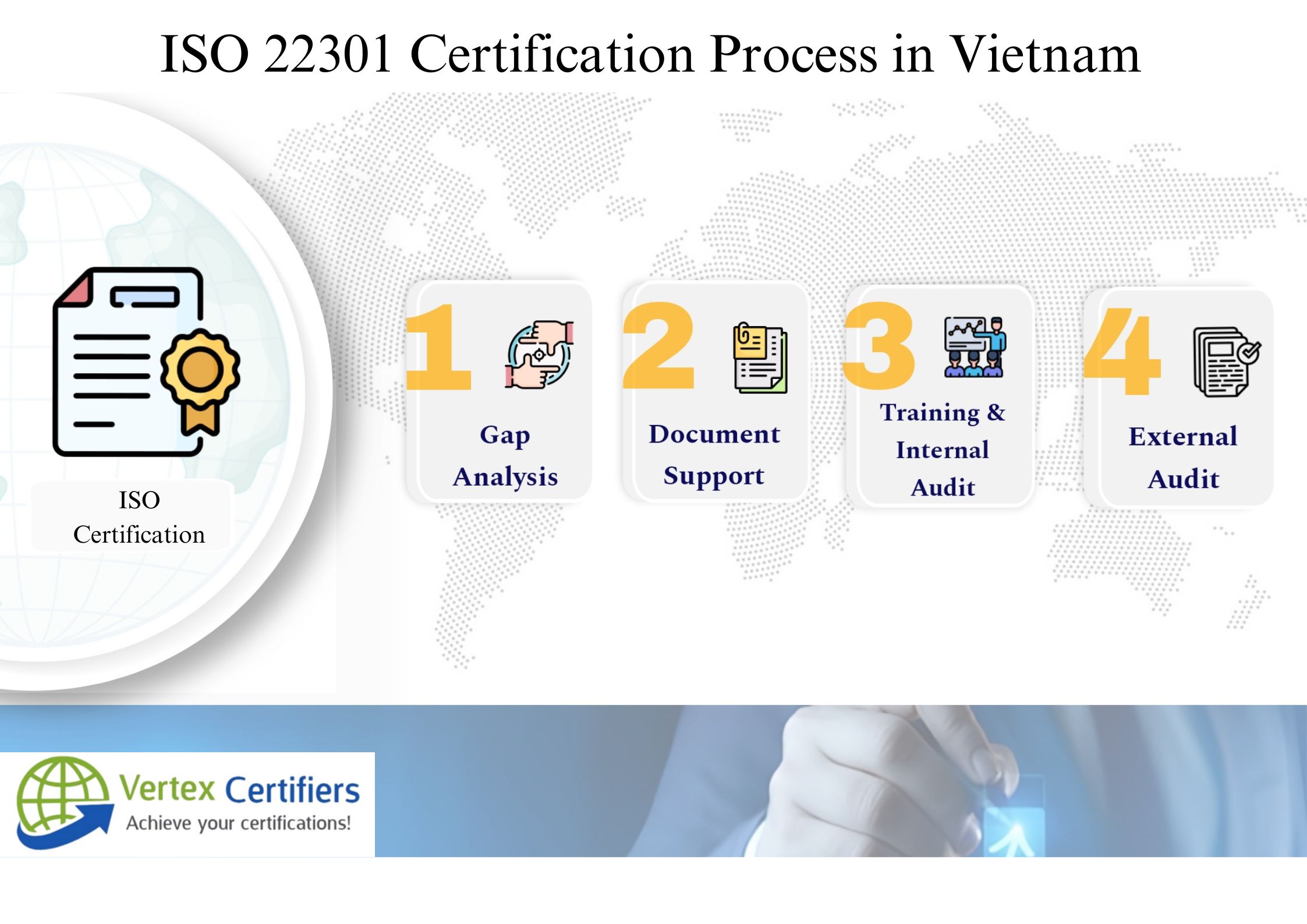
A practical BCMS project often includes gap analysis, documentation support, Business Impact Analysis, risk assessment, awareness training, internal audits, testing support, and certification audit coordination. For that reason, the final cost should always reflect the actual readiness and continuity requirements of the organization.
How Long Does ISO 22301 Certification Take in Vietnam?
ISO 22301 implementation in Vietnam generally takes around 2 to 6 months, depending on the organization’s existing readiness, documentation maturity, number of critical processes, and business continuity complexity.
- Small businesses: Usually around 2 to 3 months where operations are simpler and key processes are easier to map and protect.
- Medium organizations: Often around 3 to 5 months depending on process interdependence, technology reliance, and supplier risk.
- Large enterprises: Commonly around 4 to 6 months or longer where multiple locations, departments, systems, and recovery priorities must be coordinated.
The timeline can also be influenced by how quickly the organization completes its BIA, risk assessment, continuity planning, internal audit, management review, and certification audit readiness activities.
Industries That Benefit from ISO 22301 in Vietnam
ISO 22301 is valuable for organizations in Vietnam that cannot afford prolonged downtime, service interruption, supply chain failure, or information-system disruption. Because the standard is intended to be applicable to organizations of different types, sizes, and sectors, it can support a broad range of industries. [web:63]
- Electronics manufacturers
- Textile exporters
- Automotive suppliers
- Semiconductor companies
- Logistics providers
- Banks
- Insurance companies
- Data centres
- BPO companies
- Healthcare organizations
- Government contractors
- Manufacturing companies
- IT and software service providers
- Telecommunications companies
- Warehousing and distribution businesses
Why ISO 22301 Matters for Vietnam
ISO 22301 is especially relevant in Vietnam because many organizations operate in environments where business interruption can come from both physical and digital threats. A structured BCMS helps organizations prepare for disruption, respond more effectively, and restore essential activities with less confusion and downtime. [web:63][web:69]
- Typhoons: Severe weather can affect transportation, facilities, supply availability, and employee access.
- Flooding: Localized or large-scale flooding can disrupt offices, warehouses, production sites, and logistics routes.
- Supply chain disruptions: Export-focused and import-dependent businesses often rely on tightly connected global supply chains.
- Global export commitments: Missed deliveries and production delays can affect overseas buyers, contracts, and long-term customer confidence.
- Cyber attacks: Increasing dependence on digital systems means ransomware, outages, or data compromise can interrupt key business services.
- Manufacturing downtime: Production interruptions can create major losses in output, delivery performance, and contractual compliance.
- Data centre failures: Downtime in hosting, infrastructure, or cloud-connected systems can affect service continuity across multiple customers.
By addressing these realities directly, ISO 22301 helps Vietnamese organizations improve resilience, protect reputation, and maintain continuity under pressure.
Frequently Asked Questions
1. What is ISO 22301?
ISO 22301 is an international standard for Business Continuity Management Systems that helps organizations prepare for, respond to, and recover from disruptive incidents. [web:63][web:69]
2. Is ISO 22301 mandatory in Vietnam?
ISO 22301 certification is generally not mandatory, but many organizations adopt it to improve resilience, satisfy customer expectations, strengthen contracts, and demonstrate structured continuity capability.
3. Who should get ISO 22301 certification?
Organizations that cannot afford downtime, such as manufacturers, banks, logistics providers, IT firms, healthcare organizations, data centres, and export-focused businesses, are strong candidates for ISO 22301. [web:60][web:63]
4. How long does ISO 22301 certification take?
Implementation generally takes around 2 to 6 months depending on business size, complexity, existing controls, and readiness for certification.
5. How much does ISO 22301 certification cost in Vietnam?
The cost depends on organization size, employee count, number of locations, scope, business complexity, existing systems, and certification body fees.
6. What is the difference between ISO 22301 and ISO 27001?
ISO 22301 focuses on business continuity and recovery from disruption, while ISO 27001 focuses on information security management and protection of information assets.
7. Can SMEs get ISO 22301 certification?
Yes. ISO 22301 is described as applicable to organizations of different sizes and types, so SMEs can implement a BCMS that matches their scale and operational needs. [web:63]
8. How often are surveillance audits conducted?
Certification guidance commonly states that surveillance audits are conducted annually, with recertification typically taking place every three years. [web:60][web:62][web:68]
9. Is employee training mandatory for ISO 22301?
Employee competence and awareness are essential because staff need to understand their roles during incidents, escalation, response, and recovery activities.
10. Can ISO 22301 be integrated with ISO 9001?
Yes. Many organizations integrate ISO 22301 with ISO 9001, ISO 27001, and other management systems to streamline governance, documentation, and audit activities. [web:60]
11. What is a Business Impact Analysis in ISO 22301?
A Business Impact Analysis identifies critical activities, assesses the impact of disruption, and helps define recovery priorities and acceptable downtime. [web:69]
12. Is testing required in a business continuity system?
Yes. Business continuity arrangements should be reviewed and tested so the organization can confirm that plans are practical, understood, and effective during disruption.
13. Which industries benefit the most from ISO 22301?
Industries with high continuity demands, such as banking, manufacturing, IT services, logistics, healthcare, data centres, and export-oriented operations, often benefit the most. [web:60]
14. Can ISO 22301 help with customer confidence?
Yes. A certified BCMS can demonstrate that the organization has structured continuity arrangements in place, which can improve trust among customers, partners, and stakeholders.
15. Why is ISO 22301 important for export businesses in Vietnam?
Export businesses often work to strict delivery commitments, global supply chain requirements, and customer continuity expectations, so business continuity planning helps reduce the risk of disruption-related failure.
Get Expert ISO 22301 Certification Support in Vietnam
Vertex can help your organization implement ISO 22301 with practical support for gap analysis, Business Impact Analysis, risk assessment, documentation, employee awareness, internal audits, and certification readiness.
Contact Vertex for end-to-end ISO 22301 certification consulting in Vietnam and build a stronger, more resilient business continuity management system.