Vertex Certifiers

ISO Certification in Nairobi

ISO Certification in Nairobi | Best ISO Consultation in Nairobi

ISO Certification in Nairobi – ISO Certification services in the form of Gap Analysis, Documentation, Training, Audits, and ISO Registration are significant in helping companies achieve international standards. Vertex Certifiers is one of the best service providers offering multiple ISO standard certifications across the globe, namely ISO 9001, ISO 14001, ISO 27001, ISO 45001, ISO 22000, ISO 50001, ISO 41001, and so on. The ISO Certification service in Nairobi offers organizations the best opportunity to maximize efficiency, adherence, and global recognition.

Nairobi is the capital and economic hub of Kenya with different kinds of industries that range from manufacturing and services to agriculture and technology. Getting ISO Certification in Nairobi allows companies to gain trust, increase the effectiveness of the processes, and deliver what customers need in the market.

Nairobi is the economic, industrial, and innovation hub of East Africa, hosting thousands of local enterprises, multinational corporations, exporters, NGOs, and government contractors. As competition increases and regulatory expectations rise, ISO certification in Nairobi has become a strategic requirement for organizations aiming to win tenders, expand exports, improve efficiency, and build international credibility.

From Westlands corporate offices and Upper Hill financial institutions to Industrial Area manufacturers and Jomo Kenyatta International Airport (JKIA) logistics operators, ISO standards help Nairobi businesses align with global best practices. Vertex Certifiers provides end-to-end ISO certification services in Nairobi, supporting companies of all sizes across multiple ISO standards with fast, compliant, and IAF-recognized solutions.

What is ISO Certification ?

ISO (International Organization for Standardization) certification confirms that an organization follows internationally accepted management system standards for quality, safety, environment, information security, food safety, energy efficiency, and more. While ISO certification is voluntary in Kenya, it is mandatory in practice for most government tenders, international contracts, donor-funded projects, and export markets.

ISO certification demonstrates that your organization:


  • Operates in a controlled, consistent manner

  • Meets regulatory and customer requirements

  • Manages risks proactively

Why ISO Certification Is Important for Nairobi Businesses

Nairobi’s economy is diverse and fast-growing, but it is also highly regulated and competitive. ISO certification provides Nairobi organizations with measurable advantages:

  • Tender eligibility for government, parastatal, and donor-funded projects

  • Export readiness for East African Community (EAC), EU, and GCC markets

  • Operational efficiency in high-cost urban operations

  • Risk control for workplace safety, data security, and regulatory compliance

  • Brand credibility with international clients and partners

Organizations without ISO certification increasingly struggle to compete against certified rivals in Nairobi’s mature business ecosystem.

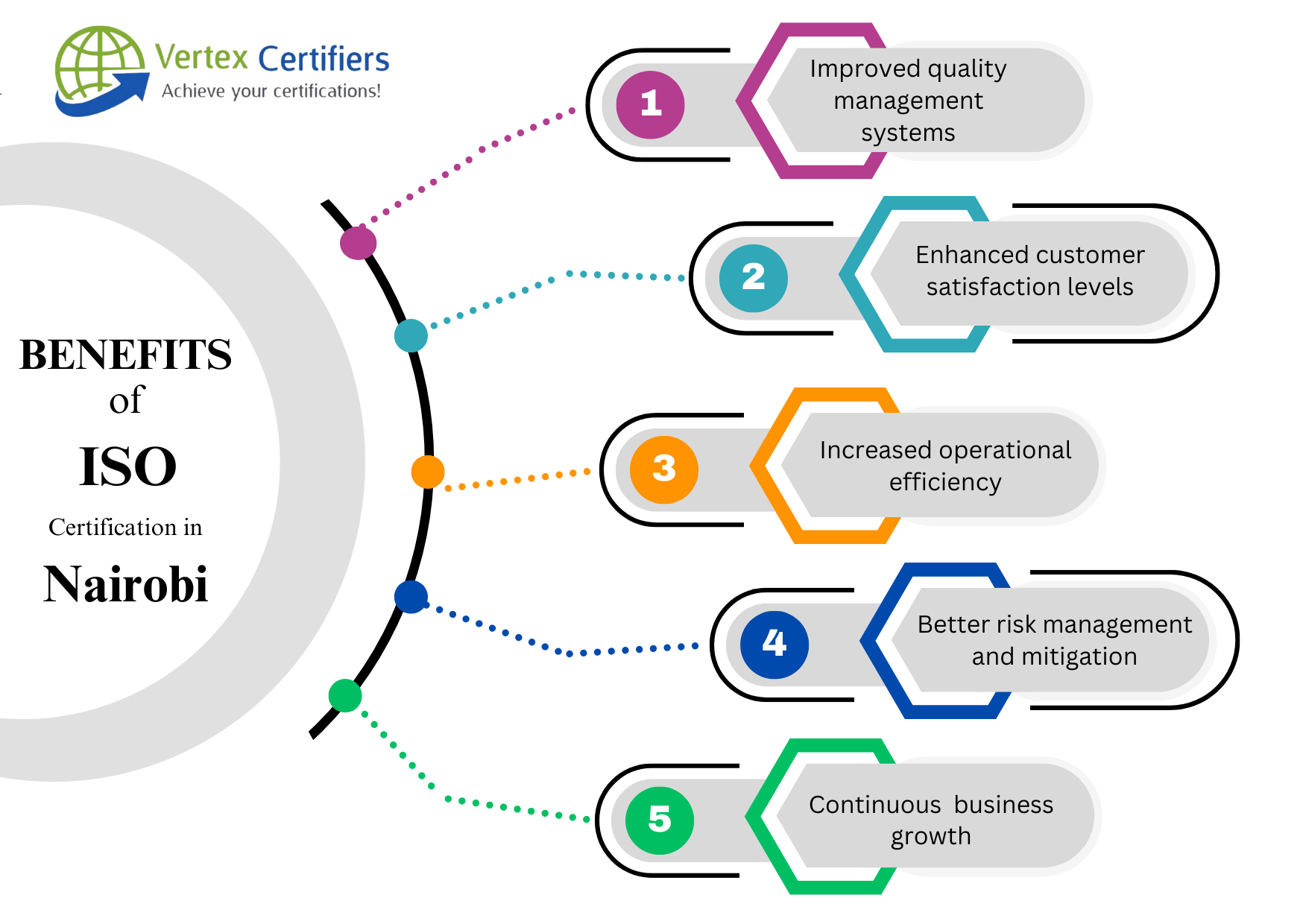
Benefits of ISO Certification in Nairobi

Benefits of ISO Certification in Nairobi

  • Enhanced Operational Efficiency: ISO standards streamline processes, reduce errors, and improve productivity.
  • Improved Customer Satisfaction: By delivering consistent quality, ISO Certification ensures enhanced customer trust and loyalty.
  • Market Competitiveness: ISO Certification develops credibility, enabling businesses to receive local and international contracts in Nairobi.
  • Compliance with the Law: Observing the ISO standards shall ensure that organizations comply with national and international standards.
  • Risk Management: ISO Certification enables the identification and mitigation of risks against specific ills.
  • Global Repute: ISO Certification allows for global recognition and expansion into more markets.
Types of ISO Certifications Available in Nairobi

ISO 9001 – Quality Management System (QMS)

ISO 9001 is the most widely adopted ISO standard in Nairobi. It ensures consistent service delivery, customer satisfaction, and process control. It is essential for:

  • Consulting firms and professional services

  • Construction and engineering companies

  • Manufacturers and traders

  • NGOs and training institutions

ISO 14001 – Environmental Management System (EMS)

ISO 14001 helps organizations manage environmental impacts such as waste, emissions, and resource usage. It is critical for:

  • Manufacturing and processing units in Industrial Area

  • Construction and infrastructure projects

  • Waste management and utilities

  • Organizations complying with NEMA regulations

ISO 45001 – Occupational Health & Safety (OH&S)

ISO 45001 protects workers from injuries and workplace hazards. It is vital for:

  • Construction and EPC contractors

  • Manufacturing and processing plants

  • Logistics, transport, and warehousing firms

  • Facilities with high-risk operations

ISO 27001 – Information Security Management System (ISMS)

ISO 27001 secures sensitive data and IT systems. It is increasingly demanded in Nairobi for:

  • IT companies and software developers

  • Fintechs and digital payment platforms

  • Banks, SACCOs, and insurance firms

  • BPOs and call centers

ISO 22000 – Food Safety Management System (FSMS)

ISO 22000 ensures food safety across the supply chain. It is essential for:

  • Food processors and packers

  • Catering companies and hotels

  • Dairy, meat, and beverage manufacturers

  • Export-oriented food businesses

ISO 50001 – Energy Management System

ISO 50001 reduces energy costs and improves efficiency. It is popular among:

  • Large factories and processing plants

  • Hospitals and hotels

  • Data centers and commercial buildings

ISO 22301 – Business Continuity Management

ISO 22301 ensures organizations can continue operations during disruptions. It is crucial for:

  • Banks and financial institutions

  • IT service providers

  • Logistics companies

  • Organizations exposed to power, cyber, or supply-chain disruptions

Integrated Management Systems (IMS)

Many Nairobi organizations implement integrated ISO systems such as ISO 9001 + ISO 14001 + ISO 45001, reducing audit time and certification costs by 25–30%.

Steps for Obtaining ISO Certification in Nairobi

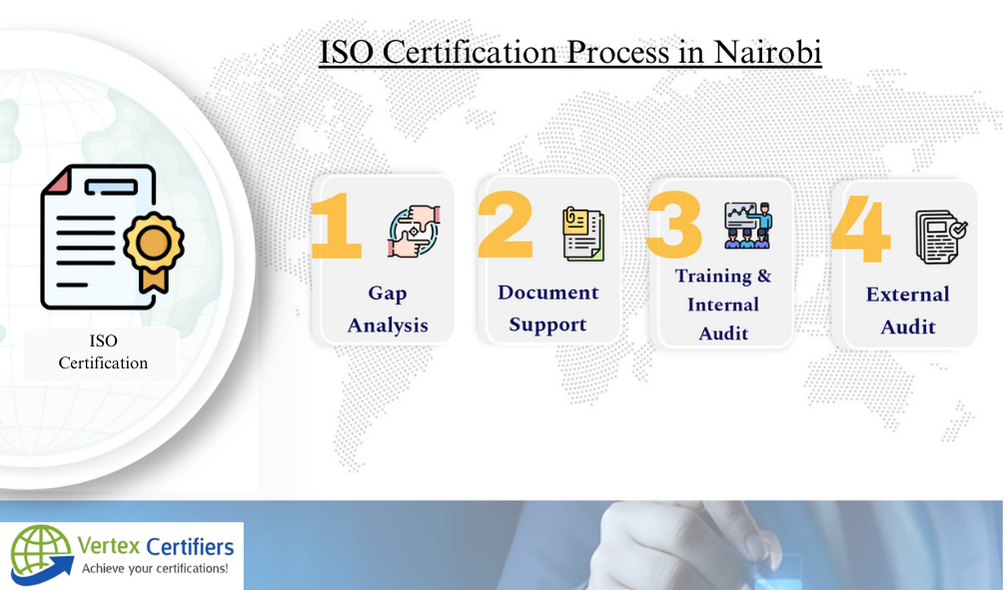
ISO Certification Process in Nairobi

ISO Certification Process in Nairobi

The ISO certification process is structured and systematic when guided by an experienced consultant like Vertex Certifiers.

Step 1: Gap Analysis

An initial assessment compares your existing practices against ISO standard requirements. Gaps are identified, and a clear action plan is prepared.

Step 2: Documentation

Policies, procedures, manuals, and records are developed or customized to match your operations and Kenyan regulatory context.

Step 3: Implementation & Training

Processes are implemented on the ground. Employees receive awareness and role-based training to ensure compliance.

Step 4: Internal Audit

An internal audit checks system effectiveness and identifies non-conformities before certification.

Step 5: Management Review

Top management reviews performance, risks, objectives, and improvement actions.

Step 6: Certification Audit

An IAF-accredited certification body conducts Stage 1 and Stage 2 audits. Upon successful completion, ISO certification is issued.
Cost of ISO Certification in Nairobi

Some of the items that affect costs include:

  • Business Nature: Highly process-intensive industries are costlier for certification.
  • Organization Size: The more employees or operational locations, the more expensive audits and implementation turn out to be.
  • Auditors: Experienced auditors may charge more, but the value obtained is greater.
  • Certification Bodies: Renowned certification bodies charge more money but provide greater credibility and authenticity.

Industries in Nairobi That Need ISO Certification

ISO certification benefits almost every sector in Nairobi, but it is especially critical for:

  • Construction & Engineering – roads, housing, commercial developments

  • Manufacturing & Processing – food, plastics, chemicals, packaging

  • IT & Technology – software, fintech, cloud services

  • Logistics & Transport – freight, courier, warehousing, aviation support

  • Healthcare – hospitals, laboratories, medical suppliers

  • NGOs & Development Organizations – donor-funded compliance

  • Education & Training – colleges, certification bodies

  • Hospitality & Tourism – hotels, catering, event management

Even SMEs with as few as 10–20 employees can successfully achieve ISO certification.

Why Vertex certifiers for ISO Certification in Nairobi?

ISO Certification in Nairobi

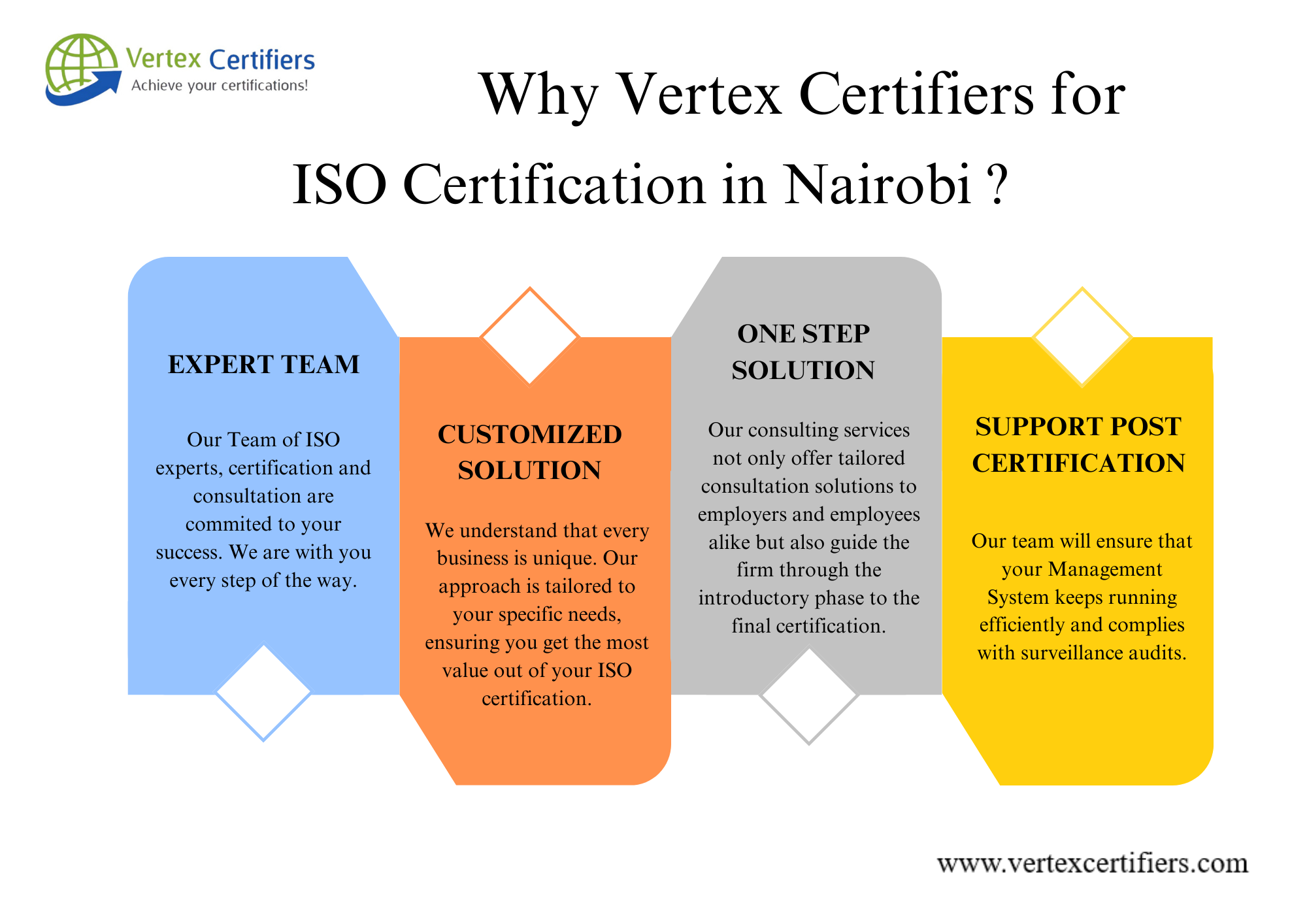
  • Comprehensive Services: We provide services from gap analysis to certification and maintenance.
  • Industry Experience: Our team has vast experience in different industries, so the solutions would be tailor-made.
  • International Acceptance: The certifications are accepted and recognized internationally.
  • Competitive Pricing: Solutions are offered at cost-effective prices without compromising quality.
  • Proven Track Record: With several successful certifications, Vertex Certifiers is a name trusted for ISO Certification in Nairobi.

FAQs about ISO Certification in Nairobi

  1. Who can obtain ISO Certification in Nairobi?
    Any company, big or small, of any industry can apply for ISO Certification.
  2. How long does the ISO Certification process take?
    The time duration depends on the size, complexity, and level of readiness of the organization but can take between 3 to 12 months to complete.
  3. Is ISO Certification mandatory in Nairobi?
    Not legally, but ISO Certification often becomes a requirement in order to tender for contracts or compete in a global market.
  4. What are the post-ISO Certification maintenance requirements?
    Organizations are required to carry out periodic audits and maintain an improvement in the management systems for continuation of the certification.
  5. What documents are needed for ISO Certification?
    The key documents would include policies, procedures, process maps, and audit records.
  6. Do small businesses in Nairobi get ISO certified?
    ISO standards are available in scales that can be implemented even by small organizations.

Get In Touch With Us

    Get Free
    Consultation


      Get Free
      Consultation


      Our Services

      Our Clients

      client
      client
      client
      client
      client

        Company Logo

        Get ISO certification


        Fill the details below, one of our executives will contact you shortly


        This will close in 0 seconds

        Call Now Button