ISO 14001 Certification in Saudi Arabia:
ISO 14001 Certification in Saudi Arabia helps organizations build a structured Environmental Management System (EMS) to manage environmental responsibilities, improve compliance, and support sustainable business growth. Vertex Certifiers is a global ISO consulting company providing end-to-end ISO 14001 consulting services across Saudi Arabia, including Riyadh, Jeddah, Dammam, Al Khobar, Dhahran, Jubail, Yanbu, Mecca, and Medina. Our services cover the complete certification journey, including gap analysis, environmental aspect-impact review, EMS documentation, implementation support, employee training, internal audits, and certification audit support. We work with organizations across oil & gas, petrochemical, construction, manufacturing, logistics, food processing, utilities, and healthcare, helping them align environmental practices with Saudi Vision 2030, environmental compliance requirements, sustainable operations, industrial growth goals, and resource efficiency expectations. ISO 14001 enables Saudi businesses to strengthen environmental performance, reduce waste, manage legal obligations, and improve credibility in both domestic and international markets.
Vertex Certifiers is a trusted global consulting and certification firm, renowned for its comprehensive ISO certification services in Saudi Arabia. Our expertise spans ISO 9001, ISO 14001, ISO 45001, ISO 27001, ISO 22000, and ISO 50001. Vertex Certifiers delivers custom ISO documentation support, staff training, internal audits, and full certification assistance for diverse industries—construction, oil & gas, manufacturing, logistics, and IT
What is ISO 14001 Certification?
ISO 14001 is the world’s leading standard for Environmental Management Systems. It provides a robust framework for organizations to continuously improve their environmental performance, manage risk, and comply with national and local environmental regulations in Saudi Arabia.
Key focus areas:
- Pollution prevention strategies
- Resource optimization through better energy and material management
- Identification and control of environmental impacts
- Commitment to continual improvement and legal compliance
By adopting ISO 14001, organizations demonstrate their dedication to protecting the environment while staying competitive in the marketplace and positioning themselves for larger, more eco-conscious contracts.
Implementation Procedure of ISO 14001 Certification in Saudi Arabia
Implementing ISO 14001 Certification in Saudi Arabia is structured to deliver results with clear stages and measurable outcomes:
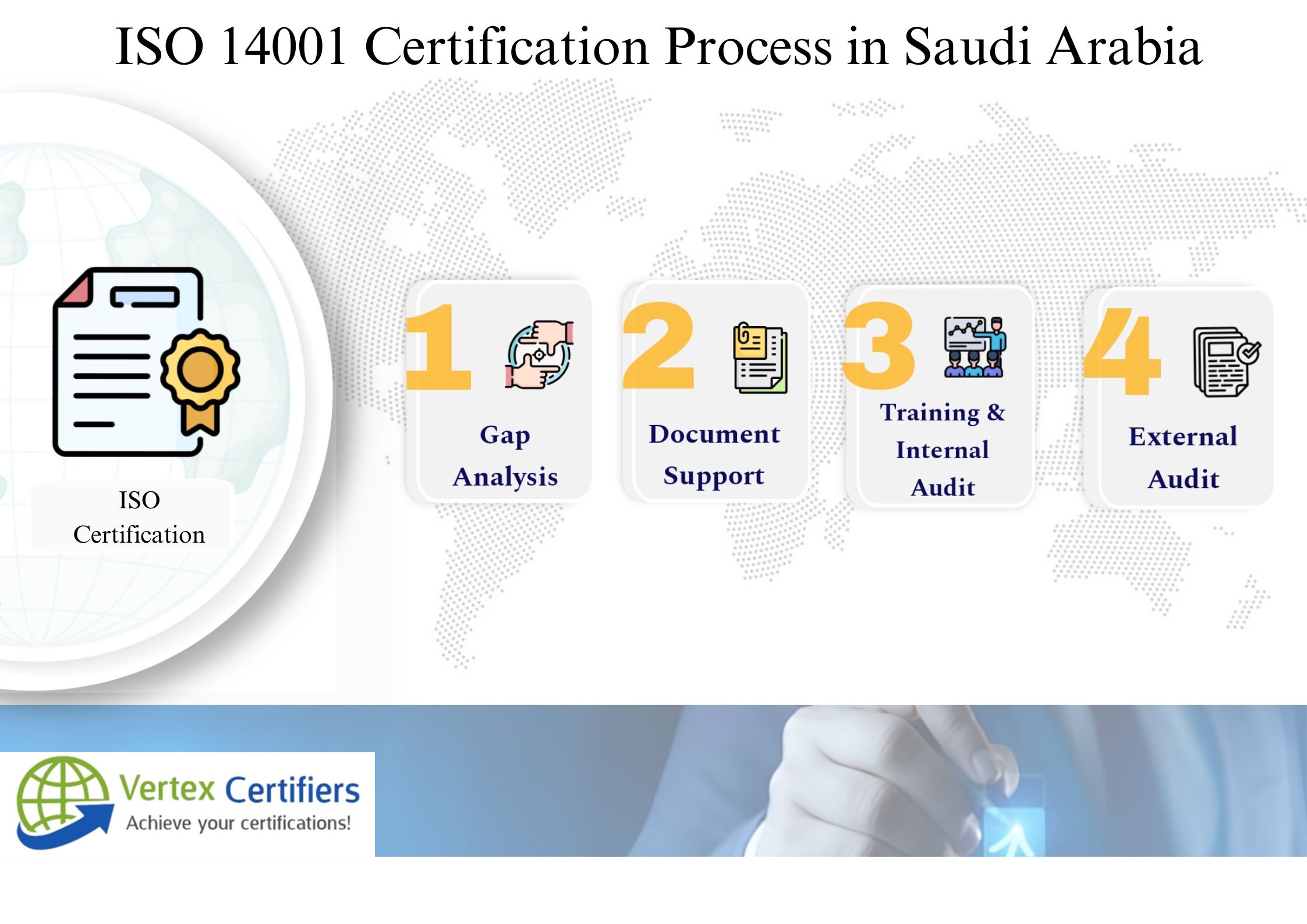
Achieving ISO 14001 Certification in Saudi Arabia involves a systematic process to establish, implement, and maintain an effective Environmental Management System. The certification process typically includes the following steps:
1. Initial Gap Analysis
The first step is to review the organization’s current environmental practices against the requirements of ISO 14001:2015. This helps identify missing controls, compliance gaps, and areas that need improvement before implementation begins.
2. Scope Definition
The organization defines the scope of the Environmental Management System by identifying the locations, departments, activities, and operations that will be covered under ISO 14001 certification. A clear scope ensures that all relevant environmental risks and obligations are included.
3. Environmental Review
A detailed environmental review is conducted to understand the organization’s activities, processes, products, and services from an environmental perspective. This includes reviewing waste generation, emissions, resource consumption, water use, energy use, and other environmental interactions.
4. Identification of Environmental Aspects and Impacts
The organization identifies its environmental aspects (activities that interact with the environment) and evaluates their environmental impacts. For example, fuel usage, emissions, wastewater discharge, hazardous waste, chemical storage, and resource consumption may all be significant environmental aspects in Saudi industries.
5. Legal and Compliance Obligation Review
Applicable environmental laws, regulations, permits, municipal requirements, and other compliance obligations relevant to the organization’s activities in Saudi Arabia are identified and evaluated. This step helps ensure the EMS is aligned with legal and regulatory requirements.
6. EMS Documentation Development
The required Environmental Management System documentation is prepared. This may include:
- EMS scope
- Environmental policy
- aspect-impact register
- legal compliance register
- environmental objectives and targets
- operational procedures
- emergency preparedness procedures
- monitoring and record formats
7. Environmental Policy and Objectives
Top management establishes the organization’s environmental policy and sets measurable environmental objectives and targets. These objectives may relate to waste reduction, energy efficiency, water conservation, emissions reduction, compliance improvement, or sustainable resource usage.
8. Operational Controls and Implementation
The EMS is then implemented throughout the organization. Operational controls are introduced to manage significant environmental aspects, reduce risks, and improve performance. This may include waste handling procedures, chemical management controls, pollution prevention practices, resource monitoring, contractor controls, and emergency preparedness measures.
9. Employee Training and Awareness
Employees are trained on ISO 14001 requirements, environmental responsibilities, emergency response, and the organization’s environmental objectives. Awareness programs help ensure that staff understand how their daily activities affect environmental performance and compliance.
10. Internal Audit
Once the EMS has been implemented, internal audits are conducted to verify whether the system conforms to ISO 14001 requirements and whether it is effectively implemented across departments. Internal audits help identify nonconformities, improvement opportunities, and areas requiring corrective action.
11. Management Review
Top management reviews the performance of the Environmental Management System at planned intervals. This review considers audit findings, compliance status, environmental objectives, incidents, corrective actions, and improvement opportunities to ensure the EMS remains suitable and effective.
12. Stage 1 Audit
An accredited certification body conducts the Stage 1 audit, which focuses on reviewing EMS documentation, understanding the organization’s readiness, and verifying whether the system has been designed in line with ISO 14001 requirements.
13. Stage 2 Audit
In the Stage 2 audit, the certification body performs a detailed assessment of actual implementation and effectiveness of the EMS. Auditors review records, interview employees, inspect operational controls, and verify compliance with ISO 14001 across the organization.
14. Certification Issuance
If the organization successfully meets the audit requirements and closes any identified nonconformities, the certification body issues the ISO 14001 certificate.
15. Annual Surveillance Audits
ISO 14001 certification is maintained through periodic surveillance audits, usually conducted annually by the certification body. These audits verify continued compliance, ongoing implementation, and continual improvement of the Environmental Management System.
ISO 14001 Certification in Riyadh
As the capital and industrial hub, Riyadh is home to numerous manufacturing, construction, and service companies. Vertex Certifiers helps Riyadh-based organizations establish efficient environmental policies, reduce resource wastage, and comply with Saudi Vision 2030 sustainability objectives.
ISO 14001 Certification in Jeddah
Located on the Red Sea coast, Jeddah is a commercial gateway with growing logistics and marine operations. Our consultants assist businesses in developing eco-friendly operational controls, reducing pollution risks, and achieving better waste management practices in line with ISO 14001 standards.
ISO 14001 Certification in Dammam
Dammam serves as a key oil, gas, and energy hub of the Kingdom. Vertex Certifiers supports industries in Dammam by integrating environmental management into daily operations, optimizing resource usage, and ensuring compliance with environmental laws and industrial safety standards.
ISO 14001 Certification in Dhahran
Known for its energy and petroleum sector, Dhahran plays a vital role in environmental responsibility. We help organizations in Dhahran design and maintain effective Environmental Management Systems to minimize emissions, control risks, and enhance sustainability performance.
ISO 14001 Certification in Al Khobar
Al Khobar hosts many corporate offices and service-based industries. Our ISO experts guide businesses in Al Khobar through systematic EMS implementation — from aspect-impact analysis to internal audits and continual improvement strategies.
ISO 14001 Certification in Mecca and Medina
For Mecca and Medina’s growing infrastructure and service sectors, we offer customized ISO 14001 solutions to ensure environmentally responsible project execution and compliance with municipal regulations.
KSA ISO Certifications
Explore our most requested ISO certification services in Saudi Arabia, including quality, information security, environment, occupational health and safety, food safety, energy, business continuity, anti-bribery, and education-related management system standards.
Our Services
What is ISO 14001?
ISO 14001:2015 is the internationally recognized standard for an Environmental Management System (EMS). It is published by the International Organization for Standardization (ISO) and provides a structured framework for organizations to identify, manage, monitor, and improve their environmental responsibilities in a systematic way. ISO explains that the standard helps organizations establish, implement, maintain, and continually improve an EMS suited to their activities, products, and services.
The purpose of ISO 14001 is to help organizations manage environmental responsibilities more effectively while supporting sustainable operations and long-term business performance. The standard focuses on environmental policy, identification of environmental aspects and impacts, compliance obligations, environmental objectives, operational controls, monitoring, and continual improvement. ISO 14001:2015 also gives stronger emphasis to leadership, risk-based thinking, and integration with other management-system standards.
Under ISO 14001, an organization is expected to identify the environmental aspects of its activities, products, and services, determine which impacts are significant, understand legal and compliance obligations, and set measurable objectives for improved environmental performance. The standard also uses a risk and opportunity approach so that businesses can prevent environmental issues, strengthen controls, and improve decision-making over time.
Another important concept in ISO 14001:2015 is lifecycle thinking. ISO guidance explains that organizations should consider environmental impacts across the life cycle of their products or services, including raw material sourcing, design, production, transportation, use, and end-of-life treatment or disposal, to avoid shifting impacts from one stage to another.
ISO 14001 also follows the PDCA cycle – Plan, Do, Check, Act. ISO’s PDCA model explains that organizations first plan their environmental objectives and controls, then implement them, evaluate performance, and take action for continual improvement. This makes ISO 14001 practical for businesses that want a repeatable and measurable system rather than one-time environmental actions.
- Environmental policy: A formal commitment to environmental protection, compliance, and improvement.
- Environmental aspects and impacts: Identification of activities that interact with the environment and the effects they can create.
- Legal and compliance obligations: Understanding applicable environmental laws, permits, and other obligations. ]
- Objectives and performance improvement: Setting targets and monitoring environmental performance.
- Risk and opportunity approach: Managing risks and opportunities linked to environmental performance and compliance.
- Lifecycle thinking: Considering impacts from sourcing to disposal. ]
- Continual improvement: Using review, corrective action, and performance evaluation to improve the EMS over time.
How ISO 14001 Differs from Other ISO Standards
ISO 14001 is specifically focused on environmental management, but it is often implemented alongside other ISO standards depending on business needs.
- ISO 14001 vs ISO 9001: ISO 14001 focuses on environmental management, while ISO 9001 focuses on quality management, customer satisfaction, and process consistency.
- ISO 14001 vs ISO 45001: ISO 14001 addresses environmental aspects and impacts, while ISO 45001 focuses on occupational health and safety risks in the workplace.
- ISO 14001 vs ISO 50001: ISO 14001 covers broader environmental management, while ISO 50001 is specifically designed for energy management and energy performance improvement.
Because these standards share a similar management-system structure, they can be integrated into one system for organizations that want to manage quality, environment, safety, and energy together more efficiently.
Why ISO 14001 Certification is Important in Saudi Arabia
ISO 14001 certification is increasingly important in Saudi Arabia because the Kingdom is undergoing large-scale industrial expansion under Vision 2030. Saudi Vision 2030 and the National Industrial Development and Logistics Program emphasize industrial diversification, logistics growth, localization, new manufacturing capacity, mining, energy transformation, and a more sustainable future, including cleaner energy and support for net zero ambitions.
In this environment, environmental management is becoming more important for businesses operating in major sectors such as oil and gas, petrochemicals, construction, manufacturing, logistics, food processing, utilities, and heavy industry. Large industrial operations, project sites, and supply chains are under growing pressure to control waste, emissions, spills, pollution risks, and resource consumption while maintaining operational discipline and compliance readiness.
ISO 14001 helps Saudi businesses build stronger environmental governance by creating a formal system for identifying environmental aspects, managing compliance obligations, setting improvement targets, and monitoring performance. This is especially relevant in industrial zones, energy projects, large infrastructure works, export-oriented manufacturing, logistics hubs, and multi-site business operations where environmental control must be consistent and auditable.
The standard is also valuable because global customers, multinational buyers, investors, and international supply chains increasingly expect stronger ESG and sustainability performance. For Saudi suppliers working with export markets, multinational companies, or government and large private tenders, ISO 14001 certification can strengthen credibility, support qualification requirements, and demonstrate a practical commitment to environmental responsibility.
Saudi businesses can also use ISO 14001 to improve waste reduction, pollution control, energy and resource efficiency, and environmental accountability across departments and sites. This makes the standard commercially relevant not only for compliance and sustainability goals, but also for customer confidence, tender competitiveness, and long-term business resilience.
ISO 14001 Certification Process in Saudi Arabia
The ISO 14001 certification process in Saudi Arabia should follow a clear step-by-step path so that the Environmental Management System is not only documented but also implemented effectively. A proper certification process usually includes the following stages.
- Initial consultation and scope definition: Define the sites, departments, products, services, and operations that will be covered under the EMS.
- Gap analysis against ISO 14001:2015: Review existing environmental controls, documentation, compliance practices, and operational risks against the standard.
- Environmental aspect and impact identification: Determine which activities, products, and services create environmental impacts and which are significant.
- Legal and compliance obligation review: Identify relevant environmental laws, permits, conditions, and other applicable obligations.
- EMS documentation development: Prepare the environmental policy, scope, registers, procedures, records, controls, and monitoring formats needed for implementation.
- Objective setting and process control alignment: Establish environmental objectives, targets, responsibilities, and operational controls.
- Implementation of environmental controls: Put the documented EMS into operation across the business.
- Employee awareness and training: Train relevant personnel on environmental responsibilities, procedures, emergency response, and control measures.
- Monitoring and performance evaluation: Track environmental performance, compliance status, resource usage, waste, emissions, and other relevant indicators.
- Internal audit: Conduct an internal EMS audit to evaluate conformity and practical implementation.
- Management review: Top management reviews performance, objectives, audit results, risks, compliance issues, and improvement needs.
- Corrective action closure: Address nonconformities and implementation gaps before the certification audit.
- Stage 1 audit: The certification body reviews EMS documentation and organizational readiness.
- Stage 2 audit: The certification body evaluates the implementation and effectiveness of the EMS at the operational level.
- Certification issuance: Once audit requirements are met and findings are closed, the ISO 14001 certificate is issued.
- Surveillance audits: Follow-up audits are conducted periodically to maintain certification and confirm continued EMS performance.
Who Should Get ISO 14001 Certification in Saudi Arabia?
ISO 14001 is relevant for many business types in Saudi Arabia, especially those with environmental aspects, compliance obligations, industrial operations, resource usage, or customer-driven sustainability expectations. It is particularly suitable for organizations that need stronger environmental controls, improved governance, or better positioning in tenders and supply chains.
- Oil and gas companies
- Petrochemical companies
- Manufacturers
- Industrial plants
- Construction and infrastructure contractors
- Logistics and warehousing companies
- Food manufacturers
- Packaging companies
- Utilities and energy companies
- Waste management businesses
- Mining and heavy industry operations
- Hospitals and large facilities
- Exporters and government contractors
If a company generates waste, uses energy and water at scale, handles chemicals or emissions, operates multiple sites, serves multinational customers, or must meet tender and client qualification expectations, ISO 14001 can be highly relevant.
Documents Required for ISO 14001 Certification in Saudi Arabia
Businesses often search for the practical documents required for ISO 14001 certification because documentation is a key part of EMS implementation and audit readiness. The required level of documentation depends on the size, complexity, and environmental risk profile of the organization, but most businesses will need a structured set of EMS documents and records.
- EMS scope
- Environmental policy
- Aspect-impact register
- Legal compliance register
- Environmental objectives and targets
- Operational control procedures
- Waste, emission, and resource management records
- Training and competence records
- Internal audit reports
- Corrective action records
- Management review records
Depending on the business, additional records may include emergency preparedness formats, monitoring logs, inspection checklists, incident reports, contractor-control records, and communication records related to environmental requirements.
ISO 14001 Certification Cost in Saudi Arabia
The cost of ISO 14001 certification in Saudi Arabia depends on the size and complexity of the business rather than a single fixed fee. A simple office-based service company will usually have a different implementation effort and audit scope compared with a petrochemical site, industrial plant, logistics network, or manufacturing operation.
- Company size: Larger organizations generally require more implementation support and broader audit coverage.
- Number of employees: More employees can mean more training, awareness, and process sampling during audits.
- Number of sites: Multi-site operations usually increase audit planning and certification effort.
- Industry risk level: Higher-risk sectors such as oil and gas, chemicals, heavy industry, and waste handling often require deeper controls.
- Existing management system maturity: Companies with mature systems and documentation often need less development effort.
- Scope of operations: Broader scope means more processes, departments, and environmental aspects to manage.
- Need for consulting, training, and documentation support: The level of external support required affects overall project cost.
- Certification body audit duration: Audit man-days are a major part of certification cost.
Contact Vertex Certifiers for a tailored quotation.
ISO 14001 Certification in Major Cities of Saudi Arabia
Vertex Certifiers supports businesses across key industrial and commercial locations in Saudi Arabia. This city-based coverage structure also helps future internal linking for dedicated location pages.
Riyadh
ISO 14001 consulting support in Riyadh is ideal for corporate offices, industrial businesses, service providers, healthcare groups, and multi-site companies seeking structured environmental management.
Jeddah
Businesses in Jeddah can benefit from ISO 14001 for manufacturing, logistics, food processing, trade, and export-linked operations requiring stronger environmental controls and customer confidence.
Dammam
Dammam is a major industrial and logistics center where ISO 14001 supports manufacturers, contractors, warehouses, and industrial service providers in improving environmental performance.
Al Khobar
Companies in Al Khobar, especially those linked to energy, engineering, consulting, and support services, can use ISO 14001 to strengthen environmental governance and tender positioning.
Dhahran
Dhahran-based businesses connected to the energy and technical-services ecosystem can benefit from ISO 14001 through better compliance, process discipline, and sustainable operations.
Jubail
Jubail is one of the Kingdom’s most important industrial zones, making ISO 14001 highly relevant for petrochemical companies, heavy industry, utilities, and large manufacturing operations.
Yanbu
In Yanbu, ISO 14001 is especially valuable for industrial, petrochemical, logistics, and port-related operations that need stronger environmental systems and performance monitoring.
Mecca
Businesses and large facilities in Mecca can use ISO 14001 to improve waste management, operational environmental controls, and sustainability performance in high-demand service environments.
Medina
Organizations in Medina, including healthcare, education, hospitality, logistics, and public-facing facilities, can benefit from structured EMS implementation through ISO 14001.
Why Choose Vertex Certifiers for ISO 14001 in Saudi Arabia
Vertex Certifiers supports businesses across Saudi Arabia with practical ISO 14001 implementation designed to match operational realities, environmental risks, and certification goals. The focus is on building a workable Environmental Management System, not just creating documents for audit.
- Experienced ISO consultants and lead auditors: Support from professionals familiar with ISO 14001 implementation and audit expectations.
- End-to-end support: Assistance with documentation, training, internal audits, implementation, corrective actions, and certification readiness.
- Remote + onsite support across Saudi Arabia: Flexible service model for single-site and multi-site businesses.
- Integrated systems support: Help with combining ISO 14001 with ISO 9001, ISO 45001, and ISO 50001 for a more efficient management system.
- Practical implementation aligned with operations: EMS controls designed around real business activities and environmental risks.
- Affordable consulting model: Suitable for SMEs as well as larger industrial and project-based organizations.
Get ISO 14001 Certification Support in Saudi Arabia
Vertex Certifiers helps organizations across Saudi Arabia with ISO 14001 consulting, EMS documentation, training, internal audits, certification coordination, and post-certification support.
- Support for Riyadh, Jeddah, Dammam, Al Khobar, Dhahran, Jubail, Yanbu, Mecca, Medina, and other Saudi cities
- Remote and onsite ISO 14001 consulting
- Integrated support with ISO 9001, ISO 45001, and ISO 50001
- Tailored quotation based on your business scope and industry
