ISO 45001 Certification in Vietnam | ISO 45001 Consultants in Vietnam
ISO 45001 certification helps organizations establish an effective Occupational Health and Safety Management System (OH&S MS) to reduce workplace risks, improve employee safety, and create safer working environments across operations in Vietnam.
For organizations operating in manufacturing, construction, logistics, engineering, utilities, healthcare, and other risk-sensitive sectors, ISO 45001 provides a structured framework for identifying hazards, controlling risks, strengthening compliance, and improving overall workplace safety performance.
What are the Benefits of ISO 45001 Certification?
ISO 45001 offers operational, legal, and commercial benefits for organizations that want to improve workplace safety and build stronger health and safety governance.
- Reduces Workplace Accidents: Helps identify hazards early and implement preventive controls before incidents occur.
- Improves Employee Safety: Creates a safer, more structured working environment across departments and job roles.
- Supports Legal Compliance: Improves monitoring of occupational health and safety obligations and compliance responsibilities.
- Better Operational Efficiency: Reduces disruption caused by unsafe practices, injuries, and unplanned incidents.
- Improved Reputation: Demonstrates a visible commitment to worker safety and responsible business operations.
- Reduced Downtime: Helps avoid production interruptions, work stoppages, and delays caused by safety failures.
- Lower Insurance and Compensation Risks: Stronger safety controls can help reduce incident-related claims and associated costs.
- Improved Customer Confidence: Shows clients and business partners that workplace risks are actively managed.
- Better Tender Eligibility: Many projects and procurement opportunities prefer or require certified safety management systems.
- Supports ESG and Sustainability Goals: Contributes to stronger governance, worker welfare, and responsible operational performance.
Industries That Require ISO 45001 in Vietnam
ISO 45001 is especially valuable for industries where workplace hazards, regulatory obligations, contractor control, and operational risk are significant.
- Manufacturing: Improve machine safety, worker protection, and operational risk control.
- Construction: Strengthen site safety, contractor management, and fall protection controls.
- Oil & Gas: Manage high-risk activities, hazardous environments, and emergency preparedness.
- Engineering: Improve field safety, project execution controls, and technical worksite risk management.
- Mining: Address hazardous conditions, worker exposure, and site-level emergency preparedness.
- Warehousing: Control lifting hazards, forklift risks, storage safety, and workplace movement risks.
- Logistics: Improve transport safety, loading operations, route-related risks, and workforce safety practices.
- Ports: Strengthen heavy equipment safety, contractor coordination, and operational hazard management.
- Chemicals: Improve control over hazardous substances, chemical exposure, and emergency response planning.
- Food Processing: Manage worker safety in production, cleaning, maintenance, and handling operations.
- Pharmaceuticals: Support controlled working environments and stronger safety discipline across manufacturing and lab activities.
- Healthcare: Improve safety for staff, patients, equipment handling, and infection-related risks.
- Utilities: Better manage electrical, field, maintenance, and operational risks.
- Renewable Energy: Support safer operations across solar, wind, installation, maintenance, and field service environments.
Requirements for ISO 45001 Certification
ISO 45001 certification requires organizations to establish, implement, maintain, and improve an occupational health and safety management system that effectively controls workplace hazards and safety risks.
- OH&S Policy: A clear policy that reflects the organization’s commitment to health and safety performance.
- Leadership Commitment: Active involvement from top management in setting direction, responsibilities, and safety priorities.
- Hazard Identification: A systematic process to identify workplace hazards across activities, equipment, people, and environments.
- Risk Assessment: Evaluation of safety risks to determine priority controls and actions.
- Legal Compliance: Identification and monitoring of applicable health and safety legal and regulatory obligations.
- Emergency Preparedness: Plans and response arrangements for accidents, fire, chemical releases, and other emergencies.
- Worker Participation: Involvement of workers in consultation, reporting, and safety improvement activities.
- Operational Controls: Defined procedures and controls to manage identified OH&S risks.
- Training & Competence: Ensuring employees and relevant personnel are competent to work safely.
- Incident Reporting: Structured reporting, investigation, and follow-up for incidents and near misses.
- Internal Audit: Periodic internal audits to assess conformity and effectiveness of the system.
- Management Review: Regular top management review of OH&S performance, risks, and improvement actions.
- Continual Improvement: Ongoing action to improve safety performance, reduce incidents, and strengthen controls.
Documents Required for ISO 45001 Certification
Organizations seeking ISO 45001 certification need documented information that demonstrates how hazards, safety risks, legal obligations, incidents, and improvement actions are controlled in practice.
- OH&S Policy: A documented occupational health and safety policy approved by top management.
- Hazard Register: A structured record of workplace hazards and associated safety concerns.
- Risk Assessment: Documented evaluation of risks and priorities for control measures.
- Legal Register: A record of applicable legal, regulatory, and compliance obligations.
- Emergency Response Plan: Procedures for responding to fires, accidents, chemical events, injuries, and other emergencies.
- Incident Reports: Records of workplace incidents, near misses, investigations, and follow-up actions.
- Objectives: OH&S objectives and related action plans for performance improvement.
- Training Records: Evidence of safety training, awareness, and competence development.
- Internal Audit Reports: Audit findings, observations, and follow-up actions.
- Management Review Minutes: Records of management review meetings and decisions.
- Corrective Action Records: Documentation showing how nonconformities and safety issues are addressed.
Cost of ISO 45001 Certification in Vietnam
The cost of ISO 45001 certification in Vietnam depends on several operational and organizational factors, so it is best evaluated based on actual scope rather than fixed pricing.
- Employee Count: Larger workforces usually require more training, broader implementation, and greater audit effort.
- Multiple Locations: Multi-site operations generally increase planning complexity and audit coverage requirements.
- Existing Systems: Organizations with existing ISO systems or safety controls may reduce implementation time and effort.
- Industry Risk: Higher-risk industries usually require deeper hazard control and more rigorous audit attention.
- Documentation: The maturity and completeness of current safety documentation affects implementation workload.
- Certification Body: Certification fees vary depending on the certification provider, accreditation, and audit duration.
A structured implementation approach helps control certification cost by reducing rework, improving audit readiness, and focusing resources on actual workplace risks.
How Long Does ISO 45001 Certification Take?
The timeline for ISO 45001 certification depends on organization size, operational complexity, existing safety systems, number of sites, workforce size, documentation readiness, and risk exposure.
- Small Organization: Typically 4 to 8 weeks where operations are simpler and management involvement is high.
- Medium Organization: Usually 6 to 10 weeks depending on departments, documentation, and current safety maturity.
- Large Organization: Commonly 8 to 16 weeks or longer where multiple sites, contractors, or higher-risk operations are involved.
Implementation may take longer where hazard identification is incomplete, legal registers are not maintained, or employee awareness and incident controls need significant improvement.
Integrating ISO 45001 with Other ISO Standards
ISO 45001 can be integrated with other management system standards to build a more efficient and unified Integrated Management System (IMS). This approach helps reduce duplication in documentation, audits, training, and management reviews.
- ISO 9001: Integrate quality and safety processes for stronger operational discipline and customer confidence.
- ISO 14001: Combine occupational health and safety with environmental management for better risk control.
- ISO 27001: Support integrated governance across operational, workplace, and information security risks.
- ISO 22000: Useful for food businesses that need both worker safety and food safety system controls.
- Integrated Management System (IMS): Improve efficiency through one aligned framework for policies, audits, objectives, reviews, and continual improvement.
Common Workplace Safety Challenges in Vietnam
Many organizations in Vietnam face recurring workplace safety challenges that can lead to injuries, downtime, legal exposure, and reputational risk if not properly managed.
- Construction Accidents: Risks related to falls, lifting operations, unstable work areas, and contractor coordination.
- Machinery Hazards: Exposure to moving equipment, machine guarding issues, and unsafe maintenance activity.
- Chemical Exposure: Risks from handling, storage, spills, fumes, and inadequate protective controls.
- Electrical Safety: Hazards related to live systems, maintenance work, temporary wiring, and unsafe equipment use.
- Manual Handling: Lifting, repetitive motion, awkward posture, and material movement injuries.
- Fire Safety: Weak emergency planning, poor housekeeping, unsafe storage, and insufficient response readiness.
- Contractor Management: Inconsistent safety expectations and control across outsourced or project-based workers.
- PPE Compliance: Inadequate use, poor supervision, or weak availability of required protective equipment.
- Employee Awareness: Limited safety understanding, reporting culture, or role-based safety competence.
How Vertex Certifiers Can Help
Vertex Certifiers provides end-to-end ISO 45001 consulting and implementation support tailored to the organization’s industry, risk profile, and certification objectives.
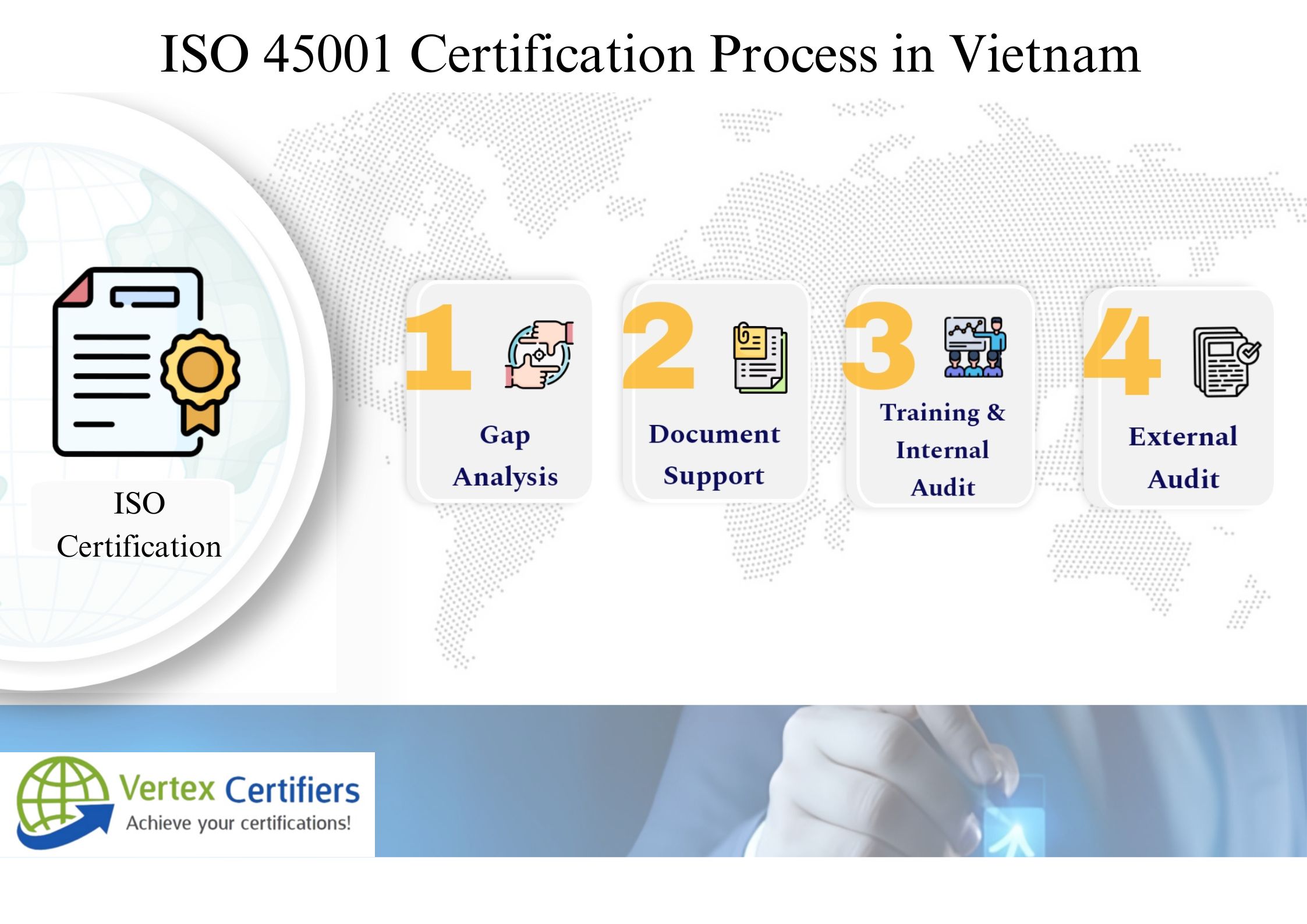
- Gap Analysis: Evaluate current workplace safety controls against ISO 45001 requirements.
- Documentation Support: Develop policies, registers, procedures, plans, and audit-ready records.
- Training: Conduct awareness programs, implementation workshops, and internal auditor training.
- Risk Assessment: Support hazard identification and practical OH&S risk assessment activities.
- Internal Audit: Perform pre-certification audits to identify and close system gaps.
- Certification Coordination: Assist with audit planning, readiness review, and certification-stage support.
- Online Support: Flexible remote consulting support for organizations across Vietnam.
- Onsite Support: Practical on-location assistance for implementation, review, and audit preparation.
- Surveillance Support: Continued support after certification to maintain compliance and prepare for annual surveillance audits. Surveillance audits are commonly conducted yearly within the certification cycle. [web:42][web:46]
Why Choose Vertex Certifiers
Vertex Certifiers is a practical implementation partner for organizations in Vietnam seeking efficient, reliable, and industry-focused ISO 45001 consulting.
- Experienced ISO Consultants: Work with professionals who understand health and safety management system implementation.
- Industry Expertise: Support tailored for manufacturing, construction, logistics, healthcare, utilities, and more.
- Affordable Pricing: Cost-effective consulting models aligned with project size and scope.
- End-to-End Implementation: Assistance from gap analysis to certification and post-certification support.
- Fast Turnaround: Efficient project planning designed to reduce delays and speed up readiness.
- Global Certification Experience: Practical understanding of internationally accepted certification expectations.
- Customized Consulting: Solutions adapted to the organization’s risks, workforce, and operational environment.
- Local Support Across Vietnam: Service coverage across major industrial and commercial regions.
ISO 45001 Certification Services Across Vietnam
We provide ISO 45001 certification consulting and implementation support across Vietnam, including Hanoi, Ho Chi Minh City, Da Nang, Hai Phong, Can Tho, Bac Ninh, Binh Duong, Dong Nai, Vung Tau, and Hai Duong.
Frequently Asked Questions
Q1: What is ISO 45001?
ISO 45001 is an international standard for occupational health and safety management systems that helps organizations reduce workplace risks and improve worker safety.
Q2: Is ISO 45001 mandatory in Vietnam?
ISO 45001 is generally not mandatory as a certification requirement, but many organizations adopt it to improve compliance, strengthen safety management, and support business opportunities.
Q3: Who should obtain ISO 45001?
Any organization with workplace safety risks can benefit, especially those in manufacturing, construction, logistics, engineering, healthcare, chemicals, and utilities.
Q4: How much does certification cost?
The cost depends on employee count, locations, industry risk, documentation maturity, existing systems, and certification body fees.
Q5: How long does implementation take?
Small organizations may take 4 to 8 weeks, medium organizations 6 to 10 weeks, and large organizations 8 to 16 weeks or longer depending on complexity and readiness.
Q6: Can SMEs get certified?
Yes, small and medium-sized enterprises can implement ISO 45001 by applying the requirements according to their size, risk profile, and operational scope.
Q7: What documents are required?
Common documents include the OH&S policy, hazard register, risk assessment, legal register, emergency response plan, training records, audit reports, and corrective action records.
Q8: How often are surveillance audits conducted?
Surveillance audits are commonly conducted annually during the three-year certification cycle to verify continued conformity and system effectiveness. [web:40][web:42][web:45]
Q9: Can ISO 45001 be integrated with ISO 9001?
Yes, ISO 45001 can be integrated with ISO 9001 and other ISO standards to form a more efficient Integrated Management System.
Q10: Which industries benefit the most?
High-risk and operationally intensive sectors such as construction, manufacturing, oil and gas, chemicals, warehousing, logistics, healthcare, and utilities often benefit the most.
Q11: Is employee training mandatory?
Employee competence and awareness are essential in practice, so safety training is generally necessary to support implementation and ongoing compliance.
Q12: Which certification body should I choose?
You should choose an accredited certification body with relevant industry experience, transparent audit processes, and recognized credibility in your market.
Q13: Does ISO 45001 improve tender eligibility?
Yes, ISO 45001 can strengthen tender eligibility because many customers and project owners prefer suppliers with certified safety management systems.
Q14: What is the difference between ISO 45001 and OHSAS 18001?
ISO 45001 replaced OHSAS 18001 and provides a more modern management system framework with stronger emphasis on leadership, worker participation, and risk-based thinking.
Q15: How can Vertex Certifiers help?
Vertex Certifiers supports organizations with gap analysis, documentation, training, internal audits, certification coordination, onsite consulting, online consulting, and surveillance support.
Get Expert ISO 45001 Support Across Vietnam
Partner with Vertex Certifiers for end-to-end ISO 45001 consulting, implementation, documentation, training, internal audits, and certification support tailored to your organization’s industry and workplace risks.
Ready to improve workplace safety and achieve ISO 45001 certification in Vietnam?
📩 Contact Vertex Certifiers today at info@vertexcertifiers.com for expert support across Vietnam.