Vertex Certifiers

ISO 22000 Certification in Portugal:

ISO 22000 Certification in Portugal, Vertex Certifiers is a trusted ISO consultancy and certification support provider in Portugal, offering end-to-end ISO 22000 Food Safety Management System (FSMS) certification services to organizations across the food supply chain. We help food manufacturers, processors, hospitality businesses, logistics providers, and exporters implement robust food safety systems that comply with Portuguese regulations and EU food safety requirements. With a team of experienced ISO lead auditors and FSMS implementers, Vertex Certifiers supports businesses in major Portuguese cities including Lisbon, Porto, Braga, Coimbra, Faro, and Setúbal. Our practical, risk-based approach ensures effective FSMS implementation with minimal disruption to daily operations. Beyond ISO 22000, we also provide integrated consulting and certification support for ISO 9001, ISO 14001, ISO 45001, ISO 27001, ISO 27701, and other international standards—delivering globally recognized, IAF-accredited certification that strengthens food safety, regulatory compliance, and international credibility for organizations in Portugal.

Portugal’s vibrant food industry—from Atlantic seafood to Douro Valley wines—powers a €10+ billion sector, but food safety remains paramount amid global supply chains. ISO 22000 certification in Portugal establishes a robust Food Safety Management System (FSMS), ensuring consistent protection against hazards.

This standard is crucial for food manufacturers, exporters, and hospitality in Lisbon, Porto, and Algarve, where EU regulations demand excellence. ISO 22000 aligns with strict EU food safety laws, facilitating seamless trade and consumer trust.

Portuguese businesses gain a competitive edge through ISO 22000, reducing recalls, enhancing quality, and opening doors to international markets like the US and Asia.

What Is ISO 22000?

ISO 22000 is the international standard for Food Safety Management Systems (FSMS), harmonizing HACCP principles with ISO’s risk-based management framework. Released by ISO, it covers the entire food chain from farm to fork.

It integrates Hazard Analysis and Critical Control Points (HACCP) with prerequisite programs (PRPs), communication protocols, and continual improvement. Organizations identify food safety hazards—biological, chemical, physical—and implement controls.

Applicable across the supply chain, ISO 22000 suits producers, processors, packagers, transporters, and retailers. In Portugal, it scales for small olive oil makers to large canned fish exporters.

Procedure to Get ISO 22000 Certification in Portugal

Achieve ISO 22000 certification in Portugal via these steps:
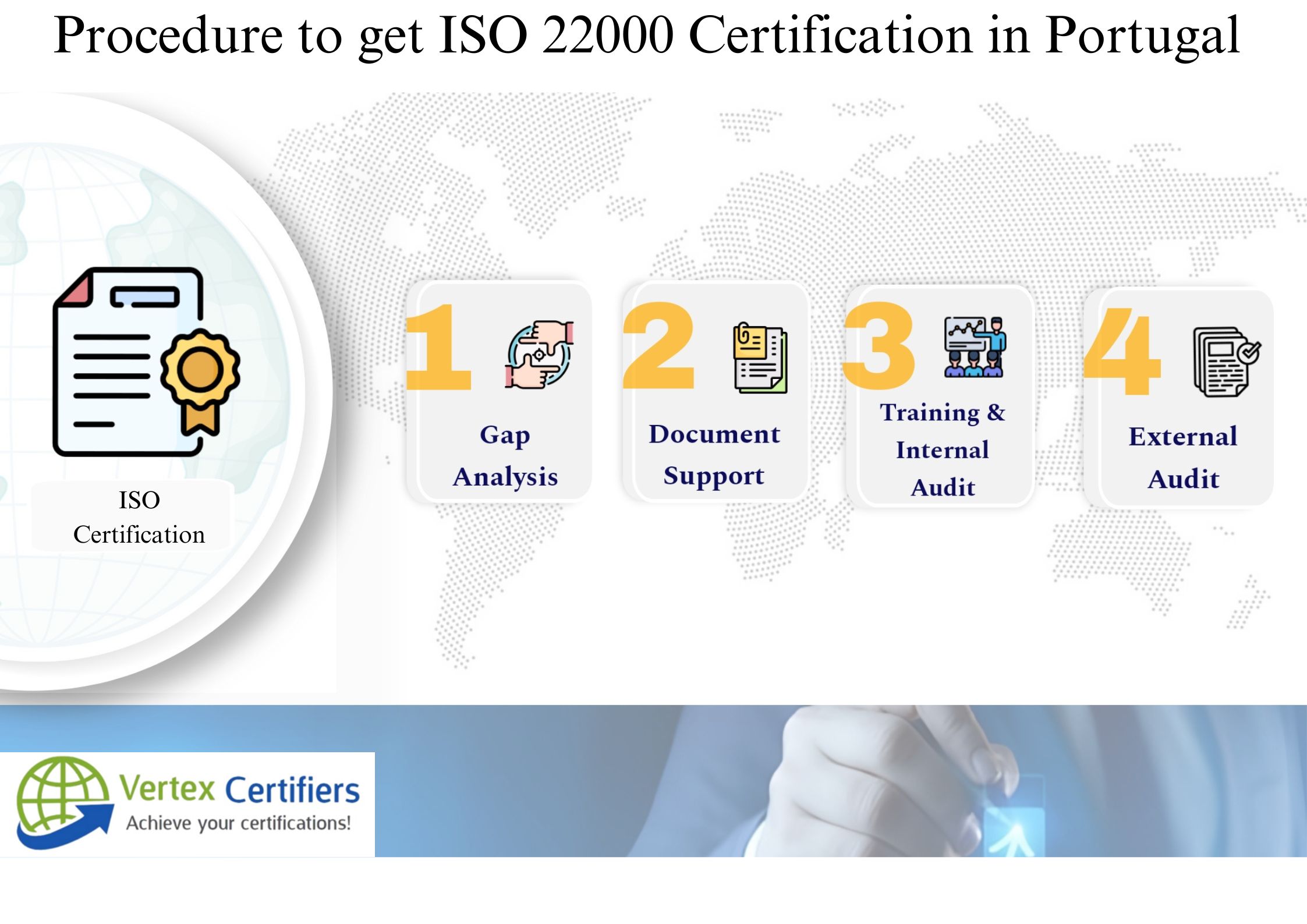
What is the Procedure to get ISO 22000 Certification in Portugal
  1. FSMS Gap Analysis and Scope Definition: Evaluate current practices.
  2. Hazard Identification and Risk Assessment: Map food safety risks.
  3. Development of HACCP Plan and FSMS Documentation: Create controls and records.
  4. Implementation of PRPs and Food Safety Controls: Deploy across operations.
  5. Employee Training and Awareness: Build competency.
  6. Internal Audit and Management Review: Confirm readiness.
  7. Stage 1 Audit (Documentation Review): Desk review by certifier.
  8. Stage 2 Audit (Certification Audit): On-site validation.
  9. ISO 22000 Certification Issuance: Three-year credential.

Vertex Certifiers streamlines this process.

Who Needs ISO 22000 Certification in Portugal?

ISO 22000 certification in Portugal is essential for organizations involved at any stage of the food supply chain, ensuring food safety, regulatory compliance, and market credibility.

  • Food Manufacturers & Processors – Cod liver oil producers, canned sardine manufacturers
  • Dairy, Meat, Seafood & Beverage Companies – Cheese producers, port wine makers, bacalhau processors
  • Bakeries, Confectionery & Packaged Food Producers – Pastéis de nata, chocolate and dessert manufacturers
  • Restaurants, Hotels & Catering Services – Algarve resorts, Lisbon restaurants and catering units
  • Food Packaging & Storage Facilities – Flexible and food-grade packaging manufacturers
  • Logistics, Warehousing & Cold Chain Providers – Refrigerated transport and cold storage operators
  • Agricultural Producers & Food Exporters – Olive processors, cork-related food exporters

Any organization handling, processing, storing, or distributing food can significantly benefit from ISO 22000 certification in Portugal.

Key Requirements of ISO 22000

  • Define the FSMS scope and establish a documented food safety policy
  • Conduct hazard analysis using HACCP principles at every process stage
  • Implement Prerequisite Programs (PRPs) such as hygiene, sanitation, and pest control
  • Establish Operational PRPs (OPRPs) for controlling significant hazards
  • Maintain traceability systems, withdrawal and recall procedures
  • Ensure emergency preparedness and response mechanisms
  • Monitor performance, verify through testing, and validate control effectiveness
  • Conduct internal audits, management reviews, and continual improvement actions

Cost of ISO 22000 Certification in Portugal

The cost of ISO 22000 certification depends on several factors:

  • Organization size and operational complexity
  • Product range and associated food safety risks
  • Number of employees and production locations
  • Certification body and audit duration

SMEs and startups can optimize implementation through focused scopes, remote audits, and phased FSMS deployment. The return on investment is realized through improved compliance, reduced recalls, and stronger market access.

Timeline for ISO 22000 Certification in Portugal

  • Small food businesses: 6–8 weeks
  • Medium-sized food companies: 8–12 weeks
  • Large or multi-site food organizations: 3–4 months

Timelines vary based on existing HACCP maturity, staff availability, and supply chain complexity. Early planning helps avoid peak-season disruptions.

Benefits of ISO 22000 Certification for Portuguese Organizations

  • Prevents food contamination and significantly reduces recall risks
  • Improves preparedness for DGAV inspections and regulatory audits
  • Enhances customer trust and brand loyalty
  • Facilitates participation in EU tenders and export markets
  • Strengthens supplier and distributor confidence

ISO 22000 and EU Food Safety Regulations in Portugal

ISO 22000 aligns with key EU regulations such as EC 852/2004 (food hygiene) and EC 853/2004 (specific hygiene rules). It goes beyond basic HACCP requirements and supports compliance with audits by EFSA and national authorities.

In Portugal, ISO 22000 strengthens traceability and documentation systems, making regulatory compliance and export approvals significantly easier.

Why Choose Vertex Certifiers for ISO 22000 Certification in Portugal?

Vertex Certifiers delivers comprehensive ISO 22000 FSMS consulting backed by extensive EU food safety expertise across more than 50 countries.

We provide tailored solutions for seafood, dairy, food manufacturing, and hospitality sectors, with flexible remote and onsite support in Lisbon, Porto, and across Portugal, ensuring smooth audits and faster certification.

Frequently Asked Questions (FAQs)

Is ISO 22000 mandatory in Portugal?
No, but it is strongly recommended for EU compliance and food exports.

How long is ISO 22000 certification valid?
Three years, subject to annual surveillance audits.

Is ISO 22000 suitable for small food businesses?
Yes, the standard is fully scalable.

What is the difference between ISO 22000 and HACCP?
ISO 22000 builds upon HACCP by adding management system controls.

Can ISO 22000 integrate with ISO 9001 or ISO 14001?
Yes, through an integrated management system.

Get ISO 22000 Certified in Portugal

Elevate your food safety standards and gain regulatory confidence with expert ISO 22000 support.

📧 Email us: info@vertexcertifiers.com

Contact Vertex Certifiers today for a free FSMS gap analysis and secure ISO 22000 certification for your food business in Portugal.

    Get Free
    Consultation


    Our Services

    Why ISO 22000 Certification Is Important for Food Businesses in Portugal

    Portugal has a well-established food industry encompassing seafood processing, wineries, dairy producers, bakeries, food packaging companies, restaurants, agricultural enterprises, and food exporters. As consumer expectations regarding food safety continue to increase, organizations are seeking structured systems to strengthen confidence in their food safety practices.

    ISO 22000 is an internationally recognized Food Safety Management System (FSMS) standard that provides organizations with a framework to identify food safety hazards, establish control measures, monitor processes, and support continual improvement. The standard integrates food safety principles throughout the supply chain to help organizations maintain consistent food safety practices.

    Organizations implementing ISO 22000 can improve communication across the food chain, strengthen food safety awareness, clarify responsibilities, and establish systematic approaches to monitoring and evaluating food safety performance.

    Who Can Benefit from ISO 22000 Certification in Portugal?

    • ✔ Seafood processing and export companies.
    • ✔ Wine and beverage manufacturers.
    • ✔ Dairy processing facilities.
    • ✔ Food packaging organizations.
    • ✔ Bakeries and confectionery businesses.
    • ✔ Restaurants and catering service providers.
    • ✔ Agricultural producers and cooperatives.
    • ✔ Food storage and distribution companies.
    • ✔ Ingredient suppliers within the food chain.
    • ✔ Small and medium-sized food enterprises.

    Benefits of Implementing ISO 22000

    • ✔ Establishes a structured food safety management framework.
    • ✔ Encourages proactive identification of food safety hazards.
    • ✔ Strengthens communication throughout the food supply chain.
    • ✔ Improves employee awareness regarding food safety responsibilities.
    • ✔ Supports systematic monitoring and evaluation activities.
    • ✔ Promotes consistency in food safety practices.
    • ✔ Encourages evidence-based decision-making.
    • ✔ Strengthens leadership involvement in food safety objectives.
    • ✔ Supports continual improvement initiatives.
    • ✔ Demonstrates commitment to internationally recognized food safety practices.

    Key Components of an ISO 22000 Food Safety Management System

    • ✔ Understanding the organizational context and food safety requirements.
    • ✔ Establishing food safety policies and objectives.
    • ✔ Conducting hazard identification and risk assessments.
    • ✔ Developing prerequisite programs (PRPs).
    • ✔ Implementing operational control measures.
    • ✔ Monitoring food safety performance.
    • ✔ Conducting internal audits and management reviews.
    • ✔ Implementing corrective actions and continual improvement activities.

    How Vertex Certifiers Supports ISO 22000 Implementation

    Vertex Certifiers provides comprehensive consulting services designed to help organizations establish effective Food Safety Management Systems aligned with ISO 22000 requirements. Our consultants work closely with clients to develop practical implementation strategies suited to their food business operations.

    • ✔ Gap assessment and implementation planning.
    • ✔ Food Safety Management System documentation support.
    • ✔ Employee awareness and implementation training.
    • ✔ Internal audit planning and execution assistance.
    • ✔ Management review guidance.
    • ✔ Corrective action support.
    • ✔ Certification audit coordination assistance.
    • ✔ Continual improvement recommendations.

    Frequently Asked Questions

    Who can implement ISO 22000?

    ISO 22000 is suitable for organizations operating at any stage of the food supply chain, including producers, processors, distributors, caterers, and packaging providers.

    Is ISO 22000 applicable to small food businesses?

    Yes. The standard can be adapted to organizations of different sizes and operational complexities.

    Can ISO 22000 be integrated with other ISO standards?

    Yes. Organizations often integrate ISO 22000 with standards such as ISO 9001 and ISO 14001.

    Does ISO 22000 require continual improvement?

    Yes. Continual improvement is a key element of the Food Safety Management System framework.

    How long does ISO 22000 implementation take?

    Implementation timelines depend on the organization's size, complexity, and existing food safety practices.

    Need ISO 22000 Certification Support in Portugal?

    Vertex Certifiers provides implementation guidance, documentation support, internal audits, awareness training, and certification coordination services to food businesses across Portugal.

      Company Logo

      Get ISO certification


      Fill the details below, one of our executives will contact you shortly


      This will close in 0 seconds

      Call Now Button