What is ISO 9001?
ISO 9001:2015 is the internationally recognized standard for a Quality Management System (QMS). It provides a structured framework that helps organizations consistently deliver products and services that meet customer requirements, applicable legal requirements, and internal quality objectives. ISO guidance explains that the standard is based on a process approach, risk-based thinking, performance evaluation, and continual improvement, and it can be applied by organizations in all sectors and of all sizes.
A Quality Management System under ISO 9001:2015 is not just about documentation. It is about how an organization plans its work, controls its processes, assigns responsibilities, measures performance, responds to risks, manages nonconformities, and improves over time. ISO 9001 places strong emphasis on customer focus, leadership involvement, understanding process interactions, maintaining documented information, and using evidence-based review to improve results.
The standard also follows the PDCA cycle – Plan, Do, Check, Act – which helps businesses plan objectives and controls, implement operations, monitor performance, and take action for continual improvement. This makes ISO 9001 useful not only for manufacturing companies, but also for construction firms, healthcare providers, logistics companies, service businesses, IT organizations, educational institutions, food businesses, laboratories, and trading companies.
- Customer focus: Understand customer needs, meet requirements, and improve satisfaction. [web:209]
- Leadership: Top management is expected to lead and support the QMS.
- Process approach: Activities are managed as linked processes to deliver consistent results.
- Risk-based thinking: Risks and opportunities are considered while planning and controlling operations.
- Documented information: Procedures, records, and operational evidence must be maintained where needed.
- Performance evaluation: Monitoring, measurement, analysis, internal audits, and management review are required.
- Continual improvement: The organization is expected to improve its QMS and business performance over time.
Why ISO 9001 Certification is Important in Saudi Arabia
ISO 9001 certification is highly important in Saudi Arabia because businesses are operating in a market shaped by Vision 2030, industrial diversification, localization requirements, and rising expectations for quality, consistency, and accountability. Saudi Vision 2030 promotes economic transformation, stronger private-sector participation, better institutional performance, and a more competitive business environment, all of which increase the value of formal quality-management systems.
In Saudi Arabia, many companies work within supply chains linked to oil and gas, petrochemicals, industrial projects, construction, infrastructure, public procurement, healthcare, logistics, and manufacturing. These sectors often require dependable process control, stronger documentation, fewer complaints, better vendor performance, and evidence of quality capability before approving contractors or suppliers.
ISO 9001 helps Saudi businesses respond to these expectations by improving process consistency across branches, departments, projects, and multi-site operations. It is especially relevant where businesses are bidding for government and semi-government tenders, seeking inclusion in approved-vendor lists, supporting large EPC projects, or supplying to industrial and export-driven customers.
The standard also supports customer satisfaction and complaint reduction by making responsibilities clearer, controls more consistent, and performance more measurable. For Saudi companies that want stronger market credibility, better supplier qualification outcomes, and smoother growth across multiple business units, ISO 9001 certification can be a strategic advantage.
ISO 9001 Certification Process in Saudi Arabia
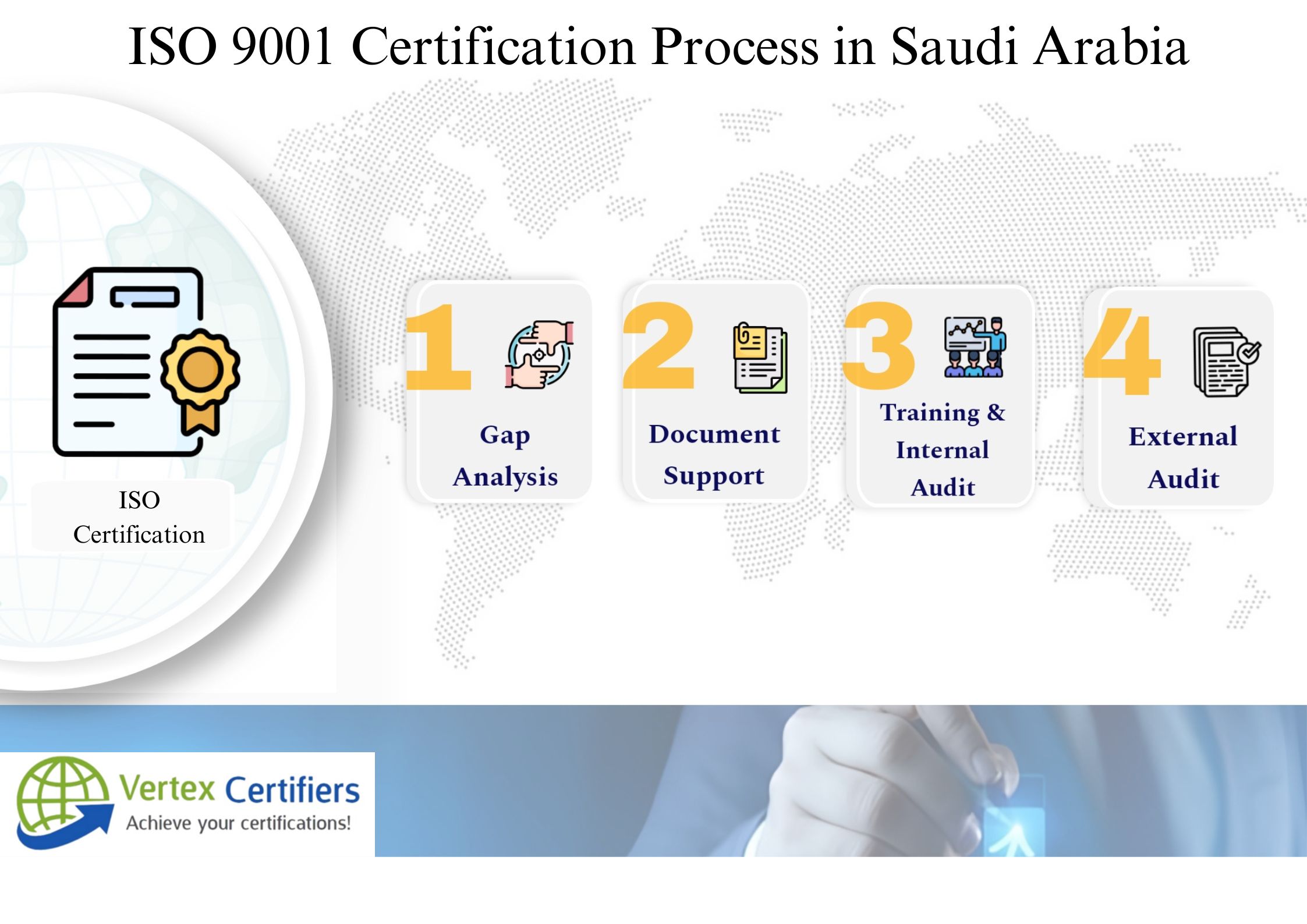
The ISO 9001 certification process in Saudi Arabia usually follows a structured implementation and audit path. The exact sequence may vary slightly depending on the company size and certification body, but the typical process includes the following steps.
- Initial consultation and scope definition: Define the business activities, locations, departments, and services that will be included in the QMS.
- Gap analysis against ISO 9001:2015: Review current processes and identify missing controls, documents, records, and system elements.
- QMS documentation development: Prepare the required policies, procedures, process maps, forms, registers, and records needed for the system.
- Process mapping and KPI alignment: Identify process inputs, outputs, responsibilities, and performance indicators linked to quality objectives.
- Implementation of quality controls: Put the documented system into actual operation across departments and sites.
- Employee awareness and training: Ensure staff understand the QMS, their responsibilities, and the importance of meeting quality requirements.
- Internal audit: Conduct an internal audit to verify conformity and detect gaps before certification.
- Management review: Top management reviews QMS performance, risks, customer feedback, audit results, and improvement needs. [web:204][web:208]
- Corrective action closure: Address internal-audit findings, process gaps, and nonconformities before the external audit.
- Stage 1 audit: The certification body reviews documentation and readiness of the QMS.
- Stage 2 audit: The certification body evaluates actual implementation and effectiveness of the QMS.
- Certification issuance: Once conformity is demonstrated and nonconformities are closed, the ISO 9001 certificate is issued.
- Surveillance audits: Periodic audits are conducted to maintain certification and verify ongoing compliance.
Requirements for ISO 9001 Certification in Saudi Arabia
Businesses searching for ISO 9001 requirements in Saudi Arabia usually want to know what must be in place before certification. The core requirements are based on ISO 9001:2015 and apply to organizations of different sizes and industries, although the depth of implementation depends on business complexity and operational risk. [web:204][web:208]
- Scope definition: The organization must clearly define what activities, products, services, departments, and sites are included in the QMS. [web:208]
- Quality policy and objectives: A clear quality policy and measurable quality objectives should guide the organization’s direction.
- Documented procedures and records: The organization must maintain documented information necessary for effective process control and evidence of implementation.
- Process controls: Key operational processes should be identified, controlled, monitored, and improved using a process-based approach.
- Risk and opportunity evaluation: Risks and opportunities affecting quality performance must be identified and addressed.
- Internal audit: Internal audits are required to assess conformity and effectiveness of the QMS.
- Management review: Top management must review QMS performance and make decisions for improvement.
- Corrective actions: Nonconformities should be addressed systematically to prevent recurrence.
- Employee competence: Staff performing work affecting quality should be competent through education, training, or experience.
- Customer feedback and monitoring: Customer satisfaction, complaints, process results, and performance data should be monitored and reviewed.
Which Industries in Saudi Arabia Need ISO 9001 Certification?
ISO 9001 certification is relevant across a wide range of industries in Saudi Arabia because quality consistency, traceability, customer confidence, and process control are important in both product-based and service-based businesses. It is especially useful in sectors where vendor qualification, project execution, or customer approval depends on formal quality systems.
- Oil & Gas contractors and service providers: Important for supplier qualification, project execution, and controlled service delivery.
- Construction and EPC companies: Helps standardize project controls, site processes, documentation, and client communication.
- Manufacturing and industrial units: Useful for process consistency, defect reduction, and export quality expectations.
- Food and beverage businesses: Supports process control, customer confidence, and integration with food-safety systems.
- Healthcare and medical suppliers: Helps improve service consistency, documentation, and customer / regulatory trust.
- Logistics and warehousing companies: Useful for service reliability, handling controls, and customer performance expectations.
- IT and software service providers: Supports consistent service delivery, documentation, and customer satisfaction.
- Facility management companies: Helps standardize service performance across contracts, sites, and teams.
- Education and training providers: Improves service quality, learner experience, and internal process discipline.
- Trading and import-export businesses: Supports supplier control, complaint handling, documentation, and customer trust.
Benefits of ISO 9001 Certification for Saudi Businesses
ISO 9001 certification offers more than a certificate. For Saudi businesses, it can create a more disciplined and scalable operating model that improves process reliability, customer confidence, and commercial eligibility. In a market shaped by competitive tenders, vendor registration, multi-site operations, and customer-driven performance expectations, ISO 9001 helps organizations work in a more controlled and measurable way.
- Improved process consistency: Standardized workflows reduce variation between departments, branches, projects, and teams.
- Reduced rework and errors: Better planning and controls help prevent mistakes, waste, and repeated corrections.
- Stronger customer satisfaction: Customer needs, feedback, and complaints are managed more systematically. [web:209]
- Better tender eligibility: ISO 9001 can strengthen credibility during tender submission and prequalification processes.
- Better vendor approval chances: Many customers and large organizations prefer approved suppliers with formal quality systems.
- Improved documentation and accountability: Clear records, roles, responsibilities, and controls improve internal discipline.
- Continual improvement culture: The QMS encourages review, analysis, corrective action, and ongoing improvement. [web:208][web:209]
- Stronger reputation with clients and regulators: Certification demonstrates commitment to consistent quality and operational control.
- Easier expansion into export and international markets: An internationally recognized QMS can improve trust with overseas buyers and global customers.
ISO 9001 Documentation Support in Saudi Arabia
Documentation is a critical part of ISO 9001 implementation, especially for businesses that want a well-structured system and smoother audit readiness. Good documentation should not be excessive, but it should clearly define how the organization controls quality, records results, responds to issues, and improves performance.
Vertex Certifiers supports Saudi businesses with practical ISO 9001 documentation tailored to their sector, process complexity, and certification scope. This typically includes:
- Quality Manual / QMS structure
- Quality Policy
- Quality Objectives
- SOPs / work instructions
- Risk & opportunity register
- Internal audit checklist
- NCR / CAPA formats
- Management review minutes
- Supplier evaluation formats
- KPI monitoring formats
Cost of ISO 9001 Certification in Saudi Arabia
The cost of ISO 9001 certification in Saudi Arabia depends on several business-specific factors. Even though there may be a separate cost page, including a cost overview here helps visitors understand that pricing is based on scope and complexity rather than a fixed flat fee.
- Number of employees: More employees may increase awareness, audit sampling, and implementation effort.
- Number of branches / sites: Multi-site businesses usually require broader audit coverage and stronger process coordination.
- Process complexity: More complex operations, technical activities, or project-based work can increase implementation depth.
- Level of existing documentation: Companies with mature procedures and records often require less development work.
- Certification body: Audit fees vary depending on the selected certification body and scope.
- Need for training, internal audit, and implementation support: The amount of consulting support required affects the total cost.
Vertex Certifiers provides customized ISO 9001 proposals for businesses across Saudi Arabia.
Why Choose Vertex Certifiers for ISO 9001 Certification in Saudi Arabia
Vertex Certifiers supports Saudi businesses with a practical and implementation-focused approach to ISO 9001 certification. The aim is not just to prepare paperwork, but to help build a QMS that improves business performance, supports approvals, and remains workable after certification.
- Experienced ISO consultants: Guidance from consultants familiar with Saudi business environments and ISO 9001 implementation needs.
- More than documentation: Support covers process mapping, implementation, training, internal audits, management review, and certification readiness.
- Industry-specific implementation: Tailored support for construction, industrial, manufacturing, trading, healthcare, logistics, food, service, and project-based companies.
- Practical documentation: Procedures and records designed for real business use, not just audit formality.
- Remote and onsite support: Flexible support model across Saudi Arabia based on your operations and locations.
- Affordable and structured consulting: Suitable for small businesses, mid-sized companies, and large multi-site organizations.
- Audit and post-certification support: Assistance with certification audits, corrective actions, surveillance readiness, and ongoing QMS maintenance.
Get ISO 9001 Certification in Saudi Arabia
Apply for ISO 9001 Certification with Vertex Certifiers
Vertex Certifiers helps businesses across Saudi Arabia implement effective Quality Management Systems with consulting, documentation, training, internal audits, and certification coordination.
- Support for Riyadh, Jeddah, Dammam, Al Khobar, Jubail, Yanbu, Madinah, and other Saudi cities
- Remote and onsite ISO 9001 consulting support
- Customized implementation based on your business scope and industry
- End-to-end support from gap analysis to certification
Contact Vertex Certifiers