Vertex Certifiers

ISO Certification in North Korea:

ISO Certification in North Korea, Vertex Certifiers is a global ISO consulting and certification support company providing end-to-end services for documentation, implementation, training, internal audits, and certification assistance across North Korea. We help organizations achieve compliance with 10–12 major ISO standards, including ISO 9001, ISO  14001, ISO 45001, ISO 27001, ISO 22000, ISO 50001, ISO 21001, ISO 10002, ISO 13485, ISO 17025, ISO 22301, ISO 37001, and others—ensuring international acceptance and regulatory readiness. With a team of qualified lead auditors and industry experts, we support businesses across Pyongyang, Nampo, Chongjin, Wonsan, Sinuiju, and Hamhung, delivering remote and onsite guidance for seamless certification. Whether you are a small enterprise or a large industrial unit, Vertex Certifiers ensures a practical, time-bound, and cost-effective ISO certification journey.

North Korea’s industrial landscape continues to evolve with developments in manufacturing, mining, energy production, machinery, and agriculture. Many state-driven enterprises and private industrial entities are focusing on improving operational efficiency, technological capability, and compliance with international trade requirements.

In this environment, ISO Certification in North Korea has emerged as a valuable tool for organizations seeking to align their management systems with globally recognized standards. ISO certification helps establish structured approaches to quality, safety, environment, and information security, enabling businesses to meet the expectations of global stakeholders and potential trade partners.

Adopting ISO standards equips North Korean organizations with transparent and reliable management frameworks that enhance their ability to operate safely, sustainably, and efficiently. It reflects a commitment to quality assurance and continuous improvement, which is vital for businesses aiming for global relevance and credibility

What Matters the Most for ISO Certification in North Korea

As economies worldwide become interlinked, international quality and safety standards have become benchmarks for global cooperation. For North Korean enterprises gradually interacting with external markets, adopting ISO standards strengthens their technical and organizational maturity.

Below are key reasons why ISO certification is increasingly relevant for industries in North Korea:

  • Enhances credibility for export-oriented industries: ISO-certified systems demonstrate reliability, making products and services more acceptable to overseas markets.
  • Meets global safety and quality expectations: International buyers and regulators recognize ISO standards as indicators of conformity, ethics, and organizational integrity.
  • Supports structured management and risk-based thinking: ISO frameworks promote consistency in processes, proactive problem-solving, and strategic planning.
  • Improves acceptance in government and industrial sectors: ISO-certified entities often operate more efficiently within structured, regulated environments and supply chains.

Through ISO certification, North Korean industries can establish standardized, traceable, and auditable systems that not only ensure compliance but also foster trust and competitiveness.

ISO Certification Process in North Korea

The process of achieving ISO Certification in North Korea follows a globally recognized workflow, ensuring consistency and integrity at every stage.
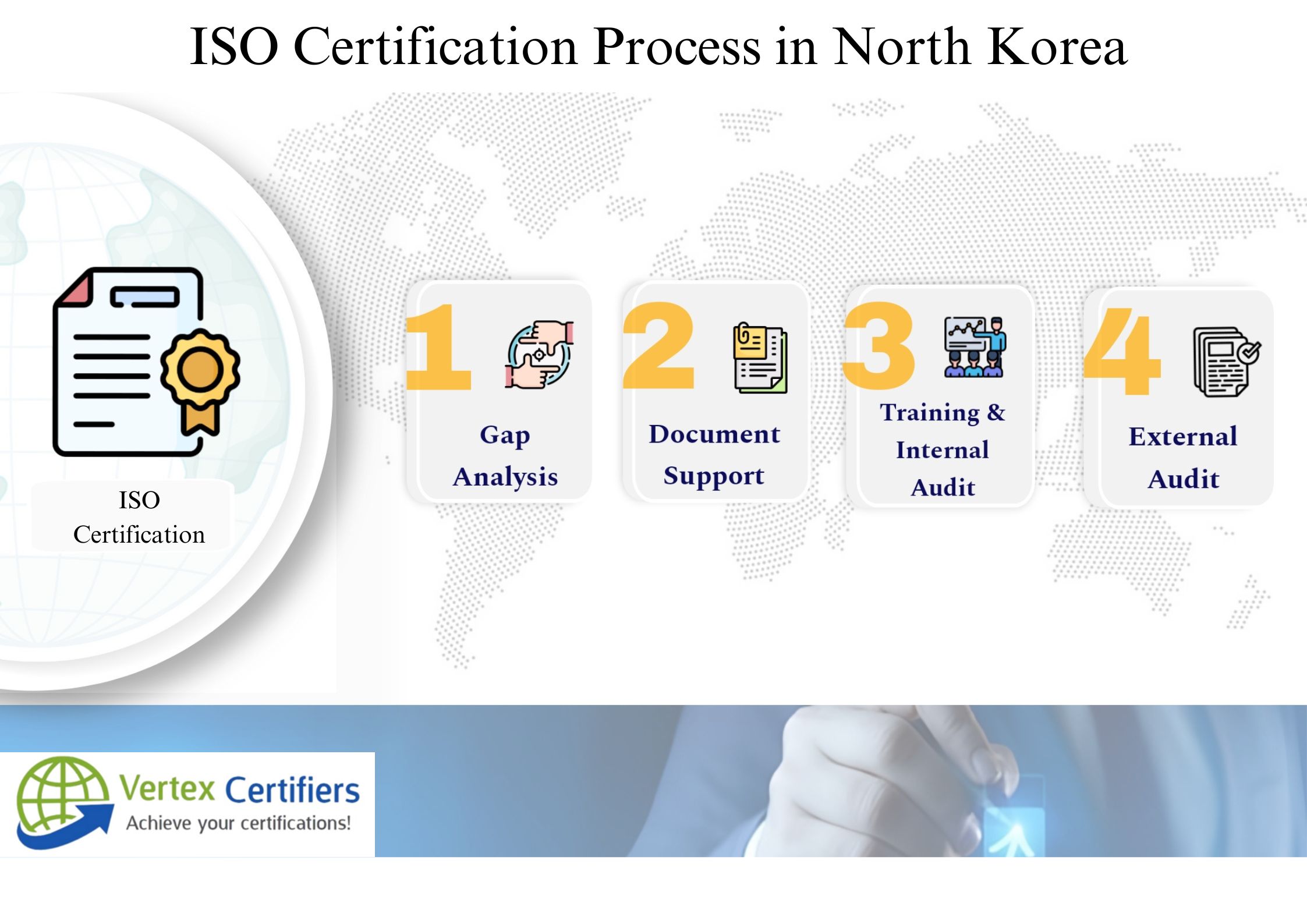
ISO Certification in North Korea

Step 1: Gap Analysis
A preliminary evaluation identifies gaps between current practices and the requirements of the selected ISO standard.

Step 2: Documentation & SOP Development
Preparation of documents such as ISO manuals, Standard Operating Procedures (SOPs), work instructions, and operational checklists.

Step 3: Training & Awareness
Employee training ensures everyone understands their roles within the ISO system, promoting awareness about best practices and compliance.

Step 4: Internal Audit
An internal audit evaluates implementation effectiveness and confirms readiness for external audit.

Step 5: Stage–1 Audit
An accredited auditor reviews documentation, processes, and overall preparedness.

Step 6: Stage–2 Audit
A detailed on-site audit examines implementation practices, evidence, and compliance with standard requirements.

Step 7: Certification Issuance
If the organization meets all conformity requirements, it is awarded the ISO certificate valid for three years (with annual surveillance).

Step 8: Surveillance Audits
Periodic audits maintain and verify continuous compliance and improvement over the certification period.

Vertex Certifiers provides full support at every step—from system design to final certification—ensuring efficient, structured, and globally acceptable results.

    Get Free
    Consultation


    Our Services

    ISO Standards in North Korea

    A wide range of ISO standards can be implemented depending on the sector and organizational goals. The following are the most commonly applied ISO standards in North Korea:

    • ISO 9001 – Quality Management System (QMS): Focuses on customer satisfaction, process efficiency, and continual improvement. Suitable for manufacturing, trading, and service organizations.
    • ISO 14001 – Environmental Management System (EMS): Encourages sustainable resource use, waste reduction, and environmental compliance. Essential for mining, manufacturing, and energy sectors.
    • ISO 45001 – Occupational Health & Safety (OHSMS): Minimizes workplace accidents and improves safety compliance—ideal for labor-intensive industries.
    • ISO 27001 – Information Security Management (ISMS): Protects data confidentiality and integrity—useful for administrative and tech-based sectors.
    • ISO 22000 / HACCP – Food Safety (FSMS): Ensures safe food production and hygiene—recommended for agriculture, food, and packaging sectors.
    • ISO 50001 – Energy Management (EnMS): Improves energy efficiency and cost control—suits mining, utilities, and energy-driven enterprises.
    • ISO 13485 – Medical Devices QMS: Ensures safety and regulatory compliance for medical device manufacturing.
    • ISO 37001 – Anti-Bribery (ABMS): Helps prevent corruption through transparent and ethical frameworks.

    Other optional certifications such as ISO 22301, ISO 21001, and ISO 50001 may be adopted depending on operational requirements.


    Industries in North Korea That Benefit from ISO Certification

    Key industrial sectors gaining from ISO certification include:

    • Mining & Metallurgy: ISO 9001, 14001 & 45001 help improve safety, efficiency, and environmental performance.
    • Energy & Power Generation: ISO 50001 & 14001 drive sustainability and improved energy utilization.
    • Food Manufacturing & Packaging: ISO 22000/HACCP enhances product hygiene and supply chain safety.
    • Mechanical & Industrial Production: ISO 9001 & 45001 ensure precision and safe industrial operations.
    • SME Trading Units: ISO 9001 boosts export credibility and customer confidence.
    • Public Utilities: ISO supports reliability, compliance, and structured project execution.
    • Export-Linked Sectors: Certification enhances legitimacy for international collaboration.

    These sectors gain operational control, reduced risks, and improved stakeholder trust through ISO systems.


    ISO Certification Cost in North Korea

    ISO certification costs are influenced by:

    • Organization size & employee count
    • Complexity of business processes
    • Industry risk category
    • Number of operating locations
    • Selected ISO standards or integrated systems
    • Documentation readiness level

    Costs may rise for multi-site or high-risk units due to extended audit durations. However, investing in ISO certification delivers sustainable benefits including efficiency, compliance, and brand reputation.


    Timeline for ISO Certification

    Organization TypeApprox. Duration
    Small organizations4–6 weeks
    Medium organizations6–10 weeks
    Large / Multi-location10–14 weeks

    Timelines depend on documentation readiness, employee training, management involvement, and operational complexity. Faster execution is possible with expert guidance from Vertex Certifiers.


    Documents Required for ISO Certification

    • Organization profile & contact details
    • Process mapping and workflow charts
    • Certification scope statement
    • Management system manuals & SOPs
    • Policy statements (quality, safety, environment, information security)
    • Training and competence records
    • Internal audit & management review reports
    • NC reports & corrective action records
    • Calibration and maintenance logs

    Vertex Certifiers assists in preparing and organizing all documentation aligned with international audit expectations.


    Why Choose Vertex Certifiers?

    • Global ISO consultants with cross-industry expertise
    • End-to-end support from gap analysis to certification
    • Online & onsite models for remote regions
    • Support for 10+ ISO standards
    • Accredited certification body partnerships
    • Flexible, fast implementation timelines
    • Practical execution with measurable improvements

    Vertex Certifiers ensures efficient, affordable, and reliable certification outcomes enabling long-term improvement.


    Call to Action

    Achieving ISO Certification in North Korea strengthens credibility, compliance, and international market access. Whether the goal is quality improvement or export eligibility, ISO standards provide a proven framework.

    Vertex Certifiers provides complete assistance—documentation, training, implementation, internal audits, and certification coordination.

      Company Logo

      Get ISO certification


      Fill the details below, one of our executives will contact you shortly


      This will close in 0 seconds

      Call Now Button