Vertex Certifiers

ISO 22000 Certification in Uzbekistan:

ISO 22000 Certification in Uzbekistan, Vertex Certifiers is a leading international ISO consulting and certification facilitation firm delivering end-to-end ISO 22000 Food Safety Management System implementation, HACCP documentation, PRPs, internal audits, regulatory alignment, and certification assistance across Uzbekistan. We support food manufacturers, processors, distributors, hotels, restaurants, packaging units, and logistics providers in implementing global food-safety best practices that prevent contamination, reduce operational risks, and ensure safe products for consumers.

Operating across major cities—Tashkent, Samarkand, Bukhara, Andijan, Namangan, Fergana, Nukus, and Qarshi—Vertex helps organizations meet local regulatory requirements and international buyer expectations. Beyond ISO 22000, we specialize in 15+ major ISO standards, including ISO 9001, ISO 14001, ISO 27001, ISO 21001, ISO 37001, ISO 50001, ISO 41001, ISO 22301, ISO 13485, ISO 20000-1, ISO 17025, ISO 27701, ISO 27017, ISO 55001, and ISO 45001, enabling Uzbek businesses to strengthen compliance, enhance market acceptance, and compete globally.

ISO 22000 certification in Uzbekistan helps food businesses prove their products are consistently safe, compliant, and trusted in local and export markets.

Introduction

Uzbekistan’s food sector is evolving rapidly, with strong growth in agriculture, food processing, cold chains, and retail distribution. As the country increases exports to regions such as the EU, Gulf, and CIS, food safety has become a critical requirement for market access and brand reputation.

ISO 22000 is the internationally recognized Food Safety Management System (FSMS) standard that helps organizations control food safety hazards across the entire supply chain—from farm to fork. For Uzbek producers, processors, logistics providers, and HORECA businesses, ISO 22000 certification is a powerful tool to demonstrate compliance, reduce risks, and build global customer confidence.

What is ISO 22000?

ISO 22000:2018 is an international standard that specifies requirements for a Food Safety Management System capable of consistently providing safe food products and services. It combines the process approach and PDCA cycle with risk-based thinking to manage food safety risks at every stage.

Key elements integrated in ISO 22000 include:

  • HACCP principles and Codex Alimentarius-based hazard analysis.
  • Prerequisite programmes (PRPs) such as hygiene, sanitation, pest control, and maintenance.
  • Critical Control Points (CCPs) and Operational PRPs (OPRPs) to control significant hazards.
  • Traceability and recall systems to identify, isolate, and withdraw unsafe products.

ISO 22000 is applicable to all organizations in the food chain, including feed producers, farmers, transporters, processors, packaging manufacturers, storage facilities, retailers, and food service operators.


Procedure to get ISO 22000 Certification in Uzbekistan:
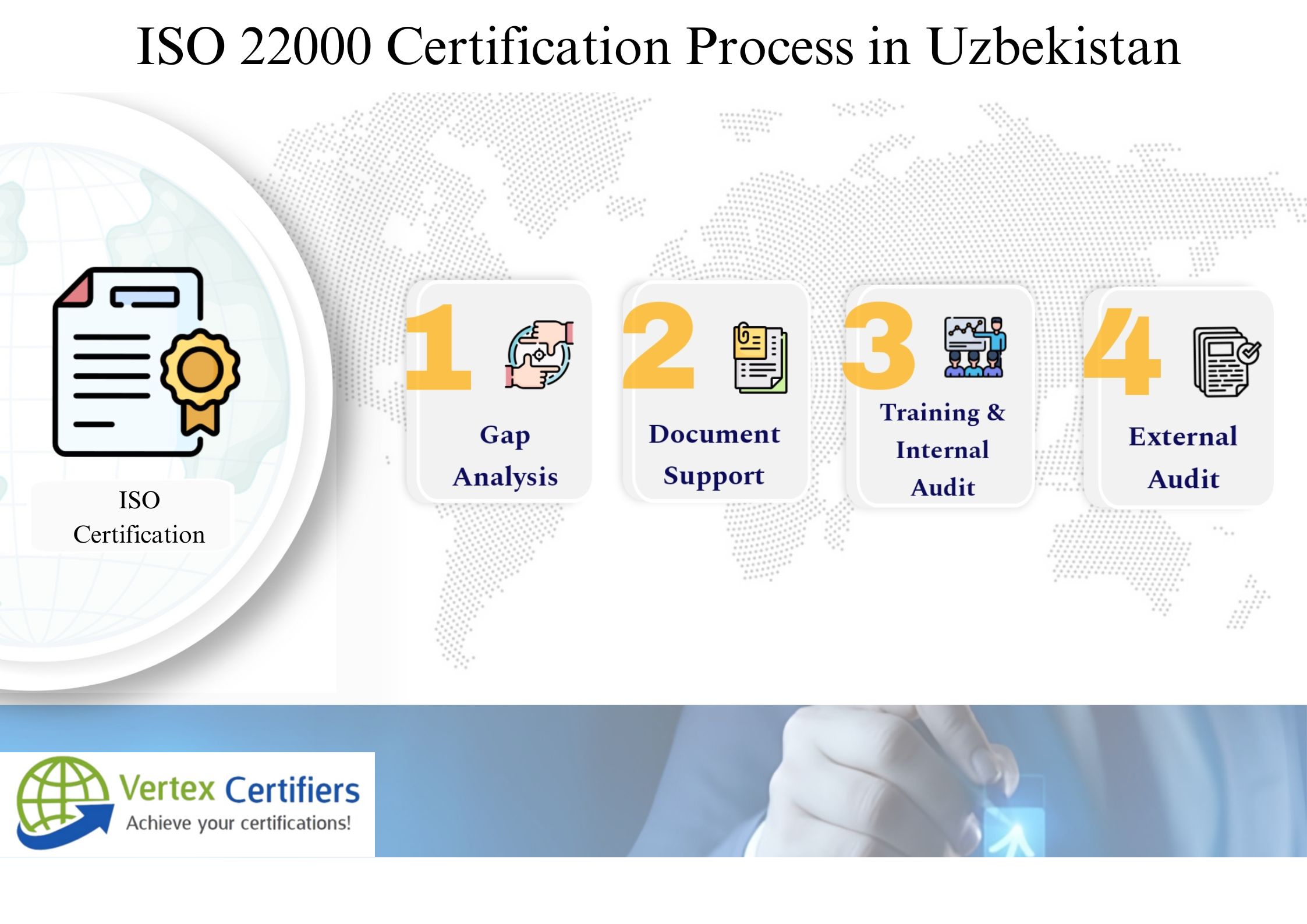
ISO 22000 Certification in Uzbekistan

    Get Free
    Consultation


    Our Services

    ISO 22000 Certification in Uzbekistan

    Uzbekistan is modernizing its food and agribusiness sector with new processing plants, cold storage facilities, and export-oriented farms. As trade links expand, importers and regulators increasingly demand verifiable food safety systems from Uzbek suppliers.

    ISO 22000 certification supports:

    • Export approvals by aligning with international food safety expectations for EU, Gulf, and CIS markets.
    • Compliance with national food safety regulations and inspection schemes.
    • Requirements from supermarkets, distributors, and hospitality chains that prefer or require certified suppliers.

    For producers in regions like Tashkent, Samarkand, Bukhara, Andijan, and Fergana, ISO 22000 is becoming a strategic differentiator in both domestic and export supply chains.

    4. Key Benefits of ISO 22000 Certification

    ISO 22000 delivers strong operational and commercial advantages for food businesses:

    • Safe and consistent food products, lowering the risk of contamination and foodborne illness.
    • Structured HACCP compliance integrated with PRPs and CCPs.
    • Reduction in product recalls, withdrawals, and customer complaints.
    • Better control of suppliers, raw materials, and process hygiene.
    • Stronger customer and regulator trust, supporting brand image.
    • Improved export readiness and easier acceptance in international markets.
    • Clear roles, training, and records that support legal and contractual compliance.

    5. Industries in Uzbekistan That Need ISO 22000

    ISO 22000 applies across the entire food value chain. Key sectors in Uzbekistan that benefit include:

    • Food processing plants (canning, ready-to-eat, frozen foods)
    • Agriculture & farming (fruit, vegetables, grains, raw materials)
    • Dairy & milk product manufacturers (cheese, yogurt, ice cream)
    • Poultry & meat exporters (slaughterhouses, meat processing units)
    • Fish & aquaculture operations
    • Beverage & soft drink manufacturers (juices, water, carbonated drinks)
    • Flour mills & grain processors
    • Packaged food & snack producers
    • Hotels, restaurants, cafes, and catering (HORECA)
    • Supermarkets, cold storage, and food logistics providers
    • Food trading and export companies
    • Packaging material manufacturers used in direct food contact

    6. ISO 22000 Documentation Requirements

    Maintaining accurate and controlled documentation is central to ISO 22000 compliance. Typical FSMS documents include:

    • Food safety policy and objectives
    • HACCP study and hazard analysis for each product/process
    • Hazard control plan including CCPs and OPRPs
    • Prerequisite programmes (PRPs) and SOPs for hygiene, cleaning, pest control, maintenance, etc.
    • Traceability procedures and batch/lot tracking records
    • Product recall & withdrawal procedures including test records
    • Supplier approval and evaluation records
    • Monitoring & measurement records for CCPs, OPRPs, and PRPs
    • Customer complaints and nonconformity handling
    • Internal audit reports and corrective action records
    • Management review minutes and continual improvement actions

    These documents provide evidence that the FSMS is implemented, monitored, and continually improved.

    7. Cost of ISO 22000 Certification in Uzbekistan

    ISO 22000 certification costs vary by organization but depend on:

    • Company size and number of employees (drives audit man-days)
    • Number of product categories and processes
    • Risk profile (e.g., chilled meat vs. dry goods)
    • Existing hygiene controls and microbiological testing structure
    • Consultant fees for FSMS, HACCP & training
    • Certification body fees for Stage 1, Stage 2 & surveillance
    • Surveillance audits in Year 1 & 2 and recertification in Year 3

    For SMEs, ISO 22000 can be implemented with affordable hybrid consulting and optimized scopes.

    8. Timeline for Certification

    Typical ISO 22000 timelines depend on organizational readiness:

    • Small organizations: 4–6 weeks
    • Medium companies: 2–3 months including HACCP design & audits
    • Large or multi-site: 3–5 months or more

    Good preparation, clear scope, and management commitment speed up certification.

    9. ISO 22000 Certification Bodies in Uzbekistan

    Businesses can select local or international accredited bodies. Key selection criteria include:

    • IAF accreditation or global recognition
    • Auditor competence in food safety and HACCP
    • Market recognition among buyers and regulators
    • Capability for ongoing surveillance and recertification

    The right certification body ensures credible certification accepted in global markets.

    10. Importance of a Consultant

    ISO 22000 implementation requires detailed HACCP planning and strong documentation. Consultants help organizations:

    • Design and validate HACCP methodologies
    • Develop FSMS documentation, SOPs & PRPs
    • Conduct hygiene & food safety training
    • Plan and execute internal audits
    • Close gaps before external audits
    • Improve audit readiness and certification speed

    This ensures a practical, sustainable food safety system—not a paper-driven one.

    11. Why Choose Vertex Certifiers

    Vertex Certifiers supports organizations in Uzbekistan with end-to-end ISO 22000 consulting. Our strengths include:

    • Complete support—gap analysis, documentation, implementation, audits & liaison
    • HACCP experts covering processing, HORECA, logistics & retail
    • Hands-on PRP, CCP & OPRP implementation
    • Flexible remote & onsite delivery
    • Coverage across Tashkent, Samarkand, Bukhara, Andijan, Fergana

    We also support combined standards like:

    ISO 9001, ISO 14001, ISO 45001, ISO 27001, ISO 22301, ISO 50001, ISO 41001, ISO 20000-1, ISO 13485, ISO 37001, ISO 31000, ISO 17025, FSSC 22000, ISO 27701, and ISO 10002.

    12. Contact Us – Start ISO 22000 Certification

    Food safety and export growth start with a robust FSMS!

    📞 Book Your Free Consultation

    Call / WhatsApp: +91 9880429121

    Email: info@vertexcertifiers.com

    Submit Your Inquiry: Contact Us

    Get a free scope analysis, quotation & certification roadmap today!

    ISO 22000 Certification in Uzbekistan – Strengthening Food Safety and Consumer Confidence

    Uzbekistan's food industry continues to expand through increased agricultural production, food processing activities, and export opportunities. As consumers, regulators, and international buyers place greater emphasis on food safety, organizations across the food supply chain are adopting internationally recognized management systems to demonstrate their commitment to producing safe food products.

    ISO 22000 Certification provides a comprehensive Food Safety Management System (FSMS) framework that enables organizations to identify food safety hazards, implement effective control measures, and continually improve food safety performance throughout the supply chain.

    What is ISO 22000?

    ISO 22000 is an internationally recognized standard that specifies requirements for a Food Safety Management System. The standard integrates the principles of hazard analysis, risk management, prerequisite programmes, and effective communication to ensure food safety from farm to fork.

    Organizations implementing ISO 22000 establish systematic processes to prevent, eliminate, or reduce food safety hazards to acceptable levels.

    Key Benefits of ISO 22000 Certification

    • Enhance food safety performance throughout the organization
    • Improve consumer confidence and trust
    • Strengthen hazard identification and control processes
    • Support compliance with applicable food safety requirements
    • Improve communication across the food supply chain
    • Reduce the likelihood of food safety incidents
    • Improve operational consistency and efficiency
    • Enhance market access and export opportunities
    • Demonstrate commitment to continual improvement
    • Strengthen brand reputation and credibility

    Organizations That Can Implement ISO 22000 in Uzbekistan

    ISO 22000 applies to organizations operating at any stage of the food chain.

    • Food manufacturing companies
    • Fruit and vegetable processing facilities
    • Dairy producers and processors
    • Meat processing organizations
    • Grain storage and flour milling companies
    • Beverage manufacturers
    • Food packaging organizations
    • Food transportation and logistics providers
    • Food retailers and distributors
    • Agricultural producers involved in food supply chains

    Importance of ISO 22000 for Uzbekistan's Food Industry

    As Uzbekistan continues to strengthen its position in regional and international food markets, organizations must demonstrate their ability to consistently produce safe food products.

    ISO 22000 certification supports organizations by improving food safety controls, increasing customer confidence, and enhancing competitiveness in both domestic and export markets.

    Common Food Safety Challenges Addressed by ISO 22000

    • Inadequate hazard identification processes
    • Inconsistent food safety practices
    • Poor supplier management controls
    • Limited employee awareness regarding food safety requirements
    • Ineffective monitoring of critical control measures
    • Weak traceability systems
    • Insufficient documentation and record control
    • Challenges in managing food safety incidents

    ISO 22000 provides a structured approach to managing these challenges through preventive planning and continual improvement activities.

    ISO 22000 Certification Process

    1. Conduct an initial gap analysis against ISO 22000 requirements.
    2. Define the scope of the Food Safety Management System.
    3. Develop food safety policies, objectives, and documented information.
    4. Identify hazards and establish control measures.
    5. Implement prerequisite programmes and operational controls.
    6. Provide food safety awareness training to employees.
    7. Monitor and verify food safety processes.
    8. Conduct internal audits and management reviews.
    9. Address identified nonconformities through corrective actions.
    10. Complete the certification audit process.

    Benefits of ISO 22000 Certification for Businesses in Uzbekistan

    ✔ Improved Food Safety Controls
    ✔ Enhanced Consumer Confidence
    ✔ Better Supply Chain Communication
    ✔ Improved Operational Efficiency
    ✔ Reduced Food Safety Risks
    ✔ Strengthened Regulatory Readiness
    ✔ Enhanced Export Opportunities
    ✔ Improved Brand Reputation
    ✔ Continual Improvement of Food Safety Performance

    Frequently Asked Questions (FAQs)

    Is ISO 22000 Certification mandatory in Uzbekistan?

    ISO 22000 certification is generally voluntary; however, many customers and international buyers may require evidence of an effective food safety management system.

    Who should implement ISO 22000?

    Any organization involved in the food supply chain, from primary production to food distribution and retail, can implement ISO 22000.

    How long does ISO 22000 implementation take?

    Most organizations complete implementation and certification within 45 to 90 days depending on operational complexity and existing food safety practices.

    Can small food businesses implement ISO 22000?

    Yes. ISO 22000 can be adapted to organizations of various sizes, including small and medium-sized enterprises.

    How long is ISO 22000 Certification valid?

    ISO 22000 certification is typically valid for three years, subject to successful surveillance audits conducted during the certification cycle.

    Need Assistance with ISO 22000 Certification in Uzbekistan?

    Vertex Certifiers provides comprehensive ISO 22000 consulting services including gap assessments, food safety documentation support, hazard analysis guidance, employee training, internal audits, and certification coordination.

    Our consultants help organizations establish effective Food Safety Management Systems that align with ISO 22000 requirements while improving food safety performance and customer confidence.

    Email: info@vertexcertifiers.com

      Company Logo

      Get ISO certification


      Fill the details below, one of our executives will contact you shortly


      This will close in 0 seconds

      Call Now Button