ISO 27001 Certification in Qatar:
ISO 27001 Certification in Qatar, Vertex Certifiers is a trusted ISO consulting and certification firm helping businesses across Doha, Al Wakrah, Mesaieed, Ras Laffan, and other cities in Qatar achieve global standards efficiently. Our expert team specializes in ISO 9001, ISO 14001, ISO 45001, ISO 27001, ISO 22000, ISO 50001, and other industry-relevant certifications, providing end-to-end support from documentation and implementation to audit readiness. With a proven track record across multiple sectors, Vertex ensures companies in Qatar not only comply with international standards but also enhance operational efficiency, credibility, and competitiveness in both local and global markets.
Qatar is rapidly emerging as one of the most connected and technology-driven economies in the Gulf Cooperation Council (GCC). The country’s focus on digital transformation, smart infrastructure, and advanced IT services has made it a leader in technological innovation across the Middle East. However, with progress comes new threats—cyberattacks, data breaches, and privacy risks targeting critical sectors like oil & gas, finance, government, and telecom.
To combat these evolving threats, organizations across Qatar are adopting ISO 27001 Certification, the globally accepted standard for Information Security Management Systems (ISMS). ISO 27001 ensures that companies protect sensitive data, maintain privacy, and ensure business continuity against cyber threats. It’s a key credential for any organization aiming to demonstrate trustworthiness and compliance under Qatar’s rigorous cybersecurity frameworks and national IT policies.
What Is ISO 27001 Certification in Qatar ?
ISO/IEC 27001:2022 is the internationally recognized standard that defines how to establish, implement, maintain, and continuously improve an Information Security Management System (ISMS).
The goal of ISO 27001 is to safeguard confidentiality, integrity, and availability of information using a systematic, risk-based approach. The standard includes:
- Identification of information security risks.
- Implementation of appropriate controls.
- Ongoing performance monitoring and improvement.
Applicable across all industries, ISO 27001 certification in Qatar helps organizations ensure data protection and legal compliance — whether dealing with financial data, client details, or intellectual property.
Why ISO 27001 Matters in Qatar
Qatar’s national priorities strongly emphasize cybersecurity resilience and data protection. The country has invested heavily in AI, cloud computing, 5G, and smart city projects — all of which depend on robust information security frameworks.
Key drivers for ISO 27001 certification in Qatar include:
- National Cybersecurity Strategy:Â Government mandates for stronger data governance and IT risk management.
- Smart Cities (Lusail, Msheireb):Â Need for secure, interconnected infrastructure with resilient digital controls.
- Financial Data Protection:Â Compliance expectations across banking, fintech, and insurance.
- Oil & Gas Digitalization:Â Advanced IoT and SCADA systems demand secure, monitored networks.
- Data Hosting Regulations:Â Data centers and cloud providers must demonstrate strong ISMS governance.
With ISO 27001 certification, Qatari companies gain a robust, globally recognized method for minimizing risks and proving their cybersecurity maturity.
ISO 27001 Certification Process in Qatar
Achieving certification involves six key phases:
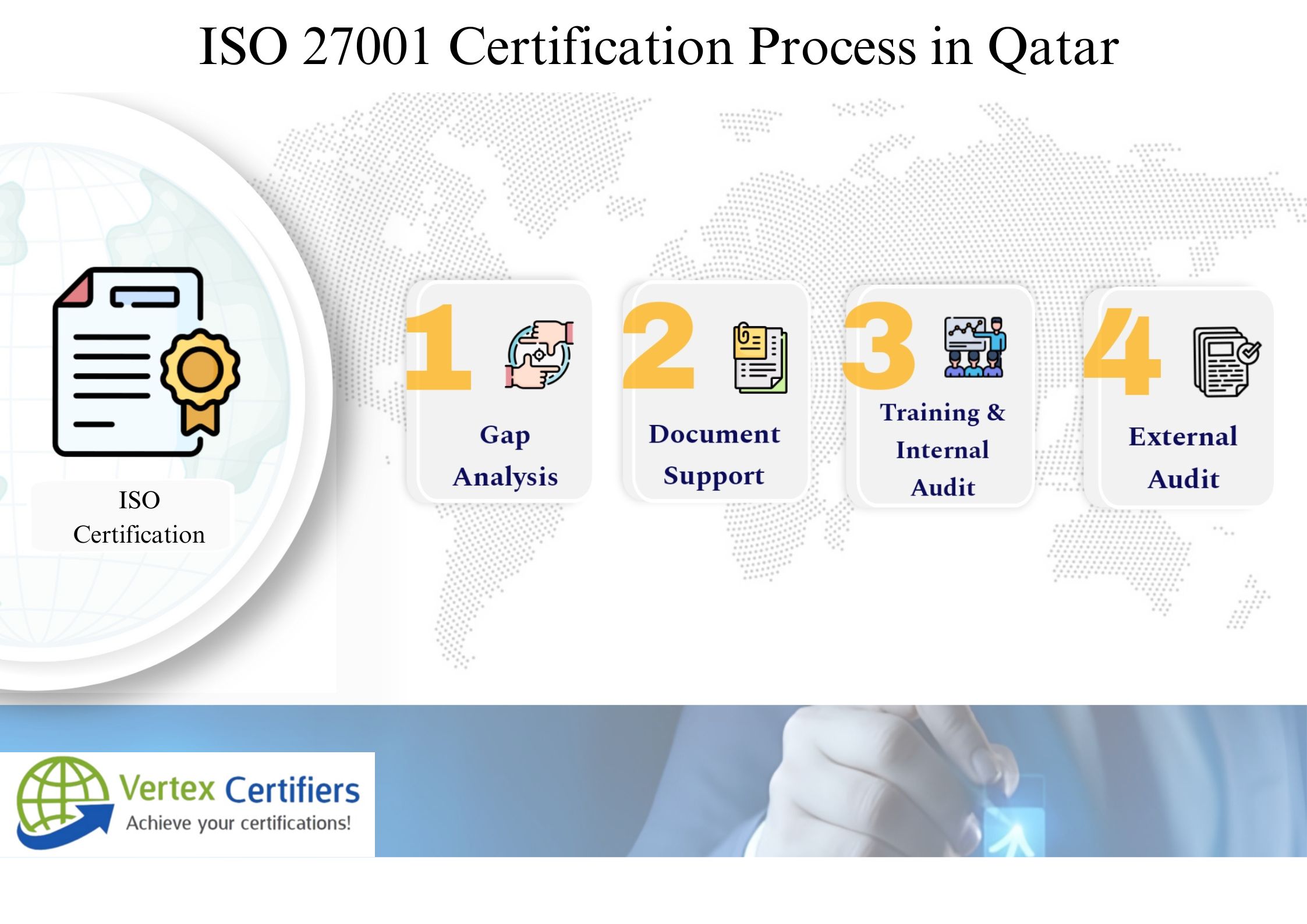
1. Gap Analysis
A detailed assessment compares current security practices with ISO 27001 standard requirements.
2. Risk Assessment
Identification and evaluation of key information security risks to determine control priorities.
3. Documentation Development
Preparation of ISMS documents — policies, SoA, procedures, risk treatment plan, and control evidence.
4. Training & Implementation
Staff are trained on security awareness, access management, and reporting responsibilities.
5. Internal Audit
Conducted to review system effectiveness and close gaps before external audit.
6. Certification Audit (Stage 1 & 2)
- Stage 1:Â Verifies documentation and readiness.
- Stage 2:Â Evaluates actual ISMS implementation.
Upon successful completion, the organization receives an ISO 27001 certificate valid for three years, subject to annual surveillance audits.
Our Services
- GMP Certification
- GLP Certification
- GDP Certification
- Halal Certificate
- Organic Certificate
- CE Marking Certification
- RoHS Certification
- FDA Certification
- CMMI Certification
- Cyber Security
- VAPT Testing
- Security Assessment
ISO 27001 Certification in Qatar
Protect your business against cyber threats and achieve global recognition with ISO 27001 certification in Qatar. Our experts guide you from ISMS setup to audit readiness.
Industries Using ISO 27001 in Qatar
The need for information security spans every major industry in Qatar.
| Industry | Application | Benefits |
|---|---|---|
| Oil & Gas | Protects digital operational networks and SCADA systems | Prevents cyber sabotage and downtime |
| Banking, Finance & Insurance | Secures customer data and payment systems | Meets AML and data protection regulations |
| IT & Data Centers | Cloud and server infrastructure protection | Improves uptime and client confidence |
| Telecom & Internet Providers | Network security and fraud prevention | Reduces risks of attacks and data leakage |
| Government & Smart Cities | Protection of e-services and citizen data | Ensures compliance with national ICT standards |
| Logistics & Supply Chain | Safeguards freight tracking data | Prevents manipulation and information theft |
| Construction & EPC | Project data and vendor contract security | Strengthens tender credibility |
| Healthcare | Secures patient records and medical devices | Compliant with privacy regulations |
| Education | Protects staff and student data | Builds trust with digital learning platforms |
| Manufacturing | Ensures protection of trade secrets | Reduces IP theft and process disruptions |
Benefits of ISO 27001 Certification in Qatar
- Reduces cyber risks through systematic control and monitoring.
- Ensures business continuity during incidents or attacks.
- Meets cybersecurity requirements for government tenders and contracts.
- Strengthens vendor approval and third-party credibility.
- Builds international reputation as a trusted, compliant organization.
- Reduces downtime by improving resource and risk management.
- Enhances customer trust by protecting sensitive information.
→ Ready to protect your business from cyber threats? Contact our Qatar ISO experts for a free consultation today!
ISO 27001 Requirements in Qatar
- Defining the ISMS Scope: Setting boundaries of information systems covered.
- Establishing Information Security Policies: Top management commitment to security principles.
- Conducting Risk Assessment: Identifying threats, vulnerabilities, and impacts.
- Statement of Applicability (SoA): Mapping 93 Annex A controls to applicable risks.
- Implementing Security Controls: Access management, encryption, backups, supplier evaluation.
- Incident Management: Processes for reporting, analyzing, and resolving cybersecurity incidents.
- Business Continuity Planning: Ensuring data availability during disruptions.
- Logging & Monitoring: Continuous oversight of security events and system activities.
- Supplier Controls: Evaluating external providers for compliance.
ISO 27001 Certification Cost in Qatar
The cost depends on:
- Number of employees and branches.
- Data volume and security process complexity.
- Nature of business and regulatory environments.
- Accreditation body fees (local or global).
- Consultant involvement and training.
- Duration of implementation and audit phases.
SMEs can access affordable blended consulting packages, while large enterprises may require tailored ISMS programs.
ISO 27001 Implementation Timeline in Qatar
- Small companies: 3–6 weeks
- Medium-sized organizations: 2–3 months
- Large, multi-site entities: 3–6 months
ISO 27001 for Government Tenders in Qatar
- QatarEnergy – oil and gas suppliers
- Ashghal – IT-enabled infrastructure projects
- Kahramaa – energy management systems
- Ooredoo & Vodafone Qatar – telecom vendors
- Qatar Airways & Hamad Airport – airline data systems
- Banks & Fintech – financial data protection
ISO 27001 enhances tender eligibility and positions your organization as a secure, reliable partner.
Accredited ISO 27001 Certification Bodies in Qatar
- Local Certification Bodies within Qatar and GCC
- International Accredited Bodies from UK, EU, US
- IAF-Accredited Certification Agencies for global recognition
Always verify accreditation on the IAF website to ensure international acceptance.
Choosing an ISO 27001 Consultant in Qatar
- Proven cybersecurity and ISMS experience in local industries
- Full ISMS documentation and SoA mapping
- Incident response and risk treatment frameworks
- Employee training and internal audit preparation
- Remote + onsite blended consulting
- Cost-effective, time-bound services
- 100% certification success rate
Why Choose Us – Your Trusted ISO 27001 Partner in Qatar
- Extensive experience in Qatar’s IT, energy, and industrial sectors
- Ready-to-use ISMS templates and risk registers
- Remote + onsite support for convenience
- Complete internal audit and management review support
- Coordination with IAF-accredited certification bodies
- Fast-track implementation programs for SMEs
FAQs – ISO 27001 Certification in Qatar
- How much does ISO 27001 certification cost? Depends on organization size, data complexity, accreditation body, and consultancy. SMEs can access cost-effective packages.
- How long does certification take? Small companies: 6 weeks; large enterprises: up to 6 months.
- Is ISO 27001 mandatory for tenders? Yes, especially for oil & gas, telecom, government, and IT services.
- Is ISO 27001 applicable to SMEs? Yes, the standard is scalable for all organization sizes.
- What is the validity period? Certificates are valid for 3 years with annual surveillance audits.
Conclusion
Secure your information assets and gain a competitive edge in Qatar’s digital economy with ISO 27001 certification. Implement a robust ISMS to reduce cyber threats, enhance trust, and align with national regulations and international standards.
