Vertex Certifiers

ISO Certification in Germany:

ISO Certification in Germany, Vertex Certifiers delivers end-to-end ISO certification services in Germany, supporting organizations across major commercial and industrial cities such as Berlin, Munich, Hamburg, Frankfurt, Cologne, Stuttgart, Düsseldorf, Leipzig, Dortmund, Essen, Bremen, Hanover, Nuremberg, Mannheim, and Karlsruhe. We provide complete ISO solutions—from gap analysis and documentation development to system implementation, employee training, internal audits, and coordination with DAkkS-accredited certification bodies—ensuring a smooth, compliant, and time-bound certification process. Our ISO consulting and certification services in Germany cover key international standards including ISO 9001, ISO 14001, ISO 45001, ISO 27001, ISO 22000, ISO 50001, ISO 13485, ISO 37001, ISO 20000-1, ISO 22301, ISO 27701, ISO 14064, ISO 41001 ISO 39001, ISO 55001, and ISO 21001, helping German SMEs, startups, and multinational enterprises achieve regulatory compliance, operational excellence, and global market credibility.

Introduction to ISO Certification in Germany

Germany is Europe’s largest economy and a leading exporter in sectors such as automotive, machinery, chemicals, pharmaceuticals, and advanced manufacturing. An export-driven model means German companies must continuously prove compliance with EU directives, global customer requirements, and complex supply-chain expectations. ISO certification supports this by offering internationally recognized frameworks for quality management, environmental performance, information security, and more, aligning German firms with both EU and global norms

For manufacturers, engineering firms, and high-tech industries, ISO certification reinforces the traditional German reputation for quality and precision. Service providers and SMEs use ISO to formalize processes, strengthen tender bids, and show that their management systems meet structured, audited standards demanded by larger buyers and international partners

What is ISO Certification and Its Role in Germany

The International Organization for Standardization (ISO) develops globally applicable standards covering management systems, products, and services. ISO management system standards such as ISO 9001, ISO 14001, or ISO 27001 define requirements for how an organization should establish, implement, monitor, and improve its processes. Certification occurs when an independent, accredited certification body audits a company and confirms that its management system meets a given ISO standard

In Germany, ISO certification complements national norms (DIN) and EU regulations by providing structured frameworks that support precision, quality, and safety traditions. For example, ISO 9001 aligns well with German engineering culture by emphasizing process control, documentation, and continual improvement. Environmental and energy-related standards (ISO 14001, ISO 50001) help German businesses meet stringent EU climate and sustainability targets while demonstrating responsible operations to regulators and stakeholders

Step by Step Process to get ISO Certification in Germany
ISO Certification in Germany

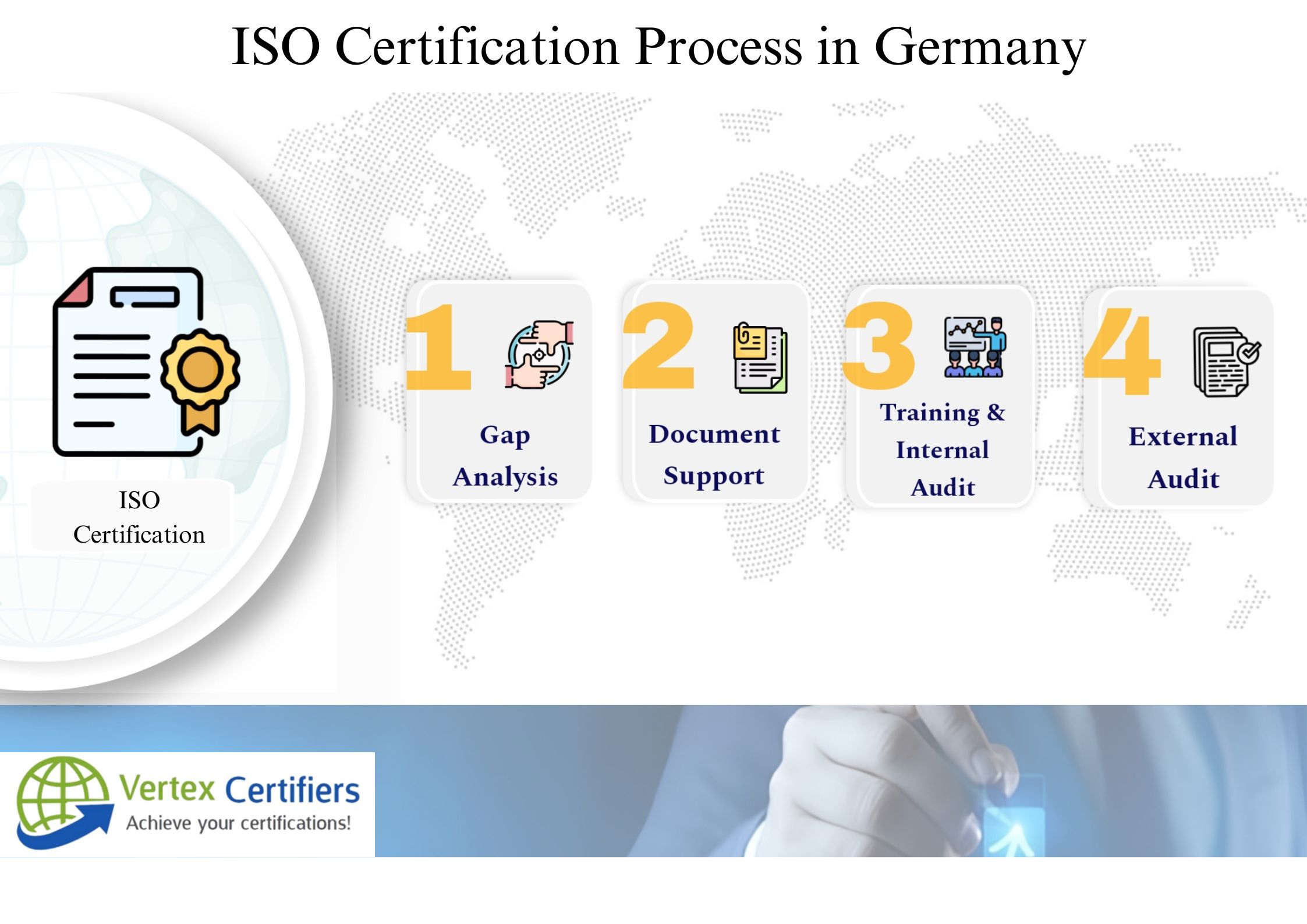
ISO Certification Process in Germany

Although project complexity varies, the core ISO certification process in Germany follows a structured and internationally recognized sequence. Typical steps include:

Gap Analysis

An initial review compares existing processes and documentation against the chosen ISO standard’s requirements, identifying gaps, risks, and priorities for implementation.

Documentation Development

Policies, procedures, process descriptions, work instructions, forms, and records are established or updated to demonstrate control and consistency. Documentation is tailored to organizational size and complexity.

Implementation & Training

Processes are rolled out into daily operations, employees are trained on their roles, and records begin to demonstrate effective application.

Internal Audit

Internal audits verify conformity and effectiveness of the management system, identifying nonconformities and improvement actions.

Management Review

Top management reviews system performance, audit results, risks, opportunities, and improvement needs, demonstrating leadership commitment.

Certification Audit (Stage 1 & Stage 2)

Stage 1: Review of documented information, scope, and readiness.
Stage 2: On-site audit including interviews, record review, and verification of implementation.

Certification Issuance

Once nonconformities are closed, the ISO certificate is issued, valid for three years with annual surveillance audits.

Why ISO Certification is Important for German Businesses

  • Access to EU and global markets: ISO certification is often required by OEMs and international buyers, particularly in automotive, aerospace, and medical sectors.
  • Supplier approval and public procurement: Many German corporations and public authorities use ISO certification as a pre-qualification criterion.
  • Operational efficiency and cost reduction: ISO standards reduce waste, rework, downtime, and inefficiencies through structured process control.
  • Risk management and regulatory compliance: Standards help manage legal, safety, data protection, food safety, and environmental risks.
  • Customer confidence and brand value: Certification by an accredited body provides independent validation and builds trust.

Who Needs ISO Certification in Germany

  • Manufacturing and engineering: Machine builders, metalworking, electronics, and industrial equipment manufacturers.
  • Automotive and components: OEMs and Tier-1/Tier-2 suppliers forming the backbone of Germany’s automotive sector.
  • Construction and infrastructure: Contractors and EPC firms managing quality, safety, and environmental impact.
  • IT, software, and data centers: Organizations demonstrating strong information security management.
  • Healthcare and pharmaceuticals: Hospitals, laboratories, and medical manufacturers supporting regulatory compliance.
  • Logistics and transport: Providers improving reliability, traceability, and cross-border trade readiness.
  • Food processing and beverages: Producers and distributors managing food safety hazards.
  • Startups and export-oriented SMEs: Growing companies building credibility and winning global clients.

Popular ISO Standards in Germany

ISO 9001

The most widely implemented standard, ensuring consistent quality, customer focus, and continual improvement.

ISO 14001

Used by industrial and energy-intensive organizations to manage environmental impact and EU regulatory compliance.

ISO 45001

Adopted to reduce workplace accidents and manage occupational health and safety obligations.

ISO 27001

Critical for protecting information assets in Germany’s highly regulated digital economy.

ISO 22000

Ensures systematic food safety management and traceability across the supply chain.

ISO 50001

Supports energy efficiency, monitoring, and continuous performance improvement.

ISO 13485

Essential for medical device organizations, complementing EU MDR requirements.

Why Choose Vertex Certifiers for ISO Certification in Germany

Vertex Certifiers provides structured, end-to-end ISO consulting and certification support for organizations across Germany, helping reduce implementation effort, audit risk, and certification timelines.

  • Comprehensive ISO consulting: Support across multiple ISO standards, enabling integrated management systems.
  • Remote and onsite support: Assistance across Berlin, Munich, Hamburg, Frankfurt, Stuttgart, Cologne, and other regions.
  • Fast-track certification: Proven templates, clear roadmaps, and focused gap analysis.
  • Audit readiness and coordination: Internal audit support and liaison with DAkkS-accredited certification bodies.

Get ISO Certification in Germany

Strengthen your market position, improve compliance, and win international business with ISO certification. Get a FREE gap analysis and expert guidance from Vertex Certifiers.

    Get Free
    Consultation


    Our Services

    ISO Certification in Germany

    Enhance organizational performance, strengthen stakeholder confidence, and support continual improvement through internationally recognized ISO management systems.

    ISO Certification Services in Germany

    Germany is one of Europe's largest economies, recognised globally for its excellence in manufacturing, engineering, automotive innovation, healthcare, logistics, and technology. Organizations across these sectors increasingly adopt ISO standards to improve efficiency, manage risks, enhance customer satisfaction, and strengthen their competitive position.

    ISO certification provides a systematic framework for establishing robust management systems that support operational consistency and continual improvement.

    Benefits of ISO Certification

    • ✔ Improve operational efficiency and productivity.
    • ✔ Enhance customer confidence and satisfaction.
    • ✔ Strengthen organizational credibility.
    • ✔ Improve risk management capabilities.
    • ✔ Support regulatory and contractual requirements.
    • ✔ Increase access to international business opportunities.
    • ✔ Improve employee awareness and accountability.
    • ✔ Encourage data-driven decision making.
    • ✔ Reduce inefficiencies and nonconformities.
    • ✔ Promote continual improvement.

    Popular ISO Standards Implemented in Germany

    • ISO 9001 – Quality Management System
    • ISO 14001 – Environmental Management System
    • ISO 45001 – Occupational Health and Safety Management System
    • ISO 27001 – Information Security Management System
    • ISO 22000 – Food Safety Management System
    • ISO 50001 – Energy Management System
    • ISO 22301 – Business Continuity Management System
    • ISO 13485 – Medical Devices Quality Management System

    Industries Benefiting from ISO Certification in Germany

    • Automotive manufacturers and suppliers.
    • Industrial engineering companies.
    • Healthcare and medical device organizations.
    • Information technology businesses.
    • Food and beverage manufacturers.
    • Logistics and transportation providers.
    • Chemical and pharmaceutical companies.
    • Construction and infrastructure firms.
    • Renewable energy organizations.
    • Professional service providers.

    General Implementation Process

    1. Gap assessment and project planning.
    2. Scope definition and risk evaluation.
    3. Documentation development.
    4. Management system implementation.
    5. Employee awareness and training.
    6. Internal audits.
    7. Management reviews.
    8. Corrective action implementation.
    9. Certification audit coordination.
    10. Continual improvement activities.

    Frequently Asked Questions

    Can small businesses obtain ISO certification?

    Yes. ISO standards are suitable for organizations of all sizes, including startups and small enterprises.

    How long does certification take?

    Implementation timelines vary depending on complexity, but many organizations complete the process within 30 to 120 days.

    Can multiple ISO standards be integrated?

    Yes. Organizations often combine standards such as ISO 9001, ISO 14001, and ISO 45001 into integrated management systems.

    How long is certification valid?

    Certification is generally valid for three years, subject to surveillance audits.

    Need Assistance with ISO Certification in Germany?

    Vertex Certifiers provides support with implementation, documentation, awareness training, internal audits, and certification coordination across various ISO standards.

      Company Logo

      Get ISO certification


      Fill the details below, one of our executives will contact you shortly


      This will close in 0 seconds

      Call Now Button