
How to get ISO Certification in Singapore ?
How to get ISO Certification in Singapore, Singapore is a global business and technology hub where internationally recognized management system standards are essential for regulatory compliance, client trust, and market expansion. Vertex Certifiers provides end-to-end ISO certification services in Singapore, helping organizations achieve and maintain multiple ISO standards such as ISO 9001 (Quality), ISO 14001 (Environment), ISO 27001 (Information Security), ISO 45001 (Occupational Health & Safety), ISO 22000 (Food Safety), and ISO 41001 (Facility Management). We support businesses across key commercial and industrial zones including Central Business District (CBD), Jurong, Tuas, Changi, Woodlands, Tampines, Ang Mo Kio, and Punggol, offering complete assistance from gap analysis and documentation to implementation, training, certification audits, and surveillance support. With practical, Singapore-specific expertise and internationally accredited certification pathways, Vertex Certifiers enables organizations to achieve ISO certification efficiently while strengthening compliance, operational excellence, and global credibility.
Singapore thrives as a global business hub, where ISO certification signals excellence and compliance. Businesses across manufacturing, IT, logistics, and F&B leverage ISO standards to meet stringent regulations, win tenders, and expand internationally. This step-by-step guide covers the complete process, from selecting the right standard to achieving certification.
Introduction to ISO Certification in Singapore
ISO certification elevates Singapore businesses in a competitive landscape dominated by quality-driven markets. With over 10,000 certified organizations, it ensures compliance with local laws like the Workplace Safety and Health Act while boosting credibility for SMEs and MNCs alike.
ISO plays a pivotal role in global trade, aligning firms with international benchmarks accepted by partners in ASEAN, EU, and the US. Popular certifications include ISO 9001 for quality management, ISO 14001 for environmental sustainability, ISO 27001 for information security, ISO 45001 for occupational health and safety, and ISO 22000 for food safety—tailored to Singapore’s diverse sectors.
Identify the Right ISO Standard
Choosing the appropriate ISO standard hinges on your business focus and risks.
- ISO 9001 (Quality Management): Ideal for manufacturing, services, and logistics to streamline processes and customer satisfaction.
- ISO 14001 (Environmental Management): Essential for firms in construction or chemicals facing NEA regulations on waste and emissions.
- ISO 27001 (Information Security): Critical for IT, fintech, and data centers amid PDPA compliance and cyber threats.
- ISO 45001 (Occupational Health & Safety): Mandatory for high-risk industries like shipyards under MOM guidelines.
- ISO 22000 (Food Safety): Vital for F&B exporters meeting SFA import/export rules.
Consider industry needs—healthcare opts for ISO 13485 integration—alongside client demands from tenders like GeBIZ or multinational contracts.
How to get ISO Certification in Singapore (Step by Step Procedure)
Structured procedure by top ISO Consultants in Singapore:
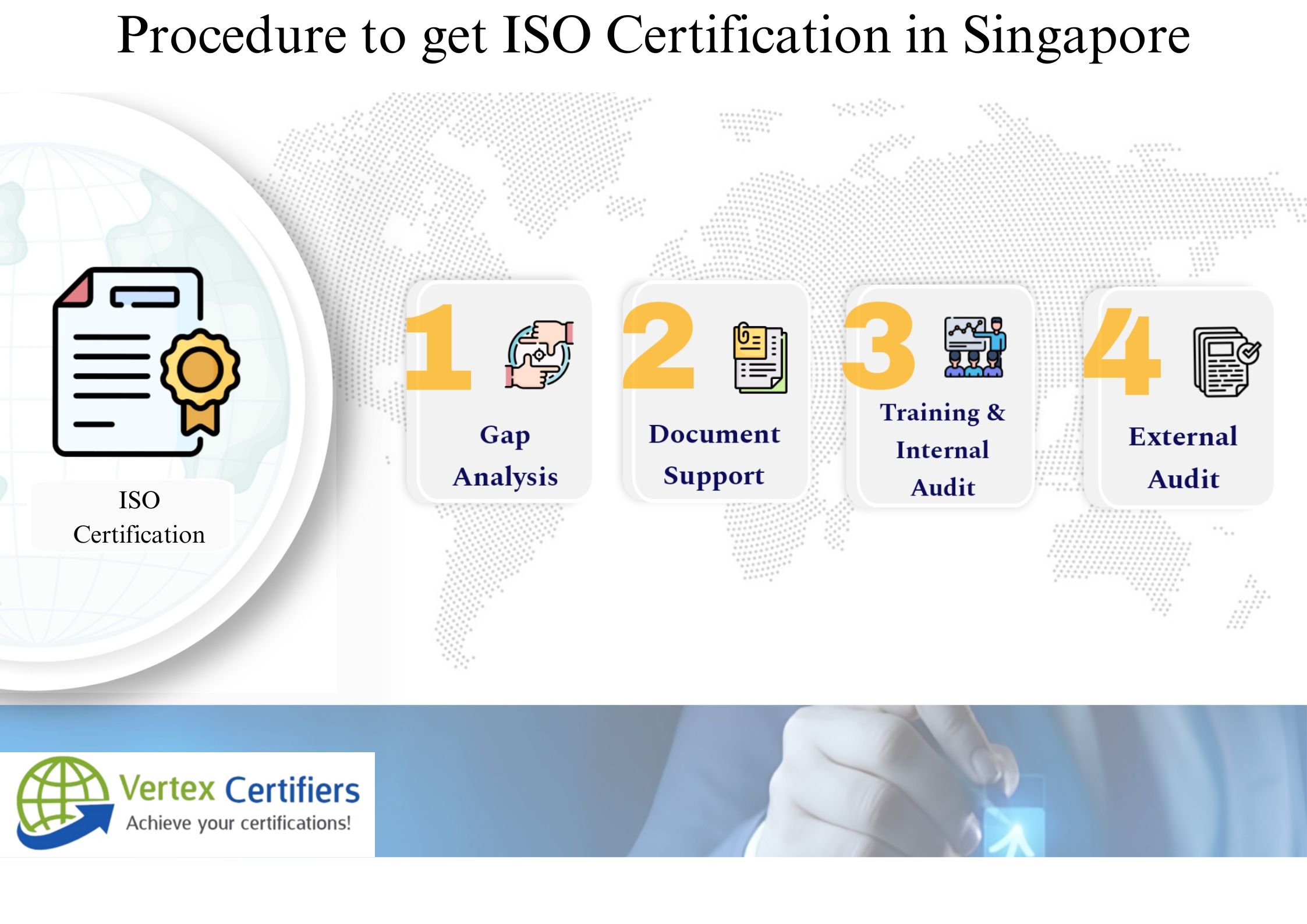
Conduct a Gap Analysis
Begin with a thorough gap analysis to benchmark current systems against the chosen ISO standard.
Assess processes like document control, risk management, and performance metrics using checklists from ISO annexes. This reveals gaps, such as inadequate training records for ISO 45001 or weak supplier audits for ISO 9001.
Develop a roadmap prioritizing high-risk areas, assigning timelines, responsibilities, and resources—typically completed in 1-2 weeks for SMEs.
Documentation Development
Craft comprehensive documentation forming the backbone of your ISO management system.
Develop policies, procedures, and manuals covering scope, context, risks, and objectives—e.g., an Information Security Policy for ISO 27001. Conduct risk assessments using tools like SWOT or FMEA to identify controls.
Integrate with existing ERP or QMS software, ensuring minimal disruption; use templates compliant with Singapore Standards (SS) for efficiency.
Implementation and Training
Roll out documented processes organization-wide, from procurement to delivery.
Train employees via workshops— per standard—fostering competence through role-playing and quizzes. For ISO 14001, train on waste segregation; for ISO 27001, on phishing awareness.
Maintain records via digital logs for operational control, monitoring KPIs like defect rates or incident frequency to demonstrate effectiveness.
Internal Audit and Certification Audit
Conduct an internal audit using trained auditors to verify compliance and uncover issues.
Hold a management review to analyze results, approve actions, and set improvement goals. Stage 1 audit by the CB reviews documentation remotely (1-2 days).
Stage 2, the onsite certification audit (3-5 days), verifies implementation through interviews and evidence checks. Address non-conformities via root-cause analysis and corrective actions within 90 days.
Certification and Maintenance
Upon success, receive your ISO certificate valid for three years, proudly displaying the CB’s logo.
Undergo annual surveillance audits (1-2 days) and a recertification audit in year three to retain status. Embrace continual improvement via PDCA cycles, internal audits, and data-driven tweaks.
This unlocks benefits like priority in GeBIZ tenders, SPRING grants, and seamless international contracts, enhancing competitiveness in Singapore’s economy.