Vertex Certifiers

ISO 22301 Certification in Indonesia | ISO 22301 Consultants in Indonesia

Vertex Certifiers is a globally trusted ISO consulting company offering end-to-end ISO 22301 Certification in Indonesia for organizations seeking to strengthen resilience, reduce operational disruption risks, and build a structured Business Continuity Management System (BCMS). Our expert consultants provide complete implementation support, including gap analysis, Business Impact Analysis (BIA), risk assessment, BCMS documentation, implementation, employee training, internal audits, certification audit support, and post-certification compliance assistance, ensuring a smooth and practical certification journey. We provide ISO 22301 consulting services across major Indonesian business hubs including Jakarta, Surabaya, Bandung, Medan, Semarang, Batam, Makassar, Denpasar (Bali), Tangerang, and Bekasi, supporting organizations across manufacturing, IT & software, cloud service providers, data centers, financial services, banking, FinTech, e-commerce, logistics, healthcare, telecommunications, government, BPO, food processing, and oil & gas sectors. In addition to ISO 22301, Vertex Certifiers also offers implementation and certification support for globally recognized standards such as ISO 9001, ISO 14001, ISO 45001, ISO 22000, ISO 27001, ISO 50001, ISO/IEC 20000-1, ISO/IEC 17025, and GMP, helping organizations in Indonesia improve governance, compliance, risk management, operational continuity, and international business credibility.

What is ISO 22301?

ISO 22301 is the internationally recognized standard for establishing, implementing, maintaining, and continually improving a Business Continuity Management System (BCMS). Published by the International Organization for Standardization (ISO), the current version ISO 22301:2019 provides a structured framework that helps organizations prepare for, respond to, and recover from disruptive incidents that could impact business operations.

The main purpose of ISO 22301 is to ensure that organizations can continue delivering critical products and services during unexpected disruptions such as cyber incidents, system failures, natural disasters, fire, supply chain interruptions, utility outages, pandemics, labor disruptions, or other operational crises. Rather than reacting to disruptions only after they occur, ISO 22301 promotes proactive business continuity planning, enabling organizations to identify critical activities, assess risks, establish response plans, and define recovery priorities in advance.

A key component of ISO 22301 is disruption preparedness, which includes identifying internal and external threats, understanding the impact of business interruptions, and implementing strategies to maintain essential operations. The standard emphasizes incident response and recovery planning, ensuring that organizations have clear procedures, responsibilities, communication channels, and escalation mechanisms to manage crises effectively.

ISO 22301 follows a risk-based approach, meaning organizations assess threats that could affect continuity and determine the most suitable controls and response measures based on business priorities. An important requirement of the standard is the Business Impact Analysis (BIA), which helps identify critical business processes, dependencies, acceptable downtime, and the financial or operational consequences of disruption. Based on this analysis, organizations establish recovery objectives such as Recovery Time Objectives (RTOs) and recovery priorities to restore operations in a structured and timely manner.

The standard also emphasizes continual improvement, requiring organizations to test business continuity plans, conduct internal audits, perform management reviews, review lessons learned from incidents, and regularly update continuity arrangements as the business environment changes.

ISO 22301 works closely with other management system standards. It complements ISO 27001 by supporting continuity during information security incidents and cyberattacks, aligns with ISO 9001 by improving process stability and customer confidence, and supports ISO/IEC 20000-1 by strengthening continuity in IT service delivery. It also plays an important role in disaster recovery planning, supply chain resilience, and cyber incident response, making it highly relevant for organizations that depend on digital systems, third-party vendors, critical infrastructure, and uninterrupted service delivery.

ISO 22301 Certification Process in Indonesia

The ISO 22301 certification process in Indonesia follows a structured and practical approach by expert iso 22301 consultants in Indonesia that helps organizations build a resilient Business Continuity Management System (BCMS) aligned with ISO 22301:2019 requirements:
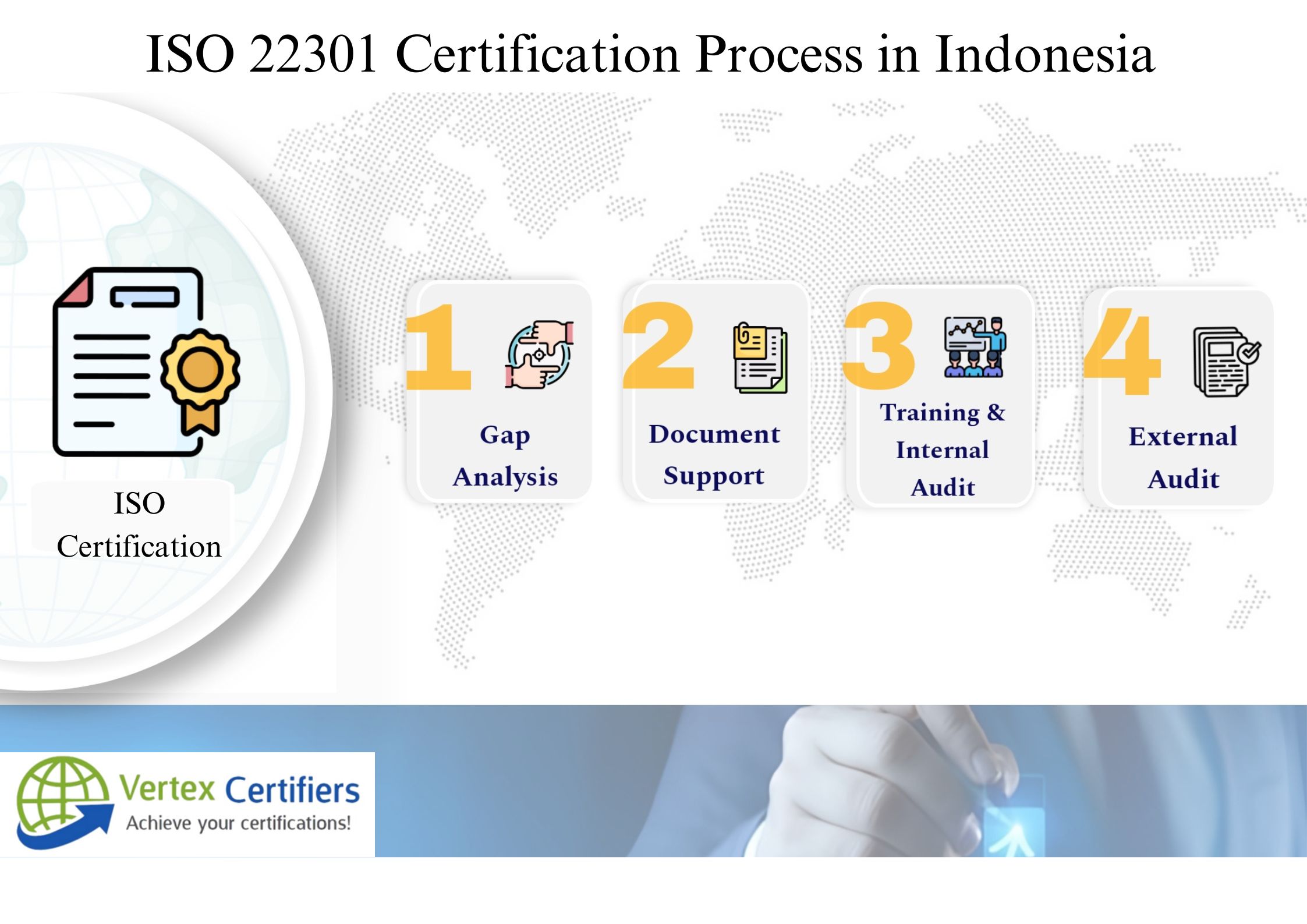
ISO 22301 Certification in Indonesia

Initial Gap Analysis

The certification journey begins with a gap analysis to assess the organization’s current business continuity practices, risk management framework, crisis response arrangements, and documentation against the requirements of ISO 22301. This helps identify missing controls, weaknesses, and improvement opportunities before implementation begins.

Scope Definition

The organization defines the scope of the Business Continuity Management System by identifying the locations, departments, business units, products, services, technologies, and critical operations that will be covered under ISO 22301 certification.

Business Impact Analysis (BIA)

A Business Impact Analysis (BIA) is conducted to identify critical business processes, dependencies, operational priorities, acceptable downtime, and the financial, legal, operational, and reputational impact of disruptions. The BIA is one of the most important elements of ISO 22301 because it helps organizations prioritize continuity and recovery efforts.

Risk Assessment

The organization identifies and evaluates threats that could disrupt operations, such as cyberattacks, fire, floods, utility failures, supplier disruptions, equipment failures, transportation interruptions, or workforce-related incidents. The risk assessment helps determine the likelihood and impact of each threat and supports continuity planning.

Business Continuity Strategy Development

Based on the BIA and risk assessment results, the organization develops continuity strategies to maintain critical operations during disruptions. These strategies may include backup arrangements, alternate sites, emergency communication plans, data recovery measures, resource redundancy, vendor contingency planning, and manual workarounds.

BCMS Documentation

The required BCMS documentation is developed to support implementation and certification. This typically includes the business continuity policy, scope document, risk assessment records, BIA reports, continuity objectives, continuity procedures, emergency contact lists, recovery plans, communication protocols, and monitoring records.

Business Continuity Plans (BCP)

Detailed Business Continuity Plans (BCP) are created for critical functions and processes. These plans define how the organization will continue operating during a disruption, who is responsible for each activity, what resources are required, and how communication and escalation will be handled.

Incident Response Planning

Incident response procedures are established to ensure that disruptions are identified quickly and managed in a structured manner. This includes roles and responsibilities, emergency response actions, incident escalation, communication procedures, and coordination with key internal and external stakeholders.

Recovery Procedure Development

Recovery procedures are developed to restore business operations, systems, facilities, and services after an incident. These procedures define recovery priorities, recovery timelines, restoration methods, and actions required to return to normal operations as efficiently as possible.

Employee Awareness & Training

Employees are trained on the BCMS, business continuity procedures, emergency response responsibilities, communication protocols, and their role during disruptive incidents. Awareness programs help ensure that continuity plans are understood and can be effectively executed during real events.

Internal Audit

An internal audit is conducted to evaluate whether the BCMS has been properly implemented and whether it complies with ISO 22301 requirements. Internal audits help identify nonconformities, gaps, and improvement opportunities before the external certification audit.

Management Review

Top management reviews the performance of the BCMS, including audit findings, business continuity objectives, test results, incidents, risks, and improvement actions. Management review ensures that the BCMS remains aligned with organizational priorities and continues to be effective.

Stage 1 Audit

The certification body conducts a Stage 1 audit to review the organization’s BCMS documentation, scope, preparedness, and readiness for the full certification audit.

Stage 2 Audit

During the Stage 2 audit, the certification body evaluates the implementation and effectiveness of the BCMS in practice. This includes reviewing records, interviewing personnel, verifying continuity planning activities, and checking whether the system meets ISO 22301 requirements.

Certification

Once the organization successfully completes the audit process and closes any nonconformities, the certification body issues the ISO 22301 Certification, confirming that the organization has implemented an effective Business Continuity Management System.

Annual Surveillance Audit

After certification, annual surveillance audits are conducted to verify that the BCMS continues to operate effectively, remains compliant with ISO 22301 requirements, and is continually improved based on changing risks, business conditions, and organizational needs.

    Get Free
    Consultation


    Our Services

    Our Local Cities

    ISO Certification in indonesia

    Why ISO 22301 Certification is Important in Indonesia

    ISO 22301 certification is highly relevant in Indonesia because the country has a large, diverse, and operationally complex economy that depends on manufacturing, exports, logistics, digital infrastructure, finance, government services, and supply-chain continuity. ISO explains that ISO 22301 helps organizations protect against disruptions, reduce their likelihood, prepare for incidents, respond effectively, and recover in a structured way. [web:176][web:178]

    Indonesia also faces significant continuity risks from earthquakes, floods, volcanic activity, infrastructure interruptions, cyber incidents, supplier disruptions, and transport-related delays. ISO specifically highlights natural disasters, supply-chain issues, and cyber-attacks as examples of threats that can disrupt operations and make effective business continuity planning essential. [web:182]

    As Indonesia continues digital transformation across e-commerce, logistics, banking, financial services, software platforms, and data-driven operations, business continuity is no longer only about physical disruption. Organizations increasingly need to protect digital services, customer-facing systems, payment infrastructure, communications, outsourced processes, and critical supply-chain dependencies.

    This makes ISO 22301 especially important for manufacturing, logistics, ports and shipping, banking, financial services, IT and software, data centers, healthcare, food processing, oil and gas, telecommunications, e-commerce, and government institutions that must maintain service continuity and stakeholder trust under difficult conditions.

    Benefits of ISO 22301 Certification in Indonesia

    • Improves business continuity and resilience: Helps organizations prepare for disruption and maintain critical operations. [web:178]
    • Minimizes downtime during disruptions: Structured planning supports faster response and recovery. [web:182]
    • Strengthens incident response: Clear roles, plans, and escalation processes improve crisis handling.
    • Protects brand reputation: Better disruption management reduces stakeholder concern and loss of confidence.
    • Enhances customer and stakeholder confidence: ISO notes that effective continuity planning provides reassurance to clients, suppliers, regulators, and other stakeholders. [web:182]
    • Reduces operational and financial losses: Faster recovery and continuity planning help limit business impact.
    • Supports regulatory and contractual compliance: A BCMS can help organizations meet continuity-related obligations and commitments. [web:176]
    • Improves supply chain resilience: Helps organizations understand dependencies and prepare for disruption in upstream and downstream operations.
    • Enhances disaster recovery readiness: Supports continuity planning beyond basic IT recovery by linking response to business priorities. [web:179]
    • Strengthens risk management culture: Encourages awareness of vulnerabilities, priorities, and recovery expectations. [web:182]
    • Competitive advantage in tenders and global business: Demonstrates preparedness and resilience to customers, partners, and international supply chains.

    Industries That Need ISO 22301 in Indonesia

    ISO 22301 is valuable for any organization that depends on uninterrupted operations, customer commitments, digital systems, supply chains, or critical service delivery. In Indonesia, it is especially useful in industries exposed to physical disruption, infrastructure risk, outsourced operations, and demanding client expectations.

    • Manufacturing: Helps reduce the impact of production stoppages, supply interruptions, and facility disruptions.
    • Export businesses: Supports continuity where shipment delays, supplier issues, and customer commitments affect international trade.
    • IT companies: Useful for protecting service delivery, data availability, and customer system support.
    • SaaS providers: Helps maintain uptime, response capability, and service continuity for cloud-based platforms.
    • Cloud service providers: Supports resilience planning for hosted environments, dependencies, and operational recovery.
    • Data centers: Important for continuity of infrastructure, availability commitments, and customer assurance.
    • Banking & FinTech: Strengthens continuity for payment systems, digital channels, and time-sensitive financial services.
    • Insurance: Helps maintain claims handling, policy services, and secure customer operations during disruption.
    • Logistics & warehousing: Useful for managing continuity across transport, inventory movement, and distribution processes.
    • Healthcare: Supports continuity for patient services, medical records, and critical support functions.
    • Telecommunications: Helps maintain critical communications infrastructure and service resilience.
    • Government departments: Useful for sustaining essential public services and administrative functions.
    • BPO / shared services: Strengthens continuity for outsourced operations, process delivery, and client obligations.
    • Oil & Gas: Supports response and recovery planning for operational disruptions and supply impacts.
    • Food & beverage supply chains: Helps manage operational continuity where delays or outages can affect product flow and customer confidence.

    Cost of ISO 22301 Certification in Indonesia

    The cost of ISO 22301 certification in Indonesia depends on organizational size, continuity scope, number of locations, operational complexity, and the maturity of existing risk and business continuity practices. There is no fixed cost because businesses differ in the number of critical processes, infrastructure dependencies, recovery priorities, and implementation support required.

    • Company size: Larger organizations usually require broader continuity planning and more audit effort.
    • Number of locations: Multi-site operations increase scope complexity and continuity coordination needs.
    • Complexity of operations: Organizations with diverse processes, dependencies, and outsourced functions need more detailed planning.
    • Scope of BCMS: Wider certification scope means more departments, services, risks, and controls to cover.
    • Number of critical processes: More business-critical activities require more analysis, recovery planning, and testing.
    • Existing risk and continuity maturity: Organizations with established continuity practices may reduce implementation effort.
    • Consultancy requirements: The level of support needed for BIA, risk assessment, documentation, training, and internal audit affects total cost.
    • Certification body charges: Audit fees vary depending on the certification body and audit scope.

    Timeline for ISO 22301 Certification

    The implementation timeline depends on the size of the organization, number of sites, complexity of operations, current continuity maturity, and internal resource availability. Organizations with strong management support and clearly defined critical processes can often move faster than businesses still developing continuity structure from the beginning.

    • Small organizations: 45 to 60 days.
    • Medium organizations: 60 to 90 days.
    • Large / multi-site organizations: 90 to 120 days.

    Integration with Other ISO Standards

    ISO 22301 can be integrated with other ISO management system standards to create a stronger and more efficient Integrated Management System (IMS). Integration helps reduce duplication in policies, procedures, internal audits, management reviews, corrective actions, and training while improving coordination across business functions.

    • ISO 27001: Combines information security and business continuity for stronger resilience and incident readiness.
    • ISO 9001: Aligns continuity planning with quality objectives and operational consistency.
    • ISO 14001: Supports broader organizational resilience by aligning environmental and continuity governance.
    • ISO 45001: Helps connect continuity planning with worker safety, emergency planning, and incident response.
    • ISO 20000-1: Useful for IT service providers that need both service continuity and service-management discipline.
    • ISO 50001: Can support resilience planning where energy continuity and performance are strategically important.
    • Benefits of IMS: Better efficiency, reduced duplication, easier audit management, and stronger cross-functional control.

    Why Choose Vertex Certifiers for ISO 22301 Certification in Indonesia

    Vertex Certifiers supports organizations in Indonesia with practical ISO 22301 consulting designed to build a workable Business Continuity Management System (BCMS), improve disruption readiness, and simplify the path to certification.

    • Experienced ISO 22301 consultants: Guidance from professionals familiar with BCMS implementation and certification expectations.
    • Strong BCMS implementation approach: Structured support for continuity planning that fits real operations.
    • BIA and risk assessment support: Assistance with identifying critical activities, impact priorities, and disruption risks.
    • Documentation support: Help with continuity policies, plans, procedures, risk records, and recovery documentation.
    • Audit readiness support: Internal review and preparation before the external certification audit.
    • Industry-specific consulting: Advice aligned to the risks and continuity needs of your sector.
    • Affordable and practical implementation: Flexible support for SMEs, mid-size firms, and larger organizations.
    • Onsite + remote consulting support across Indonesia: Support options that fit business needs and location realities.
    • Post-certification compliance support: Ongoing guidance for surveillance audits, improvements, and continuity maintenance.

    Frequently Asked Questions

    ISO 22301 certification confirms that an organization has implemented a Business Continuity Management System (BCMS) based on internationally recognized requirements for continuity and resilience. [web:176][web:178]

    Organizations that depend on uninterrupted operations, customer commitments, digital infrastructure, supply chains, or essential service delivery can benefit significantly from ISO 22301 certification.

    The cost depends on company size, number of sites, BCMS scope, continuity complexity, critical-process count, consultancy needs, and certification-body charges. There is no fixed price for all organizations.

    Small organizations may take about 45 to 60 days, medium organizations 60 to 90 days, and large or multi-site organizations 90 to 120 days depending on complexity and readiness.

    ISO 22301 is generally voluntary, but many customers, contracts, tenders, regulators, and global supply-chain partners may expect strong continuity capability in practice.

    ISO notes that disaster recovery traditionally focused more on IT-led responses, while ISO 22301 is broader and covers organizational continuity, response, recovery, and resilience across critical operations. [web:179][web:178]

    Yes. ISO 22301 is designed to be applicable to organizations of different sizes, with the extent of implementation depending on the operating environment and complexity. [web:176]

    ISO 27001 focuses on information security, while ISO 22301 focuses on business continuity and resilience. They are often integrated because cyber incidents can also create business disruption.

    Manufacturing, logistics, banking, IT, data centers, healthcare, telecom, government, BPO, oil and gas, and export-driven businesses often benefit strongly from ISO 22301.

    Vertex Certifiers supports BIA, risk assessment, documentation, internal audit readiness, certification coordination, and post-certification continuity support across Indonesia.

    Get ISO 22301 Certification in Indonesia

    Build Business Resilience with Vertex Certifiers

    Strengthen your Business Continuity Management System with expert ISO 22301 consulting, BIA and risk assessment support, documentation assistance, internal audit readiness, and certification coordination across Indonesia.

    • Expert ISO 22301 consulting
    • Remote and onsite implementation support
    • BIA, risk assessment, and documentation guidance
    • Internal audit and certification coordination
    • Support across major industries and cities in Indonesia
    Contact Vertex Certifiers

      Company Logo

      Get ISO certification


      Fill the details below, one of our executives will contact you shortly


      This will close in 0 seconds

      Call Now Button